Negotiating Margins Effectively: Protect Profit Without Losing Deals

In 2023, research by McKinsey revealed that companies lose an average of 20% in potential margin due to ineffective negotiation practices. Imagine a sales rep conceding 10% on price to close a $1 million contract — that’s $100,000 in lost profit, often avoidable. The stakes are enormous: your pricing strategy and negotiation skills can make or break profitability, sustainability, and competitive positioning. Yet many sales professionals feel trapped between the desire to win deals and the imperative to protect margins.
Negotiating margins effectively is more than just haggling over numbers—it’s a disciplined blend of psychology, economics, and strategic communication. Poor pricing decisions erode brand value and create a race to the bottom. Meanwhile, savvy negotiators leverage behavioral science principles like anchoring, reference pricing, and reciprocity to defend value while closing deals. Understanding how customers perceive price and value is critical to shaping conversations that preserve profit without sacrificing deal momentum.
In this definitive guide, you will master proven frameworks, step-by-step processes, and expert tactics used by top SaaS providers, consultancies, and enterprises to negotiate margins successfully. You will gain ready-to-use scripts and learn from case studies featuring Apple, McKinsey, and Salesforce. Whether you are a sales leader, account executive, or business owner, this guide equips you to protect your bottom line while winning the deal.
· Table of Contents
· The Psychology and Science Behind Negotiating Margins
· Key Frameworks and Models for Margin Negotiation
· Step-by-Step Process to Negotiate Margins Effectively
· Real-World Case Studies: Margin Negotiation in Action
· Common Mistakes and How to Avoid Them
· Advanced Tactics for Expert Negotiators
· Scripts and Templates: Ready-to-Use Dialogue
· Frequently Asked Questions on Margin Negotiation
· Conclusion: Synthesizing Insights and Next Steps
· References
The Psychology and Science Behind This Topic
Negotiating margins sits at the intersection of behavioral economics and sales psychology, where how buyers perceive price and value can decisively influence outcomes. Nobel laureate Daniel Kahneman’s Prospect Theory (1979) reveals that people experience losses more intensely than equivalent gains. This loss aversion means price concessions can feel like real losses to sellers, eroding profit, while buyers interpret discounts as gains. Recognizing this asymmetry is key to framing price discussions.
Ariely’s "Predictably Irrational" (2008) highlights the anchoring effect, where initial price offers disproportionately influence buyer perceptions. Anchors establish a mental reference point that shapes what customers consider reasonable. For instance, setting a high anchor price early can make subsequent concessions appear more valuable, protecting margins.
The price-quality heuristic is another psychological shortcut customers use: higher prices often signal higher quality. This perception is why premium brands like Apple sustain high margins. Conversely, deep discounting can signal lower quality, damaging brand equity.
Marketers also deploy the decoy effect, presenting a third option to nudge buyers toward higher-margin products—a tactic closely tied to reference pricing, where customers compare prices to a known baseline or competitor.
Robert Cialdini’s principles of influence—especially reciprocity, scarcity, and authority—are powerful in negotiation. Offering limited-time pricing or demonstrating expertise can motivate buyers to accept firm margins.
Together, these psychological drivers create a landscape where margin negotiation is less about numbers alone and more about managing perceptions, expectations, and influence.
Key Frameworks and Models
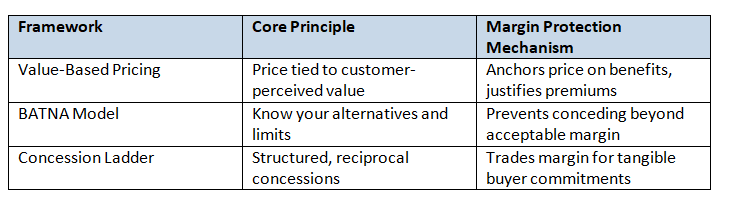
To negotiate margins effectively, sales professionals rely on structured frameworks that integrate behavioral insights with practical tactics. Below are three proven models:
1. Value-Based Pricing Framework
Focuses on quantifying and communicating the economic value delivered to the customer rather than cost-plus or competitor pricing. Encourages anchoring on value, not price.
2. The BATNA (Best Alternative to a Negotiated Agreement) Model
Identifies your walk-away point and the buyer’s alternatives to strengthen position and avoid margin erosion under pressure.
3. The Concession Ladder Model
Structures concessions in a tiered manner, exchanging price reductions for reciprocal value such as volume commitments or contract length.
Step-by-Step Process
Step 1: Prepare Thoroughly — Understand Your Costs, Customer Value, and BATNA
Before negotiation, analyze your cost structure, the unique value your solution delivers, and your best alternative options if the deal fails. Prepare data on ROI, competitive positioning, and customer pain points.
Step 2: Establish a Strong Anchor Price in Negotiation
Set the initial price anchor high but justifiable using value metrics. Use storytelling to communicate how the price reflects superior outcomes, not just features.
Step 3: Uncover Buyer Motivations and Constraints
Ask open-ended questions to reveal budget limits, priorities, and decision criteria. Understanding these allows targeted concessions without undermining margins.
Step 4: Apply the Concession Ladder
If concessions are necessary, follow a tiered approach: start with non-price terms (e.g., delivery, payment terms), then limited price discounts tied to reciprocal buyer commitments.
Step 5: Use Scarcity and Reciprocity Ethically
Highlight limited availability, early-bird pricing, or value-added services to create urgency and motivate buyer reciprocity.
Step 6: Confirm Agreements and Reinforce Value
Summarize agreed terms emphasizing the value delivered. Avoid re-opening price discussions and prepare to manage last-minute discount requests firmly.
Step 7: Document and Debrief Post-Negotiation
Record outcomes, lessons, and customer feedback to refine future negotiation strategy.
Real-World Case Studies
Apple’s Premium Pricing
Apple refuses to discount its iPhone line significantly, anchoring price on premium design and ecosystem value. This strategy leverages the price-quality heuristic to maintain high margins and brand prestige, resulting in industry-leading profitability despite competitive pressure.
McKinsey’s Value-Based Fees
McKinsey & Company sets consulting fees based on measurable client impact rather than hours worked. By quantifying ROI for clients, McKinsey anchors negotiations on delivered value, enabling margin protection and premium pricing even in competitive bids.
Salesforce Enterprise Contracts
Salesforce uses tiered pricing with clear volume discounts but ties concessions to multi-year commitments or product bundles. Their concession ladder balances margin protection with customer acquisition, using scarcity of limited-time promotions to close large deals efficiently.
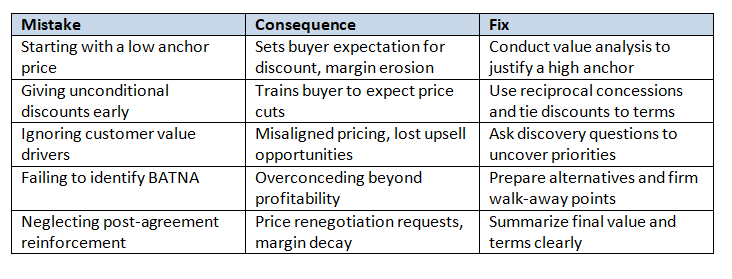
Common Mistakes and How to Avoid Them
Advanced Tactics
1. Price Decoy Strategy
Introduce an intentionally less attractive option to steer buyers toward higher-margin choices, leveraging the decoy effect to shift preferences.
2. Reference Pricing Management
Proactively shape buyer expectations by presenting competitor prices or internal historical prices as a frame of reference to justify your premium.
3. Bundling and Unbundling
Create package deals that obscure unit prices, allowing margin protection through perceived value while offering buyer customization.
4. Time-Limited Offers with Scarcity
Use deadlines and limited availability to trigger urgency and reduce negotiation drag, informed by Cialdini’s scarcity principle.
5. Multi-Stage Negotiation
Break complex deals into phases, securing commitment in stages rather than all at once, to protect margins at each step and build trust.
6. Emotional Anchoring
Frame price discussions around customer aspirations and fears, connecting value to their identity and business goals rather than just cost.
Scripts and Templates
Script 1: Setting the Anchor Price
“Based on the impact we’ve discussed, including [specific ROI metric], our standard investment starts at $X. This reflects the premium support and innovation you require to achieve those outcomes.”
Script 2: Responding to Discount Requests
“I appreciate your position on budget constraints. One way we’ve addressed this is by [offering longer contract terms / adjusting payment schedules], which allows us to maintain the quality and service levels critical to your success.”
Script 3: Using Scarcity to Create Urgency
“Our current pricing is available until [date], after which we’re adjusting rates to reflect increased demand and enhanced features. Locking in now ensures you receive this value.”
Script 4: Confirming Agreement Without Reopening Price
“To confirm, we agreed on the $X investment, with delivery by [date] and the agreed support level. I’m excited about partnering to deliver these results for you.”
Frequently Asked Questions
Q1: How do I handle buyers who only want to negotiate price?
Focus on value by asking, “Can you share what outcomes are most critical so I can ensure we align the proposal appropriately?” Shift conversation from price to impact.
Q2: When is it appropriate to offer discounts without hurting margin?
Only when paired with reciprocal concessions like volume increases, longer contract terms, or faster payment. Avoid unconditional discounts.
Q3: How do I know my BATNA in a negotiation?
Identify your next best alternative if the deal fails—another prospect, internal options, or walk-away. Calculate minimum acceptable margin accordingly.
Q4: Can anchoring backfire if my price is too high?
Yes, if the buyer perceives the anchor as unjustified. Always support anchors with data, value stories, and market context.
Q5: How do I maintain margin discipline under pressure from procurement departments?
Leverage your BATNA, involve value experts, and use structured concession ladders to manage price pressure systematically.
Conclusion
Protecting margins in negotiation is as much a science as an art, relying on deep understanding of buyer psychology, rigorous preparation, and disciplined execution. By applying behavioral economics principles like anchoring and loss aversion, framing offers around value, and strategically managing concessions, sales professionals can defend profitability without sacrificing deal momentum. The frameworks, processes, and scripts shared here provide a roadmap to elevate your margin negotiation outcomes immediately.
As competitive pressures escalate, margin negotiation skills will distinguish top performers and safeguard business viability. Start by auditing your current negotiation approach, adopt the step-by-step process, and practice the advanced tactics detailed above. Your margins—and your bottom line—depend on mastering these techniques now.
References
1. Kahneman, D., & Tversky, A. (1979). Prospect Theory: An Analysis of Decision under Risk. Econometrica.
2. Ariely, D. (2008). Predictably Irrational: The Hidden Forces That Shape Our Decisions. HarperCollins.
3. Cialdini, R. B. (2006). Influence: The Psychology of Persuasion. Harper Business.
4. McKinsey & Company. (2023). The Art and Science of Pricing: How Leading B2B Companies Capture More Value.
5. Nagle, T., Hogan, J., & Zale, J. (2016). The Strategy and Tactics of Pricing. Routledge.
6. Thaler, R. H. (1985). Mental Accounting and Consumer Choice. Marketing Science.