Negotiating Premium Pricing: How to Sell High and Win
In 2017, Apple famously launched the iPhone X with a starting price of $999—a price point that stunned consumers and competitors alike. Despite the premium price, Apple sold millions of units within months, reinforcing its position as a luxury brand that commands top dollar while maintaining unparalleled customer loyalty. Contrast this with countless other tech vendors who struggle to close deals at even modest price increases, often losing margin to commoditization or discounting wars.
The ability to negotiate premium pricing is a critical skill that can dramatically impact your company’s profitability and long-term viability. Poor pricing leaves billions of dollars on the table annually and erodes the perceived value of your product or service. Yet pricing is not just about numbers; it’s a psychological game rooted in how customers perceive value, fairness, and risk. Understanding the behavioral economics behind price perception is essential to confidently asking for—and winning—higher prices.
This comprehensive guide arms senior sales professionals, account executives, pricing managers, and business owners with proven frameworks, exact negotiation scripts, and real-world case studies. You will master how to leverage anchoring, reference pricing, and reciprocity principles; employ step-by-step negotiation processes; avoid common pitfalls; and employ advanced tactics that separate premium sellers from discount haggling. By the end, you will be equipped to confidently sell premium-priced offerings and close high-value deals without compromise.
· Table of Contents
· The Psychology and Science Behind Negotiating Premium Pricing
· Key Frameworks and Models for Premium Pricing Negotiations
· Step-by-Step Process to Negotiate Premium Prices Successfully
· Real-World Case Studies: Apple, McKinsey, Salesforce
· Common Mistakes in Premium Pricing Negotiations and How to Avoid Them
· Advanced Tactics for Elite Negotiators
· Scripts and Templates for Premium Pricing Conversations
· Frequently Asked Questions About Negotiating Premium Pricing
· Conclusion and Next Steps
· References
The Psychology and Science Behind This Topic
At its core, negotiating premium pricing is a behavioral science challenge. Pricing decisions are rarely rational calculations alone but heavily influenced by human psychology and cognitive biases. Understanding these forces enables sellers to craft offers and conversations that feel fair, valuable, and compelling.
One foundational theory is Kahneman and Tversky’s Prospect Theory (1979), which shows that people weigh losses more heavily than equivalent gains. When price increases are framed correctly, customers focus less on the “loss” of money and more on the “gain” of superior value or reduced risk. This explains why discounting to close deals often backfires by anchoring buyers to lower price expectations.
The anchoring effect, studied extensively by Dan Ariely in “Predictably Irrational” (2008), reveals how initial price exposure sets a mental benchmark. For example, a high initial anchor price makes subsequent offers seem reasonable, even if above market average. This is a core tactic in premium pricing negotiations—set a strong initial anchor that communicates value.
Moreover, the price-quality heuristic drives perception: consumers often infer quality from price, assuming higher price means better product or service. This heuristic benefits luxury brands like Apple or Mercedes-Benz, which maintain premium pricing to reinforce quality and exclusivity signals.
The decoy effect plays a subtle but powerful role. By offering a third, less attractive option, sellers can nudge buyers to choose the premium offering. For instance, a $99, $129, and $199 tiered offering often pushes buyers toward the middle or high tier due to perceived better value relative to the decoy.
Reference pricing is another behavioral tool—showing customers a higher “normal” price either from competitors or prior pricing, then presenting your premium price as justified or even discounted relative to that anchor.
Finally, Cialdini’s six principles of influence—reciprocity, scarcity, authority, consistency, liking, and social proof—are deeply embedded in effective pricing negotiations. For example, scarcity (“limited seats available at this rate”) increases urgency, while reciprocity (“we’ve tailored this solution exclusively for you”) fosters goodwill and commitment.
Integrating these psychological principles into negotiation strategies transforms mere price discussions into persuasive value conversations that justify and sustain premium pricing.
Key Frameworks and Models
Successful premium pricing negotiations rely on tested frameworks that combine behavioral insights with structured sales processes. Below are three widely respected models:
1. Value-Based Selling Framework
Focuses on quantifying and communicating the unique economic impact of your solution versus alternatives, aligning price to delivered value rather than cost-plus margin.
2. Anchored Pricing Negotiation Model
Utilizes strong initial price anchors, layered reference points, and decoy pricing to influence buyer perceptions and drive acceptance of premium prices.
3. Consultative Negotiation Framework
Centers on deep understanding of buyer needs, collaborative problem-solving, and positioning premium price as an investment in outcomes rather than a cost.
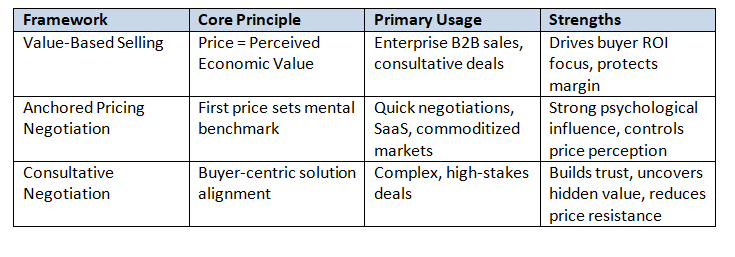
These frameworks are not mutually exclusive and often blend in practice. For example, McKinsey’s premium consulting fees combine value-based selling with consultative negotiation, while Apple uses anchored pricing and decoy effects in product pricing.
Understanding when and how to deploy each framework based on deal context and buyer psychology is key to mastering premium pricing negotiations.
Step-by-Step Process
Step 1: Preparation and Value Quantification
Before negotiation, deep-dive into customer pain points, goals, and existing costs. Quantify the economic impact your solution delivers using hard data—whether cost savings, revenue enhancement, risk mitigation, or efficiency gains. Prepare a value calculator or ROI model to justify premium pricing objectively.
Step 2: Establish Strong Anchors Early
Present your premium price early as a credible anchor. Use pricing tiers or bundles that include a high-value option as a decoy. Frame the price relative to competitor benchmarks or your historical pricing to reinforce reference pricing.
Step 3: Build Trust and Reciprocity
Demonstrate understanding and commitment by tailoring solutions and showing flexibility in non-price terms (e.g., delivery timelines, support levels). Invoke Cialdini’s reciprocity by offering exclusive insights or small concessions before discussing price.
Step 4: Address Buyer Concerns with Empathy and Data
When price pushback occurs, acknowledge concerns empathetically. Use data-backed proofs of value, case studies, and third-party validations to reinforce why the premium price is justified. Avoid discounting; instead, add value or adjust payment terms.
Step 5: Employ Scarcity and Urgency Tactically
Introduce limited-time offers, exclusive bundles, or capacity constraints to create urgency without desperation. Scarcity increases the perceived value and motivates faster commitment at premium prices.
Step 6: Close with Confidence and Confirm Commitment
Use assumptive closes and summarize agreed-upon value before restating price. Confirm next steps clearly and gain verbal or written commitment. Follow up promptly with a formal contract reiterating premium pricing benefits.
Real-World Case Studies
Apple’s iPhone Pricing Strategy
Apple consistently prices its flagship iPhones at the highest end of the smartphone market. Leveraging brand equity, superior design, and ecosystem lock-in, Apple sets a high anchor that competitors struggle to match. The decoy effect is evident in Apple’s tiered product lines, nudging buyers toward mid-to-high tiers. As a result, Apple maintains gross margins around 38%, well above industry averages, reinforcing premium pricing’s profitability.
McKinsey & Company’s Value-Based Fees
McKinsey eschews hourly billing in favor of value-based fees tied to measurable outcomes. Their consultants quantify client ROI meticulously, enabling them to command fees up to $1,000+ per hour. This consultative approach aligns fees with delivered impact, de-risks the client’s investment, and justifies premium prices even in cost-conscious environments.
Salesforce Enterprise Contracts
Salesforce negotiates enterprise deals with multi-year contracts embedding escalation clauses, volume discounts, and premium support tiers. They use anchored pricing combined with tiered offerings to maintain premium pricing while accommodating scale. Their negotiation teams emphasize strategic alignment and personalized solutions to justify price, resulting in high retention and upsell rates.
Common Mistakes and How to Avoid Them
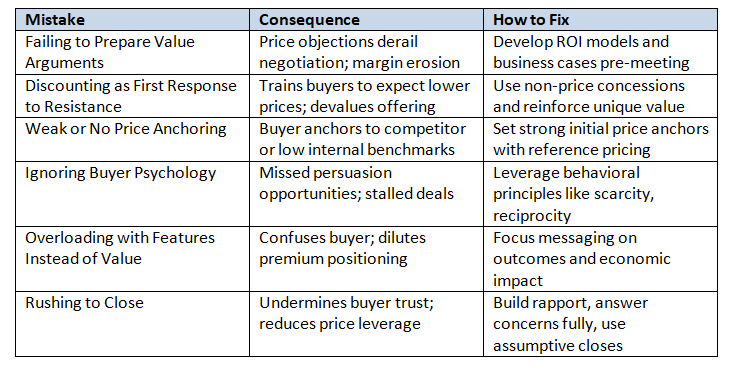
Avoiding these common pitfalls requires discipline, preparation, and a strategic mindset focused on value rather than price alone.
Advanced Tactics
Beyond foundational techniques, elite negotiators employ advanced tactics to secure premium pricing:
- **Decoy Bundling:** Introduce artificially high-priced options to steer buyers toward premium bundles perceived as better value.
- **Conditional Price Increases:** Use phased pricing tied to milestones or volume thresholds to ease initial resistance while securing future premium margin.
- **Emotional Anchoring:** Craft narratives that connect premium pricing to buyer identity or aspirational goals, such as status or innovation leadership.
- **Third-Party Endorsements:** Leverage analyst reports, awards, and customer testimonials as social proof to justify high prices.
- **Concession Patterning:** Plan concessions strategically to maximize reciprocity and create a sense of buyer investment in the deal.
These tactics require finesse and situational awareness but can dramatically improve outcomes in complex negotiations.
Scripts and Templates
Script 1: Setting the Anchor
“Based on the extensive value we deliver—improving your operational efficiency by 25% and reducing downtime costs—we have priced this solution at $150,000 annually. This aligns with market-leading offerings and reflects the premium support included.”
Script 2: Handling Price Objections
“I completely understand that this is a significant investment. Let me share how Company X achieved a 40% ROI within six months by implementing our solution, which offsets the initial cost and drives real business impact.”
Email Template: Follow-Up After Negotiation
Subject: Confirming Our Agreement and Next Steps
Dear [Client Name],
Thank you for the productive discussion yesterday. To recap, we agreed on the premium package priced at $150,000 annually, which includes [list key features].
I’ve attached the formal contract reflecting these terms. Please let me know if you have any questions. Looking forward to partnering for your success.
Best regards,
Script 3: Creating Urgency
“Our current capacity for onboarding new clients at this pricing tier is limited due to resource allocation. To ensure you benefit from this premium pricing and dedicated support, I recommend we finalize the agreement within the next two weeks.”
Frequently Asked Questions
Q1: How do I justify a premium price to cost-sensitive buyers?
A1: Focus on quantifiable value and ROI, using case studies and hard data. Highlight total cost of ownership and risk reduction rather than upfront price alone.
Q2: When should I offer discounts in premium pricing negotiations?
A2: Discounts should be a last resort and tied to non-price conditions such as extended contract length or increased volume. Always pair discounts with value-added concessions.
Q3: How can I use the decoy effect ethically in pricing?
A3: Offer transparent tiered pricing options where the decoy is clearly differentiated. The goal is to help buyers make informed choices, not to confuse or mislead.
Q4: What role does timing play in premium price negotiations?
A4: Timing is critical. Align price discussions with moments of high buyer interest, budget cycles, or before competitor offers emerge to maximize leverage.
Q5: How do cultural differences impact premium pricing negotiations?
A5: Cultural norms affect price sensitivity and negotiation styles. Research local customs and tailor your approach to emphasize relationship-building or direct value propositions accordingly.
Conclusion
Negotiating premium pricing is both an art and a science demanding deep understanding of buyer psychology, strategic frameworks, and disciplined execution. By anchoring prices strongly, quantifying unique value, and deploying behavioral economics principles like scarcity and reciprocity, sales professionals can confidently command and close high-value deals without margin erosion.
The frameworks, scripts, and real-world examples shared here offer a proven roadmap to elevate your pricing negotiations from price haggling to value partnership. Start applying these techniques today to protect your margins, reinforce your brand’s premium positioning, and drive sustainable business growth.
Ready to transform your pricing strategy and win consistently at the premium level? Begin by mapping your customer’s value drivers and crafting your strongest price anchors now.
References
- Kahneman, D., & Tversky, A. (1979). Prospect Theory: An Analysis of Decision under Risk. Econometrica.
- Ariely, D. (2008). Predictably Irrational: The Hidden Forces That Shape Our Decisions. HarperCollins.
- Cialdini, R. B. (2006). Influence: The Psychology of Persuasion. Harper Business.
- Nagle, T., Hogan, J., & Zale, J. (2016). The Strategy and Tactics of Pricing: A Guide to Growing More Profitably. Routledge.
- Monroe, K. B. (2003). Pricing: Making Profitable Decisions. McGraw-Hill Education.
- Anderson, J. C., & Narus, J. A. (1998). Business Marketing: Understand What Customers Value. Harvard Business Review.