Negotiating Service Contracts vs Product Deals in B2B

In the complex world of B2B sales, the stakes are high, and B2B negotiation skills can make or break multi-million dollar deals. Imagine a scenario where a technology firm is simultaneously negotiating a long-term managed IT service contract with a Fortune 500 client while also trying to close a multi-unit hardware product sale with the same company. The approaches, tactics, and mindset required to navigate these two negotiations successfully differ significantly. Misapplying product negotiation strategies to service contracts—or vice versa—can lead to lost revenue, strained relationships, or suboptimal contract terms.
In today’s competitive market, understanding the nuances between negotiating service contracts and product deals is crucial for sales leaders, procurement professionals, and business development executives. Service contracts often entail ongoing relationships, performance metrics, and value-based pricing, while product deals tend to focus on specifications, delivery schedules, and volume discounts. Mastering both requires tailored strategies, clear frameworks, and a deep understanding of buyer psychology.
This comprehensive guide will equip you with actionable insights, proven negotiation frameworks like BATNA and ZOPA, real-world B2B examples, and practical scripts designed to help you close better deals—whether you’re selling complex services or tangible products. By the end, you will be able to confidently differentiate and apply the appropriate tactics that maximize value and build lasting partnerships.
· Table of Contents
· Key Differences Between Service Contracts and Product Deals
· Strategic Frameworks for Negotiating Service Contracts
· Tactical Approaches for Product Deal Negotiations
· Pricing and Value Propositions: Services vs Products
· Managing Risk, SLAs, and Performance Metrics in Service Contracts
· Building Long-Term Relationships Through Service Negotiations
· Real-World Scripts and Dialogue Examples
· Frequently Asked Questions
· Conclusion and Next Steps
Key Differences Between Service Contracts and Product Deals
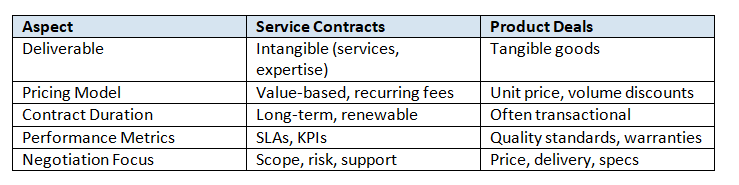
Understanding the fundamental distinctions between service contracts and product deals is the starting point for effective negotiation. Service contracts typically involve intangible deliverables such as consulting, maintenance, or software-as-a-service (SaaS), where performance and ongoing support are critical. In contrast, product deals center on tangible goods, inventory, or equipment with defined specifications.
One key difference lies in the negotiation focus areas. Product deals emphasize price, quantity, delivery timelines, and warranties. Service negotiations prioritize scope of work, service-level agreements (SLAs), response times, escalation procedures, and renewal terms.
For example, a manufacturer selling industrial machinery will focus on unit pricing, lead times, and installation support. Meanwhile, a vendor offering managed cybersecurity services will negotiate around data protection guarantees, uptime commitments, and incident response protocols.
Another differentiator is contract duration and flexibility. Service contracts often span multiple years with automatic renewals and evolving service requirements. Product deals tend to be one-off or repeat purchases with limited contract modifications.
· Summary of Key Differences
Strategic Frameworks for Negotiating Service Contracts
Negotiating service contracts requires a strategic mindset that balances value delivery, risk mitigation, and relationship management. Applying established frameworks helps structure these complex discussions.
· Strategic Tactics for Service Contract Negotiations:
· Conduct a thorough needs analysis with the buyer to tailor scope and expectations.
· Use anchoring by presenting a high-value, comprehensive service package first, then offer customizable options.
· Establish clear SLAs with measurable KPIs and penalties for non-compliance.
· Implement phased contract structures to minimize risk and build trust over time.
· Leverage consultative selling techniques to position as a strategic partner rather than a vendor.
Real-World Example: SaaS Enterprise Agreement Negotiation
A cloud software provider negotiating a multi-year SaaS contract with a global retailer used a phased rollout approach coupled with performance-linked pricing. Initial modules were priced at a premium with guaranteed uptime of 99.9%, while subsequent modules included discounts contingent on meeting adoption targets. This created a win-win scenario, aligning incentives and reducing buyer risk.
Tactical Approaches for Product Deal Negotiations
Product deal negotiations are often more transactional but still require finesse to maximize margins and close efficiently. Tactical focus areas include price setting, volume discounts, delivery terms, and warranty conditions.
Understanding the buyer’s procurement process is essential. Many enterprises use Request for Proposal (RFP) processes or reverse auctions for products, which require sellers to be competitive on price and compliance.
Negotiators should prepare to discuss logistics, inventory commitments, and after-sales support. For example, agreeing to just-in-time delivery schedules can reduce buyer storage costs but requires seller flexibility.
· Practical Tactics for Product Deals:
· Present tiered pricing based on volume to incentivize larger orders.
· Bundle complementary products to increase deal size and perceived value.
· Negotiate favorable payment terms (e.g., net 30 vs net 60) to improve cash flow.
· Use the “Good-Better-Best” model to offer product variations and upsell opportunities.
· Prepare to counter common buyer objections around price with data on total cost of ownership (TCO).
Script Example: Product Price Negotiation Dialogue
Seller: “Our standard unit price is $500, but for orders exceeding 1,000 units, we offer a 10% discount. Given your projected volume, this would significantly reduce your cost per unit.”
Buyer: “That’s helpful, but our budget is closer to $450 per unit. Can you accommodate that?”
Seller: “While $450 is below our margin threshold, if you can commit to a multi-year purchase agreement, we could explore a phased discount structure to meet your budget.”
This exchange uses anchoring, volume commitment, and phased discounts to move toward agreement.
Pricing and Value Propositions: Services vs Products
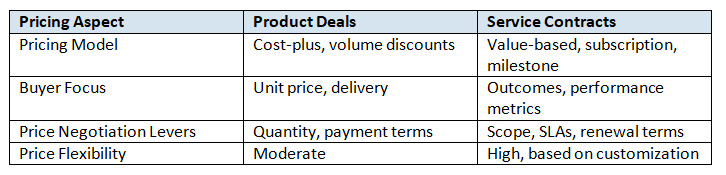
Pricing strategies differ markedly between services and products. Product prices often factor in production costs, market competition, and standard markups. In contrast, service pricing incorporates labor, expertise, customization, and ongoing support.
Communicating value is more challenging for services because benefits are intangible and realized over time. Sellers must use ROI calculators, case studies, and pilot programs to demonstrate impact.
Conversely, product sellers emphasize features, specifications, and warranties to justify pricing. Total Cost of Ownership (TCO) analysis helps buyers understand lifecycle costs beyond sticker price.
Managing Risk, SLAs, and Performance Metrics in Service Contracts
Risk allocation is a central negotiation point in service contracts. Buyers seek assurances that services will be delivered as promised, while sellers want to limit liability.
Service-Level Agreements (SLAs) codify expectations for uptime, response time, resolution time, and quality standards. Negotiating SLAs requires clear definitions, measurement methods, and remedies.
For example, an enterprise cloud provider might guarantee 99.95% uptime with credits for downtime exceeding agreed thresholds. Negotiators must balance ambitious SLAs that satisfy buyers without exposing sellers to excessive penalties.
In addition to SLAs, performance metrics and Key Performance Indicators (KPIs) are embedded in contracts to track progress and trigger payments or renewals.
Risk mitigation tactics include:
· Limiting liability caps to a percentage of contract value.
· Excluding consequential damages.
· Defining force majeure clauses.
· Including dispute resolution mechanisms like mediation or arbitration.
Building Long-Term Relationships Through Service Negotiations
Service contracts inherently involve ongoing relationships. Negotiations are not just transactional but set the foundation for collaboration, trust, and mutual growth.
Leveraging Consultative Selling techniques helps uncover buyer pain points and align service offerings to strategic objectives. This approach improves buyer engagement and reduces price sensitivity.
Including renewal and escalation clauses that allow contract adjustment based on evolving needs fosters flexibility and satisfaction.
Establishing joint governance structures (e.g., steering committees) post-contract encourages continuous dialogue and problem-solving.
· Best Practices for Relationship-Focused Service Negotiations:
· Co-create the contract scope and SLAs with the client.
· Set regular business reviews to assess service effectiveness.
· Offer training or enablement programs as value-adds.
· Implement escalation paths that prioritize rapid issue resolution.
· Be transparent about challenges and proactively propose solutions.
Real-World Scripts and Dialogue Examples
Negotiation scripts tailored to service contracts and product deals provide sales teams with structured approaches to handle objections and advance discussions.
Service Contract Negotiation Script: Addressing Scope Creep
Buyer: “We’d like to add additional consulting hours beyond the initial scope. Can we include that in this contract?”
Seller: “I understand the need for flexibility. To accommodate this, we can include a change order process that allows you to request additional hours at a predefined rate, ensuring budget control and transparency.”
Product Deal Negotiation Script: Handling Price Pushback
Buyer: “Your price is significantly higher than our current supplier. Can you match or beat their offer?”
Seller: “While our price points are higher, we offer a more robust warranty and faster delivery times, which reduce your downtime and total costs. Would you like me to provide a TCO comparison?”
Using BATNA to Close
Seller: “Our best alternative if we can’t reach an agreement here is to pursue a different client in your industry, which might not have the same volume. What alternatives are you considering if we can’t move forward?”
Buyer: “We’re evaluating internal development options.”
Seller: “Given that, I recommend we focus on a pilot phase to demonstrate ROI before committing to a full-scale contract.”
Frequently Asked Questions
Preparation for service contracts involves deep understanding of client needs, risk assessment, and defining measurable outcomes (SLAs). For product deals, focus is on pricing benchmarks, delivery logistics, and competitive positioning. Service negotiations require more consultative research and flexibility.
BATNA, ZOPA, and Value-Based Negotiation frameworks are essential. Additionally, Risk-Reward Sharing and phased contract approaches help address uncertainties and build trust. Structured SLA negotiation frameworks ensure clarity on performance expectations.
Include clear change management clauses that require formal approval for additional work and pricing adjustments. Regularly review contract scope with clients to realign expectations. Using phased contracts or modular pricing also helps control scope creep.
Subscription-based pricing, milestone payments, and performance-linked fees are common. Value-based pricing aligned with client ROI drives better outcomes than hourly or cost-plus models. Hybrid models combining fixed and variable components are also effective.
Define warranty periods aligned with industry standards and negotiate liability caps to protect your organization. Clarify repair, replacement, and return terms upfront. Use these clauses as negotiation levers to balance buyer concerns and seller risks.
Conclusion
Negotiating service contracts versus product deals in B2B requires distinct strategies, tactics, and mindsets. Services demand a consultative approach focused on outcomes, risk management, and long-term relationships, while product deals emphasize price, volume, and delivery logistics. Applying frameworks like BATNA and ZOPA, tailoring pricing models, and managing contractual risks enable sales professionals to optimize deal value on both fronts.
By integrating the insights, real-world examples, and negotiation scripts provided in this guide, B2B negotiators can confidently adapt their approach to the unique demands of service and product negotiations. The result is more favorable contracts, stronger partnerships, and sustainable business growth. Start implementing these best practices today to elevate your negotiation effectiveness and close deals with greater confidence.