Negotiating Supply Chain Agreements: A Complete Strategic Guide

In the high-stakes world of supply chain management, the negotiation of agreements can make or break a company’s operational efficiency and profitability. Imagine a global automotive giant like Toyota facing a sudden surge in raw material costs while attempting to secure long-term supplier contracts. The ability to strategically negotiate terms that balance cost, quality, and delivery reliability can determine whether they maintain their competitive edge or bleed margin in a volatile market. This scenario illustrates the critical importance of mastering supply chain negotiation beyond simple price haggling—into a domain where strategic frameworks, psychological insight, and rigorous preparation converge.
Supply chain negotiations today are not just transactional; they are strategic levers that impact total cost of ownership (TCO), risk management, innovation partnerships, and sustainability goals. Companies such as Apple leverage these negotiations to lock in cutting-edge components under favorable terms that fuel their innovation pipelines, while Walmart uses them to optimize category management and supplier segmentation for relentless cost leadership. The stakes are high, with millions or even billions of dollars influenced by contract terms, service level agreements (SLAs), and contingency clauses. For procurement and category managers, as well as sales directors engaging B2B customers, mastering the art and science of negotiation is essential.
This comprehensive guide will equip you with the strategic foundations, proven negotiation frameworks like the Kraljic Matrix and should-cost modeling, step-by-step negotiation processes, real-world case studies from industry leaders, and advanced tactics including BATNA and ZOPA analysis. You will also find actionable scripts and templates to deploy immediately. Whether you are a procurement manager aiming to improve supplier collaboration or a sales director negotiating complex supply contracts, this article will elevate your negotiation capabilities to deliver sustained value.
· Table of Contents
· The Strategic Foundation: frameworks, models, and psychology in negotiation
· Key Frameworks and Models: Kraljic Matrix, should-cost modeling, Porter’s Five Forces
· Step-by-Step Process: detailed negotiation phases with tactics and dialogue
· Real-World Case Studies: Toyota, Apple, and NHS procurement lessons
· Tactics and Counter-Tactics: negotiation moves with scripted responses
· Advanced Strategies: expert techniques for complex agreements
· Scripts and Templates: word-for-word negotiation dialogues
· Frequently Asked Questions: detailed answers on negotiation challenges
· Conclusion and Call to Action
· References: authoritative sources to deepen knowledge
The Strategic Foundation
Negotiating supply chain agreements demands a strategic mindset grounded in robust frameworks and an understanding of human behavior. At its core, negotiation is about creating value and claiming value simultaneously—a delicate balance requiring preparation, insight, and adaptability.
One foundational framework is the Kraljic Portfolio Purchasing Model, developed by Peter Kraljic in 1983. It segments suppliers and categories based on supply risk and profit impact into four quadrants: strategic, bottleneck, leverage, and non-critical items. This segmentation informs negotiation priorities: strategic items require collaborative, partnership-driven negotiations, while leverage items might focus more on cost reduction tactics.
Total Cost of Ownership (TCO) analysis complements this by expanding negotiation focus beyond unit price to include acquisition costs, logistics, inventory carrying costs, quality failure costs, and end-of-life expenses. For example, Boeing’s procurement teams rigorously apply TCO to negotiate contracts that optimize lifecycle costs for aerospace components, rather than just initial purchase price.
Psychological research, such as the work by Daniel Kahneman and Amos Tversky on prospect theory, reveals that negotiators are often loss-averse, which influences their risk tolerance and willingness to concede. Understanding behavioral biases can inform timing, framing, and anchoring tactics during negotiation discussions. Harvard Business School professor Deepak Malhotra’s insights on “negotiation jujitsu” teach how to redirect opponent’s attacks constructively rather than responding defensively.
Together, these strategic foundations create a robust platform where negotiation is not merely about price but about managing risk, fostering innovation, and building sustainable supplier relationships.
Key Frameworks and Models
Strategic negotiation in supply chain agreements relies on multiple well-established frameworks and models that guide categorization, cost analysis, and competitive dynamics. Below are three essential models with their practical applications:
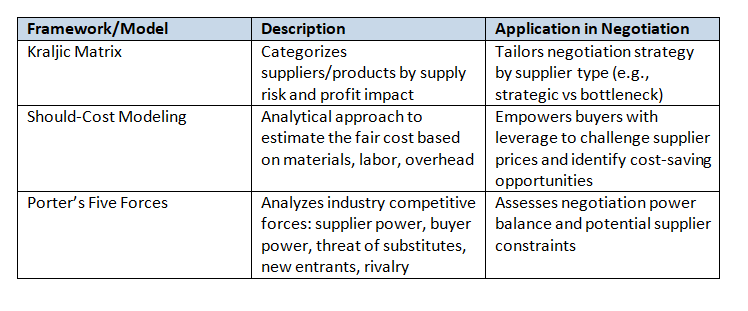
Kraljic Matrix helps you determine where to invest negotiation effort and resources. For instance, Apple applies strategic partnership negotiation for advanced components critical to product differentiation, while employing aggressive cost negotiation for non-critical parts.
Should-cost modeling, used by companies like Amazon, involves detailed calculation of expected costs, including raw materials, manufacturing processes, and logistics. This model helps procurement teams establish objective price targets and spot inefficiencies or margin padding in supplier quotes.
Porter’s Five Forces analysis anticipates supplier behavior and market conditions. When negotiating with suppliers in industries with high entry barriers and low competition, like aerospace (Boeing), supplier power is high—requiring collaborative negotiation rather than adversarial cost-cutting.
Step-by-Step Process
Successful negotiation of supply chain agreements unfolds through a disciplined, multi-phase process. Each step requires specific tactics and carefully chosen language to maximize value.
Step 1: Preparation and Research
Begin by conducting comprehensive supplier and market analysis. Use supplier segmentation (Kraljic) and should-cost models to establish your BATNA (Best Alternative to a Negotiated Agreement) and ZOPA (Zone of Possible Agreement).
Tactics:
· Gather internal data on historical spend, supplier performance, and risk assessments.
· Benchmark pricing using should-cost models and market intelligence.
· Identify negotiation team roles and decision thresholds.
Sample language:
“As per our internal analysis and market benchmarking, we see opportunity to optimize total cost while maintaining quality and delivery standards.”
Step 2: Setting Objectives and Strategy
Define clear negotiation goals: cost targets, quality metrics, delivery timelines, and innovation clauses. Align objectives with category strategy from portfolio analysis.
Tactics:
· Prioritize issues into must-haves and nice-to-haves.
· Develop concession strategy and sequencing.
Sample language:
“Our primary goal is to secure a five percent reduction in TCO over the term, while ensuring continuity of supply and adherence to our sustainability standards.”
Step 3: Initial Engagement and Relationship Building
Establish rapport and mutual trust. Set a collaborative tone to frame negotiation as a joint problem-solving exercise.
Tactics:
· Open with value recognition statements.
· Use open-ended questions to understand supplier constraints.
Sample language:
“We appreciate your continued support and expertise. Could you walk us through any constraints you foresee in meeting our new volume forecasts?”
Step 4: Proposal and Bargaining
Present your offer anchored by evidence from should-cost analysis and benchmarks. Listen actively to supplier responses and respond with calibrated concessions or counteroffers.
Tactics:
· Anchor high but reasonable to leave room for concessions.
· Use silence strategically after offers.
Sample language:
“Our analysis shows a fair price point at $X per unit given raw material costs and manufacturing complexity. We are open to discuss terms that help you achieve this.”
Step 5: Handling Objections and Counter-Tactics
Anticipate supplier pushback on price, volume, or terms. Employ negotiation jujitsu: redirect objections into joint problem solving.
Tactics:
· Ask clarifying questions to uncover interests behind positions.
· Propose alternatives such as volume-flexibility or payment terms.
Sample language:
“I understand cost pressures on your side. Can we explore options like adjusted delivery schedules or bulk order discounts that might alleviate those?”
Step 6: Closing and Agreement Formalization
Summarize agreed terms clearly. Confirm mutual understanding and next steps. Prepare for contract drafting with legal and compliance teams.
Tactics:
· Use “Yes, and” language to reinforce agreements.
· Document concessions and commitments explicitly.
Sample language:
“To confirm, we have agreed on a unit price of $X, delivery lead time of Y weeks, and quality targets as per the SLA. We will draft the contract reflecting these points for signature next week.”
Real-World Case Studies
Theoretical frameworks are best understood through practical application. These case studies illustrate strategic negotiation in action.
Toyota’s Supplier Partnership Model
Toyota’s famed just-in-time (JIT) production system depends on deep supplier collaboration. Toyota segments suppliers via the Kraljic Matrix, treating strategic suppliers as partners. Negotiations focus on joint cost reduction and innovation rather than adversarial price pressure. Toyota employs value engineering workshops to co-develop cost-saving process improvements, resulting in mutual benefits.
Lessons:
· Emphasize collaboration over confrontation for strategic items.
· Use supplier segmentation to tailor negotiation approach.
Apple’s Should-Cost Driven Innovation Sourcing
Apple uses should-cost modeling extensively for supplier negotiations on high-tech components. By deconstructing costs of materials and manufacturing steps, Apple's procurement teams push suppliers for cost transparency and innovation incentives. Negotiations include clauses for intellectual property sharing and volume scaling discounts.
Lessons:
· Use should-cost modeling as a negotiation lever.
· Align contract terms with innovation and scalability goals.
NHS Procurement and Risk-Managed Negotiation
The UK’s National Health Service (NHS) procurement teams negotiate complex supply agreements balancing cost control and risk mitigation. Using the Kraljic Matrix, NHS identifies bottleneck items with high supply risk and prioritizes risk-sharing clauses and dual sourcing arrangements. Their approach includes rigorous supplier performance metrics embedded in contracts.
Lessons:
· Embed risk management explicitly in negotiation terms.
· Utilize supplier segmentation to focus negotiation effort.
Tactics and Counter-Tactics
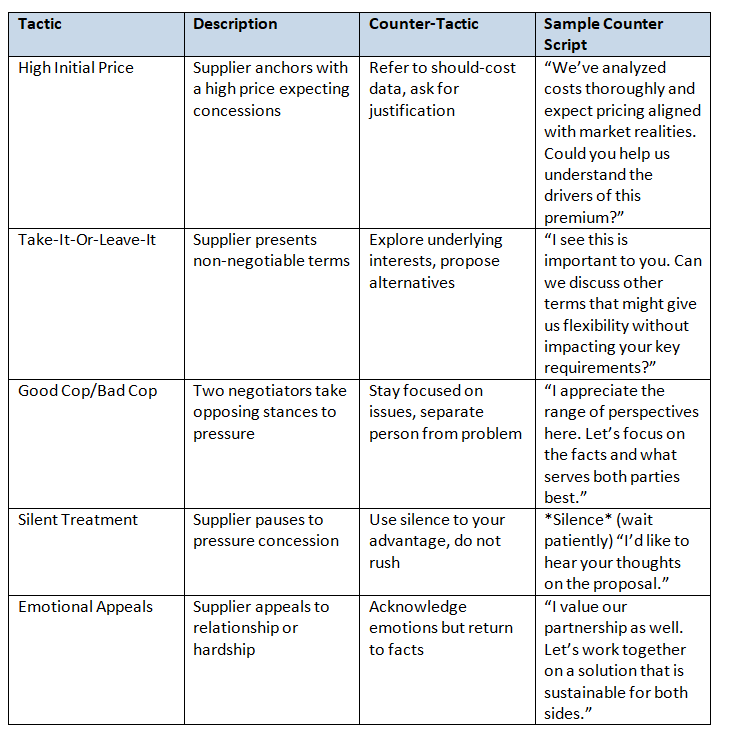
Effective negotiators prepare for common tactics suppliers or buyers use and develop counter-responses to maintain leverage and progress.
Advanced Strategies
Beyond foundational tactics, expert negotiators employ advanced strategies to master complex agreements.
Deep understanding of your BATNA and the Zone of Possible Agreement allows you to negotiate with confidence. For example, Boeing’s aerospace contracts often involve multi-round BATNA evaluations to prepare alternatives such as dual sourcing or in-house development.
Negotiating multiple contract elements (price, quality, delivery, innovation) simultaneously enables value creation through trade-offs. Walmart’s category managers bundle volume commitments with promotional support to win better pricing.
In volatile markets, including clauses for price adjustment, force majeure, and volume flexibility protects both parties. Amazon incorporates dynamic pricing adjustment mechanisms reflecting raw material fluctuations.
Using predictive analytics to model supplier behavior and pricing trends enhances negotiation accuracy. Leading companies integrate AI tools to simulate negotiation outcomes and optimize strategies.
Scripts and Templates
Deploy these word-for-word scripts in your next negotiation session to improve clarity and impact.
“We truly value the partnership we’ve built and are committed to finding a solution that benefits both parties. To that end, we’d like to explore terms that optimize cost, quality, and delivery. Could we start by reviewing your current capacity and any challenges you foresee?”
“Based on our detailed should-cost analysis, we believe a fair price range is between $X and $Y. We’d like to understand how your pricing aligns with this and discuss ways to bridge any gaps.”
“I understand your concerns about margin pressures. Could we explore adjusting delivery schedules or payment terms to ease your cash flow while meeting our cost targets?”
“To confirm, we have agreed on the price of $X, delivery lead time of Y weeks, and quality parameters as outlined. We will proceed to formalize these in the contract and schedule a follow-up review in six months.”
*After a pause* “I’m eager to hear your perspective on the proposal so we can continue making progress. What are your thoughts?”
Frequently Asked Questions
Q1: How do I determine my BATNA before entering a negotiation?
A1: Start by identifying all viable alternatives if the current negotiation fails—alternative suppliers, in-house production, or postponement. Evaluate each for cost, risk, and feasibility. Your BATNA is the strongest alternative offering acceptable value. This empowers you to walk away if negotiation terms are unfavorable.
Q2: What is the role of supplier segmentation in negotiation?
A2: Supplier segmentation (e.g., Kraljic Matrix) helps prioritize negotiation effort and tailor strategies. Strategic suppliers may require collaborative negotiations focused on innovation, while leverage suppliers can be pressured for cost reductions. It prevents a one-size-fits-all approach, optimizing resource allocation.
Q3: How can should-cost modeling be developed practically?
A3: Should-cost modeling involves breaking down the product or service into constituent cost elements—raw materials, labor, overhead, logistics—and calculating expected costs based on market data and industry benchmarks. Tools include supplier quotes, cost databases, and engineering input. This model provides an objective price target.
Q4: What negotiation tactics work best in cross-cultural supply chain agreements?
A4: Cultural awareness is critical. For example, Japanese firms value relationship-building and indirect communication, favoring consensus over confrontation. Western firms may focus on directness and results. Adapting your approach—such as spending more time on rapport and using nuanced language—helps bridge cultural gaps and fosters trust.
Q5: When is it appropriate to use advanced strategies like AI-based analytics?
A5: When negotiating large, complex contracts with multiple variables and high financial impact, leveraging AI-driven analytics can provide simulations of negotiation scenarios, supplier behavior insights, and risk forecasts. This is particularly useful for global enterprises managing extensive supplier networks, such as Amazon or Boeing.
Conclusion
Negotiating supply chain agreements is a complex, strategic endeavor that extends far beyond price negotiation. By grounding your approach in proven frameworks like the Kraljic Matrix and should-cost modeling, applying a disciplined step-by-step process, and employing advanced tactics such as BATNA analysis and scenario planning, you can create sustainable value for your organization. Real-world examples from Toyota, Apple, and NHS procurement demonstrate how strategic negotiation fosters collaboration, innovation, and risk management.
Equipped with detailed scripts, counter-tactics, and expert insights, you are now prepared to approach your next supply chain negotiation with confidence and sophistication. Start implementing these strategies today to transform your supplier relationships into powerful competitive advantages.
For more in-depth insights and tailored consultancy on supply chain negotiation, contact our expert team and elevate your procurement outcomes.
References
· Kraljic, P. (1983). Purchasing Must Become Supply Management. Harvard Business Review.
· Malhotra, D., & Bazerman, M. (2007). Negotiation Genius. Bantam.
· Porter, M. E. (1979). How Competitive Forces Shape Strategy. Harvard Business Review.
· NHS Supply Chain. (2022). Strategic Sourcing and Supplier Management Framework.
· Boeing Supply Chain Operations. (2021). Total Cost of Ownership and Supplier Collaboration.
· Harvard Business School. (2018). Behavioral Economics and Negotiation Insights.