Negotiating with Aggressive People: Tactics and Scripts for High-Stakes Success

Imagine sitting across the table from a counterpart whose voice rises sharply, words dripping with hostility, as they slam their fist on the desk during a multimillion-dollar contract negotiation. The room tightens with tension, and seconds feel like hours as you sense the deal unraveling before it even properly begins. This is not just a test of business acumen but a battle of emotional and psychological endurance. Aggressive negotiation tactics can derail even the most promising agreements, costing companies millions and fracturing relationships irreparably. Yet, beneath the surface chaos lies a predictable pattern of human behavior — one that, if understood, can be managed and even leveraged to your advantage.
Most negotiators falter because they either mirror aggression with aggression or retreat into passivity, both responses triggering an amygdala hijack that impairs rational thinking and escalation ensues. The truth is that difficult negotiations are won or lost in the first few minutes, where emotional regulation, tactical empathy, and precise communication set the tone. Daniel Kahneman’s System 1 and System 2 thinking reveal how reactive impulses often override deliberate analysis in conflict. Chris Voss’s FBI hostage negotiation techniques demonstrate how labeling emotions and establishing rapport defuse aggression. William Ury’s principle of “Going to the Balcony” teaches detachment to manage emotional flooding, a concept validated by John Gottman’s research on escalation cycles.
In this comprehensive guide, you will master the psychology behind aggressive negotiation, understand the top frameworks to structure your approach, and walk through a step-by-step process armed with specific psychological tools. You will analyze real-world case studies from high-profile hostage negotiations to boardroom battles, learn to identify manipulative tactics and counter them precisely, and acquire advanced strategies that separate novice negotiators from experts. Finally, you will receive exact word-for-word scripts tailored for the most common aggressive scenarios, empowering you to stay composed and effective under pressure. By the end, you will possess the knowledge and confidence to transform hostile encounters into opportunities for mutual gain.
· Table of Contents
· The Psychology Behind This Challenge
· Key Frameworks and Models
· Step-by-Step Process for Negotiating with Aggressive People
· Real-World Case Studies
· Recognizing and Countering Manipulative Tactics
· Advanced Psychological and Strategic Techniques
· Scripts and Templates for Common Scenarios
· Frequently Asked Questions
· Conclusion
· References
The Psychology Behind This Challenge
Understanding the psychological underpinnings of aggressive behavior in negotiation is vital for responding effectively. When a counterpart becomes aggressive, it often triggers an amygdala hijack — a term coined by Daniel Goleman describing how the brain’s emotional center (the amygdala) overrides the rational prefrontal cortex, causing impulsive, defensive reactions. This hijack leads to fight, flight, or freeze responses, which hinder thoughtful negotiation.
Daniel Kahneman’s seminal work in *Thinking, Fast and Slow* highlights the dual-process model of cognition: System 1 operates automatically and emotionally, prone to bias and snap judgments, whereas System 2 is slower, deliberate, and logical. Aggression tends to activate System 1, pushing both parties into reactive patterns. The challenge is to engage your own System 2 thinking while gently guiding the counterpart out of their System 1 emotional fog.
Chris Voss, former FBI lead hostage negotiator, advocates for tactical empathy — consciously recognizing and verbalizing the other party’s emotions without agreeing with their position. This technique reduces hostility by making the aggressor feel understood, thereby lowering defensiveness. Tactical empathy leverages Paul Ekman’s research on emotional micro-expressions to identify concealed feelings and respond appropriately.
John Gottman’s research on emotional flooding in couples applies equally to negotiation: when one party becomes overwhelmed by negative emotions, their ability to process information collapses. Recognizing signs of flooding allows you to pause, “go to the balcony” (William Ury’s metaphor for emotional detachment), and reset the interaction.
Social identity theory further explains why aggression escalates: when identities or values are threatened, people become more entrenched and hostile. This is particularly relevant in negotiations involving group affiliations, cultural pride, or professional status.
· Key Psychological Concepts at Play:
· Amygdala Hijack — emotional override of rational brain
· System 1 vs System 2 Thinking (Kahneman)
· Tactical Empathy and Labeling (Chris Voss)
· Emotional Flooding and Regulation (John Gottman)
· Fight-Flight-Freeze Response
· Social Identity Threat and Entrenchment
Recognizing these mechanisms provides the foundation for intervention strategies that calm aggression and reframe the dialogue.
Key Frameworks and Models
Several established frameworks provide structured approaches for negotiating with aggressive counterparts. Understanding their nuances allows you to select or blend tactics suited to your specific context.
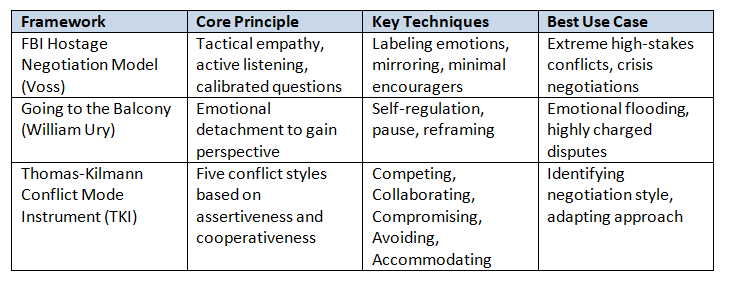
The FBI model focuses on establishing rapport through empathy and carefully crafted questions, leveraging influence without confrontation. Ury’s “Going to the Balcony” is a mindfulness-based strategy to avoid escalation by mentally stepping back, allowing clear-headed choices. The TKI model enables negotiators to diagnose their own and the opponent’s style, choosing adaptive responses such as collaboration or accommodation depending on goals and relationship priorities.
Mastering these frameworks equips negotiators with versatile tools to manage aggression dynamically rather than reactively.
Step-by-Step Process for Negotiating with Aggressive People
This six-step process integrates psychological principles and tactical moves proven effective in defusing aggression and advancing deals.
Step 1: Prepare with Emotional Self-Regulation
Before entering negotiation, perform an emotional baseline check. Utilize Amy Cuddy’s power posing and breathing techniques to increase presence and reduce anxiety. Activate System 2 thinking by rehearsing your objectives, non-negotiables, and fallback positions. Anticipate potential triggers and plan calming responses.
Step 2: Establish Tactical Empathy Immediately
Begin by observing your counterpart’s verbal and nonverbal cues. Use labeling: “It sounds like you feel frustrated with the current offer.” This validates emotions without agreement, lowering hostility per Voss’s method. Mirror key words subtly to build rapport.
Step 3: Use Calibrated Questions to Redirect
Instead of direct challenges, ask open-ended calibrated questions that require thoughtful responses: “How can we work together to resolve this issue?” or “What’s the biggest obstacle you see in this deal?” This shifts focus from confrontation to problem-solving.
Step 4: Implement ‘Going to the Balcony’ When Flooded
If aggression escalates, pause and mentally detach. Use neutral language: “Let’s take a moment to consider the options.” This breaks the cycle of emotional flooding and prevents impulsive reactions.
Step 5: Identify and Call Out Manipulative Tactics
Be vigilant of blame-shifting, false deadlines, or personal attacks. Label these behaviors calmly: “I notice deadlines seem to be moving rapidly; can we clarify priorities to avoid confusion?” Such transparency disarms manipulation without provoking defensiveness.
Step 6: Anchor Agreements Using Concrete Summaries
After de-escalation, summarize points of agreement and next steps clearly. Use phrases like: “To confirm, we agree on X, Y, and will revisit Z next week.” Concrete anchors reduce ambiguity and prevent backsliding into aggression.
This process blends cognitive control, emotional intelligence, and tactical communication to maintain control and build constructive dialogue.
Real-World Case Studies
Analyzing real incidents reveals how theory translates to practice.
Case Study 1: The 1972 Lufthansa Flight 615 Hostage Negotiation
During a high-profile hijacking, the FBI negotiator Chris Voss-style used tactical empathy and labeling to de-escalate the hijackers’ aggression. By mirroring their concerns and asking calibrated questions, he built rapport despite life-threatening stakes, ultimately securing a peaceful release without violence. The lesson: empathy under pressure works even in extreme aggression.
Case Study 2: Boeing and Union Labor Dispute 2023
In a protracted labor negotiation marked by aggressive demands and public threats, Boeing leadership implemented Ury’s “Going to the Balcony.” When talks became heated, key negotiators paused to reset emotions, allowing collaborative problem-solving to resume. This approach prevented strike escalation and preserved long-term labor relations.
Case Study 3: Toxic Client Negotiation in a Fortune 500 Sales Deal
A sales executive faced a client who frequently used blame and intimidation to extract concessions. By identifying manipulation tactics and responding with calibrated questions and labels, the executive gradually shifted the dynamic. This maintained professionalism and salvaged a multimillion-dollar contract. The takeaway: recognizing toxic patterns and countering calmly is crucial.
These examples underscore that aggression is manageable through strategic empathy, emotional control, and framework-based interventions.
Recognizing and Countering Manipulative Tactics
Difficult counterparts often deploy psychological tactics designed to gain leverage or provoke emotional reactions. Understanding the intent allows for precise countermeasures.
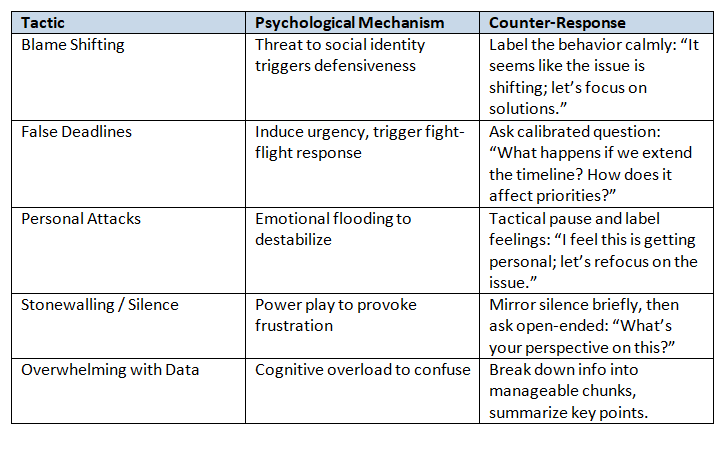
By incorporating these counters into your mental toolkit, you maintain control and steer negotiations back to productive channels.
Advanced Psychological and Strategic Techniques
For negotiators seeking expert-level mastery, these techniques enhance influence and resilience.
· Emotional Labeling Plus Reframing: Combine labeling emotions with reframing the situation positively, e.g., “I understand you’re frustrated; this shows how important this deal is to you.”
· Strategic Silence: Using well-timed silence to provoke the counterpart to fill the gap with concessions or clarifications.
· The “Accusation Audit” (Voss): Preemptively naming all the negative things the other party might say to diffuse their impact.
· Presence Under Pressure (Amy Cuddy): Employ power poses and controlled breathing to exude confidence and calm, influencing counterpart perceptions subconsciously.
· Using Moral Framing (Jonathan Haidt): Appeal to the counterpart’s core moral values to align interests and reduce resistance.
· Micro-Expression Detection (Paul Ekman): Spot fleeting expressions of fear, anger, or doubt to time interventions optimally.
These advanced techniques require practice but yield disproportionate advantages in high-conflict negotiations.
Scripts and Templates for Common Scenarios
Here are exact word-for-word scripts to deploy in typical aggressive negotiation moments.
Script 1: When the Opponent Raises Their Voice
“I can see this is really important to you. Let’s take a breath and explore what’s driving these concerns so we can find a way forward together.”
Script 2: When Facing Personal Attacks
“I want to keep our focus on solving the problem. Let’s avoid personal remarks and work on the issue at hand.”
Script 3: When Encountering a False Deadline
“I appreciate the urgency you’re suggesting. Can you help me understand what would happen if we had a bit more time to ensure the best outcome?”
Script 4: When Dealing with Stonewalling or Silence
“I’m sensing some hesitation. I’d like to hear your thoughts so we can address any concerns directly.”
Script 5: When You Detect Manipulation or Blame Shifting
“It seems the focus is moving away from the core issue. Let’s realign and concentrate on finding a solution that works for both of us.”
Using these scripts helps maintain professionalism and keep negotiations on track.
Frequently Asked Questions
Q1: How do I remain calm when someone gets aggressive quickly?
A1: Practice emotional self-regulation techniques such as deep diaphragmatic breathing, visualization, and power posing before and during the negotiation. Engage your System 2 thinking consciously to override reactive impulses. Label the aggressor’s emotions to reduce tension.
Q2: What if the aggressive person refuses to engage in dialogue?
A2: Use calibrated questions to invite participation rather than direct confrontation. If stonewalling persists, suggest a break or “going to the balcony” to reset emotions. Escalation can sometimes be avoided by changing format or timing.
Q3: Can tactical empathy be perceived as weakness?
A3: Tactical empathy is not agreement; it is a strategic recognition of emotions to build rapport. Skilled negotiators use it to diffuse hostility and gain influence, which is a position of strength.
Q4: How do I spot manipulation early in the conversation?
A4: Listen for inconsistency, shifting deadlines, personal attacks, or attempts to overwhelm you with information. Watch for changes in tone or micro-expressions indicating discomfort or deceit. Validate your perceptions by calmly labeling behaviors.
Q5: Is there a way to prepare mentally before negotiating with an aggressive counterpart?
A5: Yes, conduct scenario planning with scripts, rehearse presence techniques, and identify your triggers. Setting clear objectives and fallback positions prevents being caught off guard emotionally.
Conclusion
Negotiating with aggressive people is one of the most challenging skills a professional can master. It requires a deep understanding of human psychology, emotional intelligence, and strategic communication. By recognizing the neurological triggers of aggression, employing proven frameworks like tactical empathy and “going to the balcony,” and using specific counter-tactics and scripts, negotiators can transform potentially destructive encounters into opportunities for resolution and value creation.
Armed with the insights and tools in this guide, you are now equipped to face hostility with confidence, maintain composure under pressure, and steer negotiations toward mutually beneficial outcomes. Begin integrating these strategies today to elevate your negotiation prowess and preserve crucial relationships even in the toughest conflicts.
Take the first step: review your upcoming negotiations, identify potential aggressive flashpoints, and prepare your emotional regulation and tactical empathy scripts. The difference between winning and losing in high-conflict talks is often the mastery of these subtle, yet powerful psychological dynamics.
References
- Kahneman, D. (2011). *Thinking, Fast and Slow*. Farrar, Straus and Giroux.
- Voss, C., & Raz, T. (2016). *Never Split the Difference: Negotiating As If Your Life Depended On It*. HarperBusiness.
- Ury, W. (1991). *Getting Past No: Negotiating in Difficult Situations*. Bantam Books.
- Gottman, J. M. (1994). *What Predicts Divorce? The Relationship Between Marital Processes and Marital Outcomes*. Lawrence Erlbaum Associates.
- Cuddy, A. (2015). *Presence: Bringing Your Boldest Self to Your Biggest Challenges*. Little, Brown and Company.
- Haidt, J. (2012). *The Righteous Mind: Why Good People Are Divided by Politics and Religion*. Pantheon Books.
- Ekman, P. (2003). *Emotions Revealed: Recognizing Faces and Feelings to Improve Communication and Emotional Life*. Times Books.