Negotiating with Global Corporations: How to Win Deals Against Multinational Giants

Negotiating with global corporations can feel like David facing Goliath in the world of international business. Consider the 2018 US-China trade negotiations, where American tech companies sought to secure supply chain contracts with Chinese state-backed giants. One small software firm’s failure to appreciate China’s high-context communication style and hierarchical decision-making led to a lost opportunity worth millions. The stakes in such negotiations are staggering—not only in monetary terms but also in geopolitical influence and long-term market positioning. Missteps can cost deals, reputations, and future access to lucrative markets.
The strategic complexity of negotiating with multinational corporations arises from intersecting layers: differing cultural communication styles, complex legal and regulatory environments, asymmetrical power dynamics, and diverse organizational structures. Many professionals underestimate how cultural nuances, such as Japan’s nemawashi consensus-building or Middle Eastern wasta networks, can override even the best legal terms. Moreover, they overlook critical international frameworks—like the United Nations Convention on Contracts for the International Sale of Goods (CISG) and Incoterms—that govern cross-border transactions. Without mastering these dimensions, negotiators often find themselves outmaneuvered or blindsided.
This definitive guide will equip you with the frameworks and tactical tools required to negotiate effectively against multinational corporations. You will gain mastery over renowned cultural models like Hofstede’s dimensions and Erin Meyer’s Culture Map, understand how to identify and exploit your BATNA and ZOPA in complex environments, and learn precise step-by-step strategies tailored for global settings. Additionally, you will find ready-to-use negotiation scripts and region-specific insights to help you bridge cultural divides, manage risk, and close deals confidently—even against the largest corporate giants.
· Table of Contents
· The Strategic Foundation: Cultural and Legal Frameworks for Global Negotiation
· Key Frameworks and Models: Comparative Analysis of Top Cultural and Negotiation Theories
· Step-by-Step Strategy: Six Essential Steps to Win Deals with Multinationals
· Real-World Case Studies: Lessons from US-China, EU-UK, and Japan-Middle East Deals
· Country/Region-Specific Insights: Tactical and Cultural Challenge Matrix
· Advanced Strategies: Managing Interpreters, Relationships, and Legal Risks
· Scripts and Templates: Word-for-Word International Negotiation Communications
· Frequently Asked Questions: Long-Tail Answers on Global Corporate Negotiations
· Conclusion: Summarizing Success and Next Steps
· References: Authoritative Sources for Further Study
The Strategic Foundation — Cultural and Legal Frameworks for Global Negotiation
To triumph in negotiations with multinational corporations, one must ground strategy in a deep understanding of cultural dimensions and international legal frameworks. These layers not only shape communication but define the boundaries and opportunities of deal-making.
Cultural Dimensions Impacting Negotiation
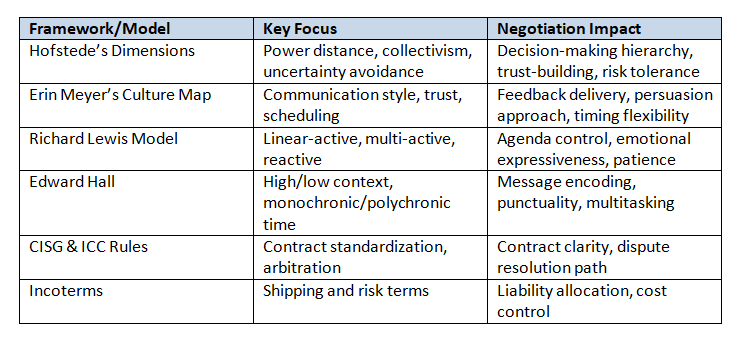
Geert Hofstede’s seminal research identifies six key cultural dimensions that influence negotiation behavior: Power Distance, Individualism vs Collectivism, Masculinity vs Femininity, Uncertainty Avoidance, Long-Term Orientation, and Indulgence vs Restraint. For example, high power distance cultures like South Korea or Mexico expect hierarchical decision-making and defer to authority, influencing negotiation protocols and who must be present.
Erin Meyer’s Culture Map further refines this with eight scales, including Communication (low vs high context), Evaluating (direct negative feedback vs indirect), Persuading (principles-first vs applications-first), Leading (egalitarian vs hierarchical), Deciding (consensual vs top-down), Trusting (task vs relationship-based), Disagreeing (confrontational vs avoids confrontation), and Scheduling (linear vs flexible). Understanding where your counterpart lies on these scales enables tailored negotiation approaches.
Richard Lewis categorizes cultures as Linear-Active (e.g., Germans, Swiss), Multi-Active (e.g., Latin Americans, Southern Europeans), or Reactive (e.g., Japanese, Chinese), revealing how time management, agenda adherence, and responsiveness differ dramatically.
Edward Hall’s concepts of high vs low context communication and monochronic vs polychronic time provide additional layers. High-context cultures (Japan, Arab countries) embed much meaning in non-verbal cues and context, requiring patient relationship-building, whereas low-context cultures (USA, Germany) rely on explicit verbal contracts. Monochronic cultures value punctuality and sequential task completion, while polychronic cultures (India, Middle East) navigate multiple simultaneous priorities.
International Legal Frameworks and Contractual Considerations
Negotiations with global corporations must also navigate complex legal instruments. The United Nations Convention on Contracts for the International Sale of Goods (CISG) standardizes contract terms for over 90 countries, reducing ambiguity in international sales contracts. However, many corporations prefer ICC arbitration under ICC Rules of Arbitration to resolve disputes efficiently.
Understanding Incoterms (International Commercial Terms) is critical for defining responsibilities in shipping, customs clearance, and risk transfer. Misunderstanding terms like FOB (Free On Board) vs CIF (Cost, Insurance, Freight) can lead to costly liabilities.
Additionally, negotiators must consider UNICTRAL model laws, bilateral investment treaties, and local regulatory restrictions—especially in emerging markets where political risk frameworks like PESTLE analysis (Political, Economic, Social, Technological, Legal, Environmental) highlight country-specific challenges. Currency volatility and transfer pricing rules also influence final deal structures.
Key Frameworks and Models — Comparative Analysis of Top Cultural and Negotiiation Theories
To synthesize the most actionable frameworks, we compare Hofstede, Meyer, and Lewis models focusing on their negotiation implications.
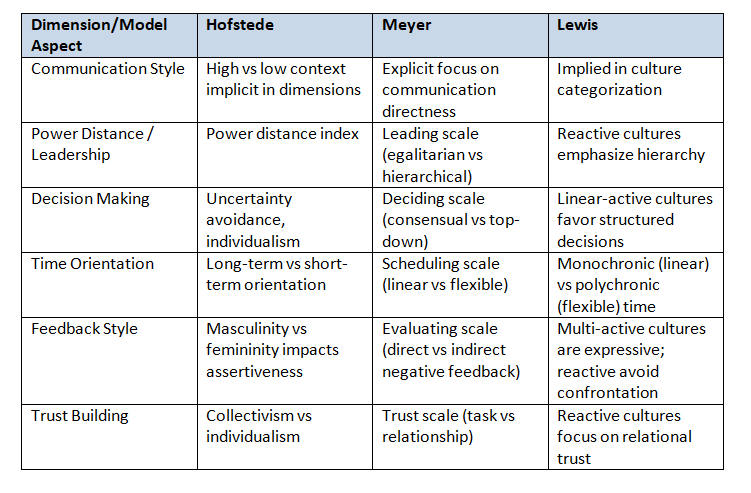
This comparative table clarifies how these models collectively inform culturally adapted negotiation strategies. For example, when negotiating with a Japanese reactive, high-context culture with high power distance, one must prioritize relationship building, indirect communication, and deference to senior decision-makers.
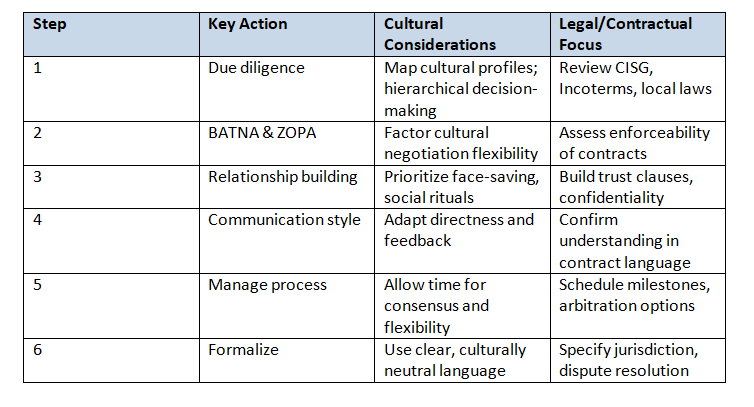
Step-by-Step Strategy — Six Essential Steps to Win Deals with Multinationals
Step 1: Conduct In-Depth Cultural and Legal Due Diligence
Before entering talks, research your counterpart’s cultural profile using Hofstede, Meyer, and Lewis frameworks. Map their organizational hierarchy and decision-making process. Review relevant legal frameworks—CISG applicability, preferred arbitration, Incoterms, and local regulations. Use political risk tools like PESTLE and country risk ratings to anticipate challenges.
Step 2: Identify Your BATNA and Estimate ZOPA
Develop your Best Alternative to a Negotiated Agreement (BATNA) to strengthen your position. Simultaneously, estimate the Zone of Possible Agreement (ZOPA) based on counterpart interests, market data, and cultural negotiation styles. For example, in high power distance cultures, decisions may be less flexible, narrowing ZOPA.
Step 3: Build Relationship and Establish Trust
In collectivist or reactive cultures (China, Middle East), invest time in relationship building through informal meetings, social events, and acknowledging hierarchical status. Use language that respects face-saving and indirect communication. For example, in Brazil, expect warm, personal interactions before discussing terms.
Step 4: Adapt Communication Style and Negotiation Tactics
Tailor your style: use direct, data-driven arguments for low-context, linear-active cultures (Germany, USA). Use storytelling and indirect persuasion for high-context, reactive cultures (Japan, South Korea). Manage feedback delivery per Meyer’s Evaluating scale.
Step 5: Manage Multistage Negotiation Process with Cultural Sensitivity
Plan for multiple rounds in consensus-driven cultures (Japan’s nemawashi). Be patient with polychronic schedules (India). Use interpreters strategically, briefed on cultural nuances. Maintain flexibility on timelines but hold firm on critical deal points.
Step 6: Formalize Agreements with Clear Legal and Contractual Safeguards
Ensure contracts clarify terms under CISG where applicable, specify Incoterms, and identify arbitration venues. Address currency and transfer pricing risks. Anticipate enforcement challenges in emerging markets with contingency clauses.
Real-World Case Studies — Lessons from US-China, EU-UK, and Japan-Middle East Deals
Case Study 1: US Tech Firm vs Chinese State-Owned Enterprise (2018)
An American hardware company sought a strategic supply contract with a Chinese SOE. Initial negotiations failed due to the American team’s reliance on direct, linear negotiation and focus on cost reduction, clashing with the Chinese preference for high-context communication and relationship-building (guanxi). After incorporating a local intermediary, understanding hierarchy, and engaging in long-term trust-building, the US firm renegotiated successfully. Lesson: adapt to high-context, reactive cultures by investing in relationships and patience.
Case Study 2: Brexit Trade Talks — EU and UK Negotiations (2019–2020)
These negotiations highlighted the clash between the EU’s legalistic, consensus-driven approach and the UK’s adversarial, linear-active style. Both sides used principled negotiation techniques but struggled with differing interpretations of legal frameworks and political pressures. The eventual deal balanced regulatory alignment with UK sovereignty demands. Lesson: understand opposing cultural negotiation styles and legal frameworks to frame mutually acceptable terms.
Case Study 3: Japanese Automotive Supplier and Middle Eastern Distributor
A Japanese supplier pursued a deal with a Gulf Cooperation Council (GCC) distributor. The Japanese relied on nemawashi (informal consensus building) but underestimated the power of wasta (personal connections) in the Middle East. By engaging local influencers and respecting hierarchical protocols, the supplier secured a long-term contract. Lesson: combine cultural negotiation styles and local social networks for success.
Country/Region-Specific Insights or Challenge Matrix
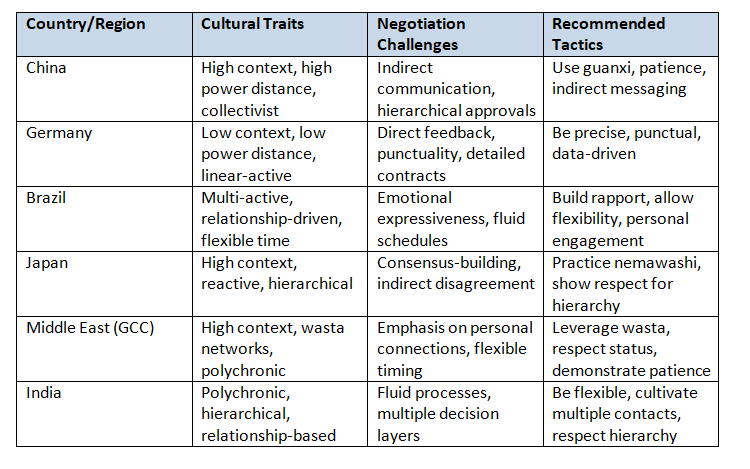
Advanced Strategies — Managing Interpreters, Relationship-Building, and Legal Risk Mitigation
Managing interpreters is often overlooked yet critical. Use professional interpreters versed in business and cultural nuances. Brief them on negotiation context and desired tone to avoid mistranslations that can damage trust.
Relationship-building must go beyond formal meetings. Engage in informal social rituals such as shared meals, gift-giving (respecting cultural taboos), and recognizing local holidays. This generates goodwill and smooths conflict resolution.
Navigating hierarchy involves identifying key decision-makers—even if not immediately visible—and engaging them appropriately. In high power distance cultures, securing buy-in from senior leaders early can accelerate negotiations.
Legal risk mitigation entails drafting contracts with clear dispute resolution mechanisms aligned with counterpart preferences, such as ICC arbitration or local courts. Include force majeure clauses addressing political risk, currency fluctuation protection, and compliance with anti-bribery laws like the US FCPA and UK Bribery Act.
Scripts and Templates — Word-for-Word International Negotiation Communications
Script 1: Initial Email to a Japanese Corporate Partner
Dear [Title and Last Name],
I hope this message finds you well. It is a great honor to introduce our company and explore potential collaboration opportunities. We greatly respect [Company’s] esteemed reputation and commitment to excellence.
We would appreciate the opportunity to arrange a meeting at your convenience to discuss how we might support your strategic goals.
Thank you very much for your kind consideration.
Sincerely,
Script 2: Follow-Up Email After Meeting with Middle Eastern Partner
Dear [Title and Last Name],
Thank you sincerely for the warm hospitality and insightful discussions during our recent meeting. We value the opportunity to build a strong relationship with [Company].
We look forward to continuing our dialogue and working together towards a mutually beneficial agreement.
Please do not hesitate to contact me should you require any additional information.
Kind regards,
Script 3: Clarification Request in German Business Negotiation
Sehr geehrte/r Herr/Frau [Last Name],
Vielen Dank für Ihre ausführlichen Erläuterungen. Um Missverständnisse zu vermeiden, möchten wir gerne einige Punkte präzisieren:
1. Könnten Sie bitte Ihre Vorschläge zur Lieferfrist näher erläutern?
2. Wie sehen Sie die Zahlungsbedingungen im Hinblick auf das Risiko?
Wir freuen uns auf Ihre Rückmeldung.
Mit freundlichen Grüßen,
Script 4: Proposal Email Incorporating CISG Contract Terms (English)
Dear [Title and Last Name],
Following our recent discussions, please find attached the draft contract for your review. The agreement is governed by CISG provisions to ensure mutual clarity and enforceability.
Key terms include delivery under FOB Incoterms 2020, payment within 30 days of invoice, and dispute resolution through ICC arbitration.
We welcome any questions or comments you may have.
Best regards,
Script 5: Virtual Meeting Opening in a Brazilian Negotiation
Good morning/afternoon everyone,
It’s a pleasure to connect with all of you today. Before we begin, I’d like to thank you for making time despite your busy schedules. We look forward to a constructive and friendly discussion as we explore ways to collaborate.
Let’s keep the conversation open and feel free to share your thoughts at any time.
Thank you.
Frequently Asked Questions
Q1: How can I identify the decision-makers in a hierarchical multinational corporation?
In high power distance cultures, decision-makers may not be visible in initial meetings. Research company organizational charts, use local contacts or intermediaries, and observe seating arrangements and speaking order during meetings. Engage politely with senior figures even if they do not intervene directly.
Q2: What is the best way to handle disagreements in high-context cultures?
Avoid direct confrontation. Use indirect language, ask open-ended questions, and employ silence strategically. Focus on preserving face for all parties and seek consensus through gradual, informal discussions (e.g., nemawashi in Japan).
Q3: How do I mitigate currency risk in international deals?
Include clauses specifying payment currency, use forward contracts or options, and consider pricing adjustments linked to exchange rate fluctuations. Also, consult with transfer pricing experts to comply with tax regulations.
Q4: When should I involve legal counsel in the negotiation process?
Engage legal counsel early when drafting term sheets or letters of intent to ensure alignment with international conventions and local law. Counsel is critical before signing to finalize enforceable contracts and arbitration agreements.
Q5: How can I manage virtual negotiations with multinational corporations?
Prepare by testing technology, establish clear agendas, and adapt communication to compensate for the lack of non-verbal cues. Use video when possible and follow up with summary emails to confirm agreements.
Conclusion
Negotiating successfully with multinational corporations requires more than technical knowledge—it demands cultural intelligence, strategic preparation, and legal savvy. By grounding your approach in proven frameworks like Hofstede’s dimensions and Erin Meyer’s Culture Map, and by following a step-by-step culturally adapted strategy, you position your organization to win deals even against the largest global giants.
Embrace relationship-building, master communication styles, and anticipate legal and political risks to transform daunting negotiations into lasting partnerships. Begin applying these insights today to elevate your international negotiation outcomes.
References
1. Hofstede, G. (2001). Culture’s Consequences: Comparing Values, Behaviors, Institutions and Organizations Across Nations. Sage Publications.
2. Meyer, E. (2014). The Culture Map: Breaking Through the Invisible Boundaries of Global Business. PublicAffairs.
3. Lewis, R. D. (2006). When Cultures Collide: Leading Across Cultures. Nicholas Brealey Publishing.
4. Hall, E. T. (1976). Beyond Culture. Anchor Books.
5. Fisher, R. & Ury, W. (1981). Getting to Yes: Negotiating Agreement Without Giving In. Penguin Books.
6. United Nations Commission on International Trade Law (UNCITRAL). (1980). United Nations Convention on Contracts for the International Sale of Goods (CISG).
7. International Chamber of Commerce (ICC). (2020). ICC Arbitration Rules.
8. World Bank Group. (2023). Doing Business Report.
9. Oxford Analytica. (2022). Political Risk and Emerging Markets Framework.