Negotiating with Toxic Counterparts: Protect Yourself and Win
Negotiations can become volatile arenas when one party embodies toxicity—manipulation, aggression, or emotional volatility. Imagine a critical M&A negotiation where a key counterpart, known for sharp power plays and relentless aggression, suddenly shifts from professional dialogue to personal attacks, undermining trust and threatening to collapse a deal worth billions. In another scenario, a labor dispute escalates rapidly as union representatives use emotional flooding and intimidation, leaving company executives scrambling to regain composure and control. These moments underscore a harsh reality: toxic negotiators do not just challenge your arguments—they attack your psychological equilibrium, threatening the success or failure of negotiations in the earliest moments.
The stakes in dealing with such adversaries are profound. Psychological science tells us that the first minutes of negotiation are decisive—System 1 thinking (fast, intuitive) can hijack reason, allowing emotional triggers to dictate outcomes. Most negotiators fail because they enter these battles unprepared for the psychological warfare ahead, mistaking aggression for strength or conceding too quickly to avoid conflict. But winning against toxic counterparts requires mastering the psychology behind their behavior, applying tactical empathy to defuse aggression, and employing structured frameworks to maintain presence and control.
In this definitive guide, you will master actionable steps and advanced frameworks—drawing on Daniel Kahneman’s cognitive models, Chris Voss’s FBI negotiation tactics, William Ury’s conflict resolution insights, and Paul Ekman’s emotional detection tools. You will learn to identify manipulation tactics with precision, deploy exact scripts to de-escalate hostility, and harness emotional regulation techniques proven to protect your negotiating position. Whether you face a hostile client, a combative board member, or a diplomatic standoff, this article equips you with everything needed to protect yourself and emerge victorious.
· Table of Contents
· The Psychology Behind This Challenge
· Key Frameworks and Models
· Step-by-Step Process for Negotiating with Toxic Counterparts
· Real-World Case Studies
· Recognizing and Countering Tactics
· Advanced Techniques for Expert Negotiators
· Scripts and Templates for Difficult Negotiation Scenarios
· Frequently Asked Questions
· Conclusion
· References
The Psychology Behind This Challenge
Negotiating with toxic counterparts activates deep psychological and neurological processes that shape decision-making. At the core is the amygdala hijack—a term popularized by psychologist Daniel Goleman—where the brain’s emotional center overrides rational thought, triggering fight, flight, or freeze responses. When faced with hostility or manipulation, negotiators without emotional regulation often default to reactive, System 1 thinking, as described by Daniel Kahneman. This fast, intuitive mode sacrifices deliberation and strategic control, making negotiators vulnerable to manipulation.
Chris Voss’s concept of tactical empathy intervenes here: by consciously engaging System 2 thinking—slow, analytical, deliberate—negotiators can recognize and validate the counterpart’s emotions without succumbing to them. Emotional flooding, a term from John Gottman’s research, describes how overwhelming emotional stimuli can incapacitate reason, often exploited by toxic negotiators to destabilize their opponents.
Social identity theory also plays a role. Toxic counterparts may weaponize group allegiances or perceived status to trigger defensive identities, escalating conflict. The fight-flight-freeze response, rooted in evolutionary survival mechanisms, explains why some negotiators react with aggression, withdrawal, or paralysis, often to their detriment.
Understanding these psychological dynamics is foundational. Without recognizing the underlying emotional currents and cognitive biases, negotiators will repeatedly fall prey to toxic tactics. Mastery begins with awareness: managing your own amygdala responses, engaging System 2 thinking, and practicing tactical empathy to defuse hostility.
Key Frameworks and Models
Several established frameworks offer structured guidance for managing toxic counterparts. This section compares three influential models: Chris Voss’s FBI negotiation method, William Ury’s “Going to the Balcony” technique, and the Thomas-Kilmann Conflict Mode Instrument (TKI). Each provides a distinct approach to emotional regulation, strategic positioning, and conflict resolution.
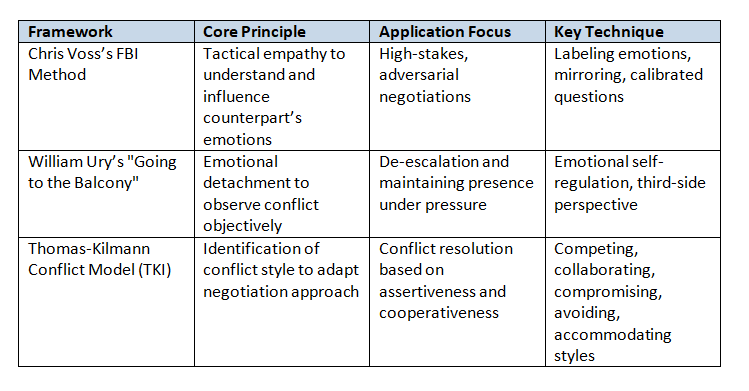
Voss’s method emphasizes emotional intelligence, using empathy as a tactical tool to lower defenses and guide counterparts toward mutually beneficial outcomes. Ury’s “balcony” metaphor teaches negotiators to step back mentally, observing the negotiation as an external party to avoid emotional hijacking. The TKI model helps negotiators identify their own and counterparts’ conflict styles, enabling strategic adaptation to either confront or accommodate toxic behavior effectively.
Each framework contributes critical tools for managing toxicity, and combining elements from all three creates a robust toolkit for complex negotiations.
Step-by-Step Process for Negotiating with Toxic Counterparts
This section outlines a detailed six-step process integrating psychological techniques and negotiation best practices to manage toxic behavior and secure agreements.
Step 1: Prepare with Mental Rehearsal and Emotional Anchoring
Before engagement, anticipate toxic tactics and mentally rehearse responses using Amy Cuddy’s power posing and presence techniques. Anchor yourself emotionally by identifying calming triggers to stabilize your nervous system and engage System 2 thinking.
Step 2: Establish Rapport through Tactical Empathy
Open by acknowledging the counterpart’s perspective without conceding. Use Voss’s labeling technique: “It seems like this issue is very important to you.” This validates emotions and reduces defensiveness.
Step 3: Set Clear Boundaries Early
Communicate your non-negotiables calmly and firmly to prevent escalation. Use Ury’s “going to the balcony” mindset to maintain composure if boundaries are challenged.
Step 4: Identify and Label Manipulation Attempts
Watch for verbal and non-verbal cues—micro-expressions, emotional flooding, aggressive tone. Label these observations neutrally: “I notice there’s some frustration here.” This disrupts manipulative patterns.
Step 5: Use Calibrated Questions to Redirect
Guide the conversation with open-ended questions that place problem-solving responsibility on the counterpart: “How can we resolve this so both sides feel heard?”
Step 6: Close with Summarization and Reinforcement
Summarize agreed points aloud to confirm understanding and create psychological commitment. Reinforce collaborative language to build trust and prevent backsliding.
This process integrates emotional regulation, influence, and strategic communication to shift power dynamics away from toxicity and toward constructive dialogue.
Real-World Case Studies
Understanding theory is strengthened by real-world examples where negotiators faced toxic counterparts and triumphed.
Case Study 1: The 1972 Munich Hostage Crisis Negotiations
FBI negotiators applied tactical empathy and emotional labeling under extreme pressure to build rapport with hostage-takers. Although the outcome was tragic, the negotiation techniques limited further violence and laid groundwork for future hostage protocols.
Case Study 2: Disney-Pixar Merger Negotiations (2006)
Toy Story’s creators initially distrusted Disney executives due to prior toxic corporate culture. Executives used William Ury’s “balcony” approach to emotionally detach and rebuild trust, focusing on mutual goals. Their patience and emotional control secured a landmark deal.
Case Study 3: Toxic Client Negotiation in a Law Firm
A senior partner faced a client prone to emotional flooding and blame-shifting. By employing calibrated questions and strict boundary-setting scripts, the partner prevented project scope creep and preserved client relationship without burnout.
Each case underscores the importance of emotional control, tactical empathy, and strategic frameworks in overcoming toxicity.
Recognizing and Countering Tactics
Toxic negotiators employ a range of psychological tactics aimed at destabilizing and manipulating. The following table maps common tactics to their psychological mechanisms and provides precise counter-responses.
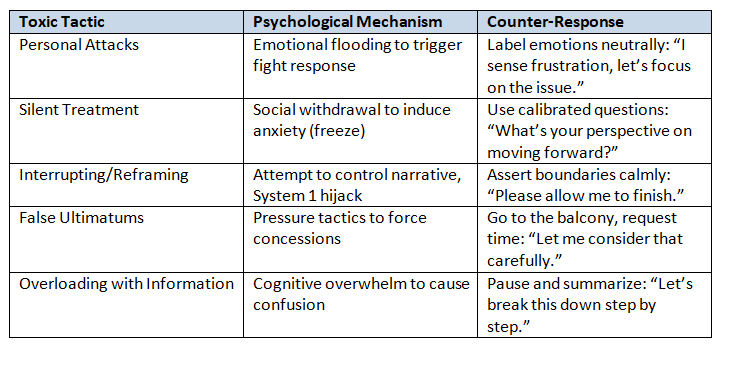
Recognizing these tactics early and deploying exact counter-responses maintains psychological advantage and prevents toxic dynamics from escalating.
Advanced Techniques for Expert Negotiators
For senior negotiators, advanced techniques leverage subtle psychological insights and strategic positioning beyond beginner tactics.
- Micro-expression Analysis: Paul Ekman’s research enables reading involuntary facial cues to detect deception or hidden emotions, allowing timely intervention.
- Moral Framing: Drawing on Jonathan Haidt’s moral psychology, reframe proposals in terms that resonate with the counterpart’s core values to reduce ideological resistance.
- Third-Side Intervention: Inspired by William Ury’s “third side” concept, bring in neutral facilitators or mediators to re-balance power and diffuse entrenched toxicity.
- Strategic Silence and Pausing: Use calibrated, intentional silence to pressure toxic counterparts into revealing more information or reconsidering aggressive positions.
- Emotional Reappraisal: Cognitive-behavioral techniques to reinterpret toxic provocations as non-personal strategic moves, preserving negotiator’s equanimity.
Integrating these nuanced methods can transform high-conflict negotiations into arenas of controlled influence and eventual cooperation.
Scripts and Templates for Difficult Scenarios
This section provides exact word-for-word dialogue templates to deploy in common toxic negotiation moments.
Script 1: Defusing Personal Attacks
“I hear that you’re upset, and I want to understand your concerns. Let’s focus on the problem together so we can find a solution.”
Script 2: Responding to Silent Treatment
“I notice we’ve hit a pause. Can you share your thoughts on where you’d like to take this next?”
Script 3: Handling Interruptions
“I appreciate your enthusiasm. I’d like to finish my point, then I’m eager to hear yours.”
Script 4: Countering False Ultimatums
“That’s an important consideration. Can we explore alternatives that might work better for both of us?”
Script 5: Managing Overload of Information
“There’s a lot here. Let’s take it one step at a time to ensure we’re aligned.”
These scripts reflect tactical empathy and assertiveness, designed to maintain control and respect even under pressure.
Frequently Asked Questions
Q1: How do I maintain emotional control when a counterpart becomes aggressive?
A1: Use Amy Cuddy’s presence techniques before and during negotiation to anchor calm. Practice deep breathing and “going to the balcony” to observe rather than react to aggression. Label emotions calmly to reduce escalation.
Q2: What if the toxic negotiator refuses to engage in good faith?
A2: Establish firm boundaries early and consider introducing a neutral third party. Use calibrated questions to invite constructive dialogue without making concessions. Protect your interests by preparing walk-away options.
Q3: How can I detect manipulation tactics in virtual negotiations?
A3: Look for verbal inconsistencies, delayed responses, and evasive answers. Apply Paul Ekman’s principles by observing micro-expressions on video and listening for emotional tone shifts. Ask clarifying questions to expose contradictions.
Q4: Is it effective to confront toxic behavior directly?
A4: Direct confrontation can escalate conflict unless carefully framed. Instead, use tactical empathy to label the behavior neutrally and reframe conversation toward problem-solving. If confrontation is necessary, maintain calm and use precise language.
Q5: How do cultural differences affect negotiating with toxic counterparts?
A5: Cultural norms influence conflict expression and perception of aggression. Research counterpart’s cultural background to adapt communication style. Use universal frameworks like the TKI model to identify appropriate conflict modes respecting cultural context.
Conclusion
Negotiating with toxic counterparts is an inevitable challenge in high-stakes business, diplomacy, and legal contexts. Success demands more than traditional bargaining skills—it requires a deep understanding of psychological processes, emotional intelligence, and strategic frameworks that protect your mental equilibrium while steering the negotiation toward resolution. By mastering tactical empathy, emotional regulation, and precise countermeasures against manipulative tactics, you can transform even the most toxic interactions into opportunities for constructive outcomes.
Equip yourself with the step-by-step processes, advanced techniques, and exact scripts detailed in this guide. Remember, control over your own emotional responses combined with strategic influence over the counterpart’s behavior is your greatest asset. Commit to practicing these tools rigorously, and you will not only protect yourself but also consistently win against toxic negotiators. Begin implementing these strategies today to transform conflict into collaboration.
References
- Kahneman, D. (2011). Thinking, Fast and Slow. Farrar, Straus and Giroux.
- Voss, C., & Raz, T. (2016). Never Split the Difference: Negotiating As If Your Life Depended On It. HarperBusiness.
- Ury, W. (1993). Getting Past No: Negotiating in Difficult Situations. Bantam Books.
- Gottman, J. M. (1994). What Predicts Divorce: The Relationship Between Marital Processes and Marital Outcomes. Lawrence Erlbaum Associates.
- Cialdini, R. B. (2006). Influence: The Psychology of Persuasion. Harper Business.
- Ekman, P. (2003). Emotions Revealed: Recognizing Faces and Feelings to Improve Communication and Emotional Life. Times Books.
- Haidt, J. (2012). The Righteous Mind: Why Good People Are Divided by Politics and Religion. Pantheon Books.
- Cuddy, A. (2015). Presence: Bringing Your Boldest Self to Your Biggest Challenges. Little, Brown and Company.