Negotiation Breakdown: What to Do When Talks Collapse

Negotiations can be the difference between thriving partnerships and costly failures. Imagine a high-stakes corporate merger where after months of careful deliberation, the talks suddenly collapse over an unexpected demand. The boardroom fills with tension, trust erodes instantly, and months of progress threaten to unravel in minutes. This is no rare occurrence; even the most seasoned negotiators face the gut-wrenching moment when discussions break down, leaving all parties frustrated and the future uncertain.
The psychological stakes in these moments are profound. What often goes wrong is that negotiators fall prey to their brain’s fast, emotional System 1 thinking — an amygdala hijack triggers fight, flight, or freeze reactions that sabotage rational dialogue. Daniel Kahneman’s research shows that under pressure, cognitive resources narrow, making meaningful communication nearly impossible. Meanwhile, trust frays quickly, and parties can slip into zero-sum thinking, turning potential collaboration into adversarial deadlock. Without a precise approach, the negotiation may collapse permanently.
This comprehensive guide will equip you with proven psychological insights and tactical frameworks to navigate and recover from negotiation breakdowns. You will master behavioral patterns such as tactical empathy from Chris Voss, trust repair mechanisms from John Gottman, and strategic distancing techniques from William Ury. Detailed scripts, decision-making processes, and real-world case studies will empower you to turn even the most fraught stalemates into new beginnings. Whether managing corporate disputes, labor strikes, or diplomatic standoffs, this pillar article is your definitive resource for high-stakes negotiation resilience.
· Table of Contents
· The Psychology Behind This Challenge
· Key Frameworks and Models
· Step-by-Step Process to Recover from Breakdown
· Real-World Case Studies
· Recognizing and Countering Difficult Dynamics
· Advanced Techniques in Negotiation Recovery
· Scripts and Templates for High-Conflict Scenarios
· Frequently Asked Questions
· Conclusion
· References
The Psychology Behind This Challenge
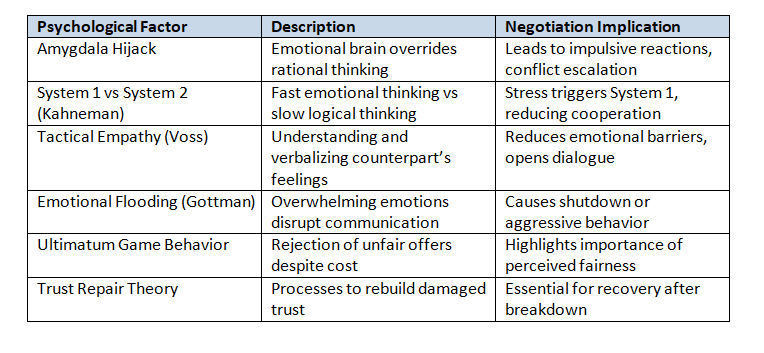
Understanding why negotiations break down requires a deep dive into the cognitive and emotional mechanisms at play. At the heart of many collapses is the amygdala hijack — a term coined by psychologist Daniel Goleman describing when the brain’s emotional center (the amygdala) overrides the prefrontal cortex’s rational thought. This leads to rapid emotional flooding, triggering the fight-flight-freeze response that shuts down productive dialogue.
Daniel Kahneman’s dual-system theory explains this further: System 1 is fast, intuitive, and emotional, while System 2 is slow, deliberate, and logical. Under stress, negotiators often default to System 1 thinking, making snap judgments and escalating conflict rather than thoughtfully addressing issues. Breaking this cycle requires shifting partners back into System 2 processing.
Chris Voss’s concept of tactical empathy — actively understanding and verbalizing the counterpart’s emotions — helps reduce emotional flooding and rebuilds communication channels. John Gottman’s research on emotional flooding and trust repair shows that recognizing negative emotional spirals and employing specific repair tactics can avert permanent breakdowns.
Behavioral economics studies, such as the ultimatum game, reveal that people often reject offers perceived as unfair, even at a cost to themselves. This instinct to punish perceived bad faith can end negotiations abruptly. Recognizing these patterns allows negotiators to design offers that feel fair, preserving engagement.
Trust repair theory emphasizes that breakdowns are not just about disagreements on substance, but about damaged relationships. Rebuilding trust requires acknowledging harm, demonstrating empathy, and consistent follow-through — all while managing one’s own emotional responses.
Key Frameworks and Models
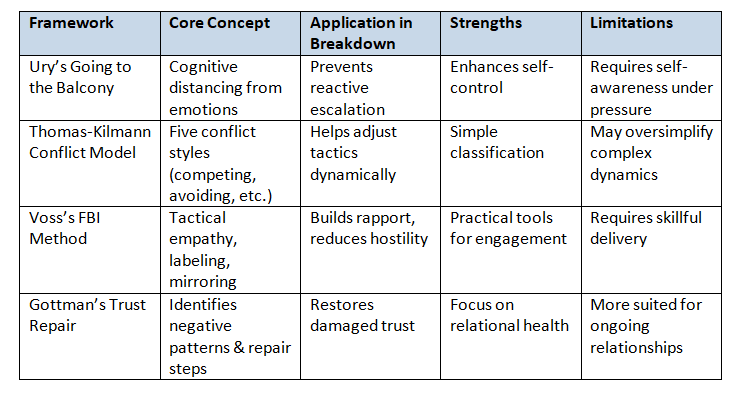
Several frameworks provide a structured approach to diagnosing and overcoming negotiation breakdowns. Comparing these models reveals complementary strengths for use in varied contexts.
William Ury’s “Going to the Balcony” encourages negotiators to mentally step back from emotional intensity, gaining perspective to avoid reactive impulses. The Thomas-Kilmann Conflict Mode Instrument (TKI) categorizes conflict responses into competing, collaborating, compromising, avoiding, and accommodating, helping negotiators identify and shift their style as needed.
Chris Voss’s FBI negotiation method focuses on tactical empathy, labeling emotions, mirroring language, and calibrated questions to defuse tension and regain rapport. John Gottman’s trust repair model identifies four destructive communication patterns (“Four Horsemen”) and prescribes antidotes to rebuild relational trust.
Step-by-Step Process to Recover from Breakdown
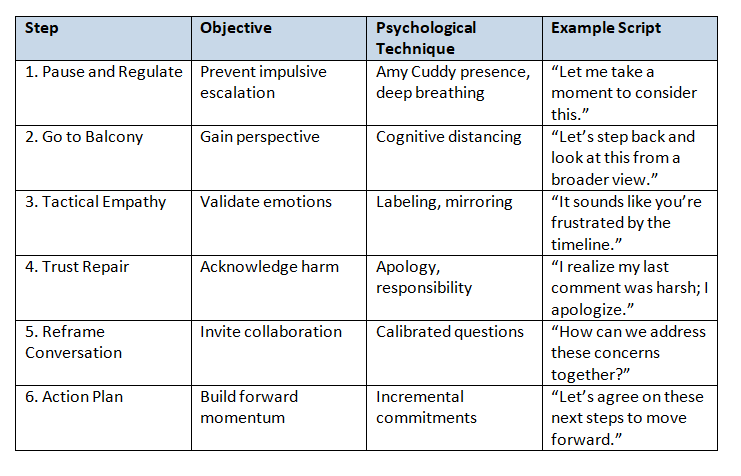
Successful recovery from a negotiation collapse requires disciplined progression through psychological and communicative stages. Below is a detailed six-step process incorporating evidence-based tactics.
Step 1: Pause and Regulate Emotion
Immediately after breakdown, avoid reactive responses. Recognize signs of amygdala hijack — rapid heart rate, tunnel vision, impulsive thoughts. Use Amy Cuddy’s power-posing technique or deep breathing to engage System 2 and regain composure.
Step 2: Go to the Balcony (Ury)
Mentally detach to observe the situation objectively. Identify emotional triggers and the counterpart’s possible perspectives. This cognitive distancing helps prevent escalation and prepares you to re-engage strategically.
Step 3: Employ Tactical Empathy (Voss)
Articulate the counterpart’s feelings and perspectives using labeling (“It seems like you feel that...”) and mirroring (“You’re concerned about...?”). This validates emotions without agreeing, reducing hostility and opening channels for dialogue.
Step 4: Assess Trust Damage and Initiate Repair (Gottman)
Identify if trust was broken by harmful communication patterns. Use Gottman’s repair techniques: express genuine apology, take responsibility, and propose concrete actions to rebuild confidence.
Step 5: Reframe and Propose Calibrated Questions
Shift focus from positions to interests by asking open-ended, calibrated questions (“How can we solve this together?”). This moves the conversation to problem-solving mode, inviting collaboration.
Step 6: Develop a Mutually Beneficial Action Plan
Define clear, specific next steps with shared accountability. Use incremental commitments to rebuild trust and momentum, ensuring that both parties feel invested in continuing.
Real-World Case Studies
Studying actual negotiation breakdowns reveals practical lessons for recovery.
Case Study 1: FBI Hostage Negotiation — The 1993 Waco Siege
During negotiations with the Branch Davidians, FBI negotiators faced repeated communication breakdowns fueled by mistrust and emotional flooding. Chris Voss, who later codified tactical empathy, observed that labeling emotions and building rapport were critical in de-escalating tensions. The failure to maintain consistent empathy and trust contributed to tragic outcomes. Lesson: Sustained tactical empathy and trust repair are vital in high-stakes talks.
Case Study 2: Corporate M&A Breakdown — The AOL-Time Warner Merger (2000)
The merger collapsed amid mutual accusations and unrealistic expectations. The parties resorted to positional bargaining and ultimatums, triggering System 1 reactions and trust erosion. A failure to “go to the balcony” and reframe interests led to the deal’s collapse. Lesson: Cognitive distancing and reframing interests can prevent breakdown.
Case Study 3: Diplomatic Standoff — Cuban Missile Crisis (1962)
President Kennedy’s team avoided breakdown by maintaining calm, using calibrated questions to probe Soviet intentions, and employing backchannel communications to rebuild trust. William Ury’s “Third Side” approach resonates here — engaging external mediators and alternative communication channels prevented collapse. Lesson: Strategic distancing and third-party involvement can revive stalled talks.
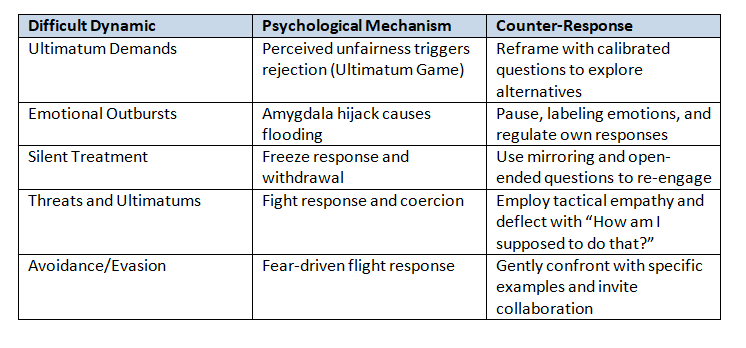
Recognizing and Countering Difficult Dynamics
Negotiations often collapse due to specific difficult tactics or psychological dynamics. The table below maps common challenges to their mechanisms and countermeasures.
Advanced Techniques in Negotiation Recovery
Beyond foundational tactics, expert negotiators deploy nuanced strategies:
- The “Accusation Audit” (Voss): Preemptively address negative perceptions the counterpart might hold (“You may think I’m being unreasonable...”)
- Using “No” as leverage: Reframing rejection not as failure but as control point (“Is now a bad time to talk?”)
- Non-verbal emotional calibration (Paul Ekman): Reading microexpressions to detect hidden resistance or sincerity
- Presence under pressure (Amy Cuddy): Harnessing body language to influence one’s own and counterpart’s emotional state
- The “Third Side” concept (William Ury): Engaging neutral parties or wider community stakeholders to mediate and provide alternative viewpoints
These techniques require practice and emotional intelligence but can transform seemingly intractable breakdowns into breakthroughs.
Scripts and Templates for High-Conflict Scenarios
Exact language matters when tensions peak. Below are tested dialogue templates:
1. Responding to Ultimatum
“I understand this feels like a make-or-break moment for you. Help me understand what’s most important here so we can find a way forward.”
2. Calming Emotional Outburst
“It sounds like this has been extremely frustrating. Let’s take a moment to breathe and work through this together.”
3. Repairing Trust after Harsh Words
“I want to acknowledge that my last comment may have come across harshly. That was not my intention, and I apologize.”
4. Re-engaging Silent Counterpart
“I notice you’ve been quiet — I’d appreciate hearing your perspective when you’re ready.”
5. Deflecting Threats
“I hear your concerns. How can we address them without escalating the situation?”
Frequently Asked Questions
Q1: How soon should you attempt to resume talks after a negotiation breakdown?
A1: It depends on emotional temperature and trust levels. Immediate resumption risks repeating mistakes. Use “going to the balcony” to assess readiness and wait until emotional flooding subsides. Often, a 24-48 hour cooling-off period allows reflection.
Q2: What if the other party refuses to engage after breakdown?
A2: Persistence combined with tactical empathy helps. Use calibrated questions to open dialogue indirectly. If necessary, involve a neutral third party to facilitate communication.
Q3: Can ultimatums ever be effective?
A3: Ultimatums may force decisions but often damage trust and future collaboration. Use sparingly and with clear consequences understood by all parties.
Q4: How do you rebuild trust after a long negotiation collapse?
A4: Follow Gottman’s repair steps: acknowledge harm without defensiveness, express genuine apology, make reparative actions, and ensure consistent follow-through over time.
Q5: What role does emotional intelligence play in negotiation recovery?
A5: Emotional intelligence is critical. It enables recognizing and regulating one’s emotions, reading counterpart’s cues, and deploying empathy to rebuild connection and cooperation.
Conclusion
Negotiation breakdowns are inevitable in high-stakes environments but not irreversible. By understanding the psychological underpinnings of conflict escalation and trust erosion, negotiators can deploy structured frameworks and tactical empathy to recover dialogue and rebuild relationships. The six-step process outlined here, supported by advanced techniques and practical scripts, transforms breakdowns from dead ends into opportunities for deeper collaboration.
Mastering these strategies requires deliberate practice and emotional self-awareness, yet the payoff is enormous: the ability to maintain influence under pressure, preserve valuable partnerships, and achieve outcomes that once seemed unreachable. Begin integrating these principles today to become the resilient negotiator who thrives when talks collapse.
Need more knowedge please visit:
https://www.michalchmielecki.com/difficult-negotiations