Negotiation Etiquette Worldwide: Country-by-Country Guide to Business Protocol

In 2018, a major U.S. tech firm attempted to finalize a joint venture in Japan. Despite months of preparation, the deal collapsed abruptly during a high-stakes boardroom meeting. The American executives, used to direct confrontation and fast decision-making, openly challenged the Japanese partners in front of their entire team. The Japanese side, valuing harmony and consensus-building, perceived this as disrespectful and confrontational, causing irreparable damage to trust and ultimately the partnership. This dramatic misstep underscores how deeply cultural nuances in negotiation etiquette can impact business outcomes.
Negotiation etiquette is not merely about manners; it is a strategic imperative that shapes relationship-building, communication, trust, and decision-making processes across cultures. Executives who fail to appreciate key cultural dimensions—such as indirectness versus directness, individualism versus collectivism, or conceptions of time—risk misunderstandings that can derail multimillion-dollar deals. Most professionals dangerously oversimplify etiquette as superficial politeness instead of recognizing it as a complex interplay of cultural values, communication styles, and conflict management preferences.
This comprehensive guide will equip you with deep cultural intelligence and actionable frameworks to navigate negotiation etiquette worldwide. You will master renowned theoretical models including Hofstede’s cultural dimensions, Erin Meyer’s Culture Map, Richard Lewis’s communication typologies, and Edward Hall’s context and time concepts. Through specific country examples, detailed do’s and don’ts, expert step-by-step strategies, and exact scripts tailored for diverse cultures, you will gain the tools to engage respectfully and effectively across borders. Whether negotiating in the hierarchical corridors of India, the consensus-driven rooms of Japan, or the direct, transactional settings of Germany and the U.S., you will be prepared to succeed.
· Table of Contents
· The Theoretical Foundation: Deep Cultural Frameworks and Country Data
· Key Frameworks and Models: Comparative Analysis of Negotiation Across Cultures
· Step-by-Step Strategy: Six Essential Actions for Cross-Cultural Negotiation Etiquette
· Real-World Case Studies: Successes and Failures in Global Negotiations
· Country/Region-Specific Insights: Do’s and Don’ts for Top Business Cultures
· Advanced Strategies: Expert Techniques for Complex Cross-Cultural Deals
· Scripts and Templates: Word-for-Word Communication for Diverse Contexts
· Frequently Asked Questions: Practical Solutions to Common Challenges
· Conclusion: Synthesizing Insights and Next Steps
· References: Authoritative Sources for Further Study
The Theoretical Foundation — Deep Dive into Relevant Cultural Frameworks
Understanding negotiation etiquette globally requires grounding in established cultural models that decode how societies differ in values, communication, and decision-making. Below is an overview of the primary frameworks and their salient dimensions with country-level data.
Hofstede’s Six Cultural Dimensions
Geert Hofstede’s research remains foundational, quantifying national cultures on six dimensions:
- Power Distance Index (PDI): Degree to which inequality and hierarchy are accepted.
- Individualism vs Collectivism (IDV): Preference for loosely-knit social frameworks or tightly-knit communities.
- Masculinity vs Femininity (MAS): Emphasis on achievement and competitiveness versus cooperation and care.
- Uncertainty Avoidance Index (UAI): Comfort level with ambiguity and uncertainty.
- Long-Term Orientation (LTO): Focus on future rewards versus respect for tradition.
- Indulgence vs Restraint (IVR): Degree of gratification of desires.
For example, Japan scores high on Power Distance (54) and Uncertainty Avoidance (92), emphasizing hierarchy and risk avoidance, while the U.S. has low PDI (40) and high Individualism (91), reflecting egalitarian and individualistic tendencies.
Erin Meyer’s Culture Map
Erin Meyer’s Culture Map analyzes eight dimensions critical to business communication and negotiation:
- Communication: Low-context (explicit) vs High-context (implicit)
- Evaluating: Direct negative feedback vs Indirect negative feedback
- Persuading: Principles-first (deductive) vs Applications-first (inductive)
- Leading: Egalitarian vs Hierarchical
- Deciding: Consensual vs Top-down
- Trusting: Task-based vs Relationship-based
- Disagreeing: Confrontational vs Avoids confrontation
- Scheduling: Linear time vs Flexible time
For instance, Germany is low-context, direct in feedback, and task-trusting, while China is high-context, indirect in disagreement, and builds relationship-based trust.
Richard Lewis’s Model
Lewis categorizes cultures into three communication types:
- Linear-Active: Task-oriented, factual, plan-driven (e.g., Germany, U.S., Switzerland)
- Multi-Active: Emotional, relationship-oriented, flexible (e.g., Italy, Brazil, Mexico)
- Reactive: Listening, respectful, indirect (e.g., Japan, China, Korea)
This model elucidates why, for example, Japanese negotiators may appear reserved and indirect compared to vocal and fast-paced Americans.
Edward Hall’s Context and Time
Hall distinguished cultures by:
- High-context vs Low-context communication: High-context cultures (Japan, Arab countries) rely heavily on implicit messages and nonverbal cues, whereas low-context cultures (U.S., Germany) prefer explicit communication.
- Monochronic vs Polychronic time: Monochronic cultures (Germany, U.S.) value punctuality and sequential task management, while polychronic cultures (India, Mexico) emphasize relationships over strict schedules.
- Proxemics: Physical space preferences vary, impacting negotiation settings.
Richard Gesteland’s Dimensions
Gesteland highlights four negotiation-relevant dimensions:
- Deal-focused vs Relationship-focused: U.S. and Germany prioritize deals; Middle East and Latin America prioritize relationships.
- Formal vs Informal: Japan and Germany favor formality; Australia and U.S. are more informal.
- Rigid-time vs Fluid-time: Northern Europe emphasizes punctuality; Latin America has flexible time.
- Expressive vs Reserved: Mediterranean and Arab cultures are expressive; Scandinavians are reserved.
David Livermore’s Cultural Intelligence (CQ)
CQ captures four capabilities essential for intercultural effectiveness:
- CQ Drive: Motivation and confidence to adapt.
- CQ Knowledge: Understanding cultural norms.
- CQ Strategy: Planning and awareness during interactions.
- CQ Action: Adjusting behavior appropriately.
High CQ correlates with successful negotiation across cultures.
Trompenaars & Hampden-Turner’s Dimensions
Key dichotomies include:
- Universalism vs Particularism: Rule-based vs relationship-based obligations.
- Individualism vs Communitarianism: Self-oriented vs group-oriented.
- Neutral vs Emotional: Controlled vs expressive emotions.
- Specific vs Diffuse: Separation vs integration of private and work life.
- Achievement vs Ascription: Status by performance vs status by age, family, or position.
For example, the U.K. leans toward universalism and neutrality, while China favors particularism and emotional expressiveness.
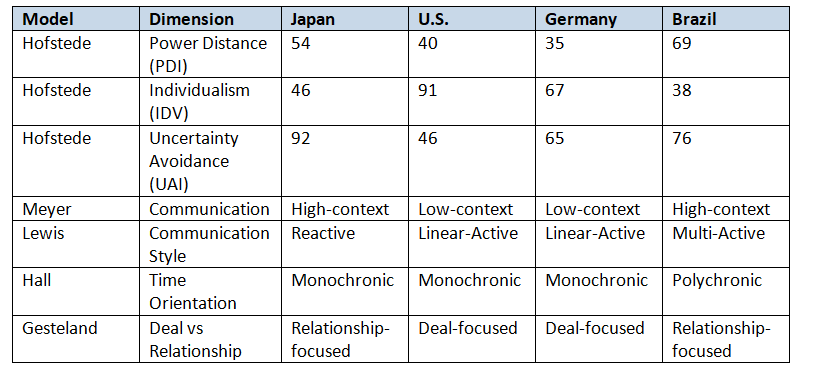
Key Frameworks and Models — Comparative Analysis of Negotiation Cultures
To operationalize cultural understanding in negotiation etiquette, three frameworks are especially practical: Erin Meyer’s Culture Map, Hofstede’s dimensions, and Gesteland’s negotiation styles. These provide complementary perspectives on communication, decision-making, and behavioral expectations.
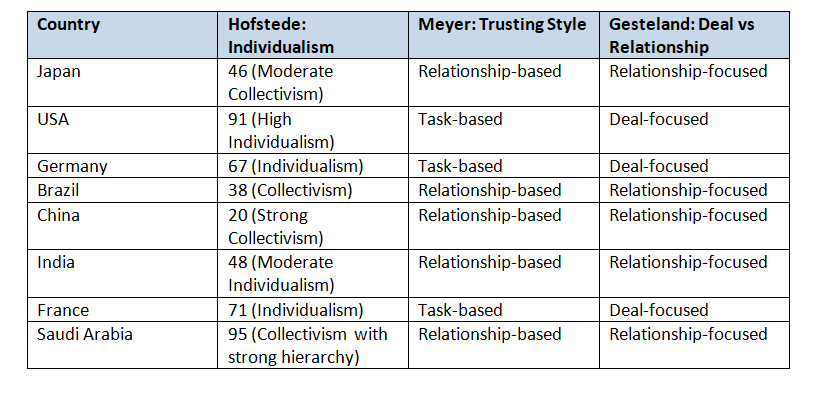
These frameworks reveal patterns, e.g., Asian cultures typically blend high-context communication, collectivism, and relationship-focus, requiring negotiators to prioritize trust and subtlety. Western cultures often prefer direct communication, individualism, and deal-focus with faster transactional dynamics.
Step-by-Step Strategy — Six Essential Actions for Cross-Cultural Negotiation Etiquette
Mastering negotiation etiquette globally involves a structured approach combining cultural intelligence, preparation, adaptation, and reflective learning.
Step 1: Conduct In-Depth Cultural Research
Before engagement, use frameworks like Hofstede and Meyer to profile counterpart culture. Identify communication preferences, hierarchy levels, time orientation, and negotiation styles. For instance, when preparing to negotiate in South Korea, recognize high Power Distance (60), Confucian emphasis on respect, and the importance of nunchi (reading the atmosphere).
Step 2: Build Relationship-Based Trust Where Required
In cultures like China, India, and the Middle East, invest time in personal rapport before discussing business. Utilize guanxi (China), wasta (Middle East), or Indian hierarchical respect protocols. Avoid rushing to contracts; instead, engage in social settings or informal meetings to establish trust.
Step 3: Adapt Communication Style
Match your communication to the context: use indirect, high-context communication with Japanese or Arab partners, employing silence and non-verbal cues. For German or American counterparts, maintain directness and explicitness. Avoid idioms or slang unless certain of comprehension.
Step 4: Respect Time Orientation and Scheduling Norms
Be punctual and agenda-driven in monochronic cultures like Germany and the U.S. Allow for flexible timing and interruptions in polychronic cultures such as Brazil or India. Confirm meeting times well in advance and be prepared for last-minute changes in some cultures.
Step 5: Manage Conflict and Feedback Appropriately
Use indirect negative feedback in high-context cultures (Japan, China) to avoid loss of face. Employ direct, factual feedback in low-context cultures (Germany, U.S.). Understand your counterpart’s conflict mode preference (competing, accommodating, avoiding) to tailor your approach, perhaps referencing Thomas-Kilmann Conflict Mode Instrument.
Step 6: Close Deals with Cultural Sensitivity
In high Power Distance cultures, expect decisions to come from senior leaders; be patient with consensus-seeking processes like Japan’s nemawashi and ringi system. In contrast, in the U.S., expect faster, individual decision authority. Use culturally appropriate gift-giving or ceremonial gestures where applicable, such as exchanging business cards with both hands in Japan.
Real-World Case Studies — Successes and Failures in Global Negotiations
Case Study 1: U.S. and Japan – The Failed Tech Joint Venture (2018)
Context: A U.S. company rushed formal contract discussions without prior consensus-building.
Cultural Dynamics: The U.S. team’s direct style clashed with Japanese preference for indirect dialogue and collective decision-making.
Outcome: Trust was broken; negotiations terminated.
Lesson: Prioritize nemawashi—informal consensus consultations—to align expectations before formal meetings.
Case Study 2: German-Brazilian Automotive Partnership
Context: German engineers’ structured, punctual approach conflicted with Brazilian partners’ flexible time and expressive communication.
Cultural Dynamics: Initial frustration gave way to adaptation by Germans respecting Brazilian warmth and relationship-building.
Outcome: Successful joint venture built on mutual respect and cultural accommodation.
Lesson: Flexibility in time management and emotional expression fosters collaboration in polychronic, multi-active cultures.
Case Study 3: Chinese and Middle Eastern Energy Deal
Context: Both sides emphasized relationship over deal, leveraging guanxi and wasta networks.
Cultural Dynamics: Emphasis on long-term trust and indirect communication delayed contracting but solidified partnership.
Outcome: Multi-year agreement with strong personal ties.
Lesson: Invest in relationship-building rituals and patience for complex consensus in collectivist cultures.
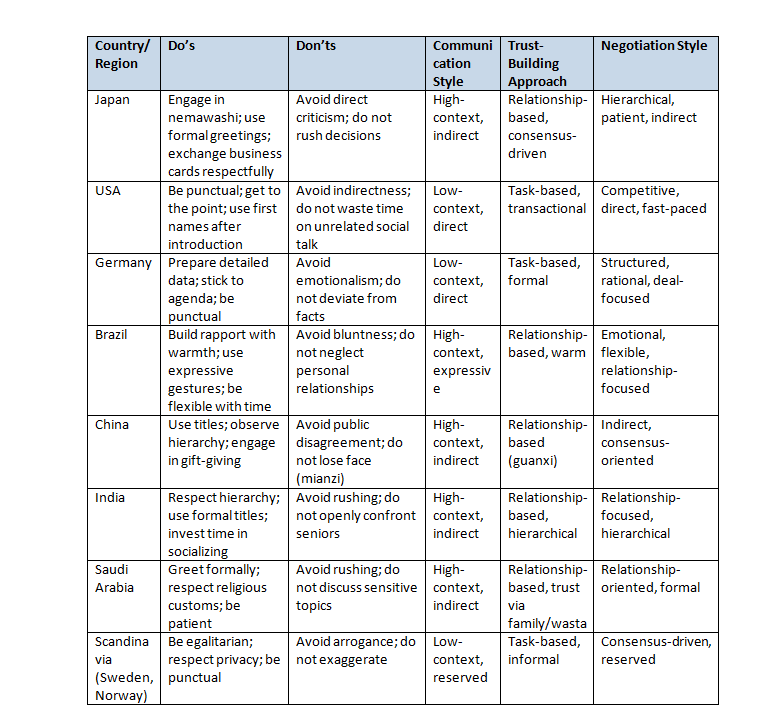
Country/Region-Specific Insights — Cultural Do’s and Don’ts, Communication Style, Trust-Building, and Negotiation Style
Advanced Strategies — Expert-Level Cross-Cultural Techniques
· Employ Cultural Intelligence (CQ) Assessments Before Negotiations: Use CQ assessments to identify your adaptability gaps and tailor training.
· Utilize Silent Periods and Non-Verbal Cues: In high-context and reactive cultures, silence conveys respect and reflection.
· Leverage Third-Party Cultural Brokers: Engage local intermediaries or cultural mentors to bridge gaps and interpret subtleties.
· Anticipate and Respect Face-Saving Needs: Design negotiation processes that allow parties to maintain dignity, avoiding public embarrassment.
· Customize Decision-Making Processes: For consensual cultures, schedule multiple meetings and embrace ringi or collective decision methods.
· Integrate Conflict Mode Flexibility: Blend accommodating and collaborating modes depending on counterpart’s culture, as per Thomas-Kilmann model.
Scripts and Templates — Word-for-Word Communication Adapted for Different Cultural Contexts
Script 1: Opening a Meeting in Japan
“Hajimemashite. Watashitachi wa [Your Company] no [Your Name] to moushimasu. Honjitsu wa, yoroshiku onegaishimasu.”
(Translation: Nice to meet you. I am [Your Name] from [Your Company]. I look forward to working with you today.)
Follow with respectful bow and business card exchange using both hands.
Script 2: Direct Proposal in Germany
“Thank you for meeting today. Based on our analysis, we propose the following terms. Please review the details carefully, and I welcome your straightforward feedback.”
Maintain eye contact, provide documents, and allow time for discussion.
Script 3: Relationship-Building in Brazil
“Before we discuss business, I would love to hear about your family and interests. Building trust and friendship is important to me.”
Use warm tone and open body language; expect reciprocal sharing.
Script 4: Indirect Disagreement in China
“I appreciate your perspective and understand your concerns. Perhaps we can explore alternative options that might satisfy both parties more effectively?”
Use softening phrases and avoid direct “no.”
Script 5: Time-Sensitive Closure in USA
“To summarize, we have agreed on the key points. I propose we finalize the contract by next Friday to meet our project timelines. Does that work for you?”
Be clear, concise, and action-oriented.
Frequently Asked Questions
Q1: How do I avoid offending my counterpart when giving negative feedback in high-context cultures?
Use indirect language, cushion criticism with positive comments, and focus on the issue not the person. For example, “We might consider revising this section to better align with your goals,” rather than “This is wrong.”
Q2: What is the best way to build trust rapidly in a deal-focused culture like the U.S.?
Demonstrate competence, deliver on promises punctually, and communicate transparently. Trust is earned through performance rather than personal relationships.
Q3: How should I handle decision-making delays typical in consensus cultures such as Japan or Korea?
Exercise patience, respect internal processes like nemawashi, and avoid pressure tactics. Use follow-up meetings to gently reaffirm interest.
Q4: Are gift exchanges appropriate in business negotiations worldwide?
Not universally. In Japan, small gifts are customary; in the U.S. and Germany, gifts may be seen as bribery. Always research local norms and company policies.
Q5: How can I prepare for different conflict styles across cultures?
Study cultural conflict preferences using models like Thomas-Kilmann. Practice active listening, empathy, and flexible conflict modes, adjusting from competing to accommodating as needed.
Conclusion
Navigating negotiation etiquette worldwide demands more than surface-level politeness; it requires deep cultural intelligence, sensitivity, and adaptability. By integrating theoretical frameworks with practical country-specific insights and tested communication scripts, global executives can minimize misunderstandings, build robust relationships, and close deals effectively across cultural divides.
This definitive guide arms you with the knowledge and tools to approach negotiations with confidence, respect, and strategic acumen — turning cultural differences from obstacles into bridges for international business success. Begin applying these frameworks today to transform your cross-cultural negotiations and unlock new global opportunities.
References
· Hofstede, G. (2011). Dimensionalizing Cultures: The Hofstede Model in Context. Online Readings in Psychology and Culture.
· Meyer, E. (2014). The Culture Map: Breaking Through the Invisible Boundaries of Global Business. PublicAffairs.
· Lewis, R. D. (2006). When Cultures Collide: Leading Across Cultures. Nicholas Brealey Publishing.
· Hall, E. T. (1976). Beyond Culture. Anchor Books.
· Gesteland, R. R. (2012). Cross-Cultural Business Behavior: Negotiating, Selling, Sourcing and Managing Across Cultures. Copenhagen Business School Press.
· Livermore, D. (2015). Leading with Cultural Intelligence: The Real Secret to Success. AMACOM.
· Trompenaars, F., & Hampden-Turner, C. (2012). Riding the Waves of Culture: Understanding Diversity in Global Business. Nicholas Brealey Publishing.