Negotiation in Export and Import: How to Secure Better Terms in Global Trade

International trade negotiations can make or break a company’s future. Consider the 2018 US-China trade talks, where misunderstanding cultural cues and legal frameworks led to months of stalled discussions, costing billions in tariffs and disrupted supply chains. In another instance, a European exporter lost a crucial deal with a Japanese partner due to disregarding Japan’s nemawashi consensus-building process, resulting in months of lost revenue and strained relations.
Negotiating in export and import environments is a complex tapestry woven from cultural nuances, legal intricacies, political risks, and economic pressures. Many professionals focus narrowly on price or delivery terms, ignoring deeper strategic layers such as Hofstede’s cultural dimensions, Erin Meyer’s communication patterns, or the legal implications of CISG versus local contract law. This oversight often leads to suboptimal outcomes, damaged relationships, and unforeseen liabilities.
This guide equips you with a holistic mastery of international negotiation for export-import deals. You will learn strategic frameworks to decode cultural behaviors, step-by-step tactics with exact scripts tailored for diverse regions, legal preparation checklists, risk mitigation techniques, and expert-level strategies including interpreter management and hierarchical navigation. Whether you’re closing a deal with Brazil, Germany, or South Korea, this definitive pillar page empowers you to secure better terms and foster enduring global partnerships.
· Table of Contents
· The Strategic Foundation: Cultural and Legal Frameworks in Export-Import Negotiation
· Key Frameworks and Models: Hofstede, Meyer, Lewis Comparison
· Step-by-Step Strategy: Six Essential Negotiation Phases with Cultural Guidance
· Real-World Case Studies: US-China Trade, EU-UK Brexit, Japan’s Nemawashi
· Country/Region-Specific Insights: Tactical and Cultural Challenge Matrix
· Advanced Strategies: Interpreter Management, Relationship-Building, Risk Mitigation
· Scripts and Templates: Word-for-Word International Negotiation Communications
· Frequently Asked Questions: Deep Dives into Export-Import Negotiation Nuances
· Conclusion: Mastering Global Trade Negotiation and Next Steps
· References: Authoritative Sources and Further Reading
The Strategic Foundation — Cultural and Legal Frameworks in Export-Import Negotiation
Successful negotiation in export and import cannot be accomplished without understanding the foundational cultural and legal frameworks that shape behavior and agreements worldwide. At its core, this involves decoding how different societies perceive time, communication, authority, and contracts, and how these influence negotiation styles and outcomes.
Geert Hofstede’s cultural dimensions provide a starting point. For example, high Power Distance countries like India and Mexico expect hierarchical respect in negotiations, while low Power Distance cultures such as Denmark emphasize egalitarianism. Individualism versus Collectivism influences whether negotiators prioritize personal or group outcomes, critical in relationship-building versus contract-focused deals.
Erin Meyer’s Culture Map expands this understanding through eight dimensions including Communication (low vs. high context), Evaluating (direct vs. indirect negative feedback), and Scheduling (linear vs. flexible time). This helps explain why German negotiators might prefer direct, fact-based discourse, while Japanese counterparts rely on implicit signals and consensus.
Richard Lewis’s model categorizes cultures as Linear-Active (e.g., Germany, US), Multi-Active (e.g., Brazil, Italy), or Reactive (e.g., Japan, China), informing how negotiators plan, react, and prioritize relationships versus tasks.
Edward Hall’s theories of high versus low context and monochronic versus polychronic time systems further elucidate how implicit communication and time management affect negotiation pacing and expectations.
Legally, international export-import contracts frequently operate under frameworks such as the United Nations Convention on Contracts for the International Sale of Goods (CISG), ICC arbitration rules, UNCITRAL model laws, and standardized Incoterms for shipping. Misunderstanding these can lead to disputes or unenforceable contracts. Furthermore, political risk assessments using PESTLE analysis and country risk ratings guide negotiators in evaluating stability, currency risks, and regulatory environments.
Integrating these cultural and legal lenses into your negotiation strategy forms the essential foundation for securing better terms and mitigating risks in global trade.
Key Frameworks and Models — Hofstede, Meyer, Lewis Comparison
To navigate the cultural complexity of export-import negotiation, three leading models offer complementary insights. Understanding their intersections enables tailored communication and strategic planning.
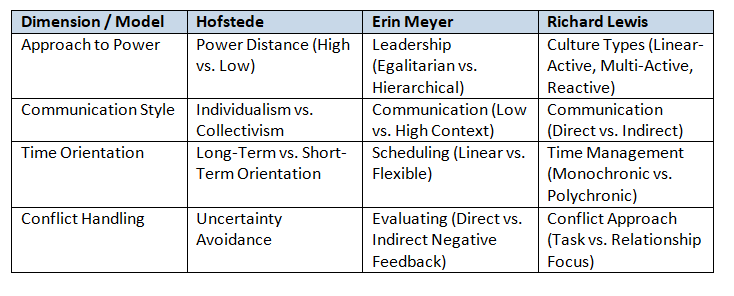
Hofstede’s dimensions quantify cultural values at a macro level, useful for initial market assessments. Meyer’s Culture Map provides nuanced communication and evaluation tactics, critical during live negotiation interactions. Lewis’s typology guides understanding of behavioral patterns and time orientation.
For example, a Linear-Active German negotiator (Lewis) with low-context communication (Meyer) and low Power Distance (Hofstede) will expect direct proposals, punctual meetings, and logical arguments. Conversely, a Multi-Active Brazilian negotiator may prioritize relationship-building, tolerate interruptions, and prefer flexible schedules, requiring a more personable, patient approach.
Combining these frameworks enables negotiators to customize strategies that align with counterpart expectations and cultural norms, reducing friction and enhancing trust.
Step-by-Step Strategy
Step 1: Preparation and Research
Before engaging, conduct thorough cultural, legal, and political research. Use Hofstede indices, Meyer’s culture guides, and country-specific PESTLE analyses. Identify your BATNA (Best Alternative to a Negotiated Agreement) and ZOPA (Zone of Possible Agreement), accounting for currency volatility and tariffs.
Tactic: Prepare a cultural briefing sheet for your team highlighting key negotiation do’s and don’ts. For example, when negotiating with South Korean firms, emphasize hierarchical respect and indirect communication.
Language: “We understand your negotiation culture values consensus and respect for senior leaders. We look forward to aligning our proposal accordingly.”
Step 2: Establishing Rapport and Building Relationships
In many cultures, especially Latin America and the Middle East, relationships precede contracts. Invest time in small talk, shared meals, and informal discussions.
Tactic: Use questions about family, local culture, or recent events to build trust. Be mindful of wasta (in Middle East) or jeitinho (in Brazil) as relational channels.
Language: “Before we proceed, I’d like to learn more about your company’s history and values to ensure our partnership is mutually beneficial.”
Step 3: Setting the Agenda and Negotiation Protocol
Clarify negotiation agenda, timeframes, and decision-making processes upfront. In high-context cultures like Japan, this may require subtle consensus-building (nemawashi).
Tactic: Propose a draft agenda and invite feedback. Confirm the roles of all participants, noting any hierarchical decision-makers.
Language: “To ensure productive discussions, may we agree on the key topics and timeline for today’s meeting?”
Step 4: Presenting Offers and Handling Objections
Tailor the presentation of terms according to cultural preferences. For example, Germans appreciate detailed data and logical structure, while Chinese counterparts may favor face-saving language and indirect feedback.
Tactic: Use the ‘principled negotiation’ approach from Fisher & Ury – separate people from the problem, focus on interests not positions, invent options for mutual gain.
Language: “We believe this pricing structure meets both our interests. However, we are open to exploring alternatives that address your concerns.”
Step 5: Managing Concessions and Closing
Use concessions strategically, maintaining face for all parties. In hierarchical cultures, defer to senior negotiators for final decisions.
Tactic: Employ conditional concessions (“If you agree to X, we can consider Y”) to maintain leverage.
Language: “If we can agree on delivery terms, we are prepared to adjust payment schedules accordingly.”
Step 6: Drafting and Finalizing Contracts with Legal Diligence
Ensure contracts comply with applicable international laws (CISG, ICC arbitration) and incorporate clear Incoterms. Translate contracts if necessary, and confirm understanding.
Tactic: Engage local legal counsel and use contract checklists covering payment terms, dispute resolution, force majeure, and compliance.
Language: “To avoid misunderstandings, we propose the contract be governed by CISG with arbitration in accordance with ICC rules.”
Real-World Case Studies
Case Study 1: US-China Trade Negotiations (2018–2019)
Context: Prolonged tariff disputes revealed cultural misreadings, including American preference for direct communication clashing with Chinese indirect styles. Failure to appreciate China’s collective decision-making and face-saving led to breakdowns.
Lessons: Adopt adaptive communication; leverage interpreters; understand political stakes and BATNA shifts.
Case Study 2: EU-UK Brexit Export Negotiations
Context: Brexit introduced new regulatory barriers and uncertainty. UK exporters had to renegotiate terms while navigating EU’s legal frameworks.
Lessons: Importance of legal preparation; flexibility in logistics (Incoterms updates); early risk assessment with PESTLE.
Case Study 3: Japan’s Nemawashi in Automotive Supply Deals
Context: A German automaker initially failed to close a deal due to neglecting informal consensus-building in Japan. Integrating nemawashi processes ensured smoother contract finalization.
Lessons: Prioritize relationship-building and informal consultations before formal negotiations.
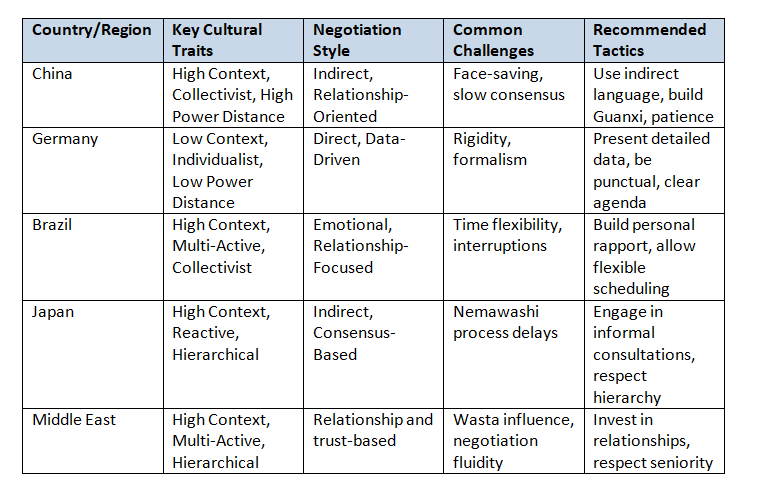
Country/Region-Specific Insights or Challenge Matrix
Advanced Strategies
Managing Interpreters: Select professional interpreters versed in business and legal terminology. Brief them on cultural nuances and confidentiality. Use short sentences to avoid errors.
Relationship-Building Across Cultures: Recognize symbolic gestures, gift-giving norms, and social rituals. For example, in India, exchanging business cards with both hands shows respect.
Face-Saving Techniques: Avoid public criticism; phrase disagreements as questions or suggestions. In Korea, indirect negative feedback preserves harmony.
Navigating Hierarchy: Identify decision-makers early. In Middle Eastern and Asian contexts, deferring to senior officials can expedite agreements.
Legal Risk Mitigation: Use multi-lingual contracts, specify governing law and arbitration forums, and include force majeure clauses addressing political risks and currency fluctuations.
Currency and Transfer Pricing Risks: Hedge FX exposure, clarify payment currency early, and comply with OECD transfer pricing guidelines in intercompany transactions.
Scripts and Templates
Script 1: Initial Meeting Email Request (for a Japanese Partner)
“Dear [Name],
I hope this message finds you well. We are eager to explore potential collaboration opportunities and would appreciate the chance to meet and discuss how we can align our objectives.
Understanding the importance of harmony and consensus in your culture, we would be happy to accommodate your preferred schedule and meeting format.
Kind regards,
Script 2: Price Proposal Presentation (German Audience)
“Dear [Name],
Please find attached our detailed quotation, which includes a comprehensive breakdown of costs and delivery timelines. We have ensured compliance with all regulatory standards applicable in your market.
We welcome any questions or feedback and look forward to your valued input.
Best regards,
Script 3: Relationship-Building Small Talk (Brazilian Negotiation)
“I was impressed by the vibrant culture of São Paulo during my last visit. How is your family enjoying the football season this year? I believe strong personal connections form the foundation of successful partnerships.”
Script 4: Handling Objections (Middle East)
“I understand your concerns regarding delivery timelines. Perhaps we could explore alternative shipping options that better suit your operational needs. Your satisfaction is our priority.”
Script 5: Contract Finalization Email (Multinational)
“Dear All,
Following our fruitful negotiations, please find the draft contract attached for your review. We propose that it be governed by CISG and subject to ICC arbitration. Kindly confirm your acceptance or suggest amendments by [date].
Looking forward to your response.
Best regards,
Frequently Asked Questions
Q1: How can I identify the decision-makers in hierarchical cultures during export-import negotiations?
A1: Research company structure beforehand; observe seating arrangements and who speaks most authoritatively; ask open questions about decision processes. Defer to senior figures respectfully to build rapport.
Q2: What are the most common legal pitfalls in international export-import contracts?
A2: Ignoring applicable international conventions like CISG, unclear Incoterms usage, ambiguous dispute resolution clauses, and inadequate force majeure provisions. Engage legal counsel early and specify terms clearly.
Q3: How do I manage currency risk when negotiating payment terms?
A3: Agree on stable currencies (e.g., USD, EUR), consider forward contracts or hedging tools, and clarify payment schedules. Include clauses addressing exchange rate fluctuations.
Q4: How important is relationship-building in export-import negotiations?
A4: Critical in many cultures (Latin America, Middle East, Asia). Investing in trust reduces misunderstandings, facilitates concessions, and enhances long-term cooperation.
Q5: What negotiation strategies work best in low-context cultures?
A5: Use direct, explicit communication; provide detailed data and written documentation; adhere strictly to agreed schedules; focus on facts over emotions.
Conclusion
Mastering negotiation in export and import is a multifaceted endeavor requiring deep cultural insight, legal acumen, and strategic communication. By integrating globally recognized frameworks such as Hofstede’s dimensions, Meyer’s Culture Map, and Richard Lewis’s typology, professionals can decode behavioral signals and tailor their approach effectively. Coupled with rigorous legal preparation, risk assessment, and advanced relationship-building strategies, negotiators can secure better terms, reduce disputes, and foster enduring international partnerships.
We invite you to apply these comprehensive frameworks and scripts in your next global trade negotiation. For tailored consultation or training workshops on cross-cultural negotiation and international contract management, contact our team of experts to elevate your export-import success.
References
1. Hofstede, G. (2001). Culture’s Consequences: Comparing Values, Behaviors, Institutions and Organizations Across Nations. Sage Publications.
2. Meyer, E. (2014). The Culture Map: Breaking Through the Invisible Boundaries of Global Business. PublicAffairs.
3. Lewis, R. D. (2006). When Cultures Collide: Leading Across Cultures. Nicholas Brealey Publishing.
4. Fisher, R., Ury, W., & Patton, B. (2011). Getting to Yes: Negotiating Agreement Without Giving In. Penguin Books.
5. United Nations Commission on International Trade Law (UNCITRAL). (1980). United Nations Convention on Contracts for the International Sale of Goods (CISG).
6. International Chamber of Commerce (ICC). (2020). Incoterms 2020 Rules. ICC Publication.