Negotiation Planning Templates: A Complete Toolkit for Strategic Success

Imagine closing a multi-million-dollar enterprise software deal with a Fortune 500 company where every concession and counteroffer is anticipated and leveraged for maximum value. Picture a labor union negotiation where both sides emerge with a durable agreement because each step was meticulously planned with precision tools. Or consider a complex M&A negotiation where parties avoid costly deadlocks by following a clear, data-backed preparation blueprint. These high-stakes scenarios underscore the importance of negotiation planning templates—not just as checklists, but as strategic toolkits that transform uncertainty into opportunity.
In today’s hyper-competitive and interconnected business environment, negotiation planning is a strategic imperative. Whether you are managing cross-border trade talks, procurement contracts, or internal resource allocations, failing to plan rigorously leaves you vulnerable to cognitive biases, power imbalances, and missed value creation. As Kahneman & Tversky’s research on loss aversion reveals, negotiators are prone to decisions that prioritize avoiding losses over maximizing gains—unless they have a structured plan that leverages behavioral insights and proven frameworks. This elevates negotiation planning templates from administrative aids to essential guides for navigating complexity and human psychology.
By the end of this comprehensive pillar page, you will master a suite of powerful negotiation planning templates grounded in academic research and field-tested frameworks. You will understand the underlying psychology and strategy, explore key models like BATNA, ZOPA, and MESO, follow a detailed step-by-step planning process, and gain access to expert-level tactics, scripts, and real-world case studies. This toolkit will empower you to approach every negotiation with confidence, clarity, and a strategic edge that drives superior outcomes.
· Table of Contents
· The Strategic Foundation: Theory, Psychology, and Research
· Key Frameworks and Models: Comparing Top Negotiation Approaches
· Step-by-Step Process: A Comprehensive Negotiation Planning Workflow
· Real-World Case Studies: Lessons from Corporate and Union Negotiations
· Common Pitfalls and How to Avoid Them: Mistakes That Undermine Deals
· Advanced Tactics: Expert Techniques Beyond the Basics
· Scripts and Templates: Ready-to-Use Dialogue and Planning Forms
· Frequently Asked Questions: Detailed Answers on Negotiation Planning
· Conclusion: Synthesis and Call to Action
· References: Authoritative Sources for Deeper Learning
The Strategic Foundation: Theory, Psychology, and Research
Negotiation planning is not merely administrative preparation—it is a strategic exercise anchored in behavioral science and conflict resolution theory. Understanding the psychological underpinnings and seminal research provides the necessary foundation for designing templates that truly impact outcomes.
One of the most influential contributions comes from Daniel Kahneman and Amos Tversky’s Prospect Theory (1979), which reveals the cognitive bias of loss aversion: people experience losses more intensely than equivalent gains. This bias often causes negotiators to reject beneficial deals or make suboptimal concessions. Effective planning templates embed prompts to recognize and counteract loss aversion—such as carefully framing offers or preparing alternative options.
Fisher and Ury’s landmark book, _Getting to Yes_ (1981), introduced the Harvard Principled Negotiation framework, emphasizing interests over positions, generating options for mutual gain, and using objective criteria. Their method underpins many modern templates by encouraging negotiators to systematically identify underlying interests and develop creative solutions rather than engage in distributive haggling.
Influence principles articulated by Robert Cialdini (2006) also inform negotiation planning. Techniques such as reciprocity, commitment, and scarcity can be anticipated and built into negotiation strategies. For example, planning templates may guide negotiators to make early concessions that trigger reciprocal goodwill or to frame offers with scarcity to increase perceived value.
Deepening the strategic approach, G. Richard Shell’s _Bargaining for Advantage_ (2006) integrates personality assessment with strategic planning, urging negotiators to assess their style, the counterpart’s style, and adapt accordingly. Shell’s emphasis on preparation—including researching counterpart needs and alternatives—reinforces why a structured planning toolkit is essential.
More recently, Malhotra and Bazerman’s _Negotiation Genius_ (2007) combines behavioral insights with practical tactics, highlighting the importance of building your Best Alternative To a Negotiated Agreement (BATNA) and preparing for integrative versus distributive bargaining scenarios. Their research shows that negotiators who rigorously plan along these lines consistently outperform less prepared counterparts.
In summary, negotiation planning templates derive their power from embedding these psychological insights and strategic principles. They transform abstract theories into actionable steps, ensuring negotiators anticipate biases, identify interests, leverage influence tactics, and develop alternatives. This foundation underpins every element of the comprehensive toolkit presented in this article.
Key Frameworks and Models
Three foundational frameworks underpin the most effective negotiation planning templates: BATNA, ZOPA, and MESO. Each offers unique strategic advantages and serves distinct roles in the preparation and execution phases. Understanding and comparing these frameworks enables negotiators to select or combine approaches suited to their specific context.
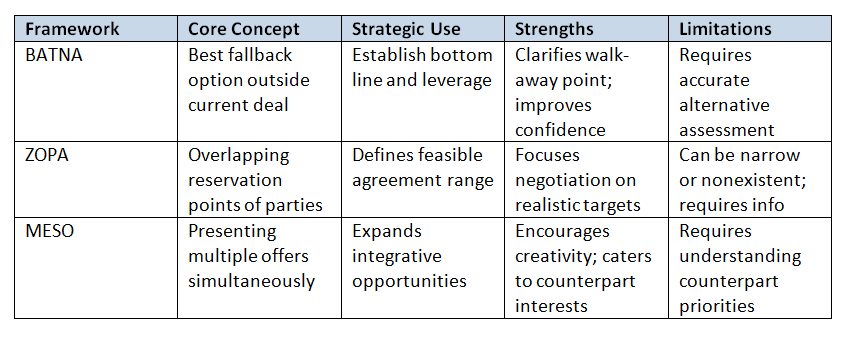
These frameworks are complementary. BATNA analysis informs ZOPA identification by setting reservation points, while MESO tactics optimize deal construction within ZOPA. Effective negotiation planning templates incorporate all three, prompting users to define alternatives, estimate feasible zones, and design multiple simultaneous offers.
Step-by-Step Process
A meticulously designed negotiation planning process transforms abstract theory into a replicable, practical workflow. Below is a detailed six-step process incorporating research-backed best practices:
Step 1: Define Objectives and Interests
Begin by clearly articulating your primary and secondary objectives. Use the Harvard Principled Negotiation method to distinguish positions (demands) from interests (underlying reasons). For example, a procurement team may position "price under $1M" but have interests in "reducing supplier risk" or "fast delivery." Document these interests in a structured template to guide option generation.
Step 2: Analyze the Counterpart and Context
Conduct thorough research on the counterpart’s business, culture, negotiation history, and known preferences. Apply Shell’s bargaining style assessment to anticipate behavioral tendencies. Use public data, prior deals, and stakeholder interviews. A dedicated research worksheet helps organize findings and assess counterpart BATNA, power, and likely negotiation style.
Step 3: Develop Your BATNA and Reservation Point
Identify and quantify your best alternatives if the negotiation fails. For example, if negotiating a software contract, alternatives might include alternative vendors or in-house development. Assign financial and non-financial values to these alternatives, establishing your reservation point—the minimum acceptable outcome. Templates often include calculators or decision trees to solidify this step.
Step 4: Estimate Counterpart BATNA and ZOPA
Based on your analysis, estimate the counterpart’s alternatives and reservation point. This enables you to define the Zone of Possible Agreement realistically. Use scenario analysis and sensitivity testing to adjust assumptions, ensuring your expectations are grounded. This step is critical to avoid entering negotiations with unrealistic demands.
Step 5: Generate Multiple Equivalent Simultaneous Offers (MESO)
Design at least two or three offers that are of equal value to you but vary on terms such as price, delivery, or service levels. For example, one offer may reduce price but extend delivery time; another may increase price but improve support. MESO increases the likelihood of agreement by appealing to counterpart priorities and opens avenues for trade-offs.
Step 6: Prepare Concession and Communication Strategy for Negotiation
Plan the sequence of concessions and framing tactics. Leverage Cialdini’s reciprocity principle by preparing small initial concessions to encourage goodwill. Script key dialogue points, including opening statements, justifications, and responses to anticipated objections. Use templates with communication checklists and scripts to rehearse.
This structured process ensures you approach negotiations with clarity about goals, alternatives, counterpart motivations, and dynamic offer strategies—maximizing your chances of a successful outcome.
Real-World Case Studies
Examining real negotiations reveals how planning templates translate into success or failure.
IBM negotiated a multi-year cloud services contract with a global retailer. Utilizing BATNA and MESO planning templates, IBM’s team identified multiple service bundles valued equally but tailored to retailer priorities (cost, scalability, support). By systematically preparing concessions and understanding the retailer’s ZOPA, IBM secured a premium contract with flexible terms. The lesson: MESO and BATNA-driven planning unlocked integrative value and prevented price erosion.
In high-stakes labor negotiations, the UAW used detailed planning templates to outline critical interests (job security, benefits) and fallback positions. GM’s team, less prepared, underestimated the union’s BATNA strength. The absence of clear ZOPA identification led to a prolonged strike causing significant financial loss. Post-negotiation analysis emphasized how rigorous planning templates could have accelerated resolution by clarifying feasible agreements.
During protracted patent licensing talks, Apple’s legal team employed comprehensive planning templates incorporating loss aversion insights and concession sequencing scripts. This enabled Apple to maintain firm positions on critical patents while offering creative licensing bundles—ultimately leading to a landmark settlement. The case illustrates how psychological and scripting tools embedded in planning templates shape negotiation dynamics.
Common Pitfalls and How to Avoid Them
Negotiators frequently stumble on predictable errors that undermine outcomes despite good intentions. Recognizing these pitfalls and applying corrective measures embedded in planning templates is critical.
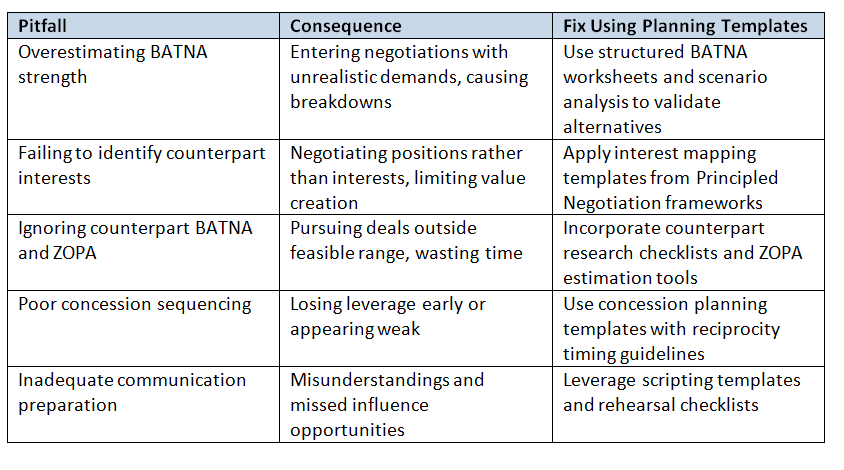
These pitfalls often result from skipping planning steps or relying on intuition rather than structured analysis. Negotiation planning templates institutionalize best practices that safeguard against these errors, ensuring consistent, favorable outcomes.
Advanced Tactics
Experienced negotiators elevate their game by integrating advanced tactics rarely covered in beginner guides. These go beyond foundational frameworks to exploit nuanced psychological and strategic levers.
Combining anchoring bias with MESO, negotiators present one offer with an intentionally high anchor alongside more balanced equivalents. This shapes counterpart expectations and shifts ZOPA in your favor.
Incorporate conditional clauses into offers that tie terms to future uncertain events (e.g., market performance), distributing risk and enhancing value creation. Planning templates help map contingencies and legal parameters.
Use planned deadlines strategically to create urgency. Templates include timing decision trees and communication scripts to apply calibrated pressure without damaging relationships.
Embed planned small favors or concessions early to trigger reciprocity and use emotionally framed narratives to increase counterpart engagement. Templates guide how and when to deploy these.
For complex negotiations involving multiple stakeholders, advanced templates help map coalition dynamics, identify alliance opportunities, and plan joint offers.
These tactics require careful preparation and ethical considerations but can decisively tip complex negotiations when integrated into a comprehensive planning toolkit.
Scripts and Templates
Practical negotiation planning demands ready-to-use scripts and customizable templates. Below are essential components negotiators can adapt immediately:
"Thank you for meeting today. Our goal is to find a mutually beneficial agreement that addresses both our core interests. We have prepared several options that we believe align well with your priorities, and we look forward to exploring them together."
- Alternative options list
- Quantitative valuation (financial/non-financial)
- Strength assessment (High/Medium/Low)
- Reservation point calculation
Includes columns for Offer ID, Price, Delivery Time, Service Level, Additional Terms, and Estimated Value to Each Party.
- List concessions by priority
- Sequence and timing plan
- Reciprocity trigger points
- Key messages
- Anticipated objections and responses
- Tone and framing notes
By integrating these scripts and templates into your preparation routine, you embed structured rigor and increase your negotiation agility.
Frequently Asked Questions
Q1: How do negotiation planning templates improve deal outcomes?
Templates systematize best practices by embedding research-based frameworks and prompting comprehensive preparation, reducing cognitive biases and enabling tailored strategies, which collectively enhance deal quality and efficiency.
Q2: Can negotiation planning templates be customized for different industries?
Yes, templates are designed to be adaptable. By modifying variables such as negotiation criteria, counterpart analysis parameters, and offer components, they suit diverse contexts from procurement to labor negotiations and M&A deals.
Q3: What’s the difference between BATNA and ZOPA in planning?
BATNA defines your fallback option and reservation point, while ZOPA identifies the overlapping range between your and the counterpart’s reservation points where agreement is possible. Both are critical but serve different roles in planning.
Q4: How does MESO increase chances of agreement?
By presenting multiple equivalent offers that vary in terms, MESO addresses counterpart preferences and fosters integrative bargaining, increasing the likelihood of acceptance and value creation.
Q5: Are negotiation planning templates useful for virtual negotiations?
Absolutely. In virtual settings, structured templates help compensate for reduced nonverbal cues by ensuring thorough preparation, clear communication plans, and multiple offer strategies.
Conclusion
Negotiation planning templates are indispensable strategic tools that elevate negotiators from reactive dealmakers to proactive architects of value. Grounded in robust behavioral research and proven frameworks, these templates guide you through dissecting interests, assessing alternatives, designing creative offers, and scripting persuasive communication. The real-world case studies demonstrate how disciplined planning can make the difference between costly deadlocks and breakthrough agreements.
By mastering the comprehensive toolkit presented here—from foundational theories and key frameworks to advanced tactics and ready-to-use scripts—you will gain a sustainable competitive advantage. Begin integrating these templates into your negotiation preparation today to unlock higher-value deals, stronger relationships, and greater confidence. Download our customizable negotiation planning templates now and start transforming your negotiation outcomes immediately.
References
1. Kahneman, D., & Tversky, A. (1979). Prospect Theory: An Analysis of Decision under Risk. _Econometrica_, 47(2), 263–291.
2. Fisher, R., Ury, W., & Patton, B. (1981). _Getting to Yes: Negotiating Agreement Without Giving In_. Penguin Books.
3. Cialdini, R. B. (2006). _Influence: The Psychology of Persuasion_. Harper Business.
4. Shell, G. R. (2006). _Bargaining for Advantage: Negotiation Strategies for Reasonable People_. Penguin Books.
5. Malhotra, D., & Bazerman, M. H. (2007). _Negotiation Genius: How to Overcome Obstacles and Achieve Brilliant Results at the Bargaining Table and Beyond_. Bantam Books.
6. Mnookin, R. H., Peppet, S. R., & Tulumello, A. S. (2000). Beyond Winning: Negotiating to Create Value in Deals and Disputes. _Harvard Negotiation Law Review_, 5(1), 1–29.