Negotiation Scripts for Price Objections: The Definitive Guide for Sales Professionals

Imagine you are a seasoned sales executive on a crucial call with a prospective client. The deal has been progressing smoothly until the moment of truth: the client pushes back, bluntly stating, "Your price is too high." Suddenly, the conversation stalls, tension rises, and the risk of losing a multi-thousand-dollar contract looms large. This scenario is all too familiar in sales environments across industries, where price objections threaten to derail deals and force unwanted discounting.
In today’s hyper-competitive market, succumbing to price objections without a strategic response can erode margins, damage brand value, and set dangerous precedents for future negotiations. Yet, price objections are not just about numbers—they tap deeply into buyer psychology, perceived value, and emotional triggers. Understanding these underlying factors and mastering precise negotiation scripts can transform price pushbacks into renewed opportunities for value creation and deal closure.
This comprehensive guide will equip you with an in-depth understanding of the psychology behind price perceptions, proven negotiation frameworks, step-by-step objection handling processes, real-world company examples, and ready-to-use scripts. By the end, you will have the tools to confidently navigate price objections, protect your margins, and close deals at your premium price.
· Table of Contents
· The Psychology of Price: Behavioral Economics in Buyer Perception
· Key Frameworks for Price Negotiation: Value Ladder, Price-Value Matrix, BATNA
· Step-by-Step Process to Address Price Objections Successfully
· Real-World Examples: Apple, McKinsey, Salesforce
· Objection Handling: Exact Scripts for Common Price Pushbacks
· Advanced Tactics: Expert Techniques Beyond Basic Responses
· Scripts and Templates: Dialogues and Email Formats to Use Today
· Frequently Asked Questions on Price Objections and Negotiation
· Conclusion and Next Steps for Sales Professionals
· References: Authoritative Sources and Research
The Psychology of Price
Price is rarely a purely logical factor for buyers. Instead, it is filtered through complex psychological biases and heuristics that shape how value and cost interrelate in the buyer’s mind. Understanding these cognitive processes is fundamental to crafting negotiation scripts that resonate and persuade.
Prospect Theory, pioneered by Kahneman and Tversky (1979), reveals that buyers experience losses more intensely than equivalent gains. This explains why price objections often manifest as fear of overpaying or regret aversion. Recognizing this, framing price discussions to emphasize value that avoids loss (e.g., cost of not buying) can reduce resistance.
Anchoring is another critical concept identified by Ariely (2008) and others, where initial price exposure sets a mental reference point. For example, presenting a premium package first can make subsequent options seem more reasonable—a tactic known as price anchoring. This is why the order and presentation of pricing tiers profoundly influence buyer acceptance.
The price-quality heuristic leads buyers to infer quality from price: higher prices often signal better products or services, especially in uncertain contexts. This phenomenon is the foundation of Veblen goods theory, where conspicuous consumption justifies higher prices as a status symbol (Veblen, 1899).
Additionally, the decoy effect shows that introducing a less attractive pricing option can steer buyers toward the target offering. For instance, placing a high-priced but less appealing option next to the preferred one increases the latter’s perceived value.
Behavioral economics research underlines that price objections are more about perceived fairness, value, and cognitive framing than raw numbers. Effective negotiation scripts must therefore address these psychological dimensions, not just counter with discounts or justifications.
Key Frameworks
Several frameworks serve as foundational tools to conceptualize and respond to price objections strategically. Below is a comparison of three widely used frameworks in price negotiation.
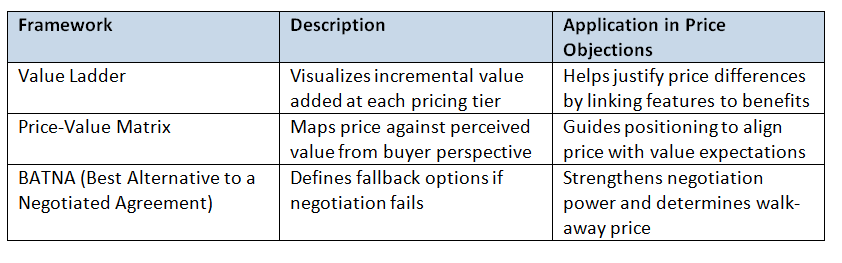
The Value Ladder enables sales professionals to articulate the stepwise increase in value that justifies higher prices. For example, a SaaS company may show how premium packages include advanced analytics or dedicated support that free or basic tiers lack.
The Price-Value Matrix helps identify where your offer stands relative to competitors and perceived buyer value. If your price is higher but value is demonstrably greater, this framework supports confident positioning against low-cost alternatives.
BATNA is a negotiation classic from Fisher and Ury’s "Getting to Yes" (1981). Knowing your BATNA prevents desperation discounts and equips you to say no when the price does not meet minimum acceptable margins.
Combining these frameworks allows sellers to design negotiation scripts that articulate value, benchmark pricing, and maintain leverage in the face of objections.
Step-by-Step Process
Addressing price objections effectively is a systematic process. Below is a six-step method sales professionals can follow, each with detailed sub-steps and word-for-word dialogue suggestions.
Step 1: Listen and Validate
When the buyer raises a price objection, pause and listen fully. Show empathy to avoid defensive escalation.
Script: "I appreciate you sharing that concern. Price is an important consideration, and I want to ensure we address it fully."
Step 2: Clarify the Objection
Ask open-ended questions to uncover underlying reasons beyond the stated "price is too high."
Script: "Can you help me understand what specifically feels high about the price? Is it the overall investment, the timing, or something else?"
Step 3: Reframe to Value
Shift the conversation from cost to value delivered by quantifying benefits tied to business outcomes.
Script: "Let’s look at the return on investment and how our solution reduces your operational costs by 20%, which translates into $X savings annually."
Step 4: Use Anchoring and Decoy Techniques
Present pricing tiers or packages to create favorable anchors and highlight the value of your preferred option.
Script: "Many clients begin with our premium package because it offers the best long-term value, especially when considering the included support and analytics."
Step 5: Address Budget Constraints with Alternatives
If budget is a real concern, propose phased approaches or scaled options without immediately discounting.
Script: "We can explore a phased rollout focusing initially on core features, which helps spread costs and demonstrate value early."
Step 6: Confirm Commitment or Next Steps
Seek agreement or identify next steps to maintain momentum.
Script: "Does this approach align with your expectations? If so, I can prepare a proposal reflecting this phased plan."
Real-World Examples
Examining how leading companies handle price objections reveals practical insights.
Apple consistently commands premium prices for iPhones despite cheaper alternatives. Their success lies in positioning products as Veblen goods — status symbols with superior design and ecosystem integration. Apple’s scripting emphasizes exclusivity and seamless user experience, justifying price without discounting.
McKinsey & Company uses value-based pricing for consulting engagements. They quantify client ROI to justify fees that often exceed competitors’ flat rates. Their negotiation scripts focus on client outcomes and risk-sharing models, turning price objections into conversations about mutual value.
Salesforce navigates enterprise contract negotiations with layered pricing and anchoring. They offer a high-end "Unlimited" edition first, making mid-tier packages appear more affordable and feature-rich. Their sales teams employ objection scripts highlighting scalability and integration benefits, converting price pushbacks into strategic investment discussions.
Objection Handling
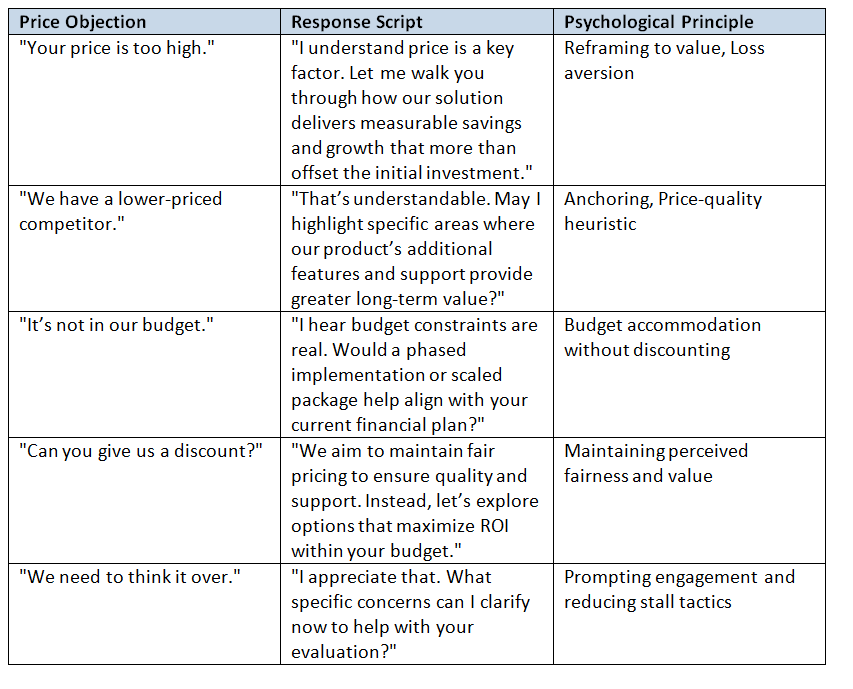
Below is a table mapping common price objections to exact, effective word-for-word responses.
Advanced Tactics
Beyond foundational scripts, expert negotiators employ advanced techniques:
· Use Social Proof and Reciprocity: Offering small value-adds (e.g., free training) can trigger reciprocity, increasing willingness to accept price.
· Scarcity Messaging: Highlight limited-time offers or capacity constraints to create urgency, leveraging Cialdini’s scarcity principle.
· Decoy Pricing: Introduce a deliberately less attractive option to make the target offer more appealing.
· Anchored Concessions: If discounting is unavoidable, frame it as a concession on a non-price term (e.g., faster delivery), preserving price integrity.
· Multi-Threading: Engage multiple buyer stakeholders to uncover broader value recognition and reduce sole focus on price.
Scripts and Templates
Here are ready-to-use scripts and email templates for common price objections.
Script 1: Phone Dialogue – Initial Price Objection
Buyer: "This price is higher than we expected."
Sales: "I understand. Many clients initially feel that way until they see how our solution reduces costs by 15% and improves efficiency. Can I share some examples?"
Script 2: Email Template – Post-Meeting Price Concern
Subject: Addressing Your Pricing Questions
Hi [Name],
Thank you for your candid feedback on pricing during our discussion. I want to ensure we align on value. Our solution’s advanced features have delivered [specific outcome] for clients like [reference]. Would you be open to a brief call to explore phased options that fit your budget?
Best,
Script 3: In-Person Meeting – Handling Discount Requests
Buyer: "Can you offer a discount?"
Sales: "We’re committed to delivering full value without compromise. Instead of discounting, let’s customize the package to better fit your needs and budget. How does that sound?"
Script 4: Follow-Up Email – Overcoming Stall
Subject: Next Steps on Your Evaluation
Hi [Name],
I appreciate you taking the time to consider our proposal. Are there any remaining questions or concerns I can assist with to help your internal decision-making?
Looking forward to your thoughts.
Best regards,
Frequently Asked Questions
Q1: How do I handle price objections without immediately discounting?
A1: Focus on uncovering the buyer’s true concerns, reframing price into value, and offering scaled options or phased approaches rather than discounts. Use empathy and evidence of ROI to justify price.
Q2: What psychological principles help in overcoming price pushbacks?
A2: Anchoring, loss aversion, price-quality heuristic, and reciprocity are key. Leveraging these can shift buyer perceptions from cost focus to value acceptance.
Q3: How important is knowing my BATNA in price negotiations?
A3: Crucial. Understanding your Best Alternative to a Negotiated Agreement empowers you to maintain margin discipline and avoid unfavorable concessions.
Q4: Can scripts really help in complex B2B negotiations?
A4: Yes. Well-crafted scripts guide conversations, reduce emotional reactivity, and ensure consistent messaging focused on value and outcomes.
Q5: What are effective ways to build urgency without discounting?
A5: Use scarcity (limited availability), time-bound benefits, or demonstrate opportunity cost of delay. These tactics increase buyer motivation without eroding price.
Conclusion
Mastering negotiation scripts for price objections is essential for sales professionals aiming to protect margins and close premium deals. By deeply understanding buyer psychology, employing proven frameworks, and practicing specific dialogue tactics, you can transform price pushbacks from stumbling blocks into stepping stones for value-driven agreements.
The strategies outlined in this guide—from behavioral economics insights to actionable scripts—equip you to confidently navigate the toughest objections. Commit to rigorous preparation and empathetic engagement, and watch your win rates improve without compromising your pricing integrity.
Take the next step today: review your current objection handling scripts, integrate these frameworks, and role-play with your team to internalize these techniques. Your bottom line will thank you.
References
1. Kahneman, D., & Tversky, A. (1979). Prospect Theory: An Analysis of Decision under Risk. Econometrica.
2. Ariely, D. (2008). Predictably Irrational: The Hidden Forces That Shape Our Decisions. HarperCollins.
3. Cialdini, R. B. (2009). Influence: Science and Practice. Pearson.
4. Fisher, R., Ury, W., & Patton, B. (1981). Getting to Yes: Negotiating Agreement Without Giving In. Penguin Books.
5. Veblen, T. (1899). The Theory of the Leisure Class. Macmillan.
6. Malhotra, D. (2010). To Sell is Human. Penguin Books.