Negotiation Skills for Managers

In today’s rapidly evolving business environment, negotiation has become a critical leadership competency. Managers are no longer just task supervisors; they are dealmakers, facilitators, and influencers who must navigate complex stakeholder interests, secure resources, and resolve conflicts to drive organizational success. The ability to negotiate effectively impacts everything from team dynamics and project budgets to supplier contracts and strategic partnerships.
This pillar article delves deep into negotiation skills tailored for managers. You will gain a robust understanding of psychological principles like BATNA (Best Alternative to a Negotiated Agreement), anchoring, and active listening. Beyond theory, you will find actionable frameworks and real-world exercises designed to sharpen your negotiation tactics. By mastering these negotiation skills, you will enhance your capacity to lead with confidence, foster collaboration, and achieve outcomes that benefit both your team and organization.
Whether you are new to management or a seasoned executive, this guide will equip you with the tools and mindset to negotiate with clarity, empathy, and authority.
· Table of Contents
· Understanding the Importance of Negotiation for Managers
· Core Psychological Principles in Negotiations
· Preparing for Negotiation: Research and Strategy Development
· Communication Techniques: Active Listening and Mirroring
· Tactical Negotiation Skills: Anchoring, Framing, and BATNA
· Managing Conflict and Emotion in Negotiations
· Practical Exercises and Scripts for Managerial Negotiations
· Frequently Asked Questions
· Conclusion
· References
Understanding the Importance of Negotiation for Managers
Negotiation is a fundamental leadership skill that transcends industries and organizational levels. For managers, negotiation is not just about price haggling; it involves aligning diverse interests, managing resources, and influencing outcomes in situations where no single party holds absolute power. According to Harvard Business Review research, managers who excel in negotiation drive better team performance and maintain stronger stakeholder relationships.
Negotiation skills directly affect a manager’s ability to secure budgets, delegate responsibilities, and advocate for their teams. For example, a marketing manager negotiating with the finance department for additional campaign funds must present a compelling business case while understanding the constraints and priorities of finance. Effective managers also negotiate internally with their teams to set expectations and externally with clients or vendors to ensure value delivery.
From a strategic perspective, negotiation enables managers to create value by identifying win-win opportunities rather than settling for zero-sum outcomes. This approach aligns with the integrative negotiation model described by Fisher and Ury in "Getting to Yes," which encourages focusing on interests rather than positions. Developing negotiation skills thus empowers managers to build trust, foster collaboration, and unlock innovative solutions.
Core Psychological Principles in Negotiations
Negotiation is as much about psychology as it is about strategy. Understanding human behavior and cognitive biases can elevate a manager’s ability to influence and persuade effectively. Several psychological principles are especially relevant:
· BATNA (Best Alternative to a Negotiated Agreement): Coined by Fisher and Ury, BATNA represents the best option a negotiator has if talks fail. Knowing your BATNA strengthens your position, as it sets a clear threshold below which you should not accept a deal. For managers, this might mean having contingency plans for projects or alternative suppliers.
· Anchoring: This cognitive bias occurs when the first number or offer sets a reference point that influences subsequent judgments. Managers can strategically use anchoring by making the first offer to shape the negotiation range favorably or be aware of anchoring attempts by counterparts.
· Active Listening: Rooted in Carl Rogers’s client-centered therapy, active listening involves fully concentrating, understanding, and responding thoughtfully. It builds rapport and uncovers underlying interests, enabling more effective negotiation outcomes.
· Mirroring: A technique from social psychology where negotiators subtly imitate the counterpart’s body language or speech patterns. Mirroring establishes trust and enhances communication flow.
· Framing Effect: How information is presented influences decisions. Managers can frame offers to highlight gains rather than losses, increasing acceptance likelihood.
Applying these principles requires self-awareness and practice. For example, a manager negotiating a deadline extension can use framing by emphasizing how the extra time ensures higher quality deliverables, appealing to the client’s desire for excellence.
Practical Exercise: Identifying Your BATNA
1. List your goals for the negotiation.
2. Identify all alternatives if the negotiation fails.
3. Evaluate the value and feasibility of each alternative.
4. Select the most advantageous alternative as your BATNA.
5. Prepare to communicate your BATNA subtly to strengthen your position if needed.
Preparing for Negotiation: Research and Strategy Development
Preparation is the foundation of successful negotiation. According to negotiation expert Leigh Thompson, spending up to 80% of your time preparing can significantly increase success rates. Preparation involves gathering information, defining objectives, and anticipating challenges.
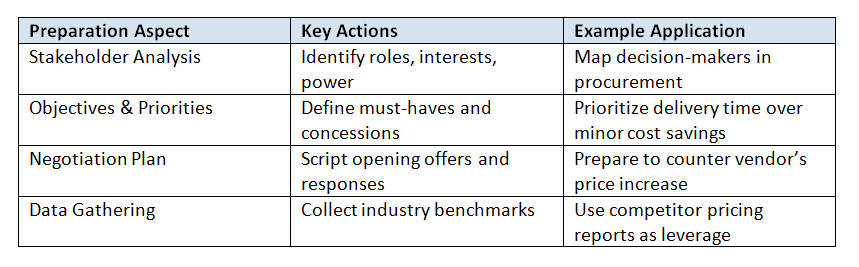
· Step 1: Stakeholder Analysis
Understand who will be involved, their interests, power dynamics, and negotiation style. For instance, a manager may negotiate differently with a risk-averse finance director than with a creative marketing head.
· Step 2: Define Clear Objectives and Priorities
Set your primary goals, fallback positions, and identify negotiables versus non-negotiables. This clarity prevents concessions that undermine core interests.
· Step 3: Develop a Negotiation Plan
Outline your opening offer, expected counteroffers, concessions strategy, and closing tactics. Include contingency plans and BATNA assessment.
· Step 4: Research Context and Data
Collect relevant market benchmarks, financial data, and historical agreements to support your position with evidence.
Consider the example of a software development manager negotiating contract terms with a vendor. By researching industry pricing standards and the vendor’s service history, the manager can negotiate from a position of informed confidence rather than guesswork.
Strategy Development Table
Communication Techniques: Active Listening and Mirroring
Effective communication is the heart of negotiation. Active listening and mirroring not only improve understanding but also build trust and rapport.
Active listening requires managing distractions, using verbal affirmations (“I see,” “That makes sense”), and paraphrasing to confirm understanding. This technique encourages the counterpart to share more information, revealing their true interests and potential areas for agreement.
Mirroring involves subtly copying the other person's body language, tone, or phrasing. For example, if a colleague leans forward and speaks softly, you might adopt a similar posture and tone. Research from the University of Chicago has shown that mirroring increases perceived empathy and likability, which can psychologically incline the counterpart toward cooperation.
· Practical Tips for Active Listening:
- Maintain eye contact without staring
- Avoid interrupting, allow pauses
- Summarize and reflect key points back
- Ask open-ended questions to deepen dialogue
· Exercise: Role-Play Active Listening
Pair with a colleague. One shares a workplace challenge for three minutes while the other practices active listening. Switch roles and discuss how the technique affected understanding.
Tactical Negotiation Skills: Anchoring, Framing, and BATNA
Beyond preparation and communication, managers must deploy tactical skills during negotiations to influence outcomes favorably.
Anchoring is powerful because initial offers create a psychological benchmark. For example, when a project manager proposes a budget of $500,000 at the outset, the negotiation tends to revolve around that figure even if it is high or low. Skilled negotiators use anchoring to set favorable terms but must also be wary of counterparts’ anchors.
Framing shapes perception by presenting options in terms of gains or losses. According to Prospect Theory by Kahneman and Tversky, people are loss-averse and react more strongly to potential losses than equivalent gains. A manager can frame a salary proposal as “a 10% increase to reward your performance” rather than “not cutting your current pay,” which sounds negative.
BATNA serves as a negotiation safety net. If the counterparty’s offer is worse than your BATNA, the rational choice is to walk away or pursue alternatives. Managers who lack clarity on their BATNA risk accepting suboptimal deals.
· Example Script Using Anchoring and BATNA:
“Based on our market analysis, we believe $120 per unit is a fair starting point given quality standards. If this doesn’t work, we have alternate suppliers who can meet our needs, but we’d prefer to continue our partnership.”
This script establishes an anchor while subtly signalling a credible BATNA.
Managing Conflict and Emotion in Negotiations
Negotiation is often accompanied by emotional undercurrents and potential conflicts. Emotional intelligence (EI) plays a key role in navigating these challenges. Daniel Goleman’s EI framework emphasizes self-awareness, self-regulation, empathy, and social skills—all critical for managers in negotiation settings.
· Techniques to Manage Emotions and Conflict:
- Pause and breathe to regulate your emotional responses
- Use “I” statements to express concerns without blaming (“I feel concerned about the timeline.”)
- Reframe negative comments into problem-solving language
- Identify common ground to shift from adversarial to collaborative dynamics
For instance, when a team member resists new responsibilities during a negotiation on workload distribution, a manager might say, “I understand this feels overwhelming. Let’s explore how we can support you to make this manageable.” This empathetic approach de-escalates tension and opens dialogue.
Conflict resolution models like Thomas-Kilmann’s Conflict Mode Instrument (TKI) help managers assess when to compete, collaborate, compromise, avoid, or accommodate based on the situation. Effective negotiators flexibly apply these modes to preserve relationships while achieving objectives.
Practical Exercises and Scripts for Managerial Negotiations
Skill development requires deliberate practice. The following exercises and scripts help managers internalize negotiation techniques:
· Exercise 1: BATNA Role Play
Simulate a negotiation where one participant must walk away if terms are unfavorable. Practice identifying and asserting BATNA confidently.
· Exercise 2: Anchoring Practice
Practice making the first offer in a mock salary negotiation. Observe how it sets the tone and influences counteroffers.
· Exercise 3: Active Listening Drill
Conduct a negotiation conversation focusing solely on listening and paraphrasing. Reflect on how it changes the dynamic.
· Sample Script: Handling Objections
Counterpart: “Your budget request is too high.”
Manager Response: “I appreciate your concern. Let’s review the value this budget delivers and explore where we might adjust without compromising quality.”
Consistent use of these exercises in team training or coaching sessions builds confidence and effectiveness.
Frequently Asked Questions
What is the most important negotiation skill for managers?
How can managers improve their BATNA?
Managers can improve BATNA by expanding alternatives through research, networking, and contingency planning. For example, cultivating multiple vendor relationships increases options if one deal fails.
How does emotional intelligence impact negotiation outcomes?
High emotional intelligence helps managers recognize their own and others’ emotions, regulate responses, and communicate empathetically, reducing conflict and facilitating mutually beneficial agreements.
What strategies help when the counterpart is uncooperative?
Techniques include reframing the conversation, asking open-ended questions to understand their perspective, employing silence strategically, and using objective criteria to shift focus from positions to interests.
Can negotiation skills be learned, or are they innate?
Negotiation skills are largely learnable through deliberate practice, training, and reflection. While some individuals may have natural tendencies, research shows that structured programs significantly improve negotiation performance.
Conclusion
Mastering negotiation skills is essential for managers who seek to lead with influence, foster collaboration, and drive organizational success. By understanding psychological principles such as BATNA and anchoring, honing communication techniques like active listening and mirroring, and preparing thoroughly, managers can approach negotiations with confidence and strategic insight. Managing emotions and conflict further ensures that negotiations are constructive rather than adversarial.
Investing time in these skills not only enhances deal outcomes but also strengthens relationships and builds trust across teams and stakeholders. Start applying these frameworks and exercises today to transform your negotiation approach and unlock value for your organization.
References
Fisher, R., Ury, W., & Patton, B. (2011). Getting to Yes: Negotiating Agreement Without Giving In. Penguin Books.
Thompson, L. (2014). The Mind and Heart of the Negotiator (6th Edition). Pearson.
Goleman, D. (1995). Emotional Intelligence: Why It Can Matter More Than IQ. Bantam Books.
Kahneman, D., & Tversky, A. (1979). Prospect Theory: An Analysis of Decision under Risk. Econometrica.
Shell, G. R. (2006). Bargaining for Advantage: Negotiation Strategies for Reasonable People. Penguin Books.