Negotiation Skills vs Tactics: Key Differences

Negotiation is a vital competency in professional and personal contexts, shaping outcomes that affect careers, business deals, and relationships. However, many confuse negotiation skills with negotiation tactics, using the terms interchangeably. This misunderstanding can lead to ineffective approaches and missed opportunities.
In today’s fast-paced, complex environment, mastering the distinction between negotiation skills and tactics is essential. Skills refer to the underlying abilities and psychological frameworks that enable negotiators to engage effectively, while tactics are the deliberate actions and maneuvers employed within the negotiation process. By developing both, negotiators can strategically influence outcomes with confidence and adaptability.
This article explores the critical differences between negotiation skills and tactics, grounded in psychological research and real-world applications. You will learn how to cultivate foundational skills like active listening and emotional intelligence, apply tactical maneuvers such as anchoring and framing, and integrate these elements to elevate your negotiation performance.
· Table of Contents
· Understanding Negotiation Skills: Definition and Core Components
· Defining Negotiation Tactics: Purpose and Types
· Psychological Frameworks Underpinning Skills and Tactics
· Practical Applications: Real-World Examples and Exercises
· Developing Negotiation Skills: Training and Practice Methods
· Deploying Effective Negotiation Tactics: Strategies and Pitfalls
· Frequently Asked Questions
· Conclusion
· References
Understanding Negotiation Skills: Definition and Core Components
Negotiation skills encompass the holistic abilities and competencies required to manage interpersonal dynamics, understand interests, and facilitate mutually beneficial agreements. They are foundational traits and behaviors developed over time through experience, reflection, and training.
At their core, negotiation skills include active listening, emotional intelligence, effective communication, problem-solving, and rapport building. For example, active listening—highlighted in Carl Rogers’ client-centered therapy model—involves fully focusing on the speaker, understanding their message, and responding thoughtfully. This skill allows negotiators to uncover underlying interests rather than just stated positions.
Emotional intelligence (EI), as conceptualized by psychologist Daniel Goleman, is equally pivotal. EI helps negotiators regulate their emotions, perceive others’ feelings, and respond empathetically. This skill mitigates conflicts and fosters trust, critical for long-term relationships in negotiation.
Another essential skill is perspective-taking, which entails understanding the counterpart’s viewpoint and constraints. Research by Galinsky and Moskowitz (2000) demonstrates that perspective-taking reduces bias and increases collaborative outcomes.
Negotiation skills are not singular actions but integrated capabilities that frame how negotiators approach the entire process. They form the foundation upon which tactics are employed effectively.
Core Negotiation Skills Summarized
· Active Listening – Focusing fully and reflecting to understand interests
· Emotional Intelligence – Managing emotions and empathizing with others
· Clear Communication – Articulating needs and offering explanations
· Problem Solving – Identifying creative solutions benefiting all parties
· Rapport Building – Establishing trust and cooperative relationships
· Perspective-Taking – Understanding the other party’s viewpoint
Defining Negotiation Tactics: Purpose and Types
Negotiation tactics are specific deliberate techniques or maneuvers employed during negotiation to influence the counterpart’s perceptions, decisions, and concessions. Unlike skills, which reflect inherent or learned abilities, tactics are situational strategies chosen based on context and objectives.
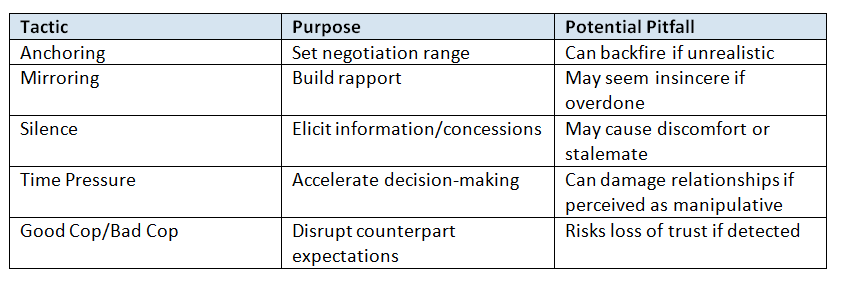
Tactics serve various purposes such as anchoring expectations, managing time pressure, creating urgency, or signaling strength. For example, the anchoring tactic involves presenting an initial offer or demand that sets the reference point for negotiations. This tactic exploits the cognitive bias known as anchoring, where individuals rely heavily on the first piece of information offered.
Another common tactic is mirroring, which entails subtly imitating the counterpart’s body language or speech patterns to build rapport and increase likability. Rooted in the psychological principle of the chameleon effect (Chartrand & Bargh, 1999), mirroring enhances trust and opens channels of influence.
Tactics can be categorized broadly as aggressive, cooperative, or neutral:
· Aggressive tactics: high-pressure demands, bluffing, deadlines
· Cooperative tactics: sharing information, joint problem solving
· Neutral tactics: framing offers, asking calibrated questions
Successful negotiators select and sequence tactics based on their understanding of context, counterpart personality, and overall negotiation goals.
Common Negotiation Tactics
· Anchoring – Setting the initial offer to influence subsequent negotiation range
· BATNA Presentation – Leveraging Best Alternative to a Negotiated Agreement as leverage
· Silence – Using pauses strategically to prompt concessions
· Framing – Presenting options to highlight benefits and minimize drawbacks
· Good Cop/Bad Cop – Alternating between cooperative and tough personas to shake the counterpart
· Time Pressure – Imposing deadlines to accelerate decisions
Psychological Frameworks Underpinning Skills and Tactics
Understanding the psychological theories behind negotiation skills and tactics enhances their effective application. Several frameworks provide insight into human behavior in negotiation contexts.
The Dual-Process Theory (Kahneman, 2011) explains decision-making as the interplay between System 1 (fast, intuitive) and System 2 (slow, rational). Skilled negotiators manage both systems by controlling emotional impulses (System 1) and applying deliberate reasoning (System 2). For instance, emotional intelligence helps regulate System 1 reactions, while problem-solving skills engage System 2.
Social Exchange Theory (Thibaut & Kelley, 1959) posits that negotiation is an exchange of rewards and costs. Skills like perspective-taking help negotiators assess the value and cost from both sides, guiding the choice of tactics that maximize mutual benefit.
The concept of BATNA (Best Alternative to a Negotiated Agreement), introduced by Fisher and Ury in "Getting to Yes," is pivotal. Knowing your BATNA is both a skill (assessment and preparation) and a tactical asset (used to strengthen your negotiating position).
The Reciprocity Principle (Cialdini, 2006) also informs tactics such as offering concessions early to invoke a sense of obligation in the counterpart.
Integrating Psychological Principles
· Manage cognitive biases through awareness and framing
· Employ emotional regulation to avoid reactive concessions
· Leverage reciprocity by initiating cooperative moves
· Use anchoring to set negotiation parameters favorably
· Prepare BATNA to maintain negotiation power and confidence
Practical Applications: Real-World Examples and Exercises
To illustrate the difference between skills and tactics, consider the following real-world example:
In a sales negotiation, a salesperson’s skill in active listening enables them to identify the client’s core need for flexibility in delivery dates. This insight leads them to use the tactic of framing, presenting a flexible delivery schedule as a competitive advantage. Here, the skill allowed the salesperson to gather pertinent information, while the tactic was the strategic move to influence the client’s decision.
Practical exercises to develop this integration include role-playing scenarios where participants practice active listening and then apply an appropriate tactic such as anchoring or calibrated questions. For instance, a script exercise might involve:
· Participant A states an opening demand (anchoring tactic)
· Participant B practices active listening and paraphrasing (skill)
· Participant B responds with a counteroffer framed to highlight value (tactic)
Repeated cycles with feedback enhance both skill fluency and tactical adaptability.
Another exercise to build emotional intelligence involves mindfulness meditation to improve self-awareness, a core component of EI. Negotiators who regulate stress and remain calm under pressure can deploy tactics more effectively.
Developing Negotiation Skills: Training and Practice Methods
Skill development is a continuous process requiring deliberate practice, feedback, and reflection. Formal training programs often incorporate simulations, behavioral modeling, and psychological education.
One evidence-based method is the use of video recordings of mock negotiations, which enable negotiators to observe their verbal and nonverbal behaviors and identify areas for improvement. This method leverages Bandura’s Social Learning Theory, emphasizing learning through observation and imitation.
Peer coaching is another effective approach where negotiators exchange feedback and discuss strategies after practice sessions. Integrating psychological assessments such as the Emotional Quotient Inventory (EQ-i) helps identify emotional intelligence strengths and gaps.
Mindfulness and stress management training enhance emotional regulation, improving skills like patience and listening.
Key measurable skill-building approaches include:
· Active listening workshops with real-time feedback
· Emotional intelligence assessments and coaching
· Perspective-taking exercises based on role reversals
· Communication style analysis and adaptation training
Skill mastery enables negotiators to select and execute tactics with greater precision and confidence.
Deploying Effective Negotiation Tactics: Strategies and Pitfalls
While tactics are essential tools, their misuse or overreliance can damage relationships and reduce long-term success. Effective deployment requires situational awareness and ethical considerations.
One common pitfall is excessive use of aggressive tactics such as bluffing or intimidation, which may yield short-term gains but erode trust. Research by Lewicki et al. (2016) highlights that trust-building behaviors correlate strongly with sustainable negotiation outcomes.
A recommended strategy is to combine cooperative tactics like sharing information early with carefully timed use of competitive tactics like anchoring. This blend fosters both collaboration and leverage.
Negotiators should also be wary of reactive tactics that play into counterpart biases, such as immediately matching high demands without analysis. Instead, applying the skill of perspective-taking before responding ensures tactics align with the broader negotiation context.
Scripts for effective tactical deployment might include:
· "Based on market standards, we propose X as our initial offer." (anchoring)
· "I understand your concerns about delivery time—let’s explore options that work for both." (framing + active listening)
· Silence after a proposal to prompt concession (strategic pause)
Regular reflection on tactic effectiveness and counterpart responses builds tactical agility.
Frequently Asked Questions
What is the main difference between negotiation skills and tactics?
Negotiation skills are the foundational abilities such as communication, emotional intelligence, and problem-solving that enable effective negotiation. Tactics are the specific strategies or maneuvers employed during negotiation to influence outcomes. Skills are broad and continuous capacities, while tactics are situational and deliberate actions.
Can good tactics compensate for poor negotiation skills?
While tactics may produce short-term gains, they rarely compensate for poor negotiation skills in the long term. Without skills like active listening and emotional regulation, a negotiator may misuse or overuse tactics, damaging relationships and credibility. Effective negotiation relies on the synergy of both.
How can I improve my negotiation skills?
Improvement requires deliberate practice, feedback, and reflection. Engage in role-playing exercises, seek coaching, develop emotional intelligence through mindfulness, and study psychological principles underlying negotiation. Recording and reviewing your negotiation interactions can provide valuable insights.
Are negotiation tactics ethical?
Tactics themselves are neutral tools; their ethicality depends on intent and context. Transparent and cooperative tactics align with ethical negotiation, while deceptive or coercive tactics risk ethical violations. Skilled negotiators balance assertiveness with fairness to maintain integrity.
How does understanding BATNA influence negotiation tactics?
Knowing your BATNA (Best Alternative to a Negotiated Agreement) strengthens your negotiation position by clarifying your fallback options. It enables confident use of tactics like anchoring or walking away, because you understand your alternatives. BATNA assessment is both a skill and a tactical asset.
Conclusion
Distinguishing between negotiation skills and tactics is fundamental for anyone seeking to improve their influence and achieve superior outcomes. Skills such as active listening, emotional intelligence, and perspective-taking establish the groundwork for understanding and connecting with counterparts. Tactics like anchoring, mirroring, and framing are the strategic tools applied within this framework to shape the negotiation’s course.
By developing both your skills and tactical repertoire, grounded in psychological principles and ethical practice, you position yourself for successful, sustainable negotiations. Begin by assessing your current skill level, engage in targeted training, and practice tactical scenarios to enhance your adaptability. With deliberate effort, you can transform negotiation challenges into opportunities for collaborative success.
Take the first step today: evaluate your negotiation skills, identify key tactics that resonate with your style, and commit to ongoing development to unlock your full negotiation potential.
References
· Fisher, R., Ury, W., & Patton, B. (2011). Getting to Yes: Negotiating Agreement Without Giving In. Penguin Books.
· Goleman, D. (1995). Emotional Intelligence: Why It Can Matter More Than IQ. Bantam.
· Kahneman, D. (2011). Thinking, Fast and Slow. Farrar, Straus and Giroux.
· Lewicki, R. J., Barry, B., & Saunders, D. M. (2016). Negotiation. McGraw-Hill Education.
· Thompson, L. (2015). The Mind and Heart of the Negotiator. Pearson.