Negotiation Strategy Examples: Real Cases and Lessons for Business Leaders

In 2018, the tense negotiations between Apple and Qualcomm over patent royalties nearly derailed billions in revenue for both companies. What began as a fierce legal battle evolved into a strategic negotiation that redefined their partnership, showcasing the power of adaptive negotiation strategies in high-stakes corporate environments. Such scenarios are not isolated; every day, senior executives face complex negotiation challenges that can make or break market positions, influence mergers, or determine multi-million-dollar contracts.
In today’s hyper-competitive and interconnected business world, mastering negotiation strategy is no longer optional—it is a strategic imperative. The rise of complex supply chains, global regulatory environments, and digital transformation demands negotiators who understand not just the tactics but the underlying psychological and theoretical foundations that drive outcomes. With multiple stakeholders, varying interests, and rapid information flows, negotiators must employ sophisticated frameworks and evidence-based approaches to secure value and sustain relationships.
This comprehensive guide will take you through the foundational research that shapes negotiation strategy, introduce you to core frameworks such as BATNA, ZOPA, and MESO, and equip you with a detailed step-by-step process used by top negotiators. You will analyze real-world case studies from industry giants like IBM, Amazon, and landmark labor union negotiations. Additionally, we’ll explore common pitfalls, share advanced tactics for seasoned negotiators, and provide ready-to-use scripts for immediate application. By the end, you will have a holistic, actionable playbook to elevate your negotiation effectiveness in any high-stakes scenario.
· Table of Contents
· The Strategic Foundation: Core Theory, Psychology, and Research
· Key Frameworks and Models: BATNA, ZOPA, MESO Compared
· Step-by-Step Process: From Preparation to Closing
· Real-World Case Studies: Apple-Qualcomm, IBM Sales, Union Negotiations
· Common Pitfalls and How to Avoid Them
· Advanced Tactics for Experienced Negotiators
· Scripts and Templates: Dialogue and Email Samples
· Frequently Asked Questions
· Conclusion: Synthesizing Strategy with Action
· References
The Strategic Foundation — Core Theory, Psychology, and Research
Negotiation is fundamentally about managing interdependent decision-making under conditions of conflict and cooperation. The seminal work of Roger Fisher and William Ury, especially their Harvard Principled Negotiation model, laid the groundwork for understanding negotiation beyond adversarial haggling. Their core principle—separating people from the problem—emphasizes focusing on interests rather than positions, which is psychologically grounded in reducing cognitive biases and emotional barriers.
Daniel Kahneman’s research on cognitive biases, particularly loss aversion and framing effects, provides critical insight into why negotiators often get anchored or become risk-averse. Understanding heuristics and biases helps negotiators design offers and counteroffers that can shift perceptions and increase acceptance probability. Robert Cialdini’s principles of influence—reciprocity, commitment, social proof, authority, liking, and scarcity—are equally impactful in shaping negotiation dynamics by managing social and psychological leverage points.
Research by Leigh Thompson and Max Bazerman at Harvard Business School underscores the importance of preparation through the concepts of BATNA (Best Alternative to a Negotiated Agreement) and reservation prices. Knowing your BATNA provides power and confidence, while understanding the Zone of Possible Agreement (ZOPA) defines where a deal can realistically be struck. Furthermore, the Multiple Equivalent Simultaneous Offers (MESO) technique, pioneered by Shell and Malhotra, leverages the psychology of choice to create integrative value and reveal preferences.
Negotiation is thus not a random act of persuasion but a strategic exercise rooted in behavioral economics, social psychology, and game theory. Mastering these foundational elements allows negotiators to anticipate counterpart behavior, manage emotional dynamics, and engineer win-win outcomes.
Key Frameworks and Models — BATNA, ZOPA, MESO Compared
To operationalize negotiation theory, practitioners rely on frameworks that provide structure and predictive power. The three most influential models—BATNA, ZOPA, and MESO—serve complementary roles in negotiation planning and execution.
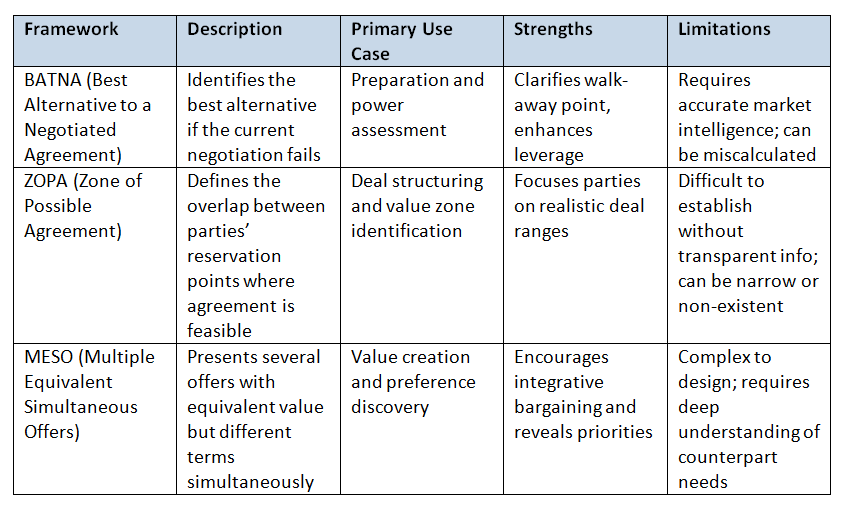
BATNA is foundational for power calibration: IBM’s enterprise sales teams rigorously develop BATNAs by analyzing alternative vendors and internal solutions before contract talks. ZOPA helps negotiators identify the “bargaining zone,” critical in M&A deals such as Amazon’s acquisition negotiations where price ranges must be well-defined to avoid stalemates. MESO strategies shine in labor union negotiations where multiple contract terms—wages, benefits, work schedules—are traded off simultaneously to reach a balanced outcome.
Understanding these models in combination equips the negotiator to diagnose the negotiation context accurately, choose the right tactics, and design offers that maximize joint value.
Step-by-Step Process — From Preparation to Closing
A disciplined approach to negotiation involves sequential phases that ensure thorough preparation, effective engagement, and robust closing.
Step 1: Comprehensive Preparation
Preparation is the most critical phase. Start by researching the counterpart’s business, interests, constraints, and cultural context. Develop your BATNA by identifying alternatives if negotiations fail. Define your reservation price and ideal outcome. Map the ZOPA by estimating counterpart’s probable reservation points. Use intelligence-gathering tools such as competitive analysis, public filings, and social media.
Step 2: Establish Rapport and Set the Tone
At the negotiation outset, build rapport to reduce tension and establish trust. Use Cialdini’s liking principle by finding genuine common ground and demonstrating empathy. Clearly agree on the agenda and process to manage expectations and avoid surprises.
Step 3: Exchange Information and Identify Interests
Encourage open dialogue to uncover underlying interests rather than stated positions. Employ active listening and ask calibrated questions to gain insight into priorities. This stage is essential to move from distributive bargaining to integrative solutions.
Step 4: Generate Options and Make Offers
Utilize MESO techniques to present multiple offers differing in terms but equivalent in value. This reveals counterpart preferences and creates opportunities for trade-offs. Frame offers using anchoring principles to manage perceptions.
Step 5: Bargain and Manage Concessions
Engage in distributive bargaining where necessary, making concessions strategically. Use reciprocity to elicit concessions from the other side. Avoid “splitting the difference” mechanically; instead, link concessions to value-added elements.
Step 6: Close the Deal and Document Agreements
Once agreement is reached within the ZOPA, summarize key terms clearly and confirm mutual understanding. Draft written agreements promptly to avoid ambiguity. Plan for implementation and post-deal relationship management.
Step 7: Review and Learn
After the negotiation, conduct a debrief to assess what worked, what didn’t, and how BATNA and ZOPA assessments aligned with actual outcomes. Continuous learning sharpens future negotiation effectiveness.
Real-World Case Studies — Apple-Qualcomm, IBM Sales, Union Negotiations
Examining real cases crystallizes abstract frameworks into practical lessons.
Apple vs Qualcomm (2018–2019): This negotiation saga involved patent royalties and licensing fees threatening to disrupt Apple’s iPhone production. Qualcomm initially adopted a hard distributive position demanding high royalties. Apple countered by leveraging its BATNA—using alternative chip suppliers and threatening litigation. Qualcomm’s underestimated Apple’s BATNA, resulting in a prolonged legal battle. Ultimately, both parties shifted to a principled negotiation style, focusing on mutual interests—supply continuity and innovation incentives. The settlement combined a multi-year licensing agreement with a chipset supply contract, exemplifying how adaptive strategy and integrative bargaining create value beyond zero-sum assumptions.
IBM Enterprise Sales Strategy: IBM’s complex B2B sales negotiations involve multiple stakeholders and technical specifications. Their negotiators rigorously apply BATNA analysis, mapping competitors’ offerings and client alternatives. They deploy MESO offers presenting various configurations of software licenses, support services, and pricing tiers. This approach uncovers client priorities, enabling IBM to tailor deals that maximize revenue while maintaining margins. IBM’s use of data analytics for negotiation preparation exemplifies the integration of cognitive and technological tools.
UAW (United Auto Workers) Labor Negotiations: The UAW’s collective bargaining with Detroit automakers illustrates the application of negotiation frameworks in labor relations. Both sides develop BATNAs—alternative suppliers or workforce strategies. The ZOPA is often narrow due to fixed cost structures and regulatory constraints. The use of MESO allows simultaneous negotiation on wages, benefits, and job security provisions. Avoiding pitfalls like positional rigidity, negotiators focus on interests such as job sustainability and productivity enhancements. These negotiations highlight the importance of relationship management and trust-building for long-term industrial peace.
Common Pitfalls and How to Avoid Them
Successful negotiation demands vigilance against frequent errors:
Pitfall 1: Inadequate Preparation
Consequence: Overestimating position strength, poor BATNA assessment
Fix: Invest time in comprehensive research and scenario planning; use decision trees to evaluate alternatives systematically.
Pitfall 2: Anchoring on Extreme Positions
Consequence: Opponent disengagement or hardened stances
Fix: Use calibrated anchoring supported by data; avoid unrealistic opening offers that alienate counterparts.
Pitfall 3: Focusing Solely on Price
Consequence: Missed opportunities for value creation in non-price terms
Fix: Employ MESO to introduce multiple negotiable dimensions; explore trade-offs on delivery, warranties, or payment terms.
Pitfall 4: Emotional Escalation and Personalization
Consequence: Breakdown in communication and trust
Fix: Separate people from the problem; utilize active listening and empathy; bring in neutral facilitators if needed.
Pitfall 5: Failure to Close and Document
Consequence: Ambiguities leading to disputes post-deal
Fix: Confirm mutual understanding verbally and in writing; summarize key points and next steps.
Advanced Tactics — Expert-Level Techniques for Experienced Negotiators
Seasoned negotiators can elevate outcomes through these sophisticated strategies:
1. Anchored MESOs: Designing multiple offers where one is intentionally anchored higher or lower to influence counterpart preferences subtly.
2. Strategic Silence and Timing: Using silence after offers to induce counterpart concessions; timing negotiations to exploit fiscal year-end pressures.
3. Pre-Commitment Devices: Publicly committing to certain negotiation parameters to signal credibility and limit counterpart’s scope for demands.
4. Framing and Reframing: Shaping the negotiation narrative to highlight gains rather than losses, leveraging Kahneman’s prospect theory insights.
5. Coalition Building: Engaging third parties or allied stakeholders to strengthen bargaining power or mediate.
6. Contingent Agreements: Structuring deals with performance-based clauses to manage uncertainty and align incentives.
Scripts and Templates — Exact Dialogue and Email Samples
Negotiators can use the following scripts immediately:
Script 1: Opening Dialogue in Supplier Negotiation
“Thank you for meeting today. We understand the importance of a mutually beneficial partnership and are keen to explore solutions that address both our priorities. Could you share your primary concerns and objectives so we can align our proposals accordingly?”
Script 2: Email Template for Proposing MESO Offers
Subject: Multiple Options for Your Consideration
Dear [Name],
Following our recent discussions, I am pleased to present several options tailored to your priorities. Each offers a unique combination of pricing, delivery timelines, and service levels to suit your operational needs.
Option A: [Details]
Option B: [Details]
Option C: [Details]
Please review and let us know which aligns best with your current objectives. We are open to customizing further to achieve a win-win outcome.
Best regards,
Script 3: Closing Confirmation Dialogue
“To ensure we are on the same page, let me summarize the key points we agreed upon: [Summarize terms]. Does this accurately reflect your understanding? If so, we will proceed to formalize the agreement.”
Frequently Asked Questions
Q1: What is the most important factor in preparing for a negotiation?
A1: Understanding your BATNA is paramount. It defines your walk-away point and informs your negotiation power. Without a clear BATNA, you risk accepting suboptimal outcomes.
Q2: How do I handle a counterpart who uses aggressive tactics?
A2: Maintain composure and focus on interests rather than positions. Use principled negotiation to reframe discussions toward problem-solving. Setting clear boundaries and calling out manipulative behavior politely can neutralize aggression.
Q3: When should I use MESO offers?
A3: MESO is best when you want to uncover counterpart preferences and create integrative value. It is particularly effective in complex negotiations involving multiple issues, such as contract renewals or labor talks.
Q4: How do I deal with a negotiation deadlock?
A4: Reassess interests, explore alternative options, and consider involving a neutral third party or mediator. Sometimes, taking a break or changing the negotiation environment can relieve tension.
Q5: Can negotiation tactics differ across cultures?
A5: Absolutely. Cultural norms influence communication styles, perceptions of power, and decision-making processes. Conduct cultural due diligence and adapt your approach to respect local practices while maintaining your objectives.
Conclusion
Negotiation is both an art and science—anchored in research, shaped by psychology, and refined through practice. From preparing with a clear BATNA to employing MESO offers and mastering advanced tactics, the examples and frameworks detailed here provide a strategic blueprint for success. Real-world cases from Apple to IBM illustrate how adaptive, interest-based negotiation generates superior outcomes while preserving relationships. Avoiding common pitfalls and leveraging proven scripts ensures efficiency and clarity.
As a senior business leader, embracing these structured approaches will transform your negotiation outcomes, turning potential conflicts into collaborative opportunities. Start integrating these lessons today—review your upcoming negotiations with this framework, prepare diligently, and execute with confidence. Your next negotiation can be your most successful yet.
References
- Fisher, R., Ury, W., & Patton, B. (2011). Getting to Yes: Negotiating Agreement Without Giving In. Penguin Books.
- Kahneman, D. (2011). Thinking, Fast and Slow. Farrar, Straus and Giroux.
- Cialdini, R. B. (2006). Influence: The Psychology of Persuasion. Harper Business.
- Shell, G. R. (2006). Bargaining for Advantage: Negotiation Strategies for Reasonable People. Penguin.
- Bazerman, M. H., & Neale, M. A. (1992). Negotiating Rationally. Free Press.
- Thompson, L. (2014). The Mind and Heart of the Negotiator. Pearson.