Negotiation Strategy for Complex Deals: Mastering High-Stakes Business Agreements
Imagine a multinational corporation locked in months of intense negotiation to acquire a cutting-edge AI startup valued at over $2 billion. The deal involves multiple stakeholders across jurisdictions, conflicting priorities, and a rapidly evolving technological landscape. Failure to navigate this complexity could cost billions and years of lost opportunity. This scenario exemplifies why mastering negotiation strategy for complex deals has never been more critical in today’s hyper-competitive, interconnected global economy.
Complex deals, from mergers and acquisitions (M&A) to multi-party contracts and international joint ventures, require negotiators to blend psychological insight, structured methodology, and adaptive tactics. Unlike straightforward transactions, these negotiations present layered interests, immense uncertainty, and high stakes, demanding a strategic mindset grounded in proven theory and real-world application. In an era where deal value hinges as much on negotiation acumen as on product innovation or market positioning, executives and dealmakers must elevate their negotiation game.
By the end of this comprehensive guide, you will master the strategic foundation of complex deal negotiation, understand and apply the foremost negotiation frameworks including BATNA, Harvard Principled Negotiation, and MESO, and execute a step-by-step process tailored for complexity. You will analyze landmark case studies from IBM, Apple-Samsung, and Amazon, avoid common pitfalls that undermine deals, apply advanced tactics to gain leverage, and employ exact scripts and templates proven in elite negotiations. This pillar page is your definitive resource to negotiate complex deals with confidence, precision, and maximum value creation.
· Table of Contents
· The Strategic Foundation of Complex Deal Negotiation
· Key Frameworks and Models: BATNA, Harvard Principled Negotiation, MESO
· Step-by-Step Process for Negotiating Complex Deals
· Real-World Case Studies: IBM Enterprise Sales, Apple vs Samsung Patent Deal, Amazon Procurement
· Common Pitfalls and How to Avoid Them
· Advanced Tactics for Experienced Negotiators
· Scripts and Templates for Complex Deal Negotiations
· Frequently Asked Questions
· Conclusion and Next Steps
· References
The Strategic Foundation
Complex deal negotiation is rooted in a rich interplay of psychological principles, decision science, and negotiation theory. Understanding these foundations empowers negotiators to anticipate counterpart behavior, manage cognitive biases, and steer conversations toward value creation.
Daniel Kahneman’s seminal research on cognitive biases and prospect theory reveals that negotiators are prone to loss aversion, anchoring effects, and overconfidence—factors that can distort rational decision-making in high-pressure deals. For example, anchoring on an initial offer can limit creative deal structuring. Skilled negotiators actively manage these biases by preparing alternatives and framing proposals strategically.
The Harvard Negotiation Project, as articulated by Fisher and Ury in "Getting to Yes," introduced the concept of Principled Negotiation, which emphasizes separating people from the problem, focusing on interests rather than positions, generating options for mutual gain, and insisting on objective criteria. This approach transforms zero-sum disputes into integrative bargaining opportunities, vital in complex deals involving multiple stakeholders and intertwined interests.
Robert Cialdini’s work on influence and persuasion adds another layer—understanding reciprocity, commitment, social proof, liking, authority, and scarcity enables negotiators to ethically shape counterpart perceptions and foster cooperation. For example, signaling scarcity of alternative deals can increase counterpart urgency.
Shell’s "Bargaining for Advantage" synthesizes these theories with practical negotiation strategy, emphasizing preparation, understanding bargaining styles, and leveraging power dynamics. Shell also underscores the importance of BATNA (Best Alternative to a Negotiated Agreement)—knowing your fallback option as a source of negotiation power.
Collectively, these research insights highlight that complex deal negotiation is not merely transactional but a dynamic psychological and strategic process. The best negotiators rigorously prepare, manage biases, build relationships, and balance distributive and integrative tactics to maximize joint value.
Key Frameworks and Models
Several frameworks provide structured approaches to navigate the complexity of high-stakes negotiations. Below is a comparison of three leading models:
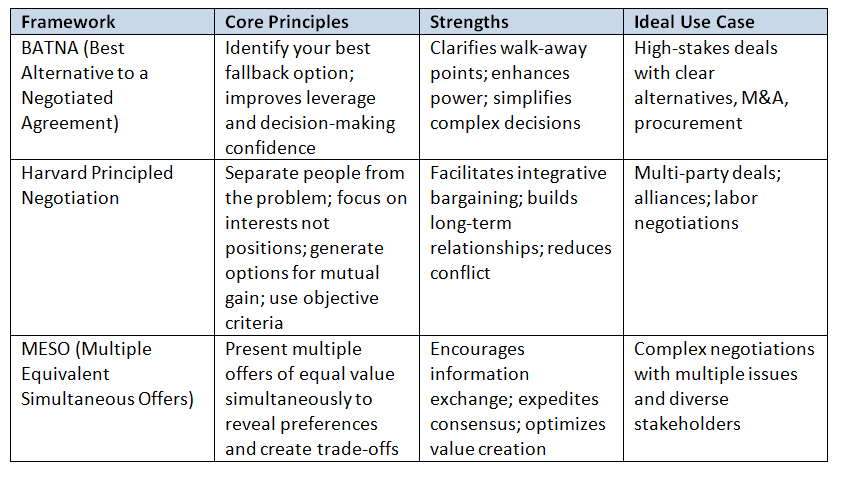
BATNA provides a baseline to measure potential agreements against alternatives, essential in complex deals with high uncertainty. Fisher and Ury’s Principled Negotiation framework guides negotiators toward collaborative solutions that address underlying interests beyond stated demands. MESO, pioneered by negotiation scholar Margaret Neale, is a sophisticated tactic that accelerates deal closure by offering trade-offs, enabling negotiators to understand counterpart priorities without explicit disclosure.
Combining these frameworks allows negotiators to flexibly adapt between distributive (claiming value) and integrative (creating value) strategies, essential when layered interests and constraints coexist.
Step-by-Step Process
Complex deals require a meticulous, phased approach. Below is a detailed process:
Step 1: Comprehensive Preparation and Research
Understand all parties’ interests, constraints, and alternatives. Map stakeholders and power dynamics. Develop your BATNA and estimate counterpart BATNA. Conduct scenario planning. Gather relevant data, including financials, legal frameworks, and market conditions.
Step 2: Define Clear Objectives and Prioritize Issues
List all deal components (price, terms, intellectual property, timelines). Rank issues by importance and flexibility. Establish minimum acceptable outcomes and aspirational targets.
Step 3: Build Relationship and Establish Rapport
Initiate trust-building conversations. Address cultural differences if applicable. Use active listening and empathy to understand counterpart perspectives. Set a collaborative tone.
Step 4: Share Information Strategically
Disclose selective information to build credibility but avoid revealing your BATNA or walk-away points prematurely. Use “interest-based” communication to uncover underlying needs.
Step 5: Deploy MESO Offers
Present multiple offers simultaneously that are equivalent in value but vary across issues. Observe counterpart reactions to gauge preferences and flexibility.
Step 6: Negotiate Trade-offs and Integrate Interests
Identify trade-offs where you concede less important issues for gains in critical areas. Propose creative options such as earn-outs, contingencies, or joint ventures to bridge gaps.
Step 7: Use Objective Criteria and Third-Party Standards
Refer to market benchmarks, industry standards, or expert valuations to justify proposals and reduce subjective disputes.
Step 8: Manage Deadlocks and Escalations
If impasse arises, suggest breaks, mediation, or involve higher authorities. Revisit BATNA evaluation.
Step 9: Document Agreements Precisely
Ensure clarity and completeness in all agreed terms. Use legal counsel to draft or review contracts.
Step 10: Plan Implementation and Follow-Up
Establish governance mechanisms for deal execution and conflict resolution. Confirm communication channels.
Real-World Case Studies
IBM’s large-scale enterprise software deals demonstrate the power of BATNA and Principled Negotiation. Faced with a major client hesitant due to cost concerns, IBM’s negotiators prepared alternative deployment options and licensing models (BATNA), used objective ROI metrics to justify price, and focused on shared goals like scalability and security. The result was a multi-year contract exceeding $500 million value with provisions for future collaboration.
The protracted patent litigation between Apple and Samsung culminated in complex settlement talks. Both sides utilized MESO tactics by exchanging multiple settlement proposals addressing patent licensing fees, cross-licensing terms, and future collaboration clauses. Integrative bargaining principles helped move beyond win-lose litigation toward a settlement preserving market competition and innovation incentives.
Amazon employs advanced negotiation tactics to manage its vast supplier network. In complex procurement deals, Amazon negotiators use data-driven objective criteria, prepared BATNAs (alternative suppliers), and MESO offers involving pricing, delivery schedules, and quality standards. These strategies enable Amazon to optimize cost efficiency while maintaining supplier relationships critical for supply chain resilience.
Common Pitfalls and How to Avoid Them
· Overemphasis on Positions Instead of Interests
Consequence: Deadlocks and suboptimal agreements
Fix: Use Harvard Principled Negotiation to explore underlying interests
· Poor BATNA Assessment
Consequence: Weak bargaining power and acceptance of unfavorable deals
Fix: Invest time analyzing realistic alternatives and contingency plans
· Information Overload or Under-sharing
Consequence: Mistrust or missed opportunities for value creation
Fix: Share information strategically and use active listening to elicit counterpart interests
· Anchoring on Initial Offers Without Flexibility
Consequence: Reduced creative deal options and strained relationships
Fix: Use MESO offers to present multiple options and avoid fixation
· Ignoring Cultural and Interpersonal Dynamics
Consequence: Miscommunication and breakdowns in trust
Fix: Prepare for cultural differences and build rapport early
Advanced Tactics
Presenting multiple equivalent offers simultaneously encourages counterpart to reveal priorities covertly, enabling tailored concessions and maximizing value.
Strategically creating deadlines or signaling urgency can shift the ZOPA (Zone of Possible Agreement) by increasing counterpart’s willingness to compromise.
Engaging neutral experts can help break deadlocks, introduce objective criteria, and preserve relationships.
Making calculated concessions triggers reciprocal moves from counterparts, facilitating progress without sacrificing key interests.
Aligning interests among internal and external stakeholders before negotiation strengthens unified positions and avoids fragmentation.
Scripts and Templates
Subject: Exploring Potential Collaboration Opportunities
Dear [Name],
I hope this message finds you well. Given our mutual interest in [industry/topic], I would like to schedule a meeting to explore potential collaboration opportunities that could benefit both organizations. Our initial assessments suggest several areas where alignment might exist, and I am eager to discuss how we can create value together.
Please let me know your availability over the next two weeks.
Best regards,
“Thank you for meeting today. Before we dive into specifics, I want to emphasize our commitment to a transparent and collaborative process. Our goal is to understand your priorities and constraints so we can identify solutions that work well for both parties. To start, could you share what your key objectives are for this deal?”
“We’ve prepared several options that address different combinations of pricing, delivery timelines, and support levels. For example, Option A focuses on faster delivery with a premium price; Option B offers a lower price with extended timelines; Option C balances both. We’d appreciate your feedback to understand which aligns best with your needs.”
Subject: Proposal to Explore Alternative Resolution Pathways
Dear [Name],
I appreciate the progress we’ve made so far. Given that some issues remain unresolved, I propose we consider bringing in a neutral facilitator or taking a short break to reassess our positions. I believe this will help us maintain momentum and achieve a mutually beneficial agreement.
Please let me know your thoughts.
Best,
Frequently Asked Questions
Identifying BATNA involves researching all viable alternatives if the current negotiation fails. This includes alternative partners, internal solutions, or delaying decisions. Quantify the value and feasibility of alternatives to understand your walk-away point, which provides leverage and confidence.
MESO is most effective when multiple issues are at play and counterpart priorities are unclear. It accelerates consensus by encouraging counterpart preferences disclosure, enabling customized trade-offs. Use it after initial rapport and information exchange are established.
Map stakeholders’ interests and influence. Use coalition-building to align internal parties. During negotiation, apply Principled Negotiation to separate people from problems and focus on underlying interests. Facilitate multi-party discussions with clear agendas and objective criteria.
Cultural norms affect communication styles, decision-making, and trust-building. Understanding counterpart culture helps avoid misinterpretations and fosters rapport. Invest in cultural training or local advisors when negotiating international deals.
Pause discussions to reassess positions and BATNAs. Introduce objective third-party mediators or facilitators. Reframe issues to focus on shared goals. Consider creative solutions or restructuring the deal into smaller agreements.
Conclusion
Negotiating complex deals demands a blend of rigorous preparation, psychological insight, structured frameworks, and adaptive tactics. By grounding your approach in proven research from Kahneman, Fisher & Ury, and Cialdini, and applying frameworks such as BATNA, Harvard Principled Negotiation, and MESO, you can transform seemingly intractable negotiations into opportunities for value creation and durable agreements. Learning from real-world exemplars such as IBM, Apple, and Amazon illustrates how these strategies apply in practice.
Avoiding common pitfalls like positional rigidity or poor BATNA assessment ensures you maintain leverage and flexibility. Advanced tactics such as strategic concessions, coalition-building, and leveraging time pressure sharpen your competitive edge. Equipped with exact scripts and templates, you can engage counterparts with confidence and clarity.
Start implementing these strategies today to elevate your negotiation outcomes in complex, high-stakes deals. Your organization’s strategic goals, financial success, and competitive positioning depend on your ability to negotiate with precision and insight.
References
· Kahneman, D. (2011). Thinking, Fast and Slow. Farrar, Straus and Giroux.
· Fisher, R., Ury, W., & Patton, B. (2011). Getting to Yes: Negotiating Agreement Without Giving In. Penguin Books.
· Cialdini, R.B. (2006). Influence: The Psychology of Persuasion. Harper Business.
· Shell, G.R. (2006). Bargaining for Advantage: Negotiation Strategies for Reasonable People. Penguin Books.
· Neale, M.A., & Northcraft, G.B. (1991). Negotiating on the Inside: The Use of Multiple Equivalent Simultaneous Offers. Journal of Experimental Social Psychology.
· Harvard Business Review articles on negotiation and conflict resolution (various).