Negotiation Strategy for Key Account Managers

In today’s hypercompetitive B2B environment, key account managers (KAMs) stand at the frontline of sustaining and growing the most critical client relationships. Imagine a scenario where a global manufacturing firm’s key account manager faces a demanding procurement team intent on slashing prices. The stakes are high: losing the contract or eroding margins could cost millions in annual revenue and jeopardize strategic partnerships. In such a landscape, a well-crafted negotiation strategy isn’t just helpful—it’s essential.
Key account managers must master negotiation not only to protect margins but also to strengthen collaboration, uncover mutual value, and future-proof client relationships. With complex buying committees, longer sales cycles, and shifting market dynamics, traditional negotiation tactics fall short. Instead, KAMs need a systematic, psychology-informed approach that balances assertiveness with empathy, rooted in deep account insights.
This article dives into proven negotiation strategies tailored specifically for key account managers. You will learn how to prepare rigorously using frameworks like BATNA and ZOPA, deploy advanced tactics such as anchoring and multi-issue bargaining, and navigate common pitfalls. Real-world examples, expert scripts, and metrics for tracking negotiation success will equip you to negotiate confidently and consistently deliver value to both your company and your key clients.
· Table of Contents
· Understanding the Role of Negotiation in Key Account Management
· Preparing for Negotiations: Research, BATNA, and Setting Objectives
· Core Negotiation Strategies and Tactics for Key Account Managers
· Advanced Techniques: Anchoring, Framing, and Multi-Issue Bargaining
· Managing Complex Stakeholders and Internal Alignment
· Measuring Negotiation Success: KPIs and Continuous Improvement
· Frequently Asked Questions
· Conclusion
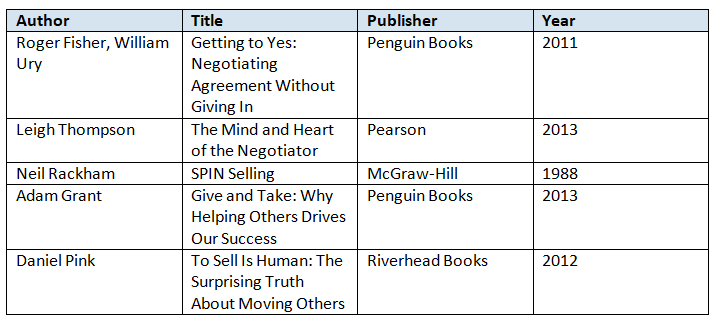
· References
Understanding the Role of Negotiation in Key Account Management
Negotiation in key account management transcends transactional price haggling. It is a strategic dialogue that shapes long-term value creation and partnership strength. Unlike one-off sales, KAM negotiations often involve multi-year contracts, volume commitments, service level agreements, and co-innovation projects. Each negotiation is an opportunity to deepen trust and align incentives.
In many B2B sectors—such as technology, manufacturing, and professional services—key accounts represent 60-80% of revenue. Failure to negotiate effectively risks margin erosion, contract losses, or missed upsell potential. Conversely, skillful negotiation can unlock joint value, differentiate your offerings, and create barriers to competitor entry.
Effective negotiation also requires KAMs to understand the broader context: corporate strategy, client industry pressures, and the evolving procurement landscape. For example, procurement professionals increasingly use data analytics and competitive bidding platforms, demanding that KAMs bring differentiated insight and flexible solutions rather than just discounting.
· Key functions negotiation serves for KAMs:
· Protecting and improving profitability
· Building collaborative, trust-based client relationships
· Aligning multi-stakeholder interests within client organizations
· Enabling innovation through flexible contract terms
· Mitigating risks associated with contract renewals and expansions
Preparing for Negotiations: Research, BATNA, and Setting Objectives
Thorough preparation is the cornerstone of successful negotiation. Key account managers must rigorously gather intelligence both about their own organization’s constraints and the client’s priorities.
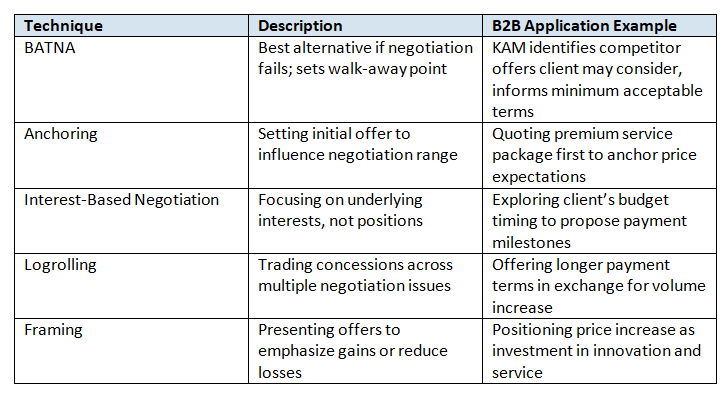
One foundational framework is BATNA (Best Alternative to a Negotiated Agreement). Understanding your BATNA clarifies your fallback options if talks stall, strengthening your position and preventing poor concessions. For instance, a KAM negotiating a software license renewal might identify alternative vendors or internal solutions as BATNA, which informs walk-away points.
Equally critical is defining clear, prioritized objectives across financial, service, and strategic dimensions. Setting a target price, acceptable minimum, and desired contract terms upfront creates discipline and helps resist pressure to concede prematurely. The Zone of Possible Agreement (ZOPA) defines the overlap between buyer and seller acceptable terms and should be estimated early based on market data and internal cost structures.
Client research includes analyzing recent financial reports, understanding key decision-makers’ roles, and identifying pain points or upcoming projects that could influence negotiation leverage. Using CRM data and account plans, KAMs can tailor value propositions that resonate with client goals.
Preparation checklist for KAM B2B negotiations:
· Identify and quantify your BATNA
· Estimate client’s BATNA and ZOPA
· Set clear, tiered objectives (target, aspiration, minimum)
· Analyze client’s organizational structure and procurement process
· Gather competitive intelligence and market benchmarks
· Develop contingency plans for negotiation roadblocks
Example: BATNA in Action
A key account manager at a telecom equipment provider preparing for a contract renewal faced a client pushing for a 15% discount. By identifying an alternative supplier the client had recently engaged for a pilot project, the KAM recognized the client's BATNA was stronger than initially assumed. This insight led the KAM to shift focus from price to service quality and reliability guarantees, resulting in a contract with a smaller discount but longer duration and higher overall value.
Core Negotiation Strategies and Tactics for Key Account Managers
With preparation complete, KAMs must deploy strategies that balance assertiveness with collaboration. The dual goals are to maximize value capture while preserving and enhancing client relationships.
One fundamental strategy is Interest-Based Negotiation (also known as Principled Negotiation), popularized by Fisher and Ury in "Getting to Yes." This approach emphasizes uncovering underlying interests rather than positional bargaining over fixed demands. For example, a client demanding a lower price may actually be concerned about budget timing or risk-sharing, which can be addressed through payment terms or performance guarantees.
Another key tactic is anchoring—the cognitive bias where the first number put on the table influences the negotiation range. KAMs can use anchoring to set favorable reference points, such as quoting a premium package first to frame subsequent discounts as concessions.
Concession planning is critical: managing the size, timing, and sequencing of concessions to maintain momentum and extract reciprocal concessions from the client. For example, a KAM might initially concede on delivery lead times but hold firm on price, then later request a volume commitment in exchange.
Effective questioning techniques also reveal client priorities and soften resistance. Open-ended questions ("What are your primary objectives for this renewal?") and reflective listening build rapport and surface value drivers.
· Core negotiation tactics for KAMs:
· Interest-Based Negotiation
· Anchoring and framing offers
· Strategic concession management
· Effective questioning and active listening
· Using deadlines and scarcity to create urgency
Sample Negotiation Script Extract
KAM: "I understand that managing costs is a top priority this quarter. Can you share more about how this fits into your broader operational challenges?"
Client: "Our budget cycle has shifted, so we need to reduce upfront expenditures."
KAM: "That makes sense. We could explore spreading payments over the contract term or including performance milestones that align payments with delivered value. Would that address your timing concerns?"
This dialogue exemplifies uncovering interests and proposing creative options rather than conceding on price outright.
Advanced Techniques: Anchoring, Framing, and Multi-Issue Bargaining
Beyond basics, advanced negotiation techniques provide KAMs with greater leverage and flexibility in complex discussions.
Anchoring is most effective when the initial offer is credible and well-justified. For instance, anchoring a software subscription price by highlighting ROI case studies and total cost of ownership can set a higher starting point that influences the entire negotiation.
Framing involves presenting proposals in ways that emphasize gains or reduce perceived losses. For example, framing a price increase as an investment in improved service levels or innovation can shift client perception from cost to value.
Multi-issue bargaining expands negotiations beyond price to include delivery schedules, payment terms, support packages, and exclusivity. This allows trade-offs that create win-win outcomes. The "Logrolling" technique involves conceding on less important issues to gain ground on priorities.
The "Good Cop / Bad Cop" tactic, while controversial, can be applied subtly in internal alignment before negotiation, where one team member pushes harder on tough points while another maintains relationship focus.
· Advanced negotiation techniques:
· Anchoring with data-driven justification
· Framing proposals to highlight value
· Multi-issue bargaining and logrolling
· Managing internal negotiation roles
· Use of deadlines for leverage
Multi-Issue Bargaining Example
A KAM negotiating a supply contract faced resistance on price but identified flexibility on delivery frequency and payment terms. By offering a longer payment window in exchange for a 5% price increase, the client agreed to a contract that improved cash flow for both parties and secured volume commitments.
Managing Complex Stakeholders and Internal Alignment
Key account negotiations rarely involve just two parties. Complex buying committees, cross-functional teams, and internal stakeholders must be managed with finesse.
Within client organizations, KAMs must identify all decision-makers and influencers—procurement, finance, operations, technical experts—and tailor messages accordingly. Mapping stakeholder interests and potential objections reduces surprises.
Internally, alignment between sales, legal, finance, and product teams ensures coherent negotiation positions and prevents last-minute concessions. The RACI matrix (Responsible, Accountable, Consulted, Informed) is a useful tool to clarify roles.
Psychological principles such as reciprocity and social proof can be leveraged by involving respected client champions or referencing successful case studies. Building consensus through iterative discussions and pilot agreements can ease contract finalization.
· Best practices for stakeholder management:
· Conduct stakeholder mapping and influence analysis
· Customize communication for different roles and concerns
· Use internal alignment tools like RACI matrices
· Engage client champions to build internal support
· Facilitate multi-stage negotiations with incremental agreements
Measuring Negotiation Success: KPIs and Continuous Improvement
To refine negotiation capabilities, key account managers and their organizations must track relevant metrics and apply lessons learned.
Key Performance Indicators (KPIs) include:
· Contract renewal rate
· Average discount percentage versus list price
· Margin contribution from key accounts
· Time to close negotiations
· Client satisfaction scores post-negotiation
Regular post-mortems on major negotiations help identify what tactics worked and where gaps remain. Incorporating feedback loops into account planning cycles supports continuous improvement.
Training programs focusing on negotiation skills, role-playing scenarios, and data-driven negotiation playbooks further enhance effectiveness.
· Metrics and processes for negotiation excellence:
· Define clear KPIs aligned with strategic goals
· Conduct structured negotiation debriefs
· Develop standardized negotiation playbooks
· Invest in ongoing skills development and coaching
· Leverage CRM and analytics for data-driven insights
Frequently Asked Questions
1. How can a key account manager identify their BATNA effectively?
Identifying BATNA requires objective analysis of alternatives if the negotiation fails. KAMs should evaluate available substitute products, competitor offerings, and internal options. Engaging cross-functional teams and leveraging market intelligence helps quantify these alternatives. Regularly updating BATNA ensures negotiation positions remain realistic and credible.
2. What role does emotional intelligence play in key account negotiations?
Emotional intelligence (EI) is critical for reading client cues, managing stress, and building rapport. High EI enables KAMs to adapt their communication style, de-escalate conflicts, and foster trust, which smooths negotiation hurdles and facilitates collaborative problem-solving.
3. How should KAMs handle multiple stakeholders with conflicting priorities?
Effective stakeholder management involves mapping interests, facilitating transparent communication, and seeking consensus-building solutions. KAMs can use tailored proposals that address specific concerns and engage internal champions to influence decision-making. Patience and persistence are key.
4. When is it appropriate to use hard negotiation tactics like deadlines or "walk-away" threats?
Hard tactics should be employed cautiously and only when BATNA is strong and the risk of damaging the relationship is acceptable. In key accounts, preserving long-term partnerships usually favors collaborative approaches. Deadlines can create constructive pressure but should not appear coercive.
5. How can technology support negotiation strategy for key account managers?
CRM platforms, sales analytics, and AI-powered tools provide data-driven insights into client behavior, pricing trends, and negotiation history. These tools help KAMs prepare better, identify value levers, and track negotiation performance for continuous improvement.
Conclusion
Mastering negotiation strategy is indispensable for key account managers striving to protect margins, deepen partnerships, and drive sustainable growth. By rigorously preparing with frameworks like BATNA and ZOPA, deploying a blend of interest-based and advanced tactics, and managing complex stakeholders skillfully, KAMs can consistently unlock superior outcomes.
Integrating measurement and continuous learning into the negotiation process ensures evolving excellence and adaptability in a dynamic B2B landscape. Start applying these strategies today to transform your key account negotiations from routine transactions into strategic value exchanges that benefit both your organization and your most important clients.