Negotiation Strategy for Procurement: Mastering Deals That Drive Competitive Advantage

Imagine a global electronics manufacturer on the brink of signing a multi-million-dollar contract with a key microchip supplier. The stakes? Securing critical components at the right price and delivery terms to meet aggressive product launch timelines. A single misstep in negotiation could inflate costs by millions or delay production, costing market share and investor confidence. In today's hypercompetitive environment, where margins are razor-thin and supply chains complex, procurement negotiation is not merely transactional—it is a strategic linchpin.
Procurement professionals now face pressure to align negotiation outcomes with broader organizational objectives: cost reduction, supplier innovation, risk mitigation, and sustainability goals. The rise of global supply chain risks, from geopolitical tensions to pandemic disruptions, further elevates the importance of robust negotiation strategies that transcend price haggling. Executives demand negotiation approaches grounded in behavioral science and advanced frameworks that yield measurable value.
This comprehensive guide will equip senior procurement leaders and strategists with an unmatched understanding of negotiation theory applied to procurement, proven frameworks like Harvard Principled Negotiation and Shell’s Influence Model, step-by-step tactical processes, and real-world case insights. You will master avoiding common pitfalls, deploying advanced techniques for complex deals, and leveraging actionable scripts and templates immediately. By the end, you will command negotiation strategies that consistently secure superior deals, build resilient supplier relationships, and create sustainable competitive advantage.
· Table of Contents
· The Strategic Foundation: Core Theory, Psychology, and Research in Procurement Negotiation
· Key Frameworks and Models for Procurement Negotiation: Comparative Analysis
· Step-by-Step Process: Tactical Walkthrough for Successful Procurement Negotiations
· Real-World Case Studies: Lessons from Leading Corporations
· Common Pitfalls and How to Avoid Them in Procurement Negotiations
· Advanced Tactics: Expert Techniques for Complex Negotiations
· Scripts and Templates: Ready-to-Use Dialogue and Email Examples
· Frequently Asked Questions: Deep-Dive on Long-Tail Procurement Negotiation Queries
· Conclusion: Synthesizing Insights and Next Steps
· References: Authoritative Sources Underpinning Best Practices
The Strategic Foundation — Core Theory, Psychology, and Research Behind Procurement Negotiation
Procurement negotiation is a multifaceted discipline that intersects economics, psychology, and strategic management. Its foundation rests on understanding human behavior, incentives, and decision-making under uncertainty. Daniel Kahneman’s Nobel Prize-winning research on cognitive biases and prospect theory illuminates why negotiators often make suboptimal concessions—anchoring effects, loss aversion, and overconfidence distort rational decision-making. Recognizing these biases is critical to structuring negotiations that mitigate such pitfalls.
Fisher and Ury’s seminal work, "Getting to Yes," introduced the Harvard Principled Negotiation framework, emphasizing separating people from the problem, focusing on interests rather than positions, generating options for mutual gain, and relying on objective criteria. This approach resonates deeply in procurement, where long-term supplier relationships must coexist with price and risk objectives. It shifts negotiation from zero-sum distributive bargaining to integrative bargaining, expanding the value pie.
Influence and persuasion research by Robert Cialdini further enriches procurement negotiation strategy. Principles such as reciprocity, commitment and consistency, social proof, authority, liking, and scarcity can be tactically leveraged to create compelling proposals and build trust with suppliers. For instance, demonstrating past partnership successes (social proof) or invoking industry certifications (authority) can lower supplier resistance.
Shell's "Bargaining for Advantage" provides a comprehensive psychological framework, including the assessment of BATNA (Best Alternative to a Negotiated Agreement), ZOPA (Zone of Possible Agreement), and the use of MESOs (Multiple Equivalent Simultaneous Offers). These concepts enable procurement professionals to prepare rigorously, identify negotiation boundaries, and propose trade-offs that satisfy both parties.
Research in supply chain risk management highlights the strategic imperative of negotiation in ensuring continuity and flexibility. Procurement negotiation extends beyond cost to encompass service levels, innovation sharing, and collaborative risk mitigation. Thus, negotiation strategy must integrate economic analysis with behavioral insights and organizational strategy to maximize value.
Key Frameworks and Models — Comparative Analysis for Procurement Negotiation
Selecting the right negotiation framework directly influences procurement outcomes. Below is a comparison of three foundational models widely applied in procurement contexts:
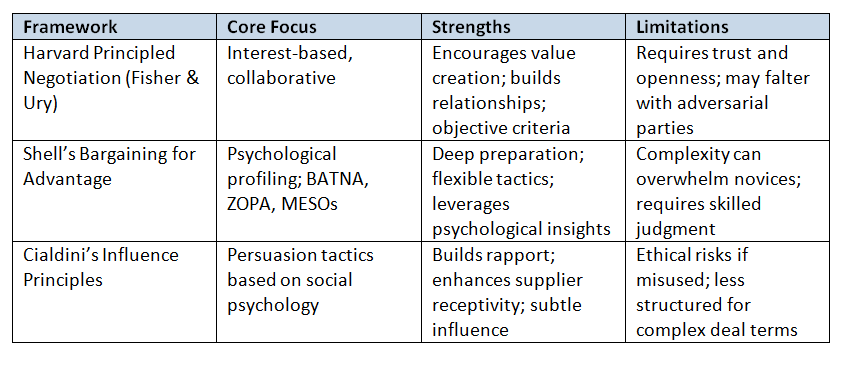
Procurement leaders often combine these frameworks. For example, they may use Harvard’s principled negotiation to frame discussions, Shell’s BATNA analysis for preparation, and Cialdini’s principles during interpersonal engagement. Understanding their synergies and limitations ensures a tailored approach that aligns with organizational culture and deal complexity.
Step-by-Step Process — Tactical Walkthrough for Successful Procurement Negotiations
Step 1: Preparation and Research
Effective procurement negotiation begins long before the table. Conduct exhaustive supplier market analysis, understand internal stakeholder requirements, and define clear objectives including price targets, quality standards, delivery schedules, and compliance needs. Identify your BATNA—what alternatives exist if negotiation fails—and estimate the supplier’s BATNA to anticipate their leverage points.
Step 2: Establish Rapport and Build Trust
Initiate communication that fosters mutual respect. Utilize Cialdini’s liking principle by finding common ground or shared goals. Transparent yet strategic disclosure can build credibility. Early rapport sets a cooperative tone, reducing adversarial friction.
Step 3: Define Interests, Not Positions
Move beyond stated positions (“We want a 10% price cut”) to uncover underlying interests (“We need cost reduction to meet budget constraints”). Engage in active listening and open-ended questioning. This aligns with Fisher & Ury’s principles and uncovers value-creation opportunities.
Step 4: Generate Multiple Equivalent Simultaneous Offers (MESOs)
Drawing from Shell’s tactics, present several offers with equivalent value but differing trade-offs (e.g., price vs delivery lead time vs payment terms). This provides the supplier choices, fosters collaboration, and reveals their priorities.
Step 5: Employ Objective Criteria and Data
Anchor discussions on industry benchmarks, historical prices, total cost of ownership analyses, and compliance standards. Objective criteria reduce conflict and enable principled agreement.
Step 6: Manage Concessions Strategically
Avoid unilateral concessions. Use reciprocity by linking concessions to supplier trade-offs. Maintain a concession log and adhere to pre-defined thresholds to protect value.
Step 7: Close with Clear Agreements and Follow-Up
Ensure clarity on all terms, document agreements meticulously, and agree on post-negotiation communication protocols. This prevents misunderstandings and lays groundwork for ongoing supplier relationship management.
Real-World Case Studies — Lessons from Leading Corporations
Apple’s procurement teams faced high stakes negotiating component contracts with Samsung, a key competitor in mobile devices. By applying integrative negotiation principles, Apple negotiated supply agreements that included quality standards and exclusivity clauses while conceding on volume flexibility. The BATNA analysis revealed that Samsung had limited alternative customers for certain cutting-edge chips, which Apple leveraged for better pricing without souring relations, enabling Apple to maintain product launch schedules and innovation leadership.
Amazon’s procurement strategy emphasizes aggressive cost control balanced with reliability. Their negotiation teams use MESOs extensively—offering suppliers multiple contract structures varying in volume commitments and payment terms. This approach unearths supplier preferences and reduces total cost of ownership. Amazon’s negotiation training integrates Cialdini’s influence principles, especially reciprocity, by offering early payments for preferential pricing, fostering ongoing collaboration.
IBM’s complex software procurement involves multiple stakeholders and risk factors. IBM applies Harvard Principled Negotiation as a framework, emphasizing interests such as software customization and support responsiveness, not just price. Their negotiations often include joint innovation clauses, reflecting integrative bargaining. IBM’s procurement teams rigorously prepare BATNA scenarios, ensuring fallback options if negotiations stall. These practices have resulted in long-term, flexible contracts that support IBM’s evolving technology needs.
Common Pitfalls and How to Avoid Them — Mistakes with Consequences and Fixes
Focusing solely on price reductions risks quality, delivery reliability, and supplier innovation. Consequence: higher long-term costs and supply disruptions. Fix: Employ total cost of ownership frameworks and integrate interests beyond price.
Failing to rigorously assess alternatives weakens negotiating position and can lead to accepting unfavorable terms. Fix: Conduct detailed scenario planning and competitor supplier analysis pre-negotiation.
Transactional, adversarial approaches erode trust and reduce supplier commitment. Fix: Apply Harvard Principled Negotiation and Cialdini’s influence principles to build rapport and mutual gain.
Conceding without reciprocity diminishes leverage and value capture. Fix: Track concessions carefully and tie them to supplier commitments or trade-offs.
Ambiguities post-negotiation cause disputes and implementation delays. Fix: Draft clear contracts, confirm agreements in writing, and establish communication protocols.
Advanced Tactics — Expert Techniques for Complex Procurement Negotiations
Set initial offers that frame the negotiation landscape favorably. Use data-driven anchors based on market intelligence to psychologically influence supplier expectations.
Develop multiple offers that reflect the supplier’s value drivers identified through prior research. Use trade-off analysis to reveal priorities and craft proposals accordingly.
Engage suppliers in joint risk and contingency planning sessions that align negotiation around shared vulnerabilities, fostering integrative outcomes.
Introduce independent certifications or industry indices as objective criteria to reduce conflict and justify terms.
Use timing strategically—e.g., deploying offers near fiscal year-ends or leveraging supplier capacity cycles—to maximize leverage. Frame proposals positively, emphasizing mutual gains.
Scripts and Templates — Ready-to-Use Dialogue and Email Examples
Subject: Exploring Strategic Partnership Opportunities
Dear [Supplier Name],
I hope this message finds you well. As we plan for our upcoming product cycles, we are evaluating potential suppliers who can align with our quality and delivery standards. We value your expertise and would like to discuss opportunities for collaboration that benefit both parties.
Could we schedule a call next week to explore this further?
Best regards,
“Thank you for meeting today. Our goal is to establish a partnership that not only meets cost targets but also supports reliable delivery and innovation. We believe there is room to create value on both sides and would like to start by discussing your current capabilities and constraints.”
“We appreciate your offer on price. In exchange for a 5% reduction, would you be willing to improve lead times by two weeks? This would help us better manage inventory and reduce costs downstream.”
Subject: Confirmation of Agreement Terms
Dear [Supplier Name],
Thank you for a productive negotiation session. To confirm, we have agreed on the following terms:
- Price: [Specify]
- Delivery Lead Time: [Specify]
- Payment Terms: [Specify]
Please review and confirm at your earliest convenience. We look forward to a successful partnership.
Best regards,
Frequently Asked Questions — Deep-Dive on Long-Tail Procurement Negotiation Queries
Preparing BATNA requires comprehensive market intelligence on alternative suppliers, cost structures, and supplier capacity. It involves scenario modeling to forecast outcomes if negotiations fail, ensuring that procurement teams can walk away confidently or leverage alternatives to extract better terms.
Emotional intelligence enables negotiators to read supplier cues, manage their own responses, and maintain constructive dialogue. It supports trust-building and conflict resolution, critical in long-term supplier relationships where collaboration outweighs adversarial tactics.
When suppliers have greater leverage (scarce resources, unique technology), focus shifts to integrative tactics: identifying mutual gains, long-term partnership value, and employing creative trade-offs like volume commitments or co-development to balance power asymmetries.
Use a concession log that records each concession, the rationale, and corresponding supplier trade-offs. This discipline avoids value leakage and ensures concessions are strategic and reciprocal.
Incorporate sustainability criteria into objective standards and contract terms, engage suppliers on shared environmental goals, and create incentives for sustainable innovations. This approach aligns procurement negotiation with broader corporate social responsibility strategies.
Conclusion — Synthesizing Key Insights and Next Steps
Procurement negotiation today demands a sophisticated blend of rigorous preparation, psychological insight, structured frameworks, and tactical agility. Understanding foundational theories from Kahneman, Fisher & Ury, and Cialdini enables procurement leaders to transcend transactional bargaining and create sustainable value. Integrating frameworks such as Harvard Principled Negotiation and Shell’s BATNA/ZOPA analysis ensures negotiations are both principled and adaptive.
The step-by-step process outlined provides a replicable blueprint for navigating complexity, while real-world cases demonstrate how global leaders translate theory into competitive advantage. Avoiding common pitfalls safeguards value and relationships, and advanced tactics empower negotiators to master high-stakes deals. With ready-to-use scripts and templates, teams can immediately apply these insights to daily procurement challenges.
As procurement increasingly shapes organizational success, mastering negotiation strategy is non-negotiable. Begin embedding these principles into your negotiation playbook today to secure deals that drive cost leadership, innovation, and resilience.