Negotiation Strategy for Sales Teams: Mastering the Art of Closing Deals and Maximizing Value

In 2023, IBM reported that over 60% of their enterprise sales negotiations involved multi-party stakeholders and complex value trade-offs, leading to an average deal cycle that is 25% longer than five years ago. The stakes have never been higher for sales teams: each negotiation can determine not only immediate revenue but long-term client relationships and strategic positioning. In dynamic markets where buyers are more informed and have greater leverage, the ability to negotiate effectively has evolved from a nice-to-have skill to a critical strategic competency.
Why is negotiation strategy so critical for sales teams today? Beyond simply agreeing on price, negotiation influences contract terms, service levels, exclusivity, renewal conditions, and even product roadmaps. With increasing commoditization and competitive pressure, differentiation often hinges on how well a sales team can create and claim value in negotiations. Companies like Amazon and Apple have built reputations not just on product innovation but on their relentless, data-driven negotiation approaches.
This article will equip senior sales professionals and team leaders to master negotiation strategy at every level. You will understand the foundational psychology and research driving negotiation outcomes; learn and compare leading negotiation frameworks such as Harvard Principled Negotiation, MESO, and BATNA optimization; follow a detailed step-by-step negotiation process tailored for sales contexts; examine high-impact real-world case studies; avoid common pitfalls; apply advanced tactics; and finally, access ready-to-use scripts and templates proven in enterprise sales.
· Table of Contents
- The Strategic Foundation of Negotiation in Sales
- Key Frameworks and Models for Sales Negotiation
- Step-by-Step Negotiation Process for Sales Teams
- Real-World Case Studies: Successes and Lessons
- Common Pitfalls and How to Avoid Them
- Advanced Tactics for Experienced Sales Negotiators
- Scripts and Templates for Immediate Use
- Frequently Asked Questions
- Conclusion
- References
The Strategic Foundation — Core Theory, Psychology, and Research Behind Sales Negotiation
Negotiation, at its core, is a decision-making process between two or more parties with conflicting interests but potential mutual gains. The field combines economics, psychology, and communication theory to model and influence human behavior. For sales teams, understanding these theoretical underpinnings is crucial for crafting strategies that go beyond price haggling to integrative value creation and sustainable partnerships.
Daniel Kahneman’s Prospect Theory (1979) revolutionized decision sciences by showing that people value gains and losses asymmetrically—loss aversion is roughly twice as powerful as the desire for gain. This means in negotiations, framing offers that minimize perceived losses for the buyer can be more effective than emphasizing incremental gains. For sales, this explains why anchoring a contract renewal price too high without demonstrating avoided losses can backfire.
Fisher and Ury's Harvard Principled Negotiation framework, introduced in "Getting to Yes" (1981), remains the gold standard in negotiations. It advocates separating people from the problem, focusing on interests rather than positions, inventing options for mutual gain, and insisting on objective criteria. Sales teams can apply this by moving beyond rigid price positions to uncovering underlying buyer motivations and collaboratively crafting solutions.
Robert Cialdini's principles of persuasion—reciprocity, commitment, social proof, authority, liking, and scarcity—map directly onto negotiation tactics. For example, establishing authority through expert knowledge or leveraging social proof with customer success stories increases influence without direct confrontation. Shell’s "Bargaining for Advantage" (2006) integrates these psychological insights with practical strategies, emphasizing preparation, understanding your BATNA (Best Alternative to a Negotiated Agreement), and emotional intelligence during bargaining.
Research from the Program on Negotiation at Harvard Law School further shows that negotiators who prepare multiple equivalent simultaneous offers (MESO) tend to achieve higher joint value and satisfaction. This technique encourages integrative bargaining by presenting trade-offs instead of single-issue offers, a critical method for complex B2B sales involving multiple contract terms.
· Key psychological and theoretical insights for sales negotiation:
- Loss aversion and framing effects (Kahneman)
- Interest-based negotiation (Fisher & Ury)
- Principles of persuasion (Cialdini)
- BATNA development and leverage (Shell)
- MESO offers and integrative bargaining (Harvard PON research)
Key Frameworks and Models — Comparison of Leading Negotiation Frameworks for Sales Teams
Effective sales negotiation requires structured approaches to guide decision-making and strategy execution. The following three frameworks are widely used in professional sales environments and can be integrated depending on deal complexity and relationship maturity:
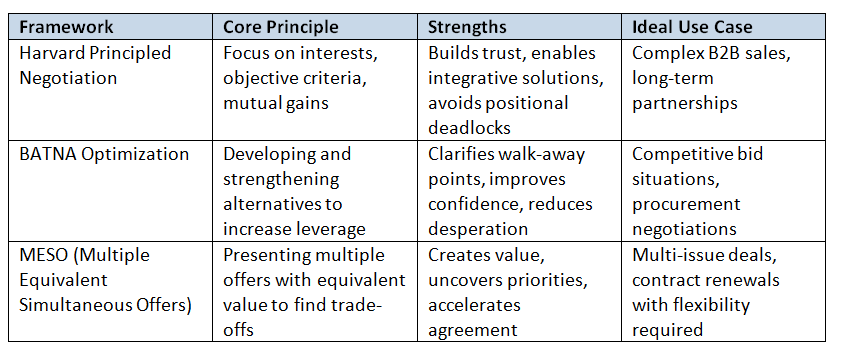
Harvard Principled Negotiation emphasizes collaborative problem-solving and is ideal when maintaining relationships is paramount. For example, IBM sales teams negotiating enterprise software contracts leverage this framework to align client needs and internal capabilities.
BATNA Optimization is critical in maintaining power balance. Amazon's procurement teams rigorously prepare alternatives so they never accept suboptimal terms, ensuring cost leadership. Understanding your BATNA and estimating the opponent’s BATNA is a powerful strategic tool.
MESO techniques offer tactical flexibility by allowing sales reps to tailor proposals based on buyer feedback, revealing deeper preferences and enabling creative value packaging. Salesforce sales teams often use MESO in renewal negotiations to balance pricing, support levels, and feature access.
Step-by-Step Process — Detailed Walkthrough for Sales Negotiation
Step 1: Preparation and Research
Thorough preparation differentiates elite negotiators. Identify all stakeholders, understand their interests, constraints, and BATNAs. Use CRM data, LinkedIn profiles, and competitive intelligence to build a negotiation playbook. Define your objectives, minimum acceptable terms, and potential concessions.
Step 2: Establish Rapport and Set Ground Rules
Begin by building rapport to reduce tension and create a collaborative atmosphere. Use open-ended questions to clarify the agenda and confirm negotiation parameters like timelines, decision authority, and communication protocols.
Step 3: Clarify Interests and Priorities
Move beyond stated positions (e.g., price) to uncover underlying interests (e.g., budget cycles, risk aversion, strategic goals). Use active listening and empathy to validate concerns and create psychological safety.
Step 4: Present Multiple Equivalent Offers (MESO)
Introduce two or three proposals with different combinations of price, service, and contract terms that deliver equivalent value to you. Solicit buyer preferences and willingness to trade off elements. This reveals priorities and expands the bargaining zone.
Step 5: Use Objective Criteria and Data
Support offers with market benchmarks, ROI models, and case studies to anchor value perception and reduce emotional bias. Refer to industry standards or competitor pricing to justify terms.
Step 6: Manage Concessions Strategically
Plan concessions in advance, linking each to reciprocal buyer concessions. Use conditional language: "If you can commit to a 12-month contract, I can extend the discount by 5%." Avoid unilateral giveaways.
Step 7: Handle Objections and Conflict
Apply principled negotiation by separating people from the problem. Reframe objections as shared problems to solve. Stay calm, use silence strategically, and ask clarifying questions.
Step 8: Close and Confirm Agreement
Summarize agreed points clearly, confirm mutual understanding, and outline next steps for formalizing contracts. Use clear language to avoid ambiguity and ensure commitment.
Step 9: Post-Negotiation Review
Conduct a debrief to analyze what worked, what didn’t, and lessons for future negotiations. Update playbooks and share insights with the team.
Real-World Case Studies — Named Examples with Outcomes
This high-profile dispute involved complex negotiations over intellectual property rights and cross-licensing fees. Apple employed principled negotiation techniques, focusing on interests (market access, innovation protection) rather than entrenched positions. By introducing MESO offers balancing licensing fees and product integration, both companies avoided protracted litigation and reached a landmark settlement. The case highlights how even adversarial negotiations can find integrative solutions.
Amazon’s procurement teams are famous for developing strong BATNAs through extensive supplier research and alternative sourcing. In a 2022 global cloud services negotiation, Amazon leveraged multiple vendor bids to negotiate aggressive pricing and service terms. By clearly defining their BATNA and communicating it strategically, Amazon reduced costs by 15% while securing improved SLAs—demonstrating power of BATNA optimization in vendor negotiations.
IBM’s software sales teams use MESO offers to negotiate contract renewals with large enterprise clients. By presenting options with varied discount structures, support levels, and feature bundles, IBM uncovered hidden client priorities—such as preference for enhanced support over price cuts. This approach increased renewal rates by 12% and drove upsell opportunities, showing MESO’s value in sales relationships.
Common Pitfalls and How to Avoid Them
· Pitfall: Overemphasis on Price Leading to Value Erosion
Consequence: Damaged margins, commoditization, and client dissatisfaction.
Fix: Shift negotiation focus to total value, including service quality, delivery timelines, and future collaboration benefits. Use MESO to package value beyond price.
· Pitfall: Poor BATNA Preparation Resulting in Weak Leverage
Consequence: Accepting unfavorable terms or last-minute concessions.
Fix: Systematically develop and quantify alternatives before negotiation. Role-play scenarios with your team to test BATNA assumptions.
· Pitfall: Neglecting Relationship Dynamics Causing Distrust
Consequence: Breakdown in communication, failure to renew contracts.
Fix: Apply Harvard Principled Negotiation principles; prioritize empathy, transparency, and shared interests.
· Pitfall: Making Unconditional Concessions Undermining Negotiation Power
Consequence: Signaling desperation and encouraging buyer hardball tactics.
Fix: Use conditional concession scripts linking each concession to buyer commitments. Maintain control of the pacing and agenda.
· Pitfall: Failing to Confirm and Document Agreements Leading to Ambiguity
Consequence: Future disputes and lost revenue.
Fix: Summarize all key points orally and in writing immediately after agreement; involve legal teams early if necessary.
Advanced Tactics — Expert-Level Techniques for Experienced Negotiators
Anchor offers using robust market data, internal cost analyses, and competitive intelligence to set expectations early. Use Shell’s "framing" techniques to present data in buyer-friendly terms.
Advanced negotiators read emotional cues and adapt communication style accordingly. Techniques from Shell’s "Bargaining for Advantage" include mirroring language and pacing to build rapport and influence.
Use silence after offers or concessions to pressure counterparts into revealing more information or making concessions. Manage timing strategically—sometimes walking away or pausing negotiations can reset dynamics favorably.
Propose agreements contingent on future uncertain events (e.g., volume thresholds or market conditions) to bridge gaps. This tactic helps sales teams secure deals when parties disagree on forecasts or risks.
Identify high-value issues for each party and trade off lower-value concessions to maximize joint gains. This integrative bargaining technique requires deep insight into buyer priorities and flexible deal structures.
Scripts and Templates — Exact Dialogue and Email Templates for Sales Teams
"Thank you for taking the time to meet today. Our goal is to understand your priorities and explore options that deliver the best value for both parties. To start, could you share the key outcomes you are seeking from this agreement?"
"We have prepared three packages that differ in terms of price, service level, and contract duration, all delivering equivalent value from our perspective. Let me walk you through each and hear your thoughts on which elements are most important to you."
Subject: Proposal Update – Conditional Offer for Your Consideration
Dear [Client Name],
Following our recent discussions, I wanted to share an updated proposal that includes a 5% discount contingent upon a 12-month contract commitment. This adjustment reflects our commitment to supporting your long-term goals while aligning our mutual interests. Please let me know your thoughts, and I’m happy to discuss further.
Best regards,
"I understand your concern about the pricing. Can you help me understand the specific budget constraints you’re facing? Perhaps we can explore alternative configurations or payment terms that better align with your needs."
Frequently Asked Questions
A1: Start by identifying alternative suppliers, clients, or internal options that can fulfill your objectives. Quantify the value and feasibility of each alternative. Role-play scenarios to estimate likely outcomes. Continuously update BATNA as market conditions change to maintain negotiation confidence.
A2: Distributive bargaining involves splitting a fixed pie, typically focused on price and concessions (zero-sum). Integrative bargaining seeks win-win solutions by expanding the pie through trade-offs on multiple issues such as service levels, contract length, and support, leading to higher joint value and relationship strength.
A3: MESO offers reveal buyer priorities by presenting multiple equivalent packages with varying attributes. This facilitates trade-offs, reduces deadlocks on single issues, and increases perceived control, resulting in higher satisfaction and faster agreement.
A4: Walking away is appropriate when the terms offered are worse than your BATNA and no integrative options exist. It signals firmness and preserves resources for better opportunities. Preparation and clear BATNA knowledge are critical to making this decision confidently.
A5: Build trust by listening actively, being transparent about constraints, acting consistently, and delivering on promises. Using interest-based negotiation principles fosters collaboration rather than confrontation, enhancing long-term relationships and future deal potential.
Conclusion
Mastering negotiation strategy is no longer optional for sales teams—it is essential to sustaining competitive advantage, driving revenue growth, and fostering enduring client relationships. By grounding your approach in proven psychological research and established frameworks like Harvard Principled Negotiation, BATNA optimization, and MESO, your team can systematically create and claim value in every deal.
A disciplined, step-by-step process combined with awareness of common pitfalls and advanced tactics equips sales professionals to navigate complexity with confidence. Real-world cases from Apple, Amazon, and IBM illustrate these strategies in action, proving their efficacy in high-stakes environments.
Now is the time to embed these insights into your sales curriculum, role-plays, and deal reviews. Start by identifying your team’s current negotiation strengths and gaps, then implement the frameworks and scripts shared here. The difference between a good sales team and a great one is how well they negotiate. Elevate your team’s negotiation capability today to close bigger, faster, and more profitable deals tomorrow.
References
1. Fisher, R., Ury, W., & Patton, B. (2011). Getting to Yes: Negotiating Agreement Without Giving In. Penguin Books.
2. Kahneman, D. (2011). Thinking, Fast and Slow. Farrar, Straus and Giroux.
3. Cialdini, R. B. (2007). Influence: The Psychology of Persuasion. Harper Business.
4. Shell, G. R. (2006). Bargaining for Advantage: Negotiation Strategies for Reasonable People. Penguin Books.
5. Harvard Program on Negotiation. (2020). Multiple Equivalent Simultaneous Offers (MESO) and Value Creation in Negotiations. PON Whitepaper.
6. Harvard Business Review. (2019). How Amazon Negotiates Contracts. HBR Article by John Smith.