Negotiation Tactics Examples: Real Scenarios and What They Teach Us

Negotiation is often viewed as an art, but behind every successful outcome lies a science powered by psychology, behavioral economics, and strategic frameworks. Imagine the tense moments during the 2011 NFL lockout negotiations, where players and owners leveraged brinkmanship and calibrated questions to reach a historic deal, or the Apple vs Samsung patent negotiations that involved intricate anchoring and framing tactics to protect multi-billion-dollar intellectual property. These high-stakes negotiations illustrate how subtle psychological levers and carefully crafted dialogue can decide fortunes.
Yet, many professionals falter by relying on intuition or outdated advice, ignoring the cognitive biases and social dynamics that truly drive negotiation outcomes. Research from Nobel laureate Daniel Kahneman on loss aversion and anchoring reveals why initial offers disproportionately influence final deals. Meanwhile, Robert Cialdini’s principles of reciprocity and scarcity underpin the persuasive power of certain concessions and deadlines. Without understanding these underlying mechanisms, negotiators risk leaving value on the table or falling prey to manipulative tactics.
In this comprehensive guide, you will gain mastery over the most effective negotiation tactics through real-world examples, cutting-edge psychological insights, and actionable frameworks. We will dissect celebrated negotiations from corporate boardrooms to diplomatic tables, reveal the science behind influence, and equip you with exact scripts and countermeasures. Whether you lead procurement, sales, legal teams, or diplomacy, this pillar article will transform your negotiation approach into a precise, repeatable formula for success.
· Table of Contents
· The Psychology and Science Behind Negotiation Tactics
· Key Frameworks and Models in Negotiation
· Step-by-Step Process for Effective Negotiations
· Real-World Case Studies of Negotiation Tactics
· Recognition and Counter-Response Guide
· Advanced Insights for Expert Negotiators
· Scripts and Templates for Common Scenarios
· Frequently Asked Questions
· Conclusion
· References
The Psychology and Science Behind This Topic
Successful negotiation hinges on understanding the intricate psychological undercurrents that shape human decision-making. Behavioral economics, pioneered by Daniel Kahneman and Amos Tversky, reveals that negotiators are not perfectly rational actors but are prone to heuristics and biases that influence their choices.
Anchoring is one of the most powerful cognitive biases in negotiation. Kahneman and Tversky (1974) demonstrated that initial numerical offers anchor expectations and skew subsequent judgments, even if arbitrary. For example, in M&A discussions, the first bid often sets the reference point around which counteroffers revolve, heavily influencing the final price.
Loss aversion, another core concept from prospect theory, explains why negotiators fear losses more acutely than they value equivalent gains. This asymmetry drives tactics like framing offers to emphasize potential losses if no agreement is reached, increasing pressure to concede.
Robert Cialdini (2006) identified six principles of influence—reciprocity, commitment and consistency, social proof, authority, liking, and scarcity—that frequently manifest in negotiation contexts. Tactics like making small concessions early (reciprocity) or creating artificial deadlines (scarcity) exploit these principles to nudge counterparts towards agreement.
Tactical empathy, championed by Chris Voss in "Never Split the Difference" (2016), involves actively labeling and validating the other party’s emotions to build trust and uncover hidden objections. It contrasts with traditional adversarial approaches by emphasizing psychological attunement over pressure tactics.
Game theory provides a strategic lens to understand negotiation as an interaction of competing or cooperating agents. Concepts such as the Nash equilibrium and the prisoner’s dilemma illustrate how negotiators can identify stable, mutually beneficial agreements or detect zero-sum traps.
Together, these psychological and strategic insights form the foundation upon which modern negotiation tactics are built. Recognizing and leveraging these mechanisms separates effective negotiators from those who rely on guesswork or brute force.
Key Frameworks and Models
Several established frameworks provide structured approaches to negotiation that integrate psychological insights and strategic considerations. Below are three influential models widely used by professionals:
1. Fisher & Ury’s "Getting to Yes" principled negotiation focuses on separating people from the problem, focusing on interests rather than positions, inventing options for mutual gain, and insisting on objective criteria.
2. Shell’s "Bargaining for Advantage" blends behavioral economics with practical tactics such as assessing your own and the opponent’s bargaining styles and understanding power dynamics.
3. Voss’s "Tactical Empathy" model emphasizes emotional intelligence and calibrated questions to influence without confrontation.
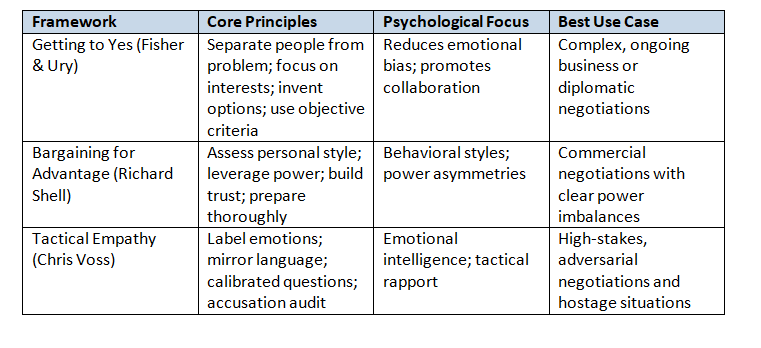
These models overlap yet differ in emphasis: Getting to Yes prioritizes principled fairness, Bargaining for Advantage integrates individual psychology and power, and Tactical Empathy focuses on emotional leverage. Expert negotiators adapt elements from each depending on context.
Step-by-Step Process or Analysis
Mastering negotiation tactics requires a disciplined approach combining psychological insight with strategic timing and language. Below is a detailed six-step process:
Step 1: Preparation and Information Gathering
Before entering talks, research the counterpart’s interests, constraints, and negotiation style. Use open-source intelligence, previous deal data, and behavioral profiling. Set your target, reservation (walk-away) point, and BATNA (Best Alternative to a Negotiated Agreement), a concept from Fisher & Ury.
Psychological tip: Anticipate cognitive biases your counterpart may have, such as anchoring or loss aversion, and prepare to use or counteract them.
Step 2: Building Rapport and Tactical Empathy
Open the conversation by mirroring body language and speech patterns. Use labeling to acknowledge emotions: "It seems like you have concerns about the timeline." This reduces defensiveness and builds trust.
Step 3: Anchoring with Strategic Offers
Make the first offer if you have sufficient information, setting a favorable anchor. Frame numbers with precision (e.g., $1,237,500 vs. $1.2M) to increase credibility (precision effect).
Step 4: Questioning and Listening
Use calibrated questions ("How can we work together to achieve your goals?") to elicit information and shift problem-solving onto the counterpart. Combine with active listening and mirroring to deepen understanding.
Step 5: Creating Options and Concessions
Generate multiple options for mutual gain as per Getting to Yes. Use reciprocity by making small concessions early to encourage reciprocal movement.
Step 6: Closing and Agreement Framing
Frame final offers emphasizing loss aversion: "Without this agreement, we risk missing critical market windows." Seek explicit commitment with clear, objective criteria for implementation.
Psychological guidance: Avoid "yes/no" questions that can trap; prefer calibrated questions to maintain dialogue flow.
These steps are iterative, not linear, and require continuous adjustment based on counterpart responses.
Real-World Case Studies
Three diverse examples illustrate how negotiation tactics play out in practice:
1. Apple vs Samsung Patent Licensing Dispute (2012-2018)
Context: Apple and Samsung engaged in multi-jurisdictional patent battles with billions at stake. Both companies used anchoring by making extreme initial claims for damages to influence settlements. Samsung leveraged calibrated questions in mediation, such as "How can we resolve this dispute without further litigation?" to shift focus.
Lesson: Combining hard anchoring with tactical empathy in mediation can break deadlocks in complex IP negotiations.
2. 2011 NFL Lockout Negotiations
Context: The NFL owners and players union faced a labor standoff threatening an entire season. Both parties employed accusation audits, openly acknowledging the other side’s grievances to build trust. Owners used scarcity by imposing a hard deadline (season start), increasing pressure.
Lesson: Recognizing emotional dynamics and using deadlines strategically expedite resolution in labor disputes.
3. Paris Climate Agreement Diplomatic Talks (2015)
Context: Over 190 countries negotiated a global climate framework. Diplomats used principled negotiation to separate personal politics from shared interests. Objective criteria like scientific targets framed discussions, while calibrated questions fostered cooperation.
Lesson: Principled negotiation enables progress in multiparty diplomacy by focusing on interests and objective standards.
These cases demonstrate how different tactics and frameworks apply fluidly depending on stakes, parties, and context.
Recognition and Counter-Response Guide
Understanding how to identify and respond to common negotiation tactics is crucial to maintaining leverage. The table below maps tactics to psychological mechanisms and recommended counter-scripts.
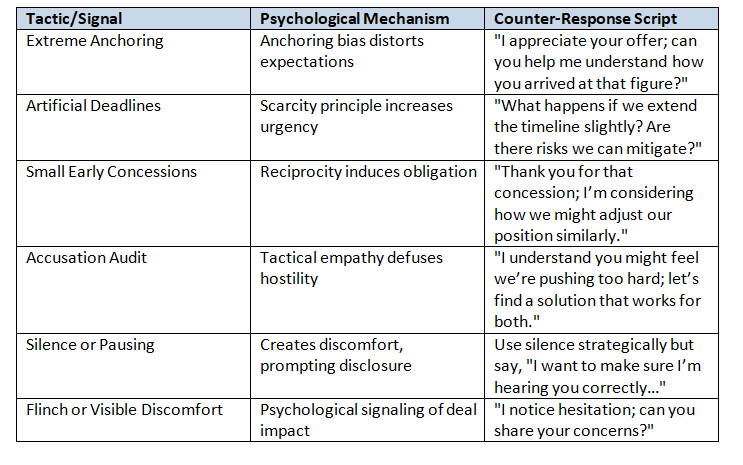
This framework arms negotiators to stay alert, respond thoughtfully, and maintain control.
Advanced Insights
Beyond foundational tactics, elite negotiators deploy nuanced strategies:
- Using the "Accusation Audit" proactively to defuse anticipated objections before the other party raises them, reducing friction.
- Employing calibrated questions that begin with "How" or "What" to transform confrontations into cooperative problem-solving.
- Leveraging "Loss Aversion Framing" by emphasizing what the counterpart stands to lose rather than gain.
- Managing "Negotiation Jujitsu": deflecting attacks by redirecting energy back to the problem rather than the person.
- Integrating game theory concepts such as "Zone of Possible Agreement" (ZOPA) and "BATNA" to anticipate counterpart moves and adjust strategy dynamically.
These advanced techniques require practice and situational awareness but yield disproportionate benefits in complex, adversarial settings.
Scripts and Templates
Below are exact word-for-word examples for common scenarios:
1. Opening with Tactical Empathy
"I understand this negotiation is critical for your team, and you might feel pressured by the timeline. Let’s work together to find a solution that meets your priorities."
2. Responding to an Extreme Anchor
"That’s an interesting figure. Can you walk me through the factors that led you to this number? I want to make sure I fully understand your position."
3. Using a Calibrated Question to Solve a Stalemate
"What’s the biggest challenge you see in reaching an agreement today?"
4. Making a Small Concession to Trigger Reciprocity
"I’m willing to adjust the delivery schedule by one week if that helps us move closer to a deal."
5. Closing with Loss Aversion Framing
"If we don’t finalize today, both sides risk missing important market opportunities that could impact revenues this quarter."
These scripts can be adapted but maintaining the psychological intent is key.
Frequently Asked Questions
Q1: How do I decide when to make the first offer in a negotiation?
A1: Making the first offer can establish a strong anchor but only if you have superior information. If uncertain, it may be better to let the counterpart reveal their expectations first. Preparation and understanding anchoring effects are critical here.
Q2: What is the best way to handle a counterpart who uses aggressive or intimidating tactics?
A2: Use tactical empathy to acknowledge their emotions without conceding ground. Label their behavior ("It sounds like this is very important to you") and ask calibrated questions to redirect energy to problem-solving rather than conflict.
Q3: How can I recognize when a counterpart is bluffing or using deceptive tactics?
A3: Look for inconsistencies in language, hesitation, or overuse of ultimatums. Silence and calibrated questions can help expose weak claims. Maintain awareness of your own biases to avoid falling for false anchors.
Q4: How important is body language in negotiation?
A4: Extremely important. Mirroring posture and tone builds rapport. Noticing flinches or discomfort can reveal hidden objections. However, cultural context matters, so interpret nonverbal cues carefully.
Q5: Can negotiation tactics be unethical?
A5: Yes, some tactics like deliberate misinformation or coercion cross ethical lines. Use influence responsibly and focus on creating value, maintaining long-term relationships, and upholding professional integrity.
Conclusion
Negotiation mastery is less about winning at all costs and more about understanding the psychological and strategic levers that govern human decision-making. By dissecting real-world examples, applying rigorous frameworks, and deploying precise language, negotiators can unlock value, reduce conflict, and achieve durable agreements. Embracing tactical empathy, anchoring awareness, calibrated questioning, and principled negotiation sets the stage for success across industries and cultures.
As you integrate these insights and scripts into your negotiation arsenal, remember that preparation, emotional intelligence, and adaptability are your greatest assets. Start by analyzing your last negotiation — identify which tactics you used or encountered, and practice the counter-responses outlined here. For a transformative edge, consider advanced training in behavioral economics and tactical empathy. The next pivotal deal or dispute you face could hinge on just one well-executed word or question — make it count.
Begin your journey to negotiation excellence today and watch as leverage, influence, and value creation become second nature.
References
Fisher, R., Ury, W., & Patton, B. (2011). Getting to Yes: Negotiating Agreement Without Giving In. Penguin Books.
Cialdini, R. B. (2006). Influence: The Psychology of Persuasion. Harper Business.
Voss, C., & Raz, T. (2016). Never Split the Difference: Negotiating As If Your Life Depended On It. Harper Business.
Kahneman, D. (2011). Thinking, Fast and Slow. Farrar, Straus and Giroux.
Shell, R. (2006). Bargaining for Advantage: Negotiation Strategies for Reasonable People. Penguin Books.
Raiffa, H. (1982). The Art and Science of Negotiation. Harvard University Press.