Negotiation Timeline Strategy: How to Use Time as Leverage to Win Deals

In 2018, Amazon’s procurement team famously extended a key negotiation timeline with a major supplier by six months, multiplying their leverage to secure a 12% cost reduction. This deliberate stretching of decision deadlines forced the supplier to weigh lost future revenues against immediate concessions — a textbook example of how timing can be a powerful negotiation asset. In an era where deals are increasingly complex and competitive, understanding how to strategically manage the negotiation timeline has become a critical differentiator for senior negotiators.
Time is not just a passive dimension in negotiations; it is a dynamic tool that can shape perceptions, influence decision-making, and redefine leverage. As markets accelerate and information flows instantaneously, savvy negotiators must master the psychology, frameworks, and tactics behind time-based leverage to outmaneuver counterparts. The ability to control, manipulate, or respond to timing pressures can be the difference between reaching a favorable agreement or settling for suboptimal terms.
By the end of this comprehensive guide, you will master the foundational theories that explain why time influences negotiation outcomes, learn how to apply proven frameworks like BATNA timing, ZOPA shifts over time, and MESO sequencing, and gain step-by-step processes to design your negotiation timeline strategically. You will also explore detailed case studies from Apple, IBM, and labor unions, uncover common timing pitfalls, and discover advanced tactics and ready-to-use scripts that transform time into your most potent bargaining chip.
· Table of Contents
Negotiation Timeline Strategy: How to Use Time as Leverage
- The Strategic Foundation
- Key Frameworks and Models
- Step-by-Step Process
- Real-World Case Studies
- Common Pitfalls and How to Avoid Them
- Advanced Tactics
- Scripts and Templates
- Frequently Asked Questions
- Conclusion
- References
The Strategic Foundation
Understanding how time functions as a lever in negotiation requires a deep dive into the psychology and decision science that underpin human behavior under temporal constraints. At the core lies the concept of loss aversion, first rigorously identified by Kahneman & Tversky (1979). Their Prospect Theory highlights that people disproportionately weigh potential losses over equivalent gains. In negotiation timelines, the looming risk of losing a deal or opportunity as deadlines tighten amplifies loss aversion, often compelling concessions.
Fisher & Ury’s seminal work Getting to Yes (1981) introduced principled negotiation, emphasizing separating people from the problem and focusing on interests over positions. Time pressures can strain this principle by elevating emotional stress, which negotiators must anticipate and manage. Recognizing how temporal stress impacts rationality is crucial to maintaining constructive dialogue.
Robert Cialdini’s Influence (2006) uncovers powerful persuasion principles like scarcity and reciprocity. Deadlines create a scarcity effect — “limited time to act” — which can accelerate agreement but also risk backlash if perceived as manipulation. Effective negotiators balance urgency with credibility, leveraging time without alienating counterparts.
G. Richard Shell’s Bargaining for Advantage (2006) underscores the importance of preparation, including understanding one’s Best Alternative to a Negotiated Agreement (BATNA). Timing directly affects BATNA strength: delaying can improve alternatives or diminish them depending on market dynamics. Similarly, Deepak Malhotra & Max Bazerman’s Negotiation Genius (2007) expands on tactical timing — knowing when to make offers or concessions to maximize leverage.
Together, these theories establish that time is not merely a background variable but an active strategic resource influencing psychology, leverage, and outcomes. Mastery requires both appreciating these cognitive and behavioral drivers and applying them within structured frameworks and processes.
Key Frameworks and Models
Several negotiation frameworks explicitly incorporate time as a strategic element. Below are three pivotal models that senior negotiators use to structure and exploit timeline dynamics.
1. BATNA Timing Model
Focuses on how the value of alternatives evolves over time, shaping leverage windows.
2. ZOPA Evolution Framework
Examines how the Zone of Possible Agreement shifts as expiration dates approach or conditions change.
3. MESO Sequencing (Multiple Equivalent Simultaneous Offers)
Involves presenting several equivalent offers with staggered deadlines to manage counterpart's decision timeline and preferences.
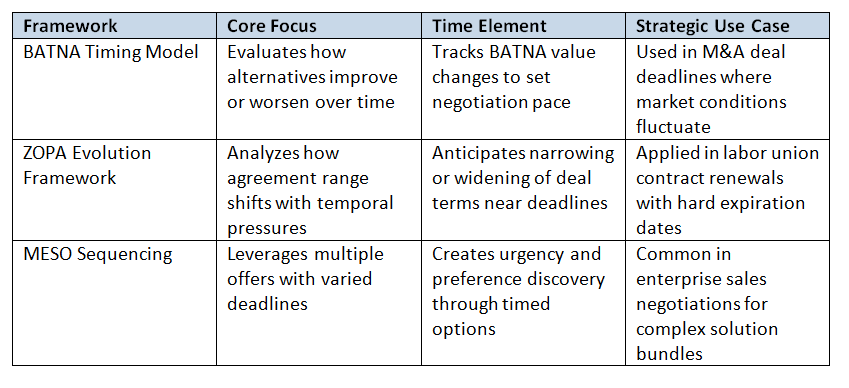
These models integrate psychological insights with tactical timing. For example, the BATNA Timing Model leverages the fact that a negotiator’s fallback options may strengthen with patience or deteriorate due to external events — a dynamic that can be weaponized to accelerate or delay agreement. The ZOPA Evolution Framework emphasizes that the willingness to concede or stand firm may change as deadlines approach, often compressing the bargaining zone and forcing compromise.
MESO Sequencing, popularized by Malhotra & Bazerman, uses staggered offers to provide counterparts with choice while embedding deadlines that pressure timely decisions. This approach simultaneously respects autonomy and exploits time pressure, a sophisticated balance that often yields superior outcomes.
Step-by-Step Process
Successfully applying a negotiation timeline strategy requires a deliberate, methodical approach. Below is a six-step process to design and execute timing leverage effectively.
Step 1: Diagnose Time Sensitivities and Constraints
Begin by identifying all relevant deadlines — internal and external. This includes contract expiration dates, market events, regulatory filings, budget cycles, and counterpart timing pressures. Map out both parties’ time constraints and urgency levels. Use stakeholder interviews, calendar reviews, and scenario analysis to uncover hidden timing factors.
Step 2: Assess BATNA Dynamics Over Time
Evaluate how your alternatives to agreement are likely to evolve during the negotiation timeline. Will waiting strengthen your BATNA (e.g., by sourcing other suppliers) or weaken it (e.g., due to inventory shortage)? Similarly, estimate your counterpart’s BATNA trajectory. This assessment informs whether to accelerate or delay proceedings.
Step 3: Define Your Timing Objectives and Milestones
Set clear objectives for when key decisions, offers, and concessions should occur. Break the timeline into phases: information gathering, proposal exchange, concession rounds, and final agreement. Define milestones and “drop-dead” dates. This roadmap guides controlled pacing and signals discipline to your counterpart.
Step 4: Craft Time-Based Offers and Concessions
Design proposals that incorporate timing elements explicitly — for example, offers contingent on acceptance before a deadline or tiered discounts expiring at specified dates. Use MESO sequencing to provide multiple equivalent options with staggered deadlines, nudging counterparts toward faster decisions without overt pressure.
Step 5: Manage Communication and Information Flow Strategically
Control when and how information is shared, leveraging timing to build momentum or create suspense. Deliberate pauses can increase counterpart anxiety about deal loss, while timely disclosures can build trust. Use time-limited proposals and calibrated silence as tactical tools.
Step 6: Monitor, Adapt, and Reset Timelines as Needed
Continuously track progress against milestones and remain flexible to adjust timelines in response to counterpart behavior, market changes, or new information. Effective negotiators treat timelines as living documents, not rigid scripts. Communicate timeline shifts transparently to maintain credibility.
This process ensures timing strategy is not guesswork but a disciplined, iterative practice embedded into the negotiation architecture.
Real-World Case Studies
Examining real cases crystallizes how timeline strategy operates in complex, high-stakes environments.
Apple vs Samsung Patent Licensing Negotiations (2012-2014)
In protracted patent licensing talks, Apple leveraged time by intentionally delaying certain counteroffers to coincide with Samsung’s product launch cycles. Apple’s team understood Samsung’s urgent need to clear patent clouds before new releases and used this timeline pressure to negotiate higher royalties. The lesson: aligning timing strategy with counterpart’s business rhythms yields leverage beyond price.
IBM Enterprise Software Sales Negotiation (2019)
IBM’s sales team employed MESO sequencing with a Fortune 500 client by presenting three solution bundles with staggered acceptance deadlines. This method uncovered the client’s preference for flexibility but pressured a decision before IBM's fiscal year-end. The result was a signed contract with enhanced terms. The lesson: time-framed multiple offers can accelerate complex B2B deals.
UAW (United Auto Workers) Labor Contract Negotiations (2019)
The UAW exploited hard expiration deadlines of existing contracts to rally membership support for concessions. The union’s communication campaign emphasized imminent job risks if talks failed before the deadline, leveraging loss aversion and urgency. The automakers, facing production stoppages, conceded wage increases. The lesson: well-managed deadline narratives mobilize stakeholder pressure effectively.
Common Pitfalls and How to Avoid Them
Despite its power, time-based negotiation strategy carries risks. Missteps can erode trust, reduce flexibility, or backfire entirely.
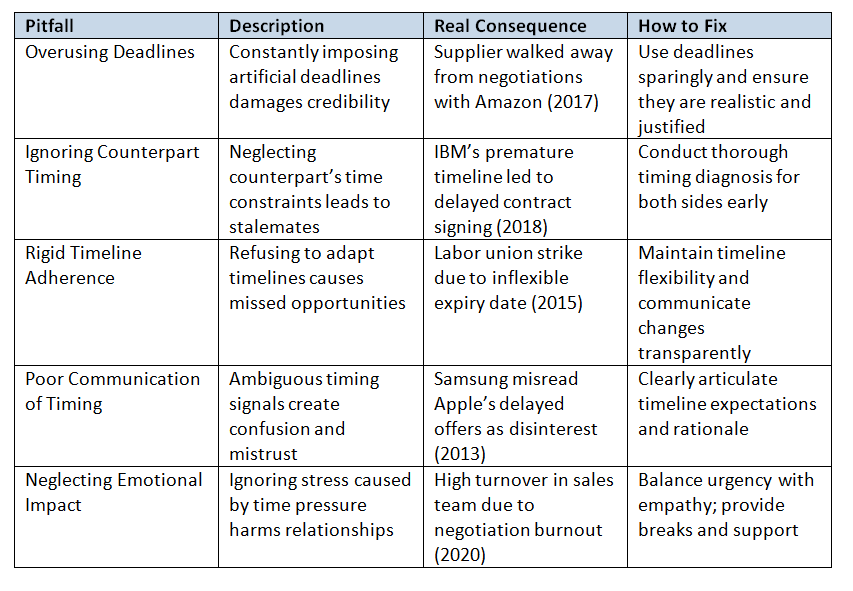
Avoiding these pitfalls requires combining timing discipline with emotional intelligence and clear communication.
Advanced Tactics
Experienced negotiators can elevate timeline strategy through nuanced techniques:
· Temporal Anchoring
Setting initial timing expectations early to anchor counterpart’s perceptions of pacing. For example, stating “We aim to finalize within 45 days” can frame all subsequent timing discussions.
· Strategic Delay with Credible Explanations
Deliberately postponing offers citing legitimate reasons (e.g., awaiting internal approvals) to build anticipation and pressure.
· Reverse Deadlines
Allowing the counterpart to set deadlines but subtly influencing the length or rigidity by framing consequences.
· Time-Phased Concessions
Scheduling concessions to unlock progressively only if counterpart agrees by certain dates, creating a structured incentive timeline.
· Psychological Time Framing
Using language that redefines perceived time pressure, e.g., “This opportunity is fleeting” or “Waiting may reduce benefits,” to magnify urgency without explicit deadlines.
· Deadline Packaging
Combining multiple offers or decisions into a single deadline event to maximize pressure and decision impact.
These tactics require sophisticated reading of counterpart behavior and situational context to deploy effectively without eroding trust.
Scripts and Templates
Below are ready-to-use negotiation timeline scripts and template language to incorporate timing leverage professionally.
“Given the complexity and urgency of this project, our team is targeting to reach a final agreement within 60 days. This timeline ensures we align with both our fiscal planning and your implementation schedule. How does this fit with your internal decision process?”
“We are prepared to offer a 10% discount on volumes committed by June 30th. After this date, standard pricing will apply due to supplier cost structures. We believe this window allows sufficient time for your review and approval.”
“To ensure we present a fully vetted proposal, we need an additional two weeks to finalize internal approvals. We appreciate your patience as this will allow us to deliver a solution that meets all your needs.”
Dear [Counterpart Name],
Please find below three viable options for your consideration. Each is equivalent in value but structured differently to align with your priorities.
Option A: [Description] — Valid until [Date 1]
Option B: [Description] — Valid until [Date 2]
Option C: [Description] — Valid until [Date 3]
We encourage you to review these options at your convenience and let us know which best supports your objectives.
Best regards,
These scripts balance professionalism, clarity, and strategic timing influence.
Frequently Asked Questions
Q1: How can I determine the optimal timing to introduce deadlines in negotiation?
A1: Analyze both parties’ time constraints and BATNA trajectories. Introduce deadlines when your alternatives strengthen or when counterpart urgency peaks. Use credible reasons for deadlines to maintain trust.
Q2: What if my counterpart ignores or resists my proposed timelines?
A2: Engage in dialogue to understand their constraints and adjust timelines collaboratively. Consider using MESO offers with flexible deadlines to increase options and reduce resistance.
Q3: How do I avoid appearing manipulative when using time pressure?
A3: Be transparent about reasons for timing requests, avoid excessive or artificial deadlines, and balance urgency with empathy. Maintain open communication about timeline shifts.
Q4: Can delaying negotiations improve my leverage?
A4: Yes, if waiting improves your BATNA or market position. However, consider risks of counterpart impatience or external changes. Always weigh benefits vs. costs of delay.
Q5: How should I respond if a counterpart uses aggressive timing tactics?
A5: Stay calm and assess their timing rationale. Use your own time-based counters, seek deadline extensions if needed, and don’t concede prematurely. Use principled negotiation to separate people from the problem.
These responses align timing strategy with best practices in negotiation psychology and tactics.
Conclusion
Mastering negotiation timeline strategy equips senior negotiators with a powerful yet often underutilized lever to shape deal outcomes. By understanding the psychological underpinnings of time pressure, leveraging proven frameworks like BATNA timing and MESO sequencing, and rigorously applying a structured step-by-step process, negotiators can transform temporal constraints from obstacles into strategic assets. Real-world examples from industry leaders underscore how timing mastery drives superior agreements.
Avoiding common pitfalls and employing advanced tactics further differentiates expert negotiators. With precise scripts and templates at your disposal, you can implement timing leverage immediately and confidently. In today’s fast-paced, high-stakes business environment, time is more than money — time is power. Harness it fully to close deals on your terms.
Take the next step now: assess your current negotiation timelines, identify timing leverage points, and integrate these strategies into your negotiation playbook. Your competitive edge awaits.
References
Fisher, R., Ury, W., & Patton, B. (1981). Getting to Yes: Negotiating Agreement Without Giving In. Penguin Books.
Kahneman, D., & Tversky, A. (1979). Prospect Theory: An Analysis of Decision under Risk. Econometrica, 47(2), 263–291.
Cialdini, R. B. (2006). Influence: The Psychology of Persuasion. Harper Business.
Shell, G. R. (2006). Bargaining for Advantage: Negotiation Strategies for Reasonable People. Penguin Books.
Malhotra, D., & Bazerman, M. (2007). Negotiation Genius: How to Overcome Obstacles and Achieve Brilliant Results at the Bargaining Table and Beyond. Bantam.
Bazerman, M., & Neale, M. (1992). Negotiating Rationally. Free Press.
Harvard Business Review. (2015). The Power of Time in Negotiations. HBR Press.