Negotiation Tips for Beginners: The Complete Guide

Negotiation is an essential skill that influences nearly every aspect of our lives, from landing a job offer to closing business deals or even resolving conflicts at home. For beginners, stepping into a negotiation can feel intimidating, but with the right knowledge and preparation, anyone can become a confident and effective negotiator. Understanding the fundamentals and practicing proven techniques will not only improve your outcomes but also enhance your communication and relationship-building skills.
This comprehensive guide is designed specifically for beginners who want to master negotiation basics and advance quickly. You will learn actionable tips, psychological principles behind successful negotiations, and real-world examples that demonstrate how to apply these concepts effectively. Whether you are negotiating your salary, purchasing a car, or navigating a business contract, this guide will equip you with the tools to negotiate with confidence and achieve favorable results.
By the end of this guide, you will understand key negotiation tactics such as preparation, framing, anchoring, and how to handle objections. You’ll also gain insight into the importance of emotional intelligence and active listening in negotiations. Let’s start your journey to becoming a skilled negotiator.
· Table of Contents
· Understanding the Basics of Negotiation
· Preparing Effectively for Negotiations
· Key Negotiation Techniques for Beginners
· Psychological Principles in Negotiation
· Handling Difficult Negotiation Scenarios
· Real-World Negotiation Examples and Scripts
· Frequently Asked Questions (FAQ)
Understanding the Basics of Negotiation
Negotiation is a process where two or more parties with differing needs and goals discuss an issue to reach a mutually acceptable agreement. At its core, negotiation involves communication, persuasion, and problem-solving. For beginners, it’s important to recognize that negotiation is not about winning at all costs but about creating value and finding a solution that satisfies all parties to some degree.
There are several types of negotiation, including:
· Distributive Negotiation – Often called “win-lose,” this type involves dividing a fixed amount of resources. For example, haggling over the price of a product.
· Integrative Negotiation – Known as “win-win,” this focuses on collaboration to expand the pie and find creative solutions that benefit all parties. For instance, negotiating a partnership deal where both sides gain unique advantages.
· Multiparty Negotiation – Involves more than two parties, requiring complex coordination and coalition-building.
Understanding these types helps beginners select the right approach depending on the context.
Most negotiations follow a similar process:
· Preparation: Research and plan your goals and limits.
· Opening: Establish rapport and set the tone.
· Bargaining: Exchange offers and counteroffers.
· Closing: Reach agreement and confirm terms.
· Implementation: Follow through on the agreement.
Each stage requires specific skills, and beginners should focus heavily on preparation and rapport-building as foundational steps.
Preparing Effectively for Negotiations
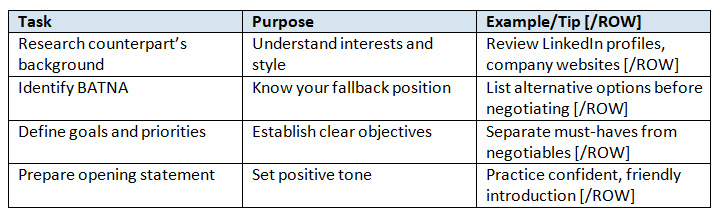
Preparation is the most critical phase of successful negotiation, often determining the outcome before the discussion even begins. Beginners tend to underestimate this stage, but thorough preparation gives you confidence, clarity, and leverage.
Understanding who you are negotiating with can reveal their interests, constraints, and negotiation style. For example, knowing whether they prefer collaborative or competitive approaches can shape your tactics.
Example: If you are negotiating a job offer, your BATNA might be another job prospect or staying in your current role. This knowledge prevents you from accepting unfavorable terms.
List your must-haves versus nice-to-haves. Prioritize aspects such as price, deadlines, or service levels. This clarity enables flexibility in less critical areas while holding firm on essentials.
First impressions matter. Prepare concise, positive opening remarks to establish rapport and frame the negotiation constructively. For example:
"I’m excited about the opportunity to work together and believe we can find a solution that works well for both of us."
Preparation Checklist for Beginners
Key Negotiation Techniques for Beginners
Mastering core negotiation techniques enables beginners to steer discussions effectively and maximize outcomes. Below are several proven methods with practical examples.
Anchoring involves setting the initial offer or reference point, which heavily influences the negotiation range. For example, if selling a car, starting at a slightly higher price than your minimum acceptable amount can anchor the buyer’s expectations upward.
Framing is about presenting information in a way that highlights benefits or reduces perceived risks. For instance, framing a salary request in terms of the value you bring to the company rather than just the amount desired increases persuasive impact.
Mirroring means subtly repeating the last few words your counterpart says to encourage elaboration. Labeling involves naming their emotions to build rapport.
Example script:
"You seem concerned about the timeline."
This validates their feelings and fosters trust.
This method addresses objections by empathizing, sharing perspective, and providing a solution.
Example:
"I understand how you feel about the price. Others have felt the same way initially, but they found that the quality and service justified the investment."
After making an offer or statement, remain silent. Humans naturally feel compelled to fill silence, often revealing more information or making concessions.
Summary of Techniques
· Anchor with the first offer to influence outcomes.
· Frame proposals positively to highlight value.
· Use mirroring and labeling to build rapport and gather information.
· Apply “Feel-Felt-Found” to handle objections empathetically.
· Leverage silence strategically to prompt concessions.
Psychological Principles in Negotiation
Understanding human psychology helps beginners decode behavior and influence decisions more effectively.
People feel compelled to return favors. Offering a concession or small gift early can encourage the other party to reciprocate.
Individuals prefer avoiding losses over acquiring gains. Framing offers highlighting what the counterpart might lose by not agreeing can be persuasive.
Example:
"If we don’t finalize this contract now, you risk losing the exclusive rights to this product."
People seek information that confirms their beliefs. Presenting data aligned with their values or expectations can increase acceptance.
As discussed, the first number put on the table sets a cognitive anchor.
Showing that others have accepted similar deals or benefited from your proposal can build trust.
Example:
"We’ve helped over 50 companies improve efficiency with this solution."
High EI negotiators perceive and manage emotions effectively, facilitating smoother interactions. Skills include active listening, empathy, and self-regulation.
Applying Psychological Principles: Example Script
Counterpart: "Your price is too high."
Response:
"I understand (labeling) that budget is a concern. Many clients initially felt the same, but they found (Feel-Felt-Found) that the long-term savings outweighed the upfront cost. Also, if you wait, you might miss out on this limited offer (loss aversion)."
Handling Difficult Negotiation Scenarios
Negotiations do not always go smoothly. Beginners should prepare for common challenges such as aggressive counterparts, deadlocks, or emotional flare-ups.
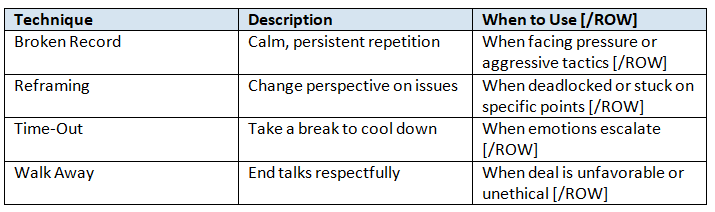
Stay calm and assertive. Use the “broken record” technique—repeating your key points calmly without escalating.
Example:
"I appreciate your concerns. My position remains that the price is fair given the quality."
If negotiations stall, try shifting focus to alternative issues or suggesting a break.
Taking a short break can defuse tension and allow both parties to reassess.
Recognize when emotions run high and use active listening to validate feelings. Avoid personal attacks and keep the discussion issue-focused.
Knowing when to exit is critical. If the deal doesn’t meet your BATNA or violates your core principles, politely end negotiations.
Conflict Resolution Techniques
Real-World Negotiation Examples and Scripts
Learning through examples helps beginners visualize how to apply techniques in practice.
Situation: Jane receives a job offer below her expectations.
Script:
"Thank you for the offer. I’m excited about the opportunity. Based on my research and experience, I was expecting a salary in the range of $70,000 to $75,000. Is there flexibility to discuss this?"
If the employer hesitates:
"I understand budget constraints. Many companies find that investing in experienced candidates leads to faster results and long-term savings. Could we explore other compensation components like bonuses or additional vacation?"
Situation: Buyer wants to negotiate price down.
Script:
“I’m very interested in the car, but the asking price is above my budget. I noticed some wear on the tires and the car has been on the market for 60 days. Would you consider $8,000?”
If seller counters higher:
"That’s a bit above what I planned. However, I’m ready to purchase today if we can agree on $8,500."
Situation: Vendor and client disagree on delivery timelines.
Script:
"I see the timeline is critical for your project. Could we look at phased delivery to meet your urgent needs while maintaining quality?"
Frequently Asked Questions (FAQ)
What is the most important skill for beginner negotiators?
The most important skill is preparation. Knowing your goals, alternatives (BATNA), and understanding the other party’s interests set the foundation for successful negotiation. Without preparation, even good communication skills may fall short.
How do I handle nervousness during negotiation?
Practice is key. Role-play with a friend or mentor to build confidence. Focus on active listening and breathing techniques to stay calm. Remember, negotiation is a dialogue, not a confrontation.
Should I reveal my bottom line or BATNA?
It’s generally better to keep your BATNA private to maintain leverage. Revealing your absolute minimum can weaken your position. Instead, focus on articulating your value and priorities.
How can I improve my negotiation skills quickly?
Engage in real negotiations frequently, even in low-stakes situations like splitting bills or scheduling. Study negotiation books, watch expert talks, and reflect on each experience to identify areas for improvement.
What if the other party is unreasonable or unethical?
Maintain professionalism and set clear boundaries. If unethical behavior persists, be ready to walk away. Protecting your integrity and interests is paramount.
Conclusion
Negotiation may seem daunting to beginners, but with deliberate preparation, understanding core techniques, and leveraging psychological insights, you can approach any negotiation with confidence and achieve better outcomes. Remember, negotiation is a skill refined over time through practice, reflection, and learning from each interaction.
Start applying these tips today by preparing thoroughly for your next negotiation, practicing techniques like anchoring and framing, and observing how people respond. The ability to negotiate effectively will serve you in your career, personal life, and countless everyday situations. Take control of your negotiations—your success depends on it.
Mastering how to negotiate is not about tricks — it's about clarity, positioning, and control. If you want to go deeper into advanced negotiation strategies, negotiation psychology, handling objections, and negotiating under pressure, explore our full library of articles designed for professionals operating in high-stakes business environments.
References
· Fisher, Roger, and William Ury. “Getting to Yes: Negotiating Agreement Without Giving In.” Penguin Books, 2011.
· Voss, Chris, and Tahl Raz. “Never Split the Difference: Negotiating As If Your Life Depended On It.” Harper Business, 2016.
· Shell, G. Richard. “Bargaining for Advantage: Negotiation Strategies for Reasonable People.” Penguin Books, 2006.
· Cialdini, Robert B. “Influence: The Psychology of Persuasion.” Harper Business, 2006.
· Ury, William. “Getting Past No: Negotiating in Difficult Situations.” Bantam, 1993.