Persuasion Skills in Negotiation

Effective negotiation is more than just exchanging offers; it is an art that hinges on the ability to persuade. In today’s complex business environments and high-stakes interactions, mastering persuasion skills is critical for negotiators who want to influence outcomes, build long-lasting relationships, and create value for all parties involved. Whether you are closing a sales deal, managing a conflict, or securing a partnership, understanding how to ethically and strategically persuade can transform your negotiation results.
Persuasion in negotiation draws heavily from psychological principles and communication strategies that help negotiators move beyond positional bargaining to influence the underlying interests of counterparts. This article will explore the foundational theories, practical techniques, and skill-building exercises essential for developing advanced persuasion skills. You will learn how to leverage frameworks like Cialdini’s principles of influence, the concept of BATNA (Best Alternative to a Negotiated Agreement), anchoring, and active listening to increase your negotiation effectiveness.
By the end of this comprehensive guide, you will be equipped with actionable strategies and real-world examples to apply immediately in your negotiations, enhancing your ability to persuade ethically and close deals with confidence.
· Table of Contents
· Understanding Persuasion in Negotiation: Theory and Psychology
· Core Psychological Principles of Influence
· Practical Persuasion Techniques and Communication Strategies
· The Role of Emotional Intelligence and Rapport Building
· Advanced Negotiation Frameworks: BATNA, Anchoring, and Framing
· Skill-Building Exercises to Enhance Persuasion Abilities
· Frequently Asked Questions about Persuasion in Negotiation
· Conclusion: Integrating Persuasion Skills for Negotiation Success
· References and Further Reading
Understanding Persuasion in Negotiation: Theory and Psychology
Persuasion in negotiation is the deliberate effort to influence another party’s attitudes, beliefs, or behaviors to reach a mutually acceptable agreement. Unlike coercion or manipulation, ethical persuasion respects the autonomy and interests of all parties. It is grounded in social psychology and communication theory, emphasizing trust, credibility, and reciprocity.
The foundation of persuasion lies in understanding that negotiation is a social interaction shaped by cognitive biases, emotional triggers, and interpersonal dynamics. The Dual Process Theory of persuasion, developed by psychologists Richard Petty and John Cacioppo, identifies two main pathways: the central route, which involves thoughtful consideration of arguments, and the peripheral route, which relies on superficial cues such as authority or likability. Skilled negotiators learn to tailor their approach depending on the counterpart’s motivation and ability to process information.
Real-world example: In a high-stakes merger negotiation, the lead negotiator used data-driven presentations (central route) to appeal to the analytical CFO while simultaneously building rapport with the CEO through shared values and social proof (peripheral route). This dual approach helped secure agreement faster and with stronger commitment than relying on facts alone.
Psychological Foundations Relevant to Negotiation
· Reciprocity: People tend to return favors or concessions, creating a cycle of cooperation.
· Commitment and Consistency: Individuals strive to act in ways consistent with prior commitments.
· Social Proof: People look to others’ behavior to guide their own decisions, especially under uncertainty.
· Authority: Credibility and expertise can significantly increase persuasive power.
· Liking: Building positive relationships increases influence potential.
Understanding these principles enables negotiators to craft messages and offers that resonate deeply with counterparts’ psychological drivers.
Core Psychological Principles of Influence
Robert Cialdini’s six principles of influence provide a robust framework for negotiators seeking to enhance persuasion effectiveness. These principles have been validated across multiple domains and offer actionable insights for negotiation contexts.
· Reciprocity: Initiate offers or concessions that encourage counterparts to reciprocate, fostering goodwill and collaboration.
· Commitment and Consistency: Secure small initial agreements or statements that make it psychologically easier for counterparts to agree to larger requests later.
· Social Proof: Use testimonials, references, or examples of others who have accepted similar terms to reduce uncertainty.
· Authority: Demonstrate expertise through credentials, data, or endorsements to increase trustworthiness.
· Liking: Build rapport by finding common ground, showing genuine interest, and employing mirroring techniques.
· Scarcity: Highlight limited availability or time-sensitive offers to motivate decision-making.
Practical Exercise: Before your next negotiation, identify which of Cialdini’s principles you can ethically integrate. For example, prepare a story illustrating social proof or formulate an introductory concession to activate reciprocity.
Mirroring and Active Listening: Enhancing Connection
Mirroring — subtly matching the counterpart’s body language, tone, and language style — creates rapport and signals empathy. Combined with active listening, which involves fully concentrating, understanding, and responding appropriately, these techniques reduce resistance and open pathways for influence.
Script Example:
Negotiator: “It sounds like you’re concerned about the timeline for implementation. Could you tell me more about the specific challenges you foresee?”
Counterpart: “Yes, our team is already stretched thin, and adding this project might delay others.”
Negotiator (mirroring tone and posture): “I understand that workload is a critical factor. Let’s explore how we can adjust the schedule without compromising your priorities.”
This approach validates concerns and encourages collaborative problem-solving.
Practical Persuasion Techniques and Communication Strategies
Persuasion in negotiation is a skillful blend of strategy, communication, and psychology. Here are several proven techniques:
· Framing Offers Positively: Present proposals by emphasizing gains rather than losses (gain-framing) to increase acceptance.
· Using Anchoring Effectively: Set the initial offer strategically to influence the negotiation range. Anchors must be realistic yet aspirational.
· Storytelling: Craft narratives that humanize your position and make abstract terms tangible for counterparts.
· Questioning Techniques: Employ open-ended and clarifying questions to uncover interests and build understanding.
· Managing Silence: Use pauses effectively to allow counterparts to process and often reveal more information.
Real-world example: A sales negotiator used storytelling to present a client success story where an early investment led to substantial ROI. This narrative reframed the pricing discussion from cost to value, increasing the likelihood of acceptance.
Scripts for Persuasive Language
· “Based on our experience with similar companies, implementing this solution can reduce your costs by 15% within six months.”
· “I want to ensure this agreement meets your needs. What concerns do you have that we can address?”
· “Our offer is limited to this quarter, which ensures you benefit from the current pricing and support.”
The Role of Emotional Intelligence and Rapport Building
Emotional intelligence (EI) is the ability to recognize, understand, and manage one’s own emotions and those of others. In negotiation, high EI enables negotiators to read cues, regulate emotional responses, and create a collaborative atmosphere.
· Self-Awareness: Recognize your triggers and biases to maintain composure.
· Empathy: Understand the counterpart’s emotions and viewpoints to tailor your approach.
· Social Skills: Use rapport-building techniques such as small talk, humor, and respectful body language.
Research published in the Journal of Applied Psychology confirms that negotiators with higher EI achieve better outcomes and maintain stronger relationships post-negotiation. Building rapport early in the negotiation reduces defensiveness and increases openness to persuasion.
Practical Exercise: Before negotiations, practice mindfulness to enhance self-awareness and plan rapport-building questions or comments relevant to the counterpart’s context.
Advanced Negotiation Frameworks: BATNA, Anchoring, and Framing
Understanding and leveraging advanced frameworks underpin successful persuasion in negotiation.
· BATNA (Best Alternative to a Negotiated Agreement): Knowing your BATNA and estimating the counterpart’s strengthens your bargaining position. It provides confidence and clarity on when to walk away.
· Anchoring: The first number or offer presented sets a psychological benchmark. Skilled negotiators craft anchors that shape the negotiation zone favorably.
· Framing: How information is presented significantly affects decisions. For example, framing a contract as “guaranteeing performance” versus “risk of failure” influences perceptions.
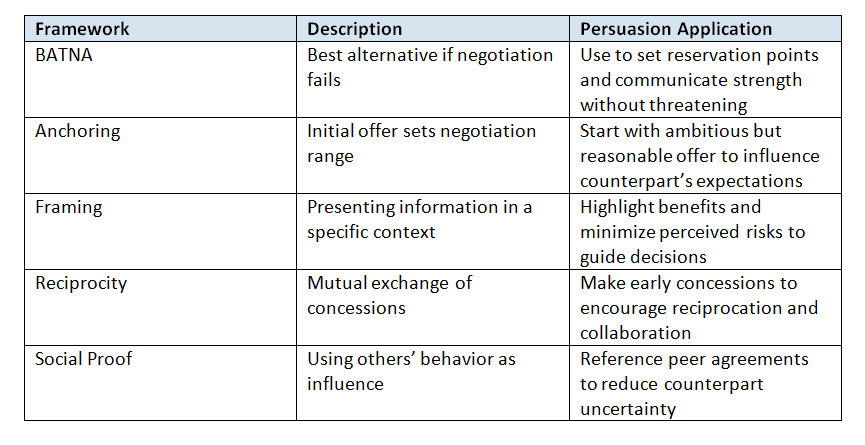
Real-world example: During a supplier contract negotiation, the buyer’s team anchored with a price 10% below market average and framed the offer around long-term partnership benefits. Simultaneously, they communicated their BATNA of an alternative supplier, which led to a favorable agreement.
Skill-Building Exercises to Enhance Persuasion Abilities
Building persuasion skills requires deliberate practice and reflection. The following exercises are designed for executives and sales professionals:
· Role-Playing Scenarios: Partner with a colleague to simulate negotiations using different persuasion principles. Focus on applying active listening, mirroring, and Cialdini’s principles.
· Persuasion Journaling: After each negotiation, document which techniques were used, what worked, and areas for improvement.
· Emotional Intelligence Self-Assessment: Use tools like the EQ-i 2.0 to identify EI strengths and development areas.
· Anchoring Practice: Create multiple opening offers for a hypothetical negotiation and analyze their potential psychological impact.
· Storytelling Development: Write and rehearse client success stories or case studies that highlight your value proposition persuasively.
By integrating these exercises into your routine, you develop muscle memory for persuasion techniques and improve adaptability across diverse negotiation contexts.
Frequently Asked Questions
How can I persuade a counterpart who is highly resistant or skeptical?
Address resistance by building trust through active listening and empathy. Use social proof and authority to validate your position. Break down complex proposals into smaller, manageable agreements to create momentum and reduce perceived risk.
What is the difference between persuasion and manipulation in negotiation?
Persuasion involves influencing others ethically, respecting their autonomy and interests. Manipulation seeks to coerce or deceive for unilateral gain, often damaging relationships and reputations. Ethical persuasion fosters long-term collaboration.
How important is nonverbal communication in persuasion?
Nonverbal cues such as body language, eye contact, and tone significantly impact persuasion. Mirroring and congruent body language increase rapport and trust, while incongruence can raise suspicion. Mastering nonverbal communication enhances overall influence.
Can persuasion skills be learned, or are they innate?
While some individuals may have a natural affinity, persuasion is a skill that can be learned and refined through study, practice, and feedback. Structured exercises and real-world application accelerate development.
How do I know which persuasion principle to apply in a given negotiation?
Assess the counterpart’s personality, motivation, and context. For analytical types, use data-driven central-route persuasion; for more relational or time-pressured counterparts, leverage peripheral cues like authority or scarcity. Flexibility is key.
Conclusion
Persuasion skills are indispensable tools in the negotiator’s arsenal, enabling influence that respects all parties’ interests while maximizing outcomes. By grounding your approach in psychological principles, emotional intelligence, and strategic frameworks like BATNA and anchoring, you can navigate complex negotiations with confidence and ethical authority. Practicing active listening, building rapport, and crafting compelling narratives further amplify your persuasive impact.
As you cultivate these negotiation skills, remember that mastery comes from intentional practice and reflection. Commit to applying the techniques and exercises outlined in this guide, and you will transform your negotiation effectiveness, build stronger relationships, and consistently achieve superior results. Begin integrating these persuasion strategies into your next negotiation and experience the difference firsthand.
References
· Cialdini, Robert B. Influence: The Psychology of Persuasion. Harper Business, Revised Edition, 2021.
· Fisher, Roger, William Ury, and Bruce Patton. Getting to Yes: Negotiating Agreement Without Giving In. Penguin Books, 2011.
· Goleman, Daniel. Emotional Intelligence: Why It Can Matter More Than IQ. Bantam Books, 2006.
· Malhotra, Deepak, and Max Bazerman. Negotiation Genius: How to Overcome Obstacles and Achieve Brilliant Results at the Bargaining Table and Beyond. Bantam, 2007.
· Shell, G. Richard. Bargaining for Advantage: Negotiation Strategies for Reasonable People. Penguin, 2006.