Power Tactics in Negotiation: How to Build and Use Leverage

Negotiations often come down to who holds the power and how effectively they wield it. Consider the 2012 Apple vs. Samsung patent dispute — a multi-billion-dollar legal battle where Apple’s strategic use of patent leverage reshaped not only the smartphone industry but also how tech companies negotiate intellectual property. Apple’s ability to marshal its patents as leverage forced Samsung into a costly settlement, demonstrating how power tactics can decisively tilt the playing field.
Yet many negotiators misunderstand power. They mistake dominance or aggression for leverage, failing to grasp the subtle psychological and strategic levers at play. Behavioral economics and negotiation science reveal that power is not merely about who has what resources, but how those resources are framed, communicated, and perceived. Cognitive biases such as anchoring and loss aversion influence how leverage works, while tactical empathy and calibrated questions can shift power dynamics even when the material advantage seems uneven.
In this definitive guide, you will master the art and science of power tactics in negotiation. You will learn proven frameworks like the BATNA model, Roger Fisher’s “Getting to Yes” principled negotiation, and game theory concepts including Nash equilibrium. We’ll break down step-by-step processes for building leverage, recognizing opponent tactics, and deploying countermeasures. You’ll access exact scripts to apply in real negotiations—from high-stakes mergers to labor talks—and explore expert-level insights that elevate your power to win.
· Table of Contents
· The Psychology and Science Behind Power Tactics in Negotiation
· Key Frameworks and Models for Building and Using Leverage
· Step-by-Step Process: How to Build and Use Power Tactics
· Real-World Case Studies: Corporate, Sports, and Diplomatic Negotiations
· Recognition and Counter-Response Guide: Tactics and Scripts
· Advanced Insights: Expert Techniques Beyond the Basics
· Scripts and Templates for Common Power Tactic Scenarios
· Frequently Asked Questions on Power Tactics in Negotiation
· Conclusion: Synthesizing Insights and Next Steps
· References: Authoritative Sources and Research
The Psychology and Science Behind This Topic
Power in negotiation is fundamentally about influence—the ability to shape the other party’s choices and perceptions. Behavioral economics and psychology uncover how leverage operates beyond mere positional strength.
Daniel Kahneman’s work on prospect theory and loss aversion is pivotal: people weigh potential losses more heavily than equivalent gains, making threat-based leverage (the power to impose losses) especially compelling. Anchoring effects also play a role—initial offers or terms set expectations that influence counteroffers and concessions. For example, a high opening anchor creates room to negotiate down while maintaining favorable terms.
Robert Cialdini’s principles of influence—reciprocity, scarcity, authority, commitment, liking, and social proof—explain how negotiators can generate leverage by creating perceived scarcity or invoking authority. For instance, scarcity (limited offer or time constraint) heightens urgency, boosting the power of an offer.
Chris Voss’s tactical empathy techniques, such as mirroring and labeling, allow negotiators to defuse resistance and subtly shift power balances by acknowledging emotions and perspectives. Voss emphasizes that understanding the counterpart’s worldview empowers you to craft calibrated questions that guide them toward your desired outcome voluntarily.
Game theory concepts like the Nash equilibrium and zero-sum versus positive-sum frameworks reveal that power is context-dependent: in some negotiations, power is a fixed pie (zero-sum), while in others, creative value creation can enlarge the pie, changing leverage dynamics.
Richard Shell’s research highlights that power derives both from sources (BATNA, alternatives, information) and processes (communication, timing, framing). Fisher and Ury’s “Getting to Yes” introduced principled negotiation that leverages objective criteria and mutual gains rather than positional power alone.
Understanding these psychological and economic mechanisms arms negotiators to wield power tactically, ethically, and effectively.
Key Frameworks and Models
Several frameworks provide structured approaches to understanding and applying power tactics in negotiation. The three foundational models are:
1. BATNA (Best Alternative to a Negotiated Agreement) - Fisher, Ury & Patton
2. Principled Negotiation - Fisher & Ury (“Getting to Yes”)
3. Game Theory Models - Nash Equilibrium, Zero-Sum vs Positive-Sum
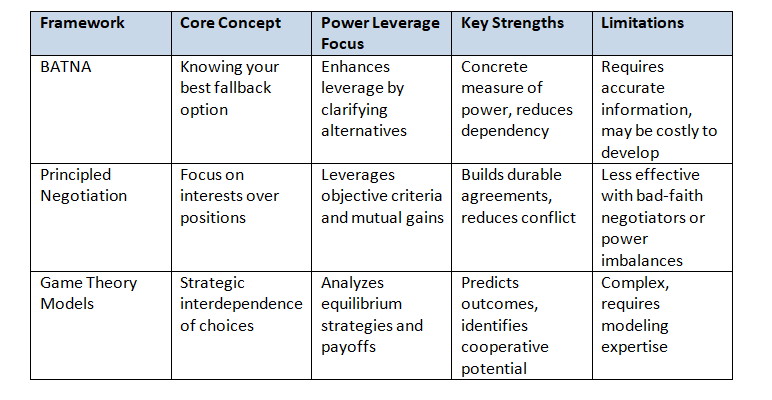
These models can be combined. For example, a negotiator with a strong BATNA can use principled negotiation to frame proposals around objective standards, while applying game theory insights to anticipate counterpart moves and responses.
Step-by-Step Process or Analysis
Mastering power tactics requires a disciplined process incorporating psychological insight, strategic planning, and tactical execution. Below is a six-step approach:
Step 1: Assess and Develop Your BATNA
Begin by rigorously identifying your alternatives if the negotiation fails. A strong BATNA provides leverage because it reduces your dependency on the counterpart’s terms. Use research, market analysis, and scenario planning to rank alternatives.
Psychological note: A well-understood BATNA boosts confidence, reducing anxiety and improving your ability to walk away if needed—this is a key behavioral advantage.
Step 2: Gather and Analyze Information
Information asymmetry is a primary source of power. Collect data on the counterpart’s needs, constraints, deadlines, and alternatives. Use open-source intelligence, industry reports, and interpersonal probing.
Use calibrated questions (Voss) like “How does this proposal align with your priorities?” to extract insight without provoking defensiveness.
Step 3: Frame Your Offers Using Anchoring and Scarcity
Set initial offers strategically to anchor negotiations favorably. Combine this with scarcity tactics (limited-time offers, exclusive terms) to increase urgency.
Language tip: “This is a unique opportunity with limited availability” leverages Cialdini’s scarcity principle.
Step 4: Apply Tactical Empathy and Labeling
Acknowledge the counterpart’s emotions to build rapport and reduce resistance. Labeling statements such as “It seems like you’re concerned about the timeline” validate feelings and open collaboration.
This shifts power by lowering emotional barriers and increasing trust.
Step 5: Use Objective Criteria and Principled Negotiation
Shift discussions from positional bargaining to interest-based negotiation using objective standards—market rates, industry benchmarks, legal norms.
Phrase scripts: “Let’s look at comparable market data to evaluate this term fairly.”
This reduces power struggles rooted in subjective claims.
Step 6: Prepare and Execute Counter-Tactics
Anticipate common power plays such as bluffing, extreme demands, or deadline pressure. Prepare counter-responses using denial, calibrated questions, or the accusation audit.
For example, if faced with a high anchor, respond: “That number seems higher than expected—can you help me understand how you arrived at it?”
This disarms tactics and preserves your leverage.
Real-World Case Studies
Examining real negotiations illustrates power tactics in action.
Case 1: Apple vs Samsung Patent Negotiations
Apple’s accumulation of key smartphone patents created a BATNA superior to many competitors. During litigation, Apple leveraged this patent portfolio to negotiate licensing agreements worth billions. Apple’s principled framing around innovation rights combined with aggressive anchoring of damages demands exemplified integrated power tactics.
Lesson: Building intellectual property as leverage combined with principled negotiation and legal framing can yield outsized power.
Case 2: NFL Contract Disputes — The 2011 Lockout
NFL players and owners engaged in labor negotiations where owners used the threat of a lockout (loss aversion leverage) to pressure players. Players countered by signaling willingness to strike, strengthening their BATNA. Tactical empathy between union reps and owners helped reestablish dialogue, eventually leading to a compromise.
Lesson: In labor negotiations, understanding and signaling alternatives is critical leverage; emotional intelligence can break deadlocks.
Case 3: Diplomatic Negotiations — Cuban Missile Crisis (1962)
President Kennedy’s careful calibration of public and private messages, combined with naval blockade framing, created leverage without escalating to war. The use of calibrated threats and backchannel communications exemplifies game theory in diplomacy.
Lesson: Power tactics in diplomacy hinge on credible alternatives and calibrated communication to avoid zero-sum escalation.
Recognition and Counter-Response Guide
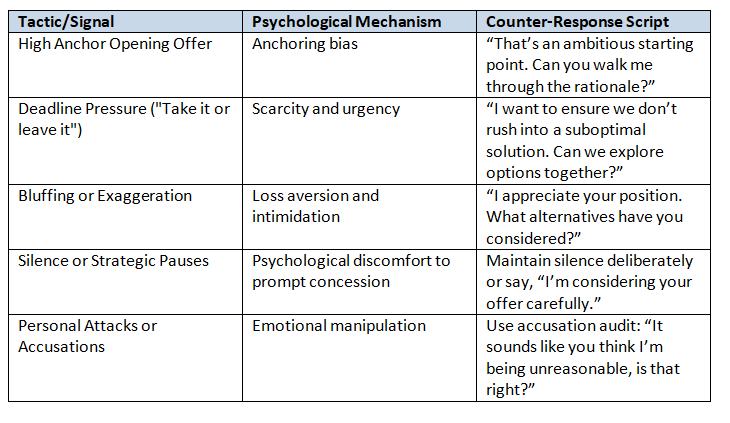
Effective negotiators not only deploy but recognize power tactics and respond aptly. The table below maps common tactics, underlying psychology, and scripted counters.
Advanced Insights
Power tactics extend beyond basics into nuanced areas:
- Timing Leverage: Knowing when to reveal or withhold information can shift power. For example, revealing your BATNA late can surprise the counterpart, changing dynamics.
- Reciprocal Concessions Framing: Instead of unilateral concessions, frame them as mutual trade-offs using Cialdini’s reciprocity principle.
- Multi-Party Negotiations: Leverage shifts when multiple stakeholders are involved; coalition-building increases your power by aligning interests.
- Meta-Negotiation: Negotiating the negotiation rules themselves (agenda, venue, timing) creates initial leverage that shapes all subsequent interactions.
- Emotional Intelligence Integration: Power can be wielded through emotional contagion and mood management, subtly influencing counterpart behavior.
Scripts and Templates
Below are tested word-for-word scripts for common power tactic scenarios:
1. Responding to a High Anchor
“I see you’ve started with a figure well above market norms. To move forward constructively, can you share the data supporting this number?”
2. Defusing Deadline Pressure
“I understand the urgency, but ensuring the terms work for both sides is critical. Can we agree on a timeline that balances speed and thoroughness?”
3. Using the Accusation Audit
“You might be thinking that I’m dragging my feet or being inflexible. I want to assure you I’m committed to finding a fair solution.”
4. Deploying Tactical Empathy
“It sounds like you’re concerned that accepting this proposal might stretch your resources too thin.”
5. Framing a Concession as Reciprocity
“I’m willing to adjust this term if you can provide flexibility on delivery timelines.”
Frequently Asked Questions
Q1: How does having a strong BATNA increase my negotiation power?
A1: A strong BATNA means you have valuable alternatives if negotiations fail, reducing your dependency on the other party and allowing you to walk away or negotiate from a position of strength. This psychological confidence also improves your bargaining posture.
Q2: Can power tactics backfire and damage relationships?
A2: Yes, aggressive or unethical power plays can erode trust and damage long-term relationships. Applying power tactically with principled negotiation, empathy, and fairness helps maintain collaboration while achieving your goals.
Q3: How do I identify when the counterpart is bluffing or using false leverage?
A3: Look for inconsistencies, evasive answers, or pressure tactics that lack supporting evidence. Use calibrated questions and accusation audits to expose or defuse bluffs without escalating conflict.
Q4: What role does timing play in deploying power tactics?
A4: Timing is crucial. Revealing your BATNA or concessions at optimal moments can maximize impact. Similarly, applying pressure too early or too late can reduce effectiveness or create resistance.
Q5: How can I improve my ability to recognize and counter power tactics?
A5: Study common tactics and their psychological roots, practice active listening and tactical empathy, rehearse counter-scripts, and analyze past negotiations to identify patterns and improve awareness.
Conclusion
Mastering power tactics in negotiation transforms the process from a zero-sum battle into a strategic dance where influence, psychology, and preparation dictate outcomes. By rigorously developing your BATNA, applying principled negotiation frameworks, and leveraging behavioral insights, you gain the tools to build and deploy leverage ethically and effectively. Recognizing opponent tactics and responding with calibrated countermeasures preserves your power and positions you for durable agreements.
This guide equips you with both foundational knowledge and advanced techniques—plus ready-to-use scripts—to elevate your negotiation game. Begin integrating these power tactics into your next negotiation to unlock superior value and sustainable success. For ongoing mastery, consider structured training programs, simulation practice, and peer feedback to deepen your expertise.
References
- Fisher, R., Ury, W., & Patton, B. (2011). Getting to Yes: Negotiating Agreement Without Giving In. Penguin Books.
- Kahneman, D. (2011). Thinking, Fast and Slow. Farrar, Straus and Giroux.
- Cialdini, R. B. (2006). Influence: The Psychology of Persuasion. Harper Business.
- Voss, C., & Raz, T. (2016). Never Split the Difference: Negotiating As If Your Life Depended On It. Harper Business.
- Shell, R. (2006). Bargaining for Advantage: Negotiation Strategies for Reasonable People. Penguin Books.
- Raiffa, H. (1982). The Art and Science of Negotiation. Harvard University Press.