Price Negotiation Examples: Real Scenarios and How to Handle Them

Price negotiation is the crucible in which deals are won or lost. Imagine a SaaS sales executive at Salesforce navigating a complex enterprise contract negotiation where a single percentage point discount could mean millions lost annually. Research shows that poorly managed price negotiations erode margins by up to 20%, directly impacting revenue and growth. The stakes are high: beyond dollars, mastering negotiation influences long-term customer relationships, perceived brand value, and competitive positioning.
Understanding the psychology of price perception is equally vital. Customers do not see price as a static number; it is a dynamic signal shaped by anchoring, scarcity, and perceived quality. Behavioral economics reveals that buyers’ decision-making is predictably irrational, influenced by heuristics and biases that can be skillfully managed by savvy sales professionals. Without this awareness, even the most polished negotiation efforts can falter.
This comprehensive guide will equip you with the knowledge and tools to master price negotiation. You will learn the science underpinning buyer behavior, proven frameworks to structure your approach, a step-by-step process for handling different scenarios, real-world examples from top companies, common pitfalls to avoid, and advanced tactics for seasoned negotiators. Additionally, you’ll gain access to ready-to-use scripts and templates that you can deploy immediately to protect margins and close deals at premium prices.
· Table of Contents
· The Psychology and Science Behind Price Negotiation
· Key Frameworks and Models for Effective Negotiation
· Step-by-Step Price Negotiation Process
· Real-World Case Studies: Apple, McKinsey, Amazon
· Common Mistakes and How to Avoid Them
· Advanced Price Negotiation Tactics
· Scripts and Templates for Negotiation Success
· Frequently Asked Questions
· Conclusion and Actionable Next Steps
· References
The Psychology and Science Behind This Topic
Price negotiation is far more than an exchange of numbers; it is a complex interplay of cognitive biases, heuristics, and influence principles. Daniel Kahneman and Amos Tversky’s Prospect Theory (1979) established that buyers evaluate gains and losses relative to a reference point rather than objectively. This means that how a price is framed significantly impacts acceptance. For example, presenting a $10,000 price as a $1,000/month subscription can reduce perceived loss aversion.
Amos Tversky and Daniel Kahneman also introduced the anchoring effect, where the first number presented sets a subconscious baseline influencing all subsequent judgments. In negotiation, setting a high but reasonable initial price anchor can steer buyer expectations upward, increasing willingness to pay. Dan Ariely’s "Predictably Irrational" (2008) showed the power of decoy pricing: adding a less attractive option makes the target price seem more reasonable.
The price-quality heuristic also plays a crucial role: buyers often infer quality from price, especially in the absence of other information. This explains why luxury brands like Apple maintain premium pricing rather than discounting. Robert Cialdini’s principles of influence—reciprocity, scarcity, authority, consistency, liking, and social proof—can be leveraged to create urgency, justify price, and build rapport. For example, emphasizing limited availability (scarcity) or expert endorsements (authority) can justify premium fees.
Reference pricing is another cognitive shortcut where buyers compare the quoted price to an internal or external benchmark. Smart negotiators strategically manage these references through competitive comparisons or value framing. Understanding these psychological levers enables sales professionals to frame prices in ways that reduce resistance, increase perceived value, and close deals at premium margins.
Key Frameworks and Models
Successful price negotiations often follow structured frameworks that guide preparation, interaction, and closing. Below are three widely adopted models:
1. The BATNA Framework (Best Alternative to a Negotiated Agreement) by Fisher and Ury emphasizes knowing your fallback options to maintain leverage.
2. The Value-Based Selling Model focuses on quantifying and communicating value rather than discounting price.
3. The Anchoring and Adjustment Model leverages initial price setting to influence negotiation range.
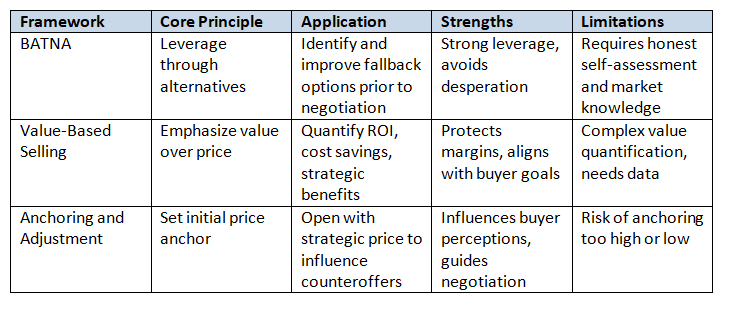
Understanding when and how to combine these frameworks empowers negotiators with strategic flexibility. For example, using BATNA to set walk-away points, value selling to justify price, and anchoring to open the range.
Step-by-Step Process
Step 1: Preparation and Market Research
Before entering negotiation, gather intelligence on customer needs, competitive pricing, and your own cost structures. Define your BATNA and target price. Prepare value quantification models to justify your price.
Step 2: Establish Rapport and Set Expectations
Open the conversation by building trust and clarifying objectives. Use Cialdini’s liking principle by finding common ground. Set mutual expectations around transparency and collaboration.
Step 3: Present Anchored Pricing with Value Justification
Introduce your price anchored on competitive benchmarks or previously established high anchors. Immediately follow with a clear articulation of value, ROI, or strategic benefits.
Step 4: Listen Actively and Identify Objections
Encourage the buyer to express concerns or price pushback. Use active listening to identify if objections stem from budget, value perception, or external pressures.
Step 5: Handle Objections Using Data and Behavioral Levers
Respond with evidence-based counterpoints. Use scarcity ("Limited capacity this quarter"), reciprocity ("Given our long partnership, I can offer ..."), or decoy options ("The premium plan includes additional features that drive...").
Step 6: Close with Confirmed Agreement and Next Steps
Summarize agreed terms, reaffirm value, and outline implementation steps. Confirm buy-in verbally or in writing to prevent buyer’s remorse and future renegotiation.
Real-World Case Studies
Apple: Premium Pricing Anchored in Innovation
Apple has consistently resisted discounting its flagship products despite intense competition. By anchoring prices high and emphasizing design, ecosystem integration, and brand status, Apple leverages the price-quality heuristic and Veblen good effect. This strategy results in high margins and loyal customers willing to pay a premium for perceived luxury and innovation.
McKinsey & Company: Value-Based Fee Negotiation
McKinsey negotiates fees based on projected client value rather than hourly rates. They employ data-driven ROI models and articulation of strategic transformation impact. This approach reduces discount requests and aligns fees with client outcomes, reinforcing partnership rather than transactional pricing.
Amazon Procurement: Anchoring and BATNA Mastery
Amazon’s procurement teams use competitive bidding to establish strong BATNAs and anchor supplier prices low. They leverage scale and alternative sourcing options to maintain negotiating power, often pushing suppliers to accept terms that protect Amazon’s margin while ensuring quality.
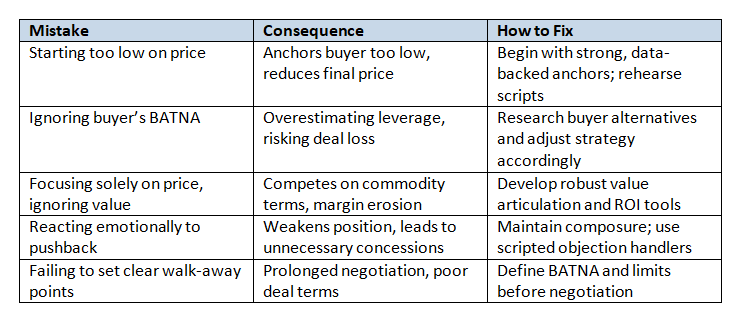
Common Mistakes and How to Avoid Them
Advanced Tactics
Expert negotiators deploy advanced approaches beyond basic scripts:
- Decoy Pricing: Introduce a less attractive option to steer buyers toward premium packages.
- Time-Limited Offers: Use scarcity by making offers valid only for a short window to accelerate decisions.
- Conditional Concessions: Offer discounts only if the buyer agrees to longer contract terms or upsells.
- Multi-Issue Negotiation: Bundle price with service levels, delivery terms, and payment schedules to create win-win trade-offs.
- Emotional Anchoring: Use storytelling to create emotional connections that justify premium pricing.
These tactics require subtlety and timing but can dramatically shift negotiation dynamics in your favor.
Scripts and Templates
Script 1: Opening Price Presentation
"Based on our analysis and the value we deliver, the investment for this solution is $50,000 annually. This price reflects not just the software itself but the measurable ROI we've projected—namely a 30% reduction in operational costs within the first year."
Script 2: Handling Price Objection
"I understand budget is a concern. Given the potential savings of $15,000 per quarter, how would you feel if we structured the payment over quarterly milestones tied to these results?"
Script 3: Offering Conditional Discount
"If committing to a two-year agreement works for you, we can explore a 10% discount that ensures price stability and priority support over the contract period."
Email Template: Post-Negotiation Confirmation
Subject: Confirmation of Agreement and Next Steps
Dear [Client Name],
Thank you for the productive discussion on pricing. To confirm, we agreed on [final price] for [product/service], including [any conditional terms]. We are excited to move forward and will prepare the contract for your review by [date].
Please let me know if you have any further questions.
Best regards,
Frequently Asked Questions
Q1: How do I establish a strong price anchor without scaring off buyers?
A1: Use competitive benchmarking and value-based rationale to justify your anchor. Position the anchor as a reference point, not a final offer, and immediately pair it with clear value articulation.
Q2: What if the buyer only wants to negotiate on price?
A2: Redirect the conversation to total value by highlighting ROI, service quality, and risk mitigation. Use multi-issue negotiation to introduce alternative trade-offs.
Q3: How can I handle a buyer who uses silence or delay tactics?
A3: Address silence by politely prompting feedback ("I want to ensure I’ve answered all your concerns. Is there anything else on your mind?"). Set deadlines for decisions to prevent indefinite delays.
Q4: When is it appropriate to offer discounts?
A4: Discounts should be conditional, tied to contract length, volume, or bundled services, and never given upfront. Always ensure concessions preserve margin and strategic value.
Q5: How do I protect margins when competitors aggressively undercut price?
A5: Focus on differentiators beyond price such as quality, support, and unique features. Educate buyers on the total cost of ownership and risks of cheaper alternatives.
Conclusion
Mastering price negotiation is essential for sales professionals and business owners seeking to protect margins and close deals confidently. By understanding the underlying psychology, employing structured frameworks, and applying real-world tested tactics, negotiators can transform price discussions from a battleground into a collaborative value exchange. The examples and scripts provided here offer actionable tools to elevate your negotiation game immediately.
Take control of your pricing conversations today by adopting these proven approaches. Begin with rigorous preparation, anchor your prices strategically, articulate compelling value, and navigate objections with data-backed confidence. Your ability to negotiate premium pricing directly translates into sustainable revenue growth and stronger client partnerships.
References
- Kahneman, D., & Tversky, A. (1979). Prospect Theory: An Analysis of Decision under Risk. Econometrica.
- Ariely, D. (2008). Predictably Irrational: The Hidden Forces That Shape Our Decisions. HarperCollins.
- Cialdini, R. B. (2006). Influence: The Psychology of Persuasion. Harper Business.
- Fisher, R., Ury, W., & Patton, B. (2011). Getting to Yes: Negotiating Agreement Without Giving In. Penguin Books.
- Nagle, T. T., & Hogan, J. E. (2006). The Strategy and Tactics of Pricing: A Guide to Growing More Profitably. Prentice Hall.
- Harvard Business Review. (2015). Negotiation Tips for Sales Professionals. HBR Press.