Price Negotiation Techniques in B2B Sales: The Definitive Guide for Sales Professionals
Imagine a seasoned enterprise salesperson sitting across the table from a procurement manager who just pushed back hard on price. The deal hangs in the balance, margins are razor-thin, and the pressure mounts to offer a discount just to keep the conversation alive. This scenario plays out daily in B2B sales environments — with 60% of deals involving some form of price pushback, according to Gartner. Yet, too often sales teams default to discounting, eroding profitability and training buyers to expect lower prices. The real challenge isn’t conceding price; it’s mastering negotiation techniques that preserve value while advancing the deal.
Price negotiation in B2B sales is critical because it directly impacts your company’s bottom line and long-term customer relationships. Behavioral economics reveals that price perception isn’t just about numbers—it’s about psychology. Buyers evaluate price relative to perceived value, anchors, and comparative options, often subconsciously. Missteps in negotiation can trigger adverse behaviors such as anchoring on low prices, underestimating your value, or losing the deal altogether. Understanding these mental heuristics and deploying strategic frameworks can transform price conversations into value-building dialogues rather than margin-sapping battles.
In this comprehensive guide, you will master price negotiation techniques that combine cutting-edge behavioral insights, proven frameworks, and actionable processes. You will learn how to harness the psychology of price, apply frameworks like the value ladder and BATNA, execute a step-by-step negotiation process, respond confidently to price objections with exact scripts, and deploy advanced tactics that elevate your negotiation game. This article is designed for senior sales professionals, pricing managers, and business owners committed to closing deals at premium prices with confidence.
· Table of Contents
· The Psychology of Price: Behavioral Economics Behind Buyer Perception
· Key Frameworks for B2B Price Negotiation
· Step-by-Step Price Negotiation Process
· Real-World Examples of Price Negotiation Success
· Objection Handling: Scripts for Common Price Pushbacks
· Advanced Tactics for Expert Negotiators
· Scripts and Templates: Ready-to-Use Dialogue Examples
· Frequently Asked Questions About B2B Price Negotiation
· Conclusion and Next Steps
· References and Further Reading
The Psychology of Price
Price is never just a number. It is a psychological signal imbued with complex behavioral cues that influence buyer decision-making in subtle but powerful ways. Understanding these underpinnings is foundational to effective negotiation.
Daniel Kahneman and Amos Tversky’s Prospect Theory (1979) revolutionized our understanding of decision-making under risk. It shows buyers perceive losses (e.g., paying more than expected) more intensely than equivalent gains (discounts). This loss aversion means buyers are highly sensitive to price increases but may undervalue price reductions. Savvy negotiators use this by framing price as an investment in reducing risk or increasing value, rather than a cost.
Ariely’s "Predictably Irrational" (2008) highlights the Anchoring Effect, where initial price points anchor buyers’ expectations and subsequent judgments. For example, setting a high initial price — even if negotiable — elevates perceived value and sets a reference point that makes discounts seem generous rather than desperate.
The Price-Quality Heuristic leads buyers to equate higher price with higher quality, a phenomenon exploited by luxury brands and premium service providers. In B2B, McKinsey’s value-based consulting fees capitalize on this by linking price directly to measurable business impact rather than cost inputs.
The Decoy Effect is another potent tool: offering a third option that makes the targeted price point appear more attractive by comparison. For instance, a mid-tier SaaS subscription priced between a basic and a premium tier steers buyers toward the middle option, increasing average deal size.
Finally, Veblen goods theory explains conspicuous consumption where higher prices increase desirability. This is rarer in B2B but applies in sectors like specialized consulting or proprietary technology where exclusivity and prestige drive purchase decisions.
· Key Psychological Concepts in Price Negotiation:
· Prospect Theory: Loss aversion shapes price sensitivity
· Anchoring Effect: Initial prices anchor buyer expectations
· Price-Quality Heuristic: Higher price implies higher quality
· Decoy Effect: Strategic pricing options influence choice
· Veblen Goods: High price enhances product desirability
Understanding and consciously applying these principles empowers sales professionals to shape price conversations strategically rather than reactively.
Key Frameworks for B2B Price Negotiation
Effective price negotiation relies on structured frameworks that align value, price, and alternatives. Here are three foundational models widely used in enterprise sales.
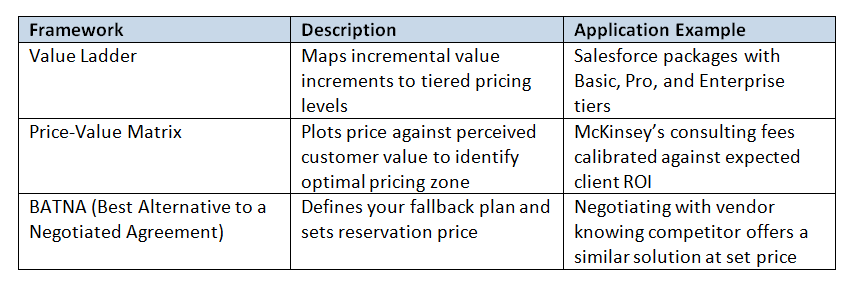
The Value Ladder framework helps sales teams justify price increases by clearly showing the additional benefits or features unlocked at higher tiers. It leverages the price-quality heuristic and can be combined with the decoy effect to steer customers toward preferred packages.
The Price-Value Matrix forces a disciplined calibration of price relative to the customer’s perceived outcomes, ensuring fees reflect value rather than cost alone. McKinsey’s value-based pricing exemplifies this by charging a percentage of client savings or revenue uplift.
BATNA is a negotiation classic introduced by Fisher and Ury (1981). Knowing your BATNA — your best alternative if the negotiation fails — equips you to set firm walk-away prices and avoid conceding unnecessarily. It also helps assess buyer BATNA and tailor your approach accordingly.
Sales teams should internalize these frameworks and use them in concert during price discussions to maintain control and confidence.
Step-by-Step Price Negotiation Process
A repeatable and disciplined process maximizes negotiation success while protecting margins. Below is a six-step breakdown with detailed guidance.
Step 1: Prepare and Research
Deeply understand your product’s differentiated value, competitive positioning, and customer’s business context. Identify the buyer’s pain points, decision criteria, and budget constraints. Research their BATNA and any internal approval hurdles.
Preparation also includes setting your pricing floor (reservation price) and ideal target price informed by value-based analysis and historical deal data.
Step 2: Establish Rapport and Frame the Conversation
Begin negotiations by reinforcing mutual goals and building trust. Use framing language that positions pricing as an investment aligned with business outcomes rather than a commodity cost.
For example: “Our goal is to ensure this solution drives measurable ROI for your team and fits within your strategic priorities.”
Step 3: Anchor the Price
Present your initial price confidently and clearly, emphasizing the value delivered. Use pricing anchors strategically to set buyer reference points.
Example script: “Our standard package, which includes X, Y, and Z, is $120,000 annually — reflecting the comprehensive impact on your operational efficiency.”
Step 4: Listen and Probe Price Objections
When buyers push back, listen attentively and ask clarifying questions to uncover underlying concerns.
Probe example: “Can you help me understand which aspects of the price are causing hesitation? Is it the upfront cost, total cost of ownership, or something else?”
Step 5: Respond with Value and Alternatives
Use frameworks like the value ladder or decoy effect to reposition the offer. Offer payment terms, phased implementations, or bundled services to increase perceived value without discounting list price.
Example: “While the full suite is $120,000, we also offer a modular package at $85,000 that addresses your immediate priorities with room to expand later.”
Step 6: Close or Agree Next Steps
If the buyer agrees, summarize the deal terms and confirm next steps. If not, reiterate your BATNA and express openness to continue exploring value.
Closing script: “I’m confident this solution delivers the value you need. Shall we proceed with contract review or schedule a follow-up to address any remaining questions?”
Real-World Examples of Price Negotiation Success
Example 1: Salesforce Enterprise Contract Negotiation
Salesforce uses a tiered pricing model combined with a strong value narrative emphasizing CRM ROI. During negotiations, account executives anchor with the enterprise package, then use modular options to address buyer budget constraints without eroding core pricing. This approach increased average deal size by 15% and reduced discounting frequency.
Example 2: McKinsey’s Value-Based Fees
McKinsey sets fees linked to client outcomes, such as cost savings or revenue growth, rather than fixed hourly rates. This aligns incentives and reduces price pushback because clients see fees as shared risk investments. Their BATNA includes walking away from deals without guaranteed value, reinforcing premium positioning.
Example 3: Adobe Creative Cloud Subscription Tiers
Adobe leverages the decoy effect with three subscription tiers—Individual, Business, and Enterprise. The Business tier is priced slightly below Enterprise but with fewer features, steering buyers to Enterprise. This pricing architecture increased upsell conversions by over 20%.
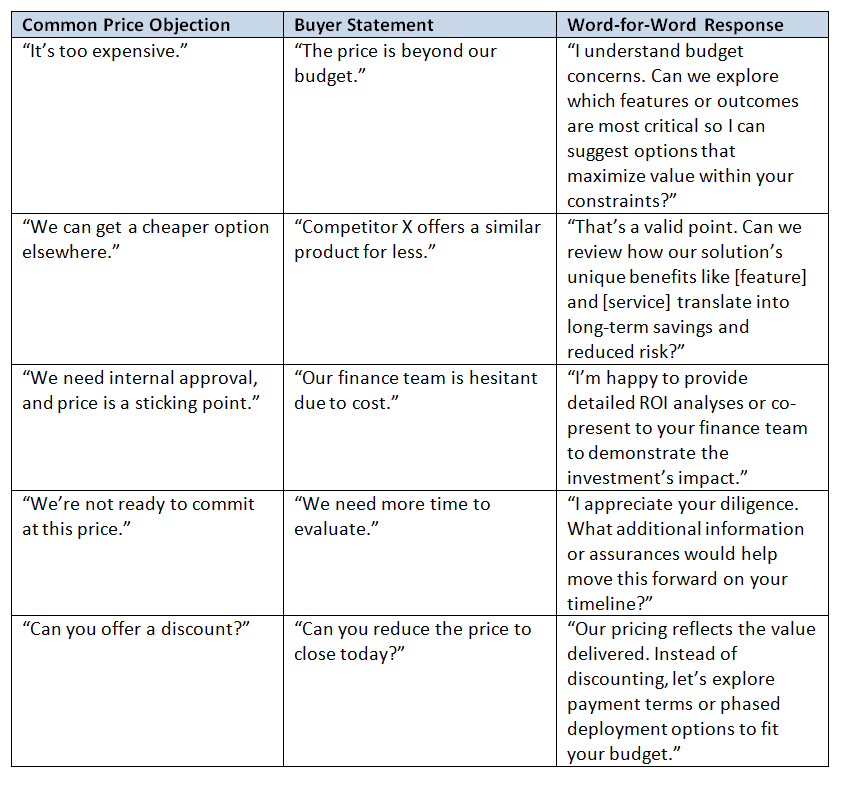
Objection Handling: Scripts for Common Price Pushbacks
Advanced Tactics for Expert Negotiators
Advanced negotiators deploy subtle tactics beyond basic frameworks:
· Use Time Scarcity: Subtly introduce limited-time offers or capacity constraints, invoking Cialdini’s scarcity principle to prompt faster decisions without explicit discounting.
· Employ Reciprocity: Offer small concessions unrelated to price (e.g., extended support, training) to trigger buyer reciprocity, increasing willingness to accept price.
· Leverage Multi-Issue Bargaining: Bundle price, delivery, payment terms, and service levels to create trade-offs that preserve revenue while addressing buyer concerns.
· Utilize “If-Then” Conditional Concessions: Frame concessions as conditional (“If you agree to X, then I can offer Y”), maintaining control and signaling value.
· Incorporate Social Proof: Reference peer companies or industry benchmarks to validate your price and reduce buyer hesitation.
Scripts and Templates: Ready-to-Use Dialogue Examples
Script 1: Initial Price Presentation
“Based on our discussions about your goals, the package we recommend is $100,000 annually. This includes features A, B, and C, which have been shown to increase efficiency by 25%. I’m confident this investment will drive measurable business value.”
Script 2: Handling “Too Expensive” Objection
“I appreciate your concern about cost. Can you share more about how you’re thinking about budget priorities? Perhaps we can tailor a solution that focuses on the highest-impact areas without compromising key outcomes.”
Script 3: Responding to Competitor Price Comparison
“I respect that you have other options. What sets us apart is our dedicated customer success team and integration capabilities that reduce your internal workload. Let’s review how these factors affect total cost of ownership.”
Email Template: Follow-Up After Price Discussion
Subject: Follow-Up on Pricing Discussion
Dear [Buyer Name],
Thank you for the productive conversation earlier. I wanted to reiterate how our solution aligns with your strategic goals and the value it delivers. I’m happy to provide any additional information or set up a session with your finance team to address pricing questions.
Looking forward to your thoughts.
Best regards,
Frequently Asked Questions About B2B Price Negotiation
Q1: How can I prevent buyers from immediately pushing for a discount?
Prevent this by anchoring early with a strong value narrative, setting expectations around pricing transparency, and framing price as an investment in outcomes rather than a negotiable number. Use open-ended questions to understand buyer priorities before discussing price.
Q2: What is the best way to handle a “We need to check with our CFO” objection?
Offer to provide tailored ROI analysis or join a call with their finance team to address concerns directly. This demonstrates partnership and reduces internal friction, increasing the chance of approval.
Q3: How do I determine the optimal reservation price or walk-away point?
Calculate your reservation price based on costs, target margin, and alternative deal opportunities (BATNA). Use historical data and value metrics to ensure your floor protects profitability without being unrealistic.
Q4: Should I ever offer discounts in B2B negotiations?
Discounts should be tactical, conditional, and aligned to incremental value or volume commitments. Avoid unconditional discounts that erode your pricing integrity. Instead, offer alternatives such as payment plans or phased delivery.
Q5: How can I leverage competitor pricing without devaluing my offer?
Acknowledge competitor pricing respectfully, then differentiate by emphasizing unique benefits, service levels, and total cost of ownership. Use social proof and case studies to validate your premium price.
Conclusion
Mastering price negotiation techniques in B2B sales is both an art and a science that combines behavioral economics, strategic frameworks, and practiced communication. Sales professionals who internalize these principles protect margins, build stronger client relationships, and close more deals without sacrificing value. Rather than reacting to price objections with instinctive discounting, use the psychology of price and structured negotiation processes to control conversations confidently.
As you apply these techniques, remember that preparation, empathy, and clarity are your greatest allies. Start today by mapping your value ladder, rehearsing objection scripts, and defining your BATNA. Elevate your negotiation skills from transactional haggling to strategic value creation — your margins and clients will thank you.
Take the next step: download our comprehensive negotiation toolkit with checklists, scripts, and customizable templates to implement these techniques immediately.
References
1. Kahneman, D., & Tversky, A. (1979). Prospect Theory: An Analysis of Decision under Risk. Econometrica, 47(2), 263–292.
2. Ariely, D. (2008). Predictably Irrational: The Hidden Forces That Shape Our Decisions. HarperCollins.
3. Cialdini, R. B. (2006). Influence: The Psychology of Persuasion. Harper Business.
4. Fisher, R., Ury, W., & Patton, B. (1981). Getting to Yes: Negotiating Agreement Without Giving In. Penguin Books.
5. McKinsey & Company. (2017). Value-Based Pricing in Professional Services. McKinsey Insights.
6. Gartner. (2023). B2B Sales Negotiation Trends and Best Practices. Gartner Research.