Pricing Psychology in Negotiation: The Definitive Guide for Sales Professionals
Negotiations often come down to one crucial battleground: price. Imagine a seasoned enterprise SaaS salesperson on a call with a C-level executive, the deal poised to close, when suddenly the prospect balks at the price. The salesperson feels the pressure to discount and fears losing the deal. According to recent sales industry studies, over 70% of deals face price objections, and discounting averages 10-20%, eroding margins significantly. This scenario is all too common — but it need not be a margin-killing crisis.
Understanding the psychology behind how buyers perceive price is the secret weapon that separates top-performing sales professionals from those trapped in a discount spiral. Price is not just a number; it is a perception shaped by cognitive biases, emotional triggers, and contextual cues. The cost of unnecessary discounting goes far beyond lost revenue — it damages brand positioning, undermines value, and trains buyers to expect less. Mastering pricing psychology allows you to negotiate with confidence, protect your margins, and close deals at premium prices.
In this comprehensive guide, you will learn the foundational behavioral economics that govern price perception, proven negotiation frameworks, a step-by-step process to apply these principles in real time, and exact scripts and objection-handling tactics used by the world’s leading sales organizations. Whether you’re a senior account executive, pricing manager, or business owner, this article equips you to transform price objections into opportunities and negotiate with strategic mastery.
· Table of Contents
· The Psychology of Price: Behavioral Economics Behind Buyer Perception
· Key Pricing Frameworks for Negotiation Success
· Step-by-Step Process to Apply Pricing Psychology in Negotiations
· Real-World Company Examples: How Industry Leaders Win on Price
· Objection Handling: Precise Responses to Price Pushbacks
· Advanced Negotiation Tactics: Beyond Beginner Strategies
· Scripts and Templates: Ready-to-Use Dialogues and Emails
· Frequently Asked Questions: Deep Dives on Pricing Psychology
· Conclusion and Next Steps to Master Price Negotiation
· References: Authoritative Sources on Pricing and Negotiation
The Psychology of Price
Price is never just a number. Behavioral economics and psychology reveal that how buyers perceive price is influenced by a web of cognitive biases and heuristics. Nobel laureate Daniel Kahneman’s prospect theory demonstrates that buyers weigh losses (price paid) more heavily than gains (product benefits), making price objections emotionally charged rather than purely rational. Understanding these biases helps negotiators frame price to reduce perceived loss.
One dominant factor is the anchoring effect . Behavioral economist Dan Ariely’s experiments in "Predictably Irrational" show that initial price anchors powerfully influence buyers’ willingness to pay. For example, presenting a high-priced option first sets a mental anchor, making subsequent prices seem more reasonable — a tactic Apple uses by positioning its premium models first to justify higher overall prices.
Another key heuristic is the price-quality heuristic , where buyers assume higher price implies better quality. This is why luxury brands like Rolex or Tesla command premium pricing: their high prices signal exclusivity and superior craftsmanship, qualifying them as Veblen goods . In contrast, commoditized products lose this advantage and compete primarily on price.
The decoy effect , derived from choice architecture research, occurs when a third option is introduced to make one of the other two choices more attractive. For example, a mid-tier software package can be framed as the “best value” between a bare-bones and expensive enterprise plan, guiding buyers toward the preferred profitable option.
Furthermore, Cialdini’s principles of reciprocity, scarcity, and social proof play into pricing psychology. Highlighting limited-time offers or referencing how many other companies have purchased reinforces value and urgency beyond price alone.
In sum, effective negotiation leverages these behavioral principles to reframe price, anchor expectations, and guide buyers toward premium decisions — all while reducing resistance rooted in loss aversion and heuristics.
Key Frameworks
Three foundational frameworks integrate pricing psychology with negotiation strategy, empowering sales professionals to manage price conversations methodically.
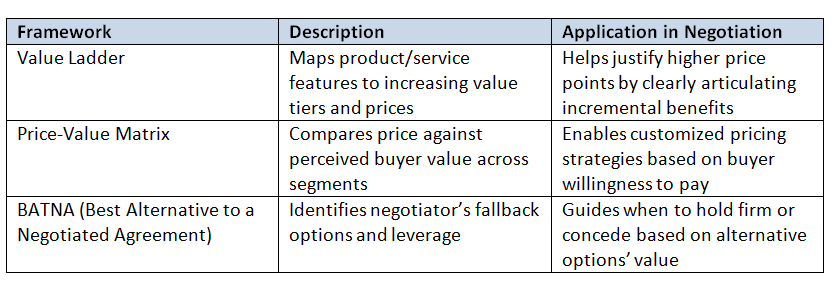
The Value Ladder is particularly useful in SaaS and professional services. By breaking down offerings into tiers with corresponding features and outcomes, salespeople can anchor price increases to tangible value increments rather than arbitrary numbers. McKinsey, for example, uses value ladders to justify premium consulting fees by linking incremental project scopes to measurable business impact.
The Price-Value Matrix aids in segmenting buyers by their price sensitivity and perceived value. Salesforce famously employs this by offering scaled enterprise contracts, with pricing tailored to company size and feature requirements, maximizing revenue without alienating budget-conscious buyers.
Combining these frameworks creates a strategic foundation to control price discussions and confidently counter objections.
Step-by-Step Process
Mastering pricing psychology in negotiation requires a deliberate, repeatable approach. Below is a detailed six-step process designed to apply behavioral insights and strategic frameworks effectively.
Step 1: Research Buyer’s Value Drivers and Alternatives
Understand what outcomes the buyer most values and their alternatives. Use discovery calls and market intelligence to identify pain points, priorities, and competitor options. This sets the foundation for value-based pricing.
Step 2: Anchor Price Early with Strategic Framing
Introduce your pricing by anchoring high-value packages first. Frame price as investment in outcomes, not cost. Use decoy options where appropriate to highlight the preferred package.
Step 3: Articulate Value in Concrete Terms
Translate features into buyer-centric benefits — saved time, increased revenue, risk reduction. Use case studies or ROI calculators to quantify value and justify premium prices.
Step 4: Listen and Acknowledge Price Concerns Empathetically
When objections arise, acknowledge emotions behind price resistance. Use active listening to uncover underlying concerns rather than react defensively.
Step 5: Apply Objection Handling Frameworks (Reciprocity, Scarcity, Social Proof)
Respond to objections with proven psychological triggers: offer limited-time incentives, share testimonials, or emphasize exclusivity to reframe price in context of value.
Step 6: Close with Confidence and Clear Next Steps
Summarize agreed value, confirm alignment, and outline next steps. Use assumptive closes that reinforce the buyer’s decision to invest at the premium price.
This process, grounded in psychology and strategic frameworks, increases the likelihood of overcoming price objections without eroding margins.
Real-World Examples
Examining industry leaders shows how pricing psychology and negotiation frameworks drive premium closes.
These examples illustrate how combining psychology, frameworks, and tactical execution results in protected margins and premium deal closures.
Objection Handling
Effective objection handling transforms price resistance into opportunity. The table below maps common price objections to precise, psychologically informed responses.
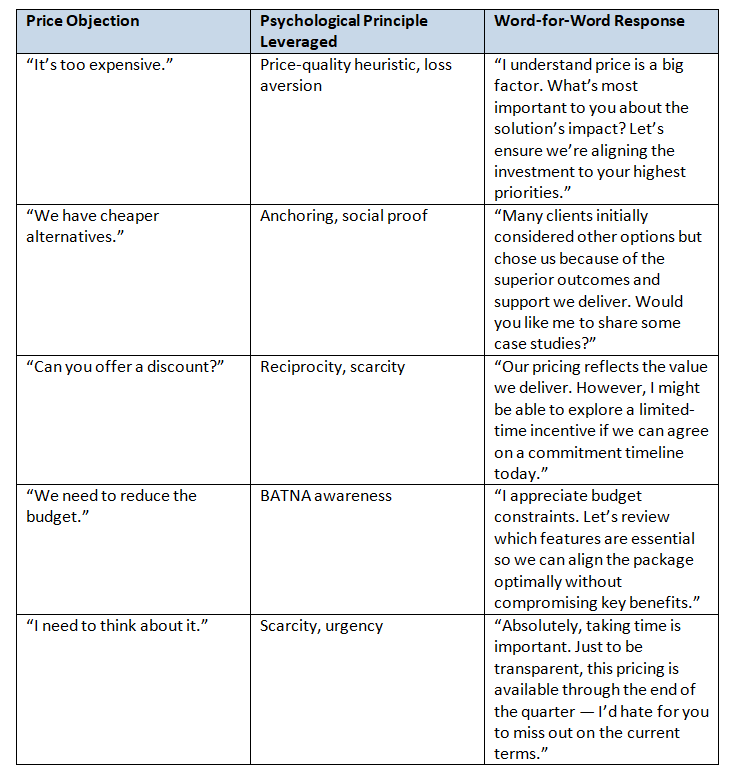
These responses are designed to acknowledge buyer concerns empathetically while subtly reframing price through behavioral triggers, increasing the likelihood of positive outcomes.
Advanced Tactics
Beyond foundational strategies, expert negotiators utilize nuanced tactics grounded in psychology.
Mastery of these tactics requires practice and timing but can decisively shift buyer mindset in high-stakes negotiations.
Scripts and Templates
Below are ready-to-use dialogue scripts and email templates integrating pricing psychology principles.
Salesperson: “Our premium package includes [feature 1], [feature 2], and dedicated support, typically valued at $50,000 annually. Many clients find that this investment accelerates their ROI within six months. Let me explain how that works.”
Buyer: “This is too expensive.”
Salesperson: “I hear that price is a concern. Could you share what outcomes you’re hoping to achieve? I want to ensure the solution aligns with your highest priorities, so the investment feels justified.”
Subject: Exclusive Offer to Secure Your Investment at Current Pricing
Dear [Name],
I wanted to follow up on our recent conversation. To help you capitalize on the value we discussed, we’re extending a limited-time incentive for commitments made by [date]. This ensures you lock in current pricing and receive priority onboarding.
Please let me know if you’d like to discuss this further.
Best regards,
Salesperson: “Given how this aligns with your goals, the next step is to finalize the agreement so we can begin delivering results. I’ll prepare the contract for your review.”
These scripts model empathetic, value-focused language that leverages behavioral insights to reduce resistance.
Frequently Asked Questions
Q1: How does anchoring influence price negotiation outcomes?
Anchoring sets a reference point that heavily influences buyer perception of what is a reasonable price. Presenting a higher anchor first can make subsequent prices appear more attractive, increasing willingness to pay.
Q2: What is the role of loss aversion in price objections?
Loss aversion means buyers feel the pain of paying more acutely than the pleasure of value gained. Recognizing this, negotiators should reframe price as an investment to mitigate perceived losses.
Q3: How can social proof be used to justify premium pricing?
Referencing satisfied customers and success stories builds trust and reduces perceived risk, making buyers more comfortable accepting higher prices.
Q4: When should discounts be offered in negotiation?
Discounts should be a last resort after value has been clearly communicated and objections addressed. If used, they should be framed as limited-time or conditional to maintain perceived value.
Q5: What psychological tactics help overcome “I need to think about it” objections?
Leveraging scarcity and urgency, such as limited-time offers, and scheduling follow-ups can prompt buyers to act without feeling pressured.
Conclusion
Pricing psychology is the hidden architecture shaping negotiation outcomes. By understanding behavioral economics principles like anchoring, loss aversion, and heuristics, sales professionals can reframe price conversations to protect margins and close at premium levels. The frameworks, processes, and scripts outlined here provide a tactical playbook to transform price objections into collaboration.
Mastering these techniques requires deliberate practice, but the payoff is profound: stronger negotiation positions, healthier profitability, and elevated brand value. Start applying these principles today to stop discounting reflexively and negotiate from a foundation of confidence and insight.
For a personalized consultation on implementing these pricing psychology strategies within your organization, contact our expert team. Unlock the full potential of your pricing and negotiation capabilities now.
References
1. Kahneman, D. (2011). Thinking, Fast and Slow. Farrar, Straus and Giroux.
2. Ariely, D. (2008). Predictably Irrational: The Hidden Forces That Shape Our Decisions. HarperCollins.
3. Cialdini, R. B. (2006). Influence: The Psychology of Persuasion. Harper Business.
4. Fisher, R., Ury, W., & Patton, B. (2011). Getting to Yes: Negotiating Agreement Without Giving In. Penguin Books.
5. Thaler, R. H., & Sunstein, C. R. (2008). Nudge: Improving Decisions About Health, Wealth, and Happiness. Yale University Press.
6. Monroe, K. B. (2003). Pricing: Making Profitable Decisions. McGraw-Hill.