
Pricing Strategy in International Markets: The Definitive Guide for Sales Professionals and Business Owners

International price negotiation is often a high-stakes chess game. Consider this: a leading SaaS company entered the German market with a uniform global price but quickly saw sales stall as local competitors undercut them by 20-30%. Conversely, Apple’s strategic premium pricing in China not only preserved margin but reinforced brand prestige, leading to outsized revenue growth despite local market complexities. These contrasting outcomes highlight how critical and nuanced pricing strategy is when expanding globally.
The cost of poor international pricing is staggering. A misjudged price can erode margins, damage brand perception, and stall market entry. Unlike domestic markets, international pricing interweaves currency fluctuations, cultural price sensitivity, local competitive landscapes, and psychological price perception shaped by behavioral economics. Mastering this complexity is essential for sales leaders and business owners seeking profitable global growth.
This comprehensive guide will equip you to craft, negotiate, and defend premium prices across borders. You will master behavioral pricing science, proven frameworks, actionable step-by-step processes, real-world case studies from Apple, McKinsey, and Amazon, plus advanced tactics and ready-to-use scripts. By the end, you will confidently protect margins and close deals in any international market.
· Table of Contents
· The Psychology and Science Behind International Pricing
· Key Frameworks and Models for Global Pricing
· Step-by-Step Process to Develop International Pricing
· Real-World Case Studies: Apple, McKinsey, Amazon
· Common Mistakes and How to Avoid Them
· Advanced Tactics for Premium Global Pricing
· Scripts and Templates for Price Negotiations
· Frequently Asked Questions on International Pricing
· Conclusion and Next Steps
· References
The Psychology and Science Behind This Topic
Pricing is not just economics; it’s deeply psychological and behavioral. Nobel laureate Daniel Kahneman’s Prospect Theory explains that buyers perceive losses (e.g., paying a higher price) more intensely than gains, making price increases particularly sensitive. Internationally, this sensitivity varies by culture and economic context but the underlying bias is universal.
Ariely’s work in "Predictably Irrational" demonstrates the anchoring effect—initial prices set expectations that skew willingness to pay. For example, a luxury Swiss watch priced at $10,000 anchors buyers to perceive $5,000 as a bargain, even if the intrinsic cost is lower. Such anchoring varies by country depending on local reference prices and currency.
The price-quality heuristic is another universal rule: buyers often infer quality from price. This explains why premium brands like Apple or Louis Vuitton maintain high prices to signal exclusivity and superior quality. However, this heuristic can backfire if the price exceeds what local markets consider reasonable, underlining the importance of cultural calibration.
The decoy effect and reference pricing are crucial tools. Presenting a mid-tier option priced between a basic and premium model steers buyers towards the premium choice, increasing average deal size. Robert Cialdini’s principles of influence—reciprocity, scarcity, authority, and social proof—also shape price acceptance, especially in markets where relationship-building is key.
Understanding these psychological drivers helps craft pricing strategies that resonate emotionally, not just rationally, increasing perceived value and minimizing discount pressure.
Key Frameworks and Models
Several proven frameworks guide international pricing strategy. The most impactful include:
1. Cost-Plus Plus Local Adjustment Model
2. Value-Based Global Pricing Framework
3. Gabor-Granger Price Sensitivity Analysis
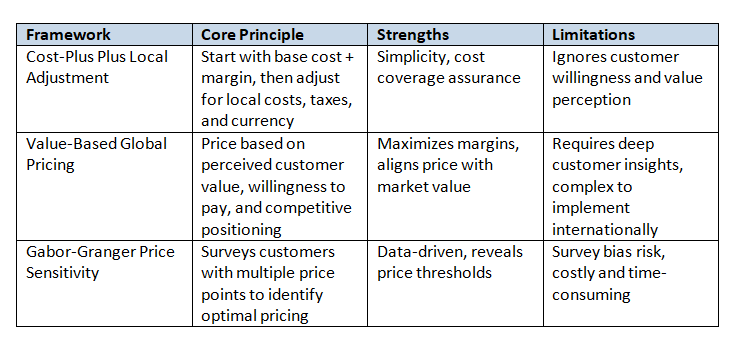
Each framework serves a distinct purpose: cost-plus ensures no losses, value-based maximizes profit, and Gabor-Granger refines price points with empirical data. Combining these approaches yields robust pricing strategies adaptable to international markets.
Step-by-Step Process
Step 1: Market Research & Competitive Benchmarking
Gather quantitative and qualitative data on local competitors, customer segments, and purchasing power. Use secondary research and local interviews to understand price sensitivity and cultural pricing norms.
Step 2: Define Business Objectives & Margin Targets
Clarify goals: market penetration, premium positioning, volume, or profitability. Set minimum acceptable margins after factoring in tariffs, taxes, and operational costs.
Step 3: Select Pricing Framework(s)
Choose between cost-plus, value-based, or hybrid methods based on market complexity and data availability. For emerging markets, cost-plus with local adjustments may be safer; for developed markets, value-based pricing pays off.
Step 4: Develop Price Structure & Tiers
Design pricing tiers reflecting customer segments and usage patterns. Apply decoy pricing and reference pricing to steer choices. Incorporate bundling where appropriate.
Step 5: Localize Prices with Currency & Regulatory Considerations
Adjust for exchange rates, inflation, import duties, and local taxes. Use dynamic pricing tools for currency fluctuations. Ensure compliance with local price-fixing laws.
Step 6: Test Pricing & Collect Feedback
Pilot prices with select customers or regions. Conduct Gabor-Granger style surveys to gauge sensitivity. Refine based on feedback and sales data.
Step 7: Train Sales Teams & Deploy Negotiation Scripts
Equip sales with scripts that emphasize value, use anchoring, and handle discount requests confidently. Align messaging with behavioral insights.
Step 8: Monitor & Adjust Continuously
Track sales performance, competitor moves, and currency shifts. Be agile; adjust prices quarterly or bi-annually as needed.
Real-World Case Studies
Apple’s Premium Pricing in China
Apple entered China with prices closely aligned to Western markets, rejecting the common practice of discounting in emerging markets. Leveraging the price-quality heuristic and brand prestige, Apple positioned its iPhones as aspirational luxury goods. This strategy built strong margin retention and robust demand despite intense local competition. Apple’s approach underscores the power of psychological pricing and cultural brand positioning.
McKinsey’s Value-Based Fees in Europe and Asia
McKinsey tailors consulting fees by demonstrating clear client value and ROI rather than applying flat hourly rates. They leverage detailed case studies to justify premiums, anchoring prices to expected outcomes. In Asia, they adjust fees to local economic realities while maintaining premium positioning through strong brand authority, illustrating value-based pricing adapted to international contexts.
Amazon’s Dynamic Pricing & Localization
Amazon uses sophisticated algorithms to adjust prices dynamically based on currency fluctuations, competitor pricing, and demand elasticity across markets. Their localized pricing ensures they remain competitive without sacrificing margins, illustrating how data-driven pricing supports global scale.
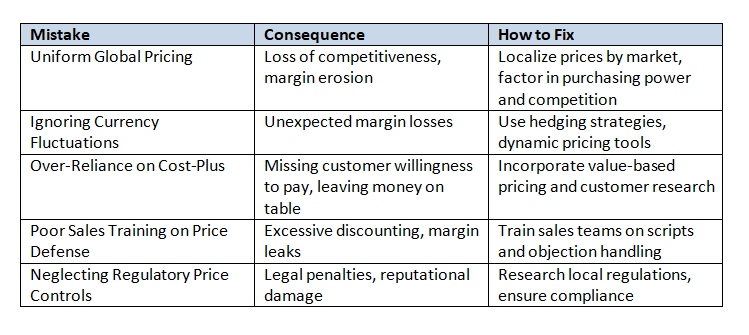
Common Mistakes and How to Avoid Them
Advanced Tactics
1. Price Segmentation by Channel and Customer Persona
Use granular data to create micro-segments with tailored prices, maximizing capture of willingness to pay.
2. Employing Decoy Pricing Internationally
Introduce strategically priced mid-tier offerings to shift buyer preference to premium packages.
3. Leveraging Reciprocity & Scarcity
Offer limited-time regional promotions tied to exclusive features, invoking Cialdini’s scarcity to justify premium.
4. Hedging Currency Risk with Forward Contracts
Lock in exchange rates to protect margins when pricing in volatile currencies.
5. Integrating AI-Powered Price Optimization Tools
Use machine learning models to forecast demand elasticity and recommend price changes in real time.
6. Reference Pricing Anchoring in Proposals
Always present a higher-priced “anchor” option first in sales presentations to elevate perceived value of the main offer.
Scripts and Templates
Script 1: Handling Price Objection in German Market
“Thank you for raising concerns about the price. We’ve tailored this offering specifically for your market, considering local regulations and our premium service levels. Our price reflects the value and reliability that competitors cannot match. Let me explain how this translates into cost savings and efficiency gains over time.”
Script 2: Email Proposal Anchoring with Decoy Option
“Dear [Client],
To maximize your ROI, we’ve prepared three options: Basic, Pro, and Elite. While the Basic meets essential needs, the Pro includes strategic features that deliver enhanced outcomes. The Elite package, our top-tier option, provides comprehensive support and best-in-class benefits. Many clients find Pro offers the best balance of value and investment.”
Script 3: Negotiation Close with Reciprocity
“We understand the budget constraints and appreciate your openness. To support your growth, we’re willing to extend a 5% discount if you commit to a 12-month contract by next week. This helps us allocate resources and deliver the highest level of service.”
Script 4: Follow-up After Price Pushback
“Hi [Name],
I wanted to check in after our pricing discussion. Our goal is to ensure you receive unmatched value aligned with your objectives. Are there specific features or outcomes I can clarify that would help justify the investment?”
Frequently Asked Questions
Q1: How do I factor currency fluctuations into international pricing?
A1: Use forward contracts or currency hedging to lock exchange rates where feasible. Incorporate a buffer margin for volatility and update pricing periodically (e.g., quarterly). Dynamic pricing software can automate adjustments based on real-time data.
Q2: Should I use the same pricing model in all international markets?
A2: No. Different markets require customized strategies considering local competition, purchasing power, and cultural price sensitivity. For example, cost-plus may suffice in emerging markets, while value-based pricing works better in developed economies.
Q3: How can I justify higher prices to price-sensitive customers?
A3: Emphasize value through case studies, ROI metrics, and quality signals. Use anchoring by presenting a higher-priced option first. Leverage Cialdini’s principles like scarcity and social proof to influence perception.
Q4: What role does localization play in pricing?
A4: Localization ensures prices reflect local economic conditions, tax regimes, and cultural expectations. This enhances acceptance and protects margins. Localization also applies to payment methods and contract terms.
Q5: How do I train sales teams to defend prices internationally?
A5: Provide scripts rooted in behavioral science, role-play objections, and reinforce value messaging. Teach negotiation frameworks focusing on anchoring, reciprocity, and decoy effects. Regularly review performance and recalibrate tactics.
Conclusion
International pricing strategy is a complex but critical lever for global success. By deeply understanding the psychology behind price perception and employing robust frameworks, sales professionals and business owners can defend premium prices and unlock sustainable margins across diverse markets. The stakes are high—mispricing can cost millions and damage brand equity, while strategic pricing creates competitive moats and accelerates growth.
This guide armed you with actionable processes, real-world insights, advanced tactics, and ready-to-use scripts to confidently navigate cross-border pricing challenges. Now is the time to apply these principles, pilot your pricing strategy, and train your teams to maximize value in every international deal. For tailored consulting and pricing audits, contact our experts to turn your global pricing into a competitive advantage.
References
1. Kahneman, D. & Tversky, A. (1979). Prospect Theory: An Analysis of Decision under Risk. Econometrica.
2. Ariely, D. (2008). Predictably Irrational: The Hidden Forces That Shape Our Decisions. HarperCollins.
3. Cialdini, R. B. (2006). Influence: The Psychology of Persuasion. Harper Business.
4. Hinterhuber, A. & Liozu, S. (2014). Innovation in Pricing: Contemporary Theories and Best Practices. Routledge.
5. Nagle, T. T., Hogan, J., & Zale, J. (2016). The Strategy and Tactics of Pricing. Routledge.
6. McKinsey & Company. (2019). The Psychology of Pricing: A Behavioral Approach to Price Setting in B2B Markets. McKinsey Insights.