Procurement Negotiation Checklist: Everything You Need Before, During, and After

In the high-stakes arena of global procurement, negotiation can make or break a company’s competitive edge. Imagine Toyota’s procurement team negotiating a multi-billion-dollar contract for automotive semiconductors amid a global shortage. The stakes? Production continuity, supplier reliability, and cost containment—failure means production halts with cascading effects on market share and brand reputation. This scenario exemplifies why mastering a comprehensive procurement negotiation checklist is vital for procurement leaders, category managers, and CPOs aiming to safeguard value and build resilient supplier relationships.
Today’s procurement negotiation goes far beyond price haggling. It demands a strategic approach grounded in frameworks such as the Kraljic Matrix, Total Cost of Ownership (TCO) analysis, and should-cost modeling. Successful negotiators leverage supplier segmentation insights, understand their BATNA and ZOPA boundaries, and apply category management rigor to secure win-win outcomes. The psychological dimension—anchoring, framing, and listening skills—can decisively tilt the balance in complex B2B negotiations.
This article delivers a deep dive into every phase of the procurement negotiation lifecycle. You will master essential frameworks, discover step-by-step tactics with exact scripts, analyze real-world examples from Apple, Boeing, and the NHS, and learn advanced strategies to outmaneuver even the most seasoned suppliers. Prepare to elevate your negotiation outcomes and transform your procurement function into a strategic powerhouse.
· Table of Contents
· The Strategic Foundation: Frameworks, Models, and Negotiation Psychology
· Key Frameworks and Models for Procurement Negotiation
· Step-by-Step Procurement Negotiation Process
· Real-World Case Studies: Lessons from Industry Leaders
· Tactics and Counter-Tactics: Scripts and Responses
· Advanced Strategies for Expert Negotiators
· Word-for-Word Scripts and Templates for Procurement Negotiations
· Frequently Asked Questions on Procurement Negotiations
· Conclusion and Call to Action
· References and Further Reading
The Strategic Foundation - frameworks, models, psychology with named research
Effective procurement negotiation hinges on a strategic foundation integrating proven frameworks, analytical models, and behavioral psychology insights. At the core lies Peter Kraljic’s seminal 1983 model, the Kraljic Purchasing Portfolio, which segments suppliers into four quadrants—strategic, bottleneck, leverage, and non-critical—based on supply risk and profit impact. This segmentation guides procurement managers to tailor negotiation strategies aligned with supplier importance and market dynamics. For instance, Toyota applies Kraljic’s logic to secure strategic parts by building partnerships, while leveraging competitive tactics for leverage items.
Equally critical is Total Cost of Ownership (TCO) analysis, which extends negotiation focus beyond unit price to encompass acquisition, operation, maintenance, and end-of-life disposal costs. Lean procurement advocates integrating TCO with should-cost modeling—using engineering and market intelligence to estimate a fair supplier cost baseline. Apple’s procurement teams are renowned for deploying should-cost models to benchmark supplier quotes and negotiate stringent cost savings without sacrificing quality.
Psychological research also informs negotiation tactics. Nobel laureate Daniel Kahneman’s work on cognitive biases reveals how anchoring effects influence price expectations. Procurement negotiators trained to set strong opening anchors and manage framing can shape supplier proposals favorably. Furthermore, understanding the Zone of Possible Agreement (ZOPA) and Best Alternative to a Negotiated Agreement (BATNA), concepts popularized by Fisher and Ury in "Getting to Yes," empowers buyers to negotiate from positions of strength while recognizing walk-away points.
Key Frameworks and Models
This section introduces three foundational frameworks essential to procurement negotiation success: The Kraljic Matrix, Total Cost of Ownership (TCO), and BATNA/ZOPA concepts. Each framework supports precise negotiation planning and execution.
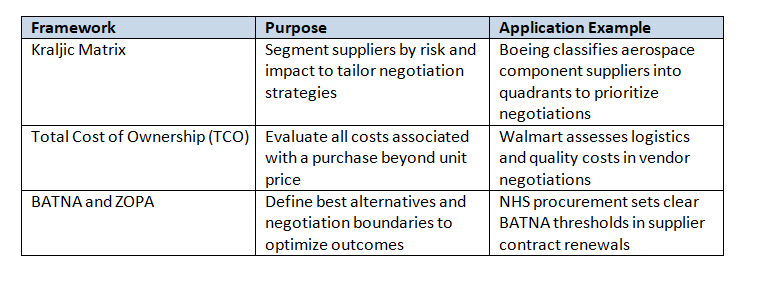
The Kraljic Matrix guides negotiation approach by supplier category. Strategic items require collaborative negotiation focusing on joint value creation and risk sharing. Bottleneck items demand risk mitigation tactics, possibly including dual sourcing or inventory buffers. Leverage items give buyers stronger bargaining power to drive cost reductions, while non-critical items favor process efficiency and transactional negotiation.
Total Cost of Ownership analysis ensures negotiations address hidden costs such as quality failures, logistics, and obsolescence. For example, Amazon’s procurement team negotiated contracts with fulfillment technology providers by examining TCO to improve long-term ROI rather than lowest upfront price.
BATNA and ZOPA concepts provide a negotiation roadmap. By identifying their BATNA, procurement managers know their fallback if negotiations stall, while ZOPA defines the mutually acceptable price and terms range. A strong BATNA strengthens negotiating leverage and prevents acceptance of suboptimal deals.
Step-by-Step Process
Step 1: Preparation and Market Intelligence Gathering
Begin by conducting thorough market research and supplier intelligence. Use Porter’s Five Forces to assess supplier power, competitive rivalry, and substitution risks. Build should-cost models using internal engineering data and industry benchmarks. Define your negotiation objectives clearly—target price, quality standards, delivery terms, and innovation commitments.
Example tactic: “Based on our market analysis and volume forecasts, we believe a unit price of $X is achievable.”
Step 2: Supplier Segmentation and Risk Assessment
Segment suppliers using the Kraljic Matrix to determine negotiation strategy per category. Assess supplier financial health, capacity, and geopolitical risks. Identify key negotiation levers such as volume commitments, exclusivity, or payment terms.
Example tactic: “Given your critical role in our supply chain, we’d like to explore partnership models that secure capacity while optimizing cost.”
Step 3: Define BATNA and ZOPA
Establish your Best Alternative to a Negotiated Agreement to understand your fallback options. Calculate the Zone of Possible Agreement with the supplier to identify acceptable price and contractual boundaries.
Example tactic: “Our internal analysis shows alternative suppliers capable of meeting our specs at $Y, which informs our negotiation parameters.”
Step 4: Conduct Initial Negotiation Meeting
Start with agenda setting and rapport building. Use anchoring to set favorable price expectations without alienating suppliers. Employ active listening to uncover supplier constraints and interests.
Example opening script: “We appreciate your partnership and want to align on terms that are mutually beneficial. Based on our cost model, we believe there’s room to optimize pricing while ensuring quality.”
Step 5: Manage Concessions and Leverage Counter-Tactics
Use conditional concessions to maintain control—for example, linking price reductions to volume increases or payment terms. Monitor supplier responses closely and deploy counter-tactics when facing hardball moves.
Example concession language: “If you can improve lead times by 15%, we’re prepared to commit to an additional 20% volume.”
Step 6: Finalize Agreement and Plan Post-Negotiation Activities
Once terms are agreed, document them meticulously. Plan for contract execution, supplier performance monitoring, and continuous improvement discussions.
Example closing script: “We’re aligned on terms and look forward to a successful collaboration. Let’s schedule quarterly reviews to track performance and identify improvement areas.”
Real-World Case Studies
Apple applies should-cost modeling combined with rigorous TCO analysis to negotiate with its global suppliers. By dissecting component costs and logistics expenses, Apple secured up to 5% cost reductions annually without compromising quality. This approach enables Apple to maintain product margins despite aggressive market pricing.
Boeing segments its supplier base using the Kraljic Matrix and invests in strategic partnerships for critical aerospace parts. Negotiations focus on risk-sharing, joint innovation, and long-term capacity commitments rather than short-term price concessions. This approach reduces supply chain disruptions and fosters collaborative problem solving.
The NHS employs BATNA and ZOPA frameworks rigorously, especially during pandemic-driven supply shortages. Clear alternative sourcing strategies and defined negotiation boundaries enabled NHS buyers to negotiate priority access and cost controls with key suppliers under extreme pressure.
Tactics and Counter-Tactics
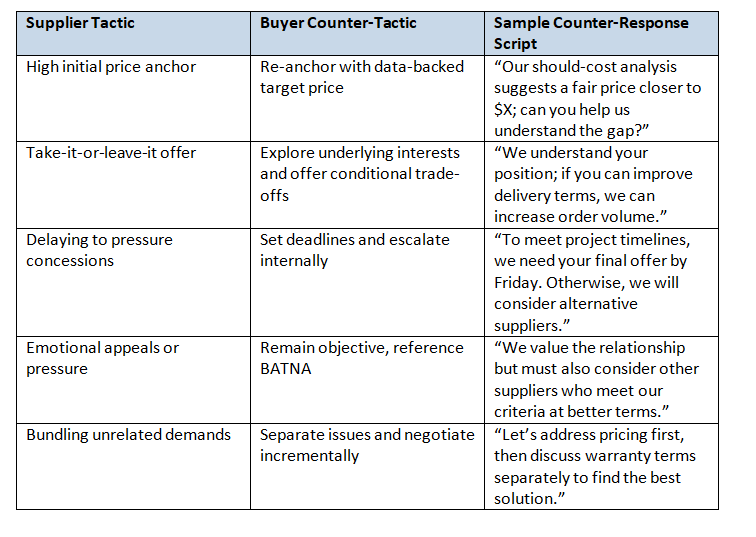
This table summarizes common negotiation tactics buyers may encounter and recommended counter-responses with scripts.
Advanced Strategies
Experienced procurement negotiators deploy advanced techniques to unlock additional value. These include multi-issue negotiation to create trade-offs across price, quality, delivery, and innovation; leveraging supplier competition via reverse auctions for leverage items; and applying value engineering principles jointly with suppliers to redesign products reducing cost and enhancing function.
Another advanced approach is scenario-based negotiation planning where multiple market or supplier risk scenarios are modeled to prepare flexible strategies. Toyota’s procurement teams use this extensively to mitigate semiconductor supply chain risks by pre-negotiating contingency terms.
Behavioral economics techniques such as reciprocity—offering small concessions early to build goodwill—and framing effects—presenting proposals emphasizing gains rather than losses—can powerfully influence supplier behavior.
Scripts and Templates
Below are precise word-for-word scripts for critical negotiation moments.
1. Opening Negotiation Meeting
“We appreciate your continued partnership and want today’s discussion to focus on creating mutual value. Based on our internal cost analysis and market trends, we believe there is room to optimize pricing while maintaining your quality standards. Could you walk us through your current cost drivers?”
2. Anchoring Price Discussion
“Our should-cost model suggests a target price around $X per unit, reflecting raw material costs and manufacturing efficiencies. How close is this to your current pricing framework?”
3. Conditional Concession Offer
“If you can agree to reduce lead times by 10%, we’re willing to increase our order volumes by 15%. Would this be feasible on your end?”
4. Handling Hardball Delay Tactics
“To maintain our project schedule, we require a definitive pricing commitment by end of day Friday. Without this, we will need to explore alternative suppliers to avoid disruptions.”
5. Closing and Agreement Confirmation
“We’re pleased to have reached this agreement today. We will circulate the draft contract reflecting these terms by tomorrow and schedule a kickoff meeting next week for implementation planning.”
Frequently Asked Questions
Q1: How do I determine my BATNA in procurement negotiations?
A1: Start by identifying alternative suppliers or internal substitutes capable of meeting your specifications. Evaluate their pricing, quality, and delivery capabilities. Your BATNA is the most advantageous alternative if the current negotiation fails, providing a walk-away benchmark to avoid unfavorable agreements.
Q2: When should I use collaborative versus competitive negotiation styles?
A2: Use collaborative approaches with strategic suppliers where long-term partnerships and innovation are priorities. Competitive styles suit leverage or bottleneck suppliers where cost reduction or risk mitigation is urgent. Segment suppliers with frameworks like Kraljic Matrix to decide the style.
Q3: How can I prepare for supplier emotional or pressure tactics?
A3: Maintain objectivity by focusing on data and your BATNA. Acknowledge emotions empathetically but steer conversations back to facts and mutual interests. Prepare scripts to deflect pressure and keep negotiations professional.
Q4: What role does should-cost modeling play in negotiation?
A4: Should-cost modeling helps estimate a fair supplier cost base using engineering inputs and market data. It provides a factual foundation to challenge inflated prices, negotiate smarter concessions, and identify areas for value engineering.
Q5: How do I ensure agreements are effectively implemented post-negotiation?
A5: Develop clear contract documentation, set KPIs for supplier performance, schedule regular review meetings, and establish continuous improvement initiatives. Transparent communication and accountability foster sustained value delivery.
Conclusion
Mastering procurement negotiation requires a holistic approach integrating rigorous preparation, proven frameworks, psychological insight, and tactical agility. By following this comprehensive checklist—from initial market intelligence to final contract execution—procurement professionals can secure optimal value, mitigate risks, and build resilient supplier partnerships critical for competitive advantage.
We invite CPOs, category managers, and procurement teams to adopt these strategies and scripts proactively. Begin your next negotiation with confidence armed by this pillar guide, transforming negotiations into strategic value engines. For customized support and advanced training, contact our team to elevate your procurement function today.
Need more knowedge? Visit:
https://www.michalchmielecki.com/procurement-negotiation
References
- Kraljic, P. (1983). Purchasing Must Become Supply Management. Harvard Business Review.
- Fisher, R., Ury, W., & Patton, B. (2011). Getting to Yes: Negotiating Agreement Without Giving In. Penguin Books.
- Porter, M. E. (1979). How Competitive Forces Shape Strategy. Harvard Business Review.
- NHS Supply Chain. (2021). Strategic Procurement Framework.
- Harvard Business Review. (2019). The Art and Science of Negotiation.
- Institute for Supply Management. (2023). Total Cost of Ownership in Procurement.