Procurement Negotiation Examples: Real Cases and Lessons Learned

In 2018, a mid-sized steel supplier lost a multi-million-dollar contract with a leading automotive manufacturer after a procurement negotiation collapsed. Despite having competitive pricing, the supplier failed to anticipate the buyer’s strategic shift towards long-term partnerships emphasizing innovation and risk-sharing. The negotiation ended abruptly as the buyer awarded the contract to a competitor who offered not just price savings but value-added collaboration. This scenario exemplifies how procurement negotiation is far more than price haggling; it is a complex interplay of strategy, psychology, and value creation.
Procurement negotiations operate within a high-stakes environment where information asymmetry and power dynamics profoundly shape outcomes. Buyers wield significant leverage using category management insights, supplier segmentation, and total cost of ownership (TCO) models to squeeze margins, while suppliers must balance protecting profitability and building sustainable relationships. Many procurement professionals, whether on the buying or selling side, falter by focusing narrowly on price or failing to understand the deeper strategic levers that influence decision-making. This myopia leads to lost contracts, eroded margins, and missed opportunities for innovation.
This guide arms procurement managers, category directors, and sales professionals with an authoritative, step-by-step mastery of procurement negotiation. You will learn how to apply proven frameworks such as the Kraljic Matrix and BATNA analysis, implement should-cost modeling, and deploy negotiation scripts tailored for each phase of interaction. Real-world cases from Toyota, Apple, and Amazon provide concrete lessons, while tactical tables and advanced strategies empower you to anticipate counter-moves and build winning, long-term contracts. Whether you are a buyer aiming to optimize supplier partnerships or a seller striving to protect margins, this comprehensive resource will transform how you negotiate.
· Table of Contents
· The Strategic Landscape: How Procurement Really Works
· Key Frameworks and Models
· Step-by-Step Strategy for Buyers and Sellers
· Real-World Case Studies
· Tactics and Counter-Tactics in Procurement Negotiations
· Advanced Strategies for Procurement Negotiations
· Scripts and Templates for Common Scenarios
· Frequently Asked Questions
· Conclusion
· References
The Strategic Landscape: How Procurement Really Works
Procurement is a strategic function designed not only to acquire goods and services but to optimize total value delivery while managing risk and innovation. The procurement lifecycle encompasses need identification, market analysis, supplier evaluation, negotiation, and contract management. At its core, professional buyers are incentivized to reduce costs, ensure supply continuity, and accelerate innovation cycles — all measured against KPIs such as cost savings, supplier performance, and compliance rates.
A foundational tool in procurement strategy is the Kraljic Matrix, introduced by Peter Kraljic in 1983, which segments suppliers into four quadrants based on supply risk and profit impact: strategic, leverage, bottleneck, and non-critical. This segmentation informs negotiation approaches, with strategic suppliers engaged collaboratively, while leverage suppliers face more price-driven tactics.
Total Cost of Ownership (TCO) analysis extends beyond purchase price to incorporate logistics, quality, maintenance, and end-of-life costs. Should-cost modeling estimates the supplier’s actual production costs, providing buyers with a realistic baseline for negotiation. These tools reveal the asymmetry buyers exploit — they often have deeper spend data and market intelligence than suppliers, creating an uneven playing field.
The psychology of buyers is shaped by loss aversion as described by Kahneman — buyers fear overpaying more than they value minor gains, leading to risk-averse behaviors. Understanding this helps sellers frame proposals to mitigate perceived risks and emphasize unique value propositions, rather than just price.
Finally, category management integrates demand forecasting, supplier innovation, and market trends to align procurement with corporate strategy. This holistic perspective transforms negotiations into value engineering exercises where both parties seek win-win outcomes.
Key Frameworks and Models
Understanding procurement negotiation requires command of several frameworks that provide structure and insight into decision-making dynamics.
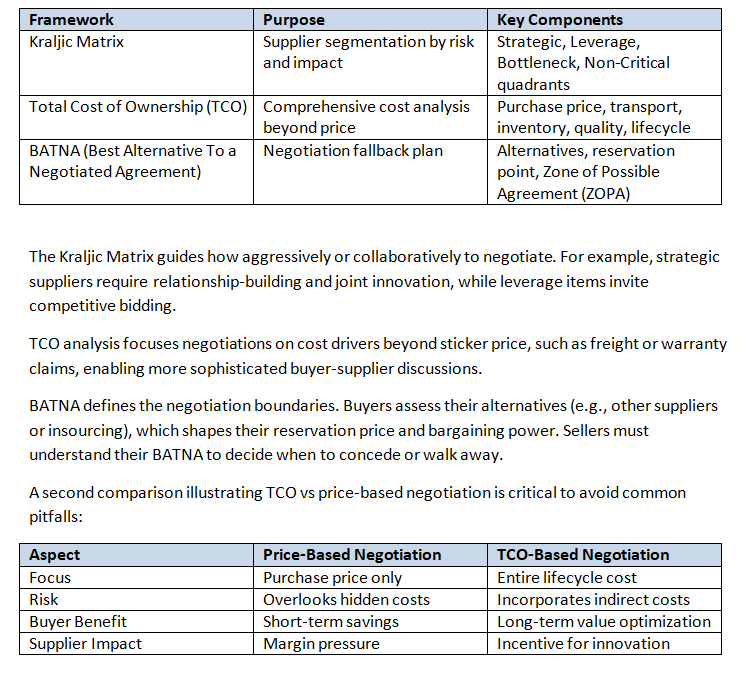
Mastering these frameworks equips negotiators to structure deals that balance cost, risk, and value, maximizing strategic outcomes.
Step-by-Step Strategy
Here is a detailed six-step procurement negotiation strategy, presenting buyer and seller perspectives with specific tactics and recommended language.
Step 1: Preparation and Intelligence Gathering
Buyer: Conduct detailed spend analysis, segment suppliers using Kraljic Matrix, and develop should-cost models. Identify BATNA and ZOPA.
Seller: Research buyer’s business priorities, procurement processes, and competitor offers. Prepare value-based messaging focusing on innovation and risk mitigation.
Recommended Buyer Phrase: “Our analysis shows that total cost impact exceeds unit price. Let’s explore a solution that optimizes lifecycle costs.”
Recommended Seller Phrase: “We understand your cost pressures; here is how our value-added services reduce your overall risk and downtime.”
Step 2: Setting Objectives and Strategy Alignment
Buyer: Define clear KPIs (cost reduction, quality improvement, delivery) and negotiation boundaries. Decide on collaborative vs competitive posture based on supplier segment.
Seller: Align internal stakeholders (sales, finance, operations) on pricing floors and concession strategies. Prepare counteroffers emphasizing unique differentiators.
Buyer Script: “Our objective is to achieve at least 10% cost savings while maintaining quality standards. What flexibility do you have on delivery terms?”
Seller Script: “We can meet your cost targets by adjusting payment terms and implementing joint quality checks to reduce defects.”
Step 3: Initial Engagement and Proposal Exchange
Buyer: Issue RFP or RFQ with detailed scope and evaluation criteria. Use procurement software to manage responses.
Seller: Submit proposals highlighting TCO benefits and innovation potential, not just price.
Buyer Email Template Opening: “Thank you for your proposal. We appreciate the detailed cost breakdown and would like to clarify a few points on warranty coverage.”
Seller Response Template: “We’re happy to provide more detail on warranty terms and how our proactive maintenance reduces your downtime risk.”
Step 4: Negotiation and Concession Management
Buyer: Use anchoring tactics by opening lower but reasonable offers. Employ silence and calibrated questions to probe seller flexibility.
Seller: Counter-anchor by emphasizing should-cost insights. Use calibrated counter-questions to understand buyer constraints.
Buyer Script: “Given market benchmarks, our proposed price reflects fair value. How can we work together to close this gap?”
Seller Script: “Our pricing reflects materials and labor costs. If volume commitments increase, we can explore discounts.”
Step 5: Closing and Contract Finalization
Buyer: Confirm all negotiated terms, including penalties and incentives. Engage legal early for contract drafting.
Seller: Ensure contract reflects agreed scope and terms. Propose mechanisms for future renegotiations tied to performance.
Buyer Closing Phrase: “We’re ready to proceed on these terms; please prepare the contract for signature.”
Seller Closing Phrase: “We appreciate the partnership and look forward to delivering on our commitments as outlined.”
Step 6: Post-Negotiation Relationship Management
Buyer: Implement supplier scorecards and continuous improvement plans. Share performance feedback regularly.
Seller: Maintain proactive communication and propose innovation initiatives to deepen relationship.
Buyer Follow-Up Email: “Thank you for your collaboration during negotiation. Our supplier performance review starts next quarter.”
Seller Follow-Up Email: “We’d like to schedule a quarterly innovation workshop to identify further cost-saving opportunities.”
Real-World Case Studies
Three emblematic procurement negotiations illustrate strategic lessons.
Toyota’s Supplier Partnership Model: Toyota revolutionized automotive procurement by integrating suppliers into product development and focusing on long-term collaboration rather than price wars. Their supplier segmentation combined Kraljic’s strategic quadrant with lean manufacturing principles. Toyota’s negotiation approach emphasizes mutual trust, shared risk, and continuous improvement, ensuring supply stability and innovation.
Lesson: Beyond price, embedding suppliers within your value chain enhances competitive advantage.
Apple’s Procurement Leverage: Apple’s massive scale affords it extraordinary leverage. In negotiating with chip manufacturers and component suppliers, Apple uses detailed should-cost analysis and BATNA positioning to drive down prices while securing exclusivity. By structuring long-term contracts with volume commitments, Apple balances supplier dependence and cost control.
Lesson: Leverage scale and exclusivity to extract value but maintain supplier viability.
Amazon’s Vendor Negotiations: Amazon’s procurement team is notorious for aggressive negotiation, often leveraging data analytics and category management to squeeze supplier margins. They use rapid RFP cycles and threat of delisting as leverage. In response, suppliers have adopted innovative value-based proposals highlighting differentiation to avoid commoditization.
Lesson: In high-power buyer scenarios, suppliers must innovate beyond price to protect margins.
Tactics and Counter-Tactics
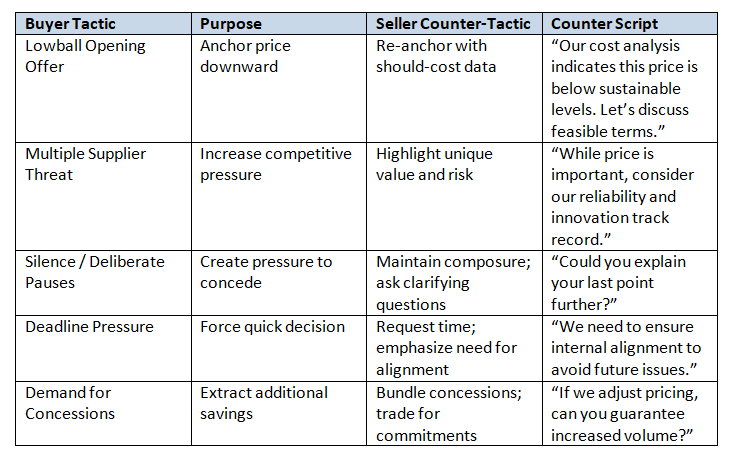
This table maps common procurement negotiation tactics to their purposes and effective counter-responses with scripts.
Advanced Strategies
For expert negotiators, the following advanced strategies deepen procurement outcomes:
Relationship Leverage: Use data-driven supplier segmentation to identify “champion suppliers” and invest in joint innovation programs, thus transforming negotiation from adversarial to collaborative.
Multi-Year Deal Structuring: Negotiate contracts with rolling price reviews tied to indices or performance milestones, balancing risk and fostering supplier commitment.
Value-Based Positioning: Develop should-cost models and customer impact analyses to articulate your value proposition beyond price—such as speed to market, quality improvements, or supply risk reduction.
Data Analytics and AI: Deploy predictive analytics to anticipate supplier behavior and market shifts, enabling proactive negotiation adjustments.
Behavioral Economics: Apply Kahneman’s framing techniques to counter loss aversion and cognitive biases, reframing offers to highlight gains rather than concessions.
Scripts and Templates
1. Buyer Initial RFP Invitation Email:
“Dear [Supplier],
We invite you to participate in our Request for Proposal for [Category]. Our goal is to identify partners who can deliver competitive pricing with high quality and innovation. Please review the attached scope and submit your proposal by [date]. Let us know if you have questions.
Best regards,
2. Seller Proposal Follow-Up Email:
“Dear [Buyer],
Thank you for considering our proposal. We believe our solution offers significant lifecycle cost savings and risk reduction. We welcome the opportunity to discuss any questions or clarifications.
Best regards,
3. Buyer Concession Request Script:
“Based on our analysis, we require an additional 5% cost reduction to meet budget targets. Can you accommodate this by adjusting payment terms or volume commitments?”
4. Seller Counteroffer Script:
“We can offer a 3% price reduction if we agree on a 24-month contract with quarterly performance reviews to ensure mutual benefit.”
5. Buyer Contract Closing Email:
“Dear [Supplier],
We are pleased to move forward on the terms agreed during negotiations. Please prepare the final contract documents for signature. Looking forward to a successful partnership.
Best regards,
Frequently Asked Questions
Q1: How can buyers use should-cost modeling effectively in negotiations?
A1: Buyers should develop detailed cost breakdowns of materials, labor, overhead, and logistics to create a realistic cost baseline. This informs negotiation anchors and enables objective discussions, reducing reliance on supplier pricing claims.
Q2: What are common mistakes suppliers make in procurement negotiations?
A2: Suppliers often focus too narrowly on price, ignore buyer KPIs, fail to understand procurement frameworks, and underestimate buyer BATNA. They also neglect building relationships, which limits long-term opportunities.
Q3: How does the Kraljic Matrix impact negotiation strategy?
A3: It segments suppliers to prioritize focus and tactics. Strategic suppliers require collaborative negotiation; leverage suppliers face price competition; bottleneck suppliers need risk mitigation; non-critical suppliers are managed for efficiency.
Q4: What role does BATNA play for sellers in procurement deals?
A4: Sellers need to identify their best alternative—other buyers, markets, or product lines—to understand their reservation price and decide when to hold firm or concede, avoiding margin erosion.
Q5: How can technology improve procurement negotiation outcomes?
A5: Advanced procurement analytics, e-sourcing platforms, and AI-driven insights enable data-driven decisions, scenario modeling, and faster, more transparent negotiations, enhancing buyer-seller alignment.
Conclusion
Procurement negotiation is a nuanced, strategic discipline that extends far beyond price haggling. Mastery requires a deep understanding of supplier segmentation, cost structures, buyer psychology, and negotiation dynamics. By applying frameworks such as the Kraljic Matrix, leveraging TCO and should-cost modeling, and deploying precise negotiation scripts and tactics, both buyers and sellers can create value-driven, sustainable contracts.
Real-world cases from industry leaders like Toyota and Apple illustrate that successful procurement negotiation balances power with partnership, cost with innovation, and short-term gains with long-term relationships. We encourage procurement professionals to integrate these insights and tools into their daily practice to transform negotiations into strategic competitive advantages. Start implementing these frameworks today to elevate your procurement outcomes.
References
1. Kraljic, Peter. “Purchasing Must Become Supply Management.” Harvard Business Review, 1983.
2. Kahneman, Daniel. “Thinking, Fast and Slow.” Farrar, Straus and Giroux, 2011.
3. Porter, Michael E. “Competitive Strategy: Techniques for Analyzing Industries and Competitors.” Free Press, 1980.
4. Williamson, Oliver E. “Transaction-Cost Economics: The Governance of Contractual Relations.” Journal of Law and Economics, 1979.
5. Monczka, Robert M., et al. “Purchasing and Supply Chain Management.” Cengage Learning, 2015.
6. Harvard Business Review. “Negotiation Strategies for Procurement Professionals.” HBR, 2019.