Procurement Negotiation Tactics Explained: What Every Supplier Must Know

Negotiations in procurement can make or break a supplier’s business. Imagine a leading electronics component supplier losing a multi-million-dollar contract with a global smartphone manufacturer because they failed to understand the buyer’s negotiation playbook. The supplier’s pricing was technically competitive, but the buyer’s relentless margin squeeze and strategic use of leverage left no room for long-term partnership. This loss wasn’t just about price; it was about mastering the complex dynamics of procurement negotiation — where information asymmetry, psychological tactics, and strategic frameworks dictate outcomes. Many suppliers either underestimate the sophistication of procurement teams or fall into common traps that erode their margins and damage relationships.
At stake in procurement negotiations are not just immediate contract terms but the supplier’s strategic positioning, profitability, and future pipeline. Buyers operate with specific KPIs like cost reduction targets, supplier risk mitigation, and total cost of ownership (TCO) optimization, wielding frameworks such as the Kraljic Matrix and category management to segment suppliers and prioritize negotiations. Meanwhile, suppliers often lack visibility into these buyer processes, making it difficult to respond strategically rather than reactively. The power imbalance and information gaps mean most suppliers approach negotiations from a transactional, price-only mindset rather than a value-creation perspective.
This comprehensive guide will equip suppliers — and buyers seeking insight — with a deep understanding of procurement negotiation tactics. You will master the strategic landscape of procurement, learn critical frameworks such as BATNA and TCO analysis, walk through a step-by-step negotiation strategy with exact scripts tailored for both sides, and explore counter-tactics to common buyer moves. Real-world case studies from Toyota, Apple, and Walmart will illustrate how world-class companies negotiate for mutual advantage. This is the definitive resource for anyone who wants to win procurement negotiations sustainably and profitably.
· Table of Contents
· The Strategic Landscape: How Procurement Really Works
· Key Frameworks and Models
· Step-by-Step Strategy for Buyers and Suppliers
· Real-World Case Studies
· Tactics and Counter-Tactics Table
· Advanced Procurement Negotiation Strategies
· Scripts and Templates for Common Scenarios
· Frequently Asked Questions
· Conclusion and Next Steps
· References
The Strategic Landscape: How Procurement Really Works
Procurement is far more than transactional purchasing; it is a strategic function designed to optimize organizational objectives through supplier relationships. Understanding this landscape is critical for suppliers who want to negotiate successfully.
Professional buyers are measured by KPIs such as cost savings, supplier risk reduction, innovation sourcing, and compliance. Their incentives align with delivering shareholder value by reducing Total Cost of Ownership (TCO) — a holistic view that includes purchase price, quality, delivery reliability, service levels, and lifecycle costs. Buyers use category management to segment spend into groups with common characteristics, enabling tailored negotiation strategies per category.
The Kraljic Matrix, developed by Peter Kraljic, is a cornerstone framework used by buyers to segment suppliers into four quadrants based on supply risk and profit impact: strategic, bottleneck, leverage, and non-critical items. This segmentation guides negotiation intensity and collaboration level. For example, strategic suppliers often engage in joint value engineering and long-term contracts, while leverage suppliers face competitive bidding and aggressive price negotiations.
Supplier segmentation also influences negotiation tactics. Buyers apply should-cost modeling to estimate what a product or service should cost based on component breakdowns and market data, enabling more informed price challenges. The psychology of professional buyers includes loss aversion — they fear paying above market or losing savings targets — which often drives tough bargaining but can also open doors for value-based negotiation if suppliers understand and address buyer pain points.
In essence, procurement negotiation is a game of asymmetric information, strategic segmentation, and psychological leverage. Suppliers who treat negotiations as adversarial price wars will struggle. Those who understand buyer KPIs, segmentation, and decision criteria can position themselves as partners rather than mere vendors.
Key Frameworks and Models
Understanding core procurement frameworks empowers suppliers to anticipate buyer strategies and respond effectively. This section compares three essential models: the Kraljic Matrix, Total Cost of Ownership (TCO) vs. Price Analysis, and BATNA (Best Alternative to a Negotiated Agreement) in the procurement context.
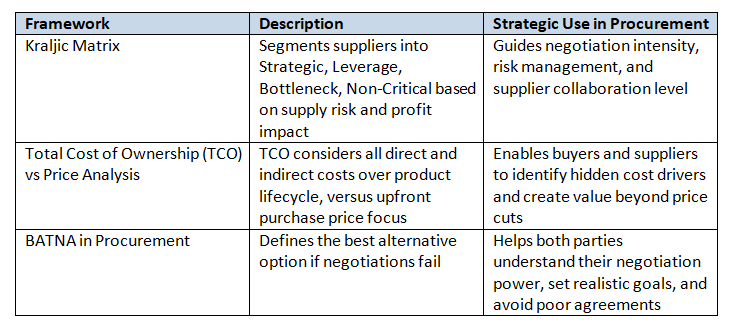
The Kraljic Matrix is vital for supplier segmentation. For example, strategic suppliers like Boeing’s key aerostructure vendors receive collaborative, joint development negotiation approaches, while leverage suppliers face auction-style competitive bidding.
TCO analysis is a sophisticated approach that goes beyond price to include quality defects, inventory carrying costs, maintenance, and downtime. Apple leverages TCO to negotiate with suppliers by highlighting cost drivers that impact product launch timelines or warranty costs, not just unit price.
BATNA is an essential negotiation concept from negotiation theory, adapted for procurement. A supplier with strong BATNA (e.g., multiple interested customers) wields more power, while buyers with few alternatives may concede more. Knowing BATNA and ZOPA (Zone of Possible Agreement) boundaries prevents deadlocks and enables creative deal structures.
Step-by-Step Strategy
This section unpacks a detailed six-step negotiation process, presenting both buyer and supplier perspectives, including exact tactics and language for each phase.
Step 1: Preparation and Intelligence Gathering
Buyer Perspective: Conduct category analysis, supplier segmentation (Kraljic Matrix), and should-cost modeling. Define objectives like target cost, quality, and delivery KPIs. Identify BATNA and ZOPA. Prepare RFP with clear evaluation criteria.
Supplier Perspective: Research buyer’s procurement process, KPIs, and pain points. Analyze competitor pricing and capabilities. Calculate should-cost to understand buyer expectations. Prepare value proposition beyond price.
Script (Supplier internal): "We estimate the buyer’s should-cost at $X based on component and overhead analysis; we will highlight our superior quality and on-time delivery record to justify price premiums."
Step 2: Initial Engagement and RFP Response
Buyer: Issue RFP with structured scoring. Use initial meetings to gauge supplier flexibility and innovation potential.
Supplier: Submit comprehensive proposal emphasizing total value, not just price. Request clarification on evaluation criteria.
Script (Buyer to Supplier): "Our evaluation prioritizes total cost of ownership and supplier risk mitigation alongside price. Can you provide data on your quality defect rates and service levels?"
Step 3: Opening Negotiation
Buyer: Open by reiterating cost targets and highlighting competitive bids. Use anchoring tactics by setting low initial offers.
Supplier: Respond by emphasizing unique value drivers and referencing should-cost analysis. Avoid immediate concessions.
Script (Buyer): "Our target price is $X per unit, which aligns with market benchmarks. How can you meet this given your current pricing?"
Script (Supplier): "While our price is higher than your target, this reflects enhanced reliability and lower lifecycle costs, which we believe will reduce your TCO significantly."
Step 4: Concession and Value Engineering
Buyer: Push for cost reduction through value engineering workshops and supplier collaboration.
Supplier: Identify non-price value-adds and suggest multi-year contracts or volume commitments in exchange for price flexibility.
Script (Buyer): "If you can reduce cost by 5% through material substitution or process improvements, we are prepared to commit to a three-year contract."
Script (Supplier): "We can explore value engineering options but propose a five-year contract with volume rebates to ensure mutual investment."
Step 5: Handling Deadlocks and Counter-Tactics
Buyer: Apply pressure tactics such as threatening to move to alternative suppliers or delay awards.
Supplier: Use BATNA to push back or propose phased implementation to reduce buyer risk.
Script (Buyer): "If we cannot reach your price target, we will proceed with another supplier who can meet our cost criteria."
Script (Supplier): "We understand cost is critical; however, our quality and on-time delivery reduce your risk significantly, which may cost more if compromised. Could we pilot a smaller volume to demonstrate value?"
Step 6: Closing and Contract Finalization
Buyer: Finalize terms with penalties, service levels, and incentives.
Supplier: Ensure contract includes clear KPIs and protects margin through escalation clauses.
Script (Supplier): "To maintain service levels and manage inflation risk, we propose a price adjustment clause linked to raw material indices."
Script (Buyer): "We agree on performance-linked incentives but require penalties for missed deliveries to protect our operations."
Real-World Case Studies
Examining real procurement negotiations reveals how top firms apply these tactics.
Toyota’s Supplier Partnership Model: Toyota’s approach emphasizes long-term collaboration and mutual problem-solving. Rather than aggressive price cuts, Toyota works closely with strategic suppliers on value engineering and continuous improvement, fostering trust and innovation. Suppliers understand their role in the value chain, enabling smoother negotiations focused on joint gains rather than zero-sum price battles.
Apple’s Procurement Leverage: Apple wields enormous buying power and uses rigorous should-cost models combined with competitive auctions to squeeze supplier margins aggressively. However, Apple balances this with demands for strict quality and innovation, compelling suppliers to invest in advanced capabilities. Negotiations often include strict confidentiality, volume commitments, and penalty clauses, reflecting Apple’s precise control of supply risk.
Walmart’s Supplier Squeeze Tactics: Walmart is famous for relentless margin pressure on suppliers, leveraging its scale to demand price concessions. However, Walmart also uses category management to segment suppliers, offering strategic partners better terms in exchange for innovation and loyalty. Suppliers facing Walmart must prepare detailed cost breakdowns and be ready for tough concessions but also explore joint promotional investments.
Tactics and Counter-Tactics
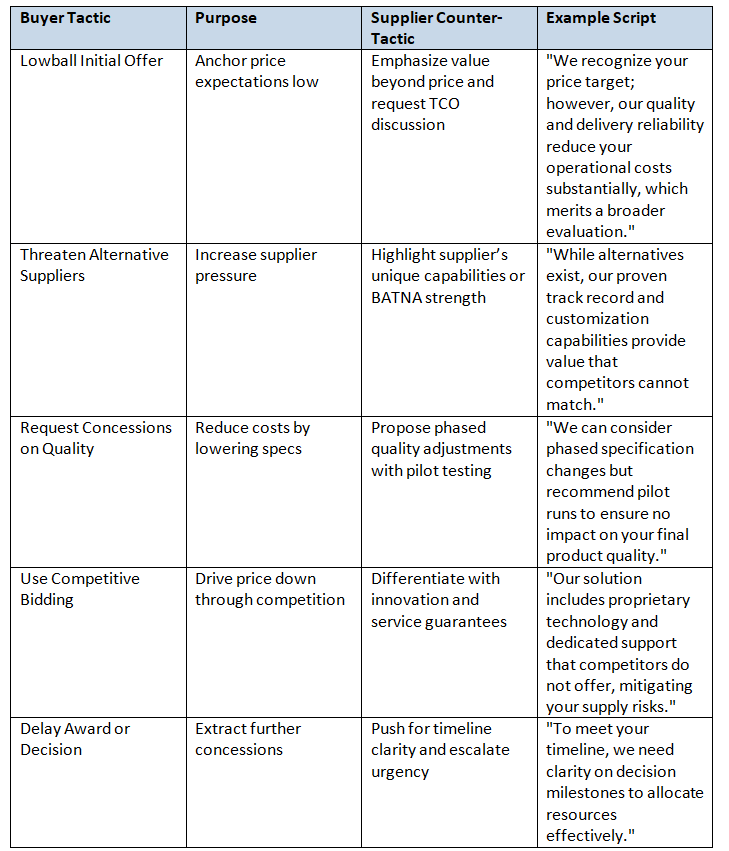
The following table maps common buyer procurement tactics with their purposes and exact supplier counter-response scripts.
Advanced Strategies
Beyond foundational tactics, expert negotiators employ advanced strategies to maximize outcomes.
Relationship Leverage: Building long-term partnerships with key buyers creates trust and preferential treatment. Suppliers can leverage relationship capital to negotiate better terms, reduce transactional friction, and co-develop innovations.
Multi-Year Deal Structuring: Negotiating multi-year contracts with built-in escalation clauses based on indices like raw materials or inflation stabilizes margins and aligns incentives over time. This approach reduces renegotiation frequency and secures pipeline visibility.
Value-Based Positioning: Moving beyond price, suppliers present comprehensive value propositions encompassing risk mitigation, innovation, supply continuity, and lifecycle cost savings. Using data-driven TCO models and joint value engineering workshops supports this positioning.
Behavioral Economics in Negotiation: Applying Kahneman’s loss aversion principle, suppliers can frame offers to highlight buyer risks of switching or cost increases, nudging buyers toward agreement.
Lean Procurement Collaboration: Engaging in lean procurement initiatives where suppliers reduce waste and improve process efficiency creates shared savings, enabling negotiation based on mutual operational gains.
Scripts and Templates
Below are exact word-for-word scripts and email templates for common procurement negotiation scenarios.
1. Initial Supplier Proposal Email:
"Dear [Buyer Name],
Thank you for the opportunity to submit our proposal for [Category/Product]. Based on our analysis, we believe our offering delivers not only competitive pricing but also superior quality and delivery reliability that will reduce your total cost of ownership.
We welcome the opportunity to discuss our value-added capabilities in more detail and explore how we can support your strategic objectives.
Best regards,
2. Buyer Cost Challenge Email:
"Dear [Supplier Name],
After reviewing your proposal, we would like to understand opportunities to optimize pricing in line with our cost targets. Can you provide detailed cost breakdowns and participate in a value engineering workshop to explore potential savings?
Regards,
3. Supplier Counter-Concession Response:
"Dear [Buyer Name],
We appreciate your feedback and are open to exploring value engineering opportunities. However, given our current pricing reflects quality and service levels, we propose a pilot project to validate cost-saving measures without impacting performance.
Looking forward to your thoughts.
Best,
4. Buyer Deadline Pressure Email:
"Dear [Supplier Name],
As we approach our contract finalization date, we require confirmation of your best and final offer to proceed. Delays may impact our operational timelines significantly.
Thank you for your prompt attention.
Regards,
5. Supplier Contract Clause Proposal:
"Dear [Buyer Name],
To ensure mutual success, we suggest including a price adjustment clause linked to raw material indices and clear KPIs with associated incentives and penalties to align expectations throughout the contract term.
Please advise your thoughts.
Best regards,
Frequently Asked Questions
Q1: How can suppliers accurately estimate a buyer’s should-cost?
A1: Suppliers conduct reverse engineering of the product, analyze raw material prices, labor rates, overheads, and logistics costs. Industry benchmarking and supplier experience also inform should-cost models. This intelligence helps suppliers anticipate buyer expectations and justify pricing.
Q2: What is the role of BATNA in procurement negotiations?
A2: BATNA defines the best alternative if negotiations fail. Knowing BATNA empowers suppliers or buyers to set reservation prices, avoid unfavorable deals, and identify when to walk away. For example, a supplier with multiple potential buyers has a strong BATNA and can negotiate more assertively.
Q3: How do buyers use the Kraljic Matrix in supplier negotiations?
A3: Buyers classify suppliers into quadrants to tailor negotiation strategies. Strategic suppliers receive collaborative negotiations, while leverage suppliers face competitive bidding. Understanding your quadrant helps suppliers anticipate negotiation intensity and focus.
Q4: What tactics should suppliers use when facing aggressive price pressure?
A4: Suppliers should shift the conversation from price to total value, propose multi-year contracts to stabilize margins, engage in joint value engineering, and use data-driven TCO arguments. Maintaining composure and clearly articulating unique strengths also helps.
Q5: How important are relationship-building tactics in procurement negotiations?
A5: Extremely important. Long-term relationships foster trust, reduce adversarial behavior, and enable collaborative problem-solving. Suppliers investing in relationship management often secure better terms, preferred supplier status, and innovation partnerships.
Conclusion
Mastering procurement negotiation tactics requires more than price haggling; it demands a strategic understanding of buyer psychology, segmentation frameworks, and negotiation dynamics. Suppliers who align their approach with buyer KPIs, leverage should-cost analysis, and employ advanced strategies like multi-year deals and value-based positioning stand to protect margins and build enduring partnerships. This guide provides the comprehensive toolkit—frameworks, step-by-step strategies, counter-tactics, real-world cases, and scripts—you need to elevate your negotiation outcomes.
Whether you are a supplier striving to win and sustain major contracts or a procurement professional seeking to enhance your negotiation acumen, applying these insights will move you from transactional adversaries to strategic collaborators. Begin implementing these tactics today to create win-win deals that drive competitive advantage and lasting value.
References
Harvard Business Review. (2017). "The Powerful Role of Procurement in Corporate Strategy." By Michael L. Smith.
Kraljic, P. (1983). "Purchasing Must Become Supply Management." Harvard Business Review.
Williamson, O. E. (1985). "The Economic Institutions of Capitalism." Free Press.
Kahneman, D. (2011). "Thinking, Fast and Slow." Farrar, Straus and Giroux.
Monczka, R. M., Handfield, R. B., Giunipero, L. C., & Patterson, J. L. (2020). "Purchasing and Supply Chain Management." Cengage Learning.
Christopher, M. (2016). "Logistics & Supply Chain Management." Pearson Education.