Procurement Pressure Tactics: How to Recognize and Neutralize Them

In 2019, a mid-sized supplier to a global automotive manufacturer faced a sudden and aggressive demand to cut prices by 15% during contract renewal. The buyer wielded a detailed spend analysis and threatened to shift production to cheaper vendors. The supplier, unprepared for such pressure, lost a $30 million contract that represented 40% of its annual revenue. This standoff was emblematic of a broader pattern in procurement negotiations where buyers leverage asymmetric information and power dynamics to squeeze suppliers, often without full visibility of the supplier's cost structure or strategic value.
Procurement negotiations are high-stakes chess matches with billions of dollars on the line annually. Buyers seek to optimize total cost of ownership (TCO) and meet KPIs tied to cost savings, quality, and on-time delivery. Suppliers aim to protect margins while building long-term partnerships. The tension arises from information asymmetry, psychological biases such as loss aversion, and the strategic use of pressure tactics to extract concessions. Yet, many parties falter by misunderstanding these dynamics, failing to prepare, or reacting emotionally rather than strategically.
This definitive guide arms you with a deep understanding of the procurement process, key frameworks like the Kraljic Matrix and BATNA, and a step-by-step strategy to recognize and neutralize pressure tactics. Both buyers and sellers will gain actionable scripts, counter-tactics, and expert-level negotiation techniques that turn pressure into productive dialogue, safeguarding value without sacrificing relationships.
· Table of Contents
· The Strategic Landscape: How Procurement Really Works
· Key Frameworks and Models
· Step-by-Step Strategy for Buyers and Sellers
· Real-World Case Studies
· Tactics and Counter-Tactics Table
· Advanced Strategies in Procurement Negotiations
· Scripts and Templates for Common Scenarios
· Frequently Asked Questions
· Conclusion and Call to Action
· References
The Strategic Landscape: How Procurement Really Works
Procurement is a complex discipline that transcends simple price haggling. The process begins with comprehensive category management — segmenting spend into defined categories to align purchasing decisions with corporate strategy and risk management. Buyers are measured on KPIs such as cost savings, supplier quality, risk mitigation, and innovation sourcing.
At the heart of procurement lies the Kraljic Matrix, developed by Peter Kraljic in 1983, which segments suppliers and spend into four quadrants based on supply risk and profit impact: Strategic, Leverage, Bottleneck, and Non-Critical. This framework informs how buyers allocate resources and manage supplier relationships. For example, strategic suppliers require collaborative partnerships, while leverage items invite competitive bidding.
A critical concept is Total Cost of Ownership (TCO), which includes purchase price, logistics, quality costs, and long-term maintenance. Buyers increasingly use should-cost analysis — a detailed, data-driven model estimating the supplier’s cost structure — to identify realistic negotiation targets and challenge inflated prices. This data-driven approach reduces asymmetry and levels the playing field.
Professional buyers also operate under cognitive biases described by Kahneman, such as loss aversion, making them risk-averse and sometimes overly aggressive in negotiations to avoid perceived losses. Recognizing this psychology is essential for suppliers and buyers alike to maintain balance.
Supplier segmentation based on strategic value, risk, and market dynamics guides procurement strategy. For instance, Walmart’s supplier squeeze tactics focus on leverage items, using its positioning power to demand price cuts but risking supplier relationships if overused.
Understanding these mechanisms, incentives, and psychological drivers is crucial to navigating procurement pressure tactics effectively.
Key Frameworks and Models
Three foundational models illuminate procurement dynamics and provide tools to recognize and counter pressure tactics:
1. Kraljic Matrix: Segments suppliers by supply risk and profit impact.
2. Total Cost of Ownership (TCO) vs. Price Analysis: Differentiates between upfront price and all associated costs.
3. BATNA (Best Alternative to a Negotiated Agreement) in Procurement: Defines the fallback option and negotiation zone (ZOPA).
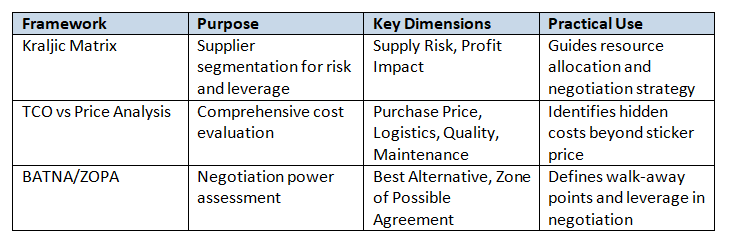
Each framework plays a complementary role. For example, identifying a supplier as “Strategic” on the Kraljic Matrix signals the buyer to pursue collaboration rather than pressure tactics. Meanwhile, deep TCO analysis equips the buyer to justify demands and the supplier to defend pricing with data. BATNA analysis ensures both sides avoid losing value by walking away prematurely or conceding too much.
Step-by-Step Strategy
This section provides a six-step approach to handle procurement pressure tactics from both buyer and supplier viewpoints.
Step 1: Preparation and Intelligence Gathering
Buyer: Conduct internal spend analysis, supplier segmentation, and should-cost modeling. Define KPIs and risk appetite.
Supplier: Map your own cost structure, understand client priorities, and research competitor offers.
Step 2: Establish Clear Objectives and BATNA
Buyer: Define target savings, acceptable concessions, and fallback suppliers.
Supplier: Identify minimum margin thresholds, alternative customers, and value-added differentiators.
Step 3: Opening the Negotiation — Anchoring and Framing
Buyer: Use anchoring by presenting a data-backed initial offer below current prices but within realistic TCO.
Supplier: Frame value beyond price — quality, innovation, reliability — to counter immediate price pressure.
Step 4: Recognize Pressure Tactics
Buyer & Supplier: Identify tactics such as sudden deadlines, “take it or leave it” ultimatums, or threats to source elsewhere.
Step 5: Neutralize Pressure with Techniques
Buyer: Employ techniques like the "Columbo" method — asking gentle, probing questions to expose supplier constraints.
Supplier: Use “mirror” listening and reframe buyer demands as mutually beneficial opportunities.
Step 6: Close with Value-Based Agreements
Buyer: Structure multi-year deals with performance incentives.
Supplier: Propose joint cost-saving initiatives and continuous improvement plans.
This process ensures negotiations progress from adversarial pressure to collaborative value creation.
Real-World Case Studies
Toyota’s Supplier Partnership Model
Toyota revolutionized procurement by treating suppliers as partners rather than adversaries. Rather than applying pressure tactics, Toyota engaged in open-book costing and joint problem-solving, resulting in continuous cost reductions and innovation. The strategic lesson: collaborative relationships reduce conflict and improve long-term value.
Apple’s Procurement Leverage
Apple leverages its massive volume to negotiate aggressively but pairs this with strict supplier code of conduct programs and investments in supplier capacity. Apple’s buyers use should-cost models combined with rigorous supplier audits. Lesson: leverage can be powerful but must be balanced with supplier support to avoid disruptions.
Walmart’s Supplier Squeeze Tactics
Walmart famously demands steep price cuts, backed by their dominant buyer power and sophisticated data analytics. However, overuse of pressure tactics has sometimes led to supplier pushback or quality issues. Lesson: buyer power is a double-edged sword that requires careful management to sustain supplier relationships.
Tactics and Counter-Tactics
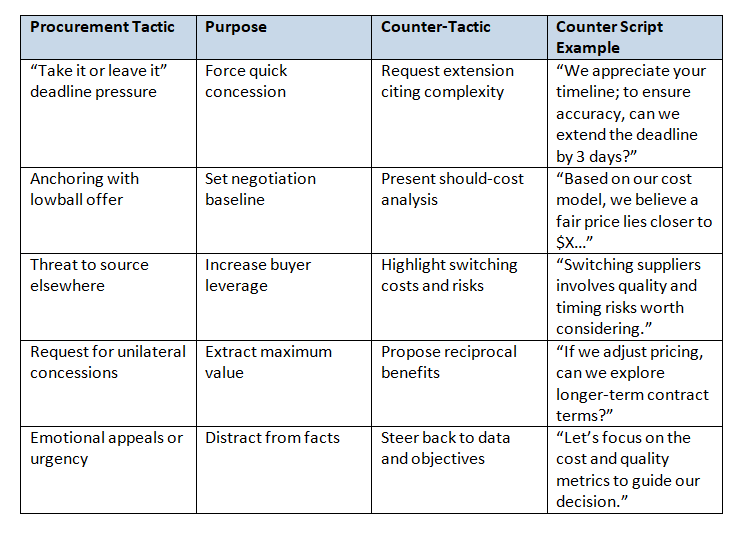
Understanding these tactics and having ready counter-scripts empowers negotiators to maintain control and steer negotiations toward balanced outcomes.
Advanced Strategies
Beyond basic negotiation, expert procurement professionals employ:
- Relationship Leverage: Use long-term partnership value and co-investment opportunities to offset short-term price pressures.
- Multi-Year Deal Structuring: Lock-in favorable terms with escalation clauses tied to market indices to share risk.
- Value-Based Positioning: Shift discussion from price to total value, incorporating innovation, sustainability, and risk mitigation.
- Transaction Cost Economics: Apply Williamson’s theory to minimize opportunism and complexity costs through contractual safeguards.
- Lean Procurement: Streamline processes to reduce internal costs and improve supplier responsiveness, creating mutual gains.
These strategies demand deep category expertise and trust but unlock superior outcomes.
Scripts and Templates
1. Supplier Response to Sudden Price Reduction Demand
“Thank you for sharing your cost reduction targets. To support this, could you please provide detailed spend data? We’d like to explore joint cost-saving initiatives that maintain quality and delivery.”
2. Buyer Request for Should-Cost Breakdown
“As part of our due diligence, please share a breakdown of your manufacturing costs, including labor, materials, and overhead. This transparency will help us identify optimization opportunities.”
3. Supplier Counter to “Take it or Leave it” Ultimatum
“We understand your urgency. However, ensuring a sustainable partnership requires thorough evaluation. Let’s schedule a follow-up meeting next week to review all aspects.”
4. Buyer Proposal for Multi-Year Contract
“To stabilize pricing and improve supply security, we propose a 3-year agreement with annual performance reviews and indexed price adjustments.”
5. Supplier Inquiry on Alternative Solutions
“Given your pricing constraints, are there product modifications or alternative specifications we can explore to reduce costs while meeting your needs?”
Frequently Asked Questions
Q1: How can suppliers identify when buyers are using pressure tactics versus normal negotiation?
A1: Pressure tactics often involve artificial deadlines, ultimatums, or disproportionate demands inconsistent with market data. Suppliers should look for signs such as sudden shifts in tone, refusal to share data, or repeated “take it or leave it” offers. Using objective frameworks like should-cost analysis helps differentiate legitimate negotiation from undue pressure.
Q2: What role does should-cost modeling play in neutralizing procurement pressure?
A2: Should-cost modeling provides a fact-based estimate of supplier costs, reducing information asymmetry. Suppliers can use it to validate pricing, while buyers use it to justify offers. When both sides share transparency, pressure tactics lose effectiveness as negotiations focus on data rather than emotions.
Q3: How can buyers avoid damaging supplier relationships while applying pressure tactics?
A3: Buyers should segment suppliers using the Kraljic Matrix to tailor approaches. For strategic suppliers, collaborative dialogue and joint value creation are preferable. Transparency, respect, and clear communication mitigate relationship risks even when cost pressures are applied.
Q4: Are multi-year contracts effective against procurement pressure tactics?
A4: Yes. Multi-year contracts with defined performance metrics and price adjustment clauses create stability and align incentives. They reduce the frequency of contentious renegotiations and provide suppliers with revenue predictability, lowering temptation to apply or concede to pressure.
Q5: How can negotiation scripts improve outcomes in procurement pressure situations?
A5: Scripts enable consistent, professional responses that defuse tension and redirect conversations to objective criteria and mutual value. They help avoid emotional reactions, clarify positions, and prepare parties for common pressure tactics.
Conclusion
Procurement pressure tactics are pervasive in today’s global supply chains, reflecting the intense competition and cost focus of modern enterprises. However, recognizing these tactics and responding with a structured, informed approach transforms negotiations from adversarial standoffs into collaborative value-creation opportunities. By mastering frameworks like the Kraljic Matrix and BATNA, employing should-cost modeling, and using precise scripts and counter-tactics, both buyers and suppliers can protect their interests and foster sustainable partnerships.
As procurement professionals, your challenge is to balance power dynamics with strategic insight and relational intelligence. Embrace the advanced techniques and real-world lessons shared here to elevate your negotiation outcomes and secure lasting value. Begin implementing these strategies today to neutralize pressure tactics and lead your procurement function with confidence and excellence.
References
- Kraljic, P. (1983). “Purchasing Must Become Supply Management.” Harvard Business Review, 61(5), 109-117.
- Kahneman, D. (2011). Thinking, Fast and Slow. Farrar, Straus and Giroux.
- Porter, M.E. (1979). Competitive Strategy: Techniques for Analyzing Industries and Competitors. Free Press.
- Williamson, O.E. (1985). The Economic Institutions of Capitalism. Free Press.
- Harvard Business Review. (2015). “How Apple and Walmart Negotiate with Suppliers.” Harvard Business Review Case Studies.
- Institute for Supply Management. (2020). “Total Cost of Ownership: A Practical Guide for Procurement.”