Procurement vs Price Negotiation: Key Differences and Strategies for Sales and Business Success

Picture a global manufacturing firm locked in a tense negotiation with a key supplier for critical components. The procurement team, armed with detailed cost data and supplier scorecards, navigates a complex supplier selection process, while the sales team on the other side deploys carefully calibrated price negotiation tactics to hold premium margins. Despite months of discussions, a misstep in understanding the distinct nature of procurement versus price negotiation costs the seller millions in lost revenue.
This scenario underscores why mastering the nuanced differences between procurement and price negotiation is essential for senior sales professionals, pricing managers, and business owners alike. The cost of poor pricing decisions—stemming from confusing procurement's broader strategic role with the narrower focus of price negotiation—can be devastating. Behavioral economics research, including Kahneman and Tversky’s prospect theory and Ariely’s studies on price perception, reveals how buyers’ and sellers’ minds process value and price differently, amplifying the stakes in every deal.
In this definitive guide, you will master the psychology behind price perception, uncover key frameworks that differentiate procurement from negotiation, and gain actionable step-by-step processes to elevate your deal outcomes. You will explore real-world case studies from Apple, McKinsey, and Amazon, learn to avoid common pitfalls, and acquire advanced strategies and ready-to-use scripts proven to protect margins and close deals at premium prices.
· Table of Contents
· The Psychology and Science Behind Procurement and Price Negotiation
· Key Frameworks and Models: Comparing Procurement and Negotiation
· Step-by-Step Process: From Preparation to Closing
· Real-World Case Studies: Apple, McKinsey, Amazon
· Common Mistakes and How to Avoid Them
· Advanced Tactics for Expert Negotiators
· Scripts and Templates: Word-for-Word Examples
· Frequently Asked Questions
· Conclusion and Call to Action
· References
The Psychology and Science Behind This Topic
Understanding procurement versus price negotiation demands a dive into behavioral economics and psychology. Daniel Kahneman and Amos Tversky’s prospect theory (1979) explains how buyers perceive gains and losses asymmetrically—loss aversion means sellers must frame price proposals carefully to avoid triggering defensive reactions. This explains why blunt price cuts often backfire.
Ariely’s "Predictably Irrational" (2008) uncovers how anchoring shapes price expectations. The first price or reference point a buyer sees (whether official list price or competitor quote) heavily biases their willingness to pay. For procurement professionals, anchoring is a key lever both to establish negotiation boundaries and to engineer perceived value.
The price-quality heuristic suggests consumers often infer quality from price alone—higher prices imply superiority. This is especially relevant in procurement where brand reputation or supplier certification can justify premium pricing. The decoy effect, another behavioral quirk, occurs when a third, less attractive pricing option nudges buyers toward a preferred choice. Negotiators can strategically introduce such decoys to steer procurement decisions.
Robert Cialdini’s six principles of influence—reciprocity, scarcity, authority, consistency, liking, and social proof—are powerful in negotiation. Procurement teams rely heavily on authority (company policies), consistency (supplier scorecards), and scarcity (limited supplier options) to drive compliance. Sales teams can counterbalance this by establishing rapport (liking) and demonstrating unique value (social proof).
Reference pricing is a tactic both sides use to justify price levels. Buyers benchmark offers against prior deals or market standards, while sellers position prices relative to premium competitors to reinforce value.
In sum, successful engagement with procurement and price negotiation is less about numbers and more about mastering the psychological triggers shaping decisions.
Key Frameworks and Models
Distinguishing procurement from price negotiation is simplified by applying three foundational frameworks: the Procurement Cycle Model, the Negotiation Funnel Framework, and the Value-Based Pricing Model.
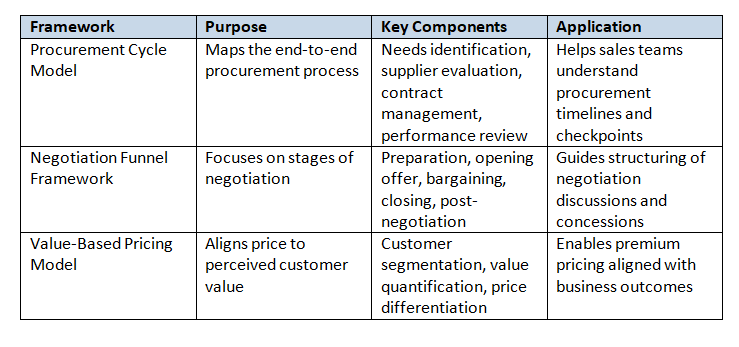
The Procurement Cycle Model emphasizes a strategic, often cross-functional process involving multiple stakeholders, rigorous supplier qualification, and long-term relationship management. It is not merely about price but total cost of ownership, risk mitigation, and compliance.
The Negotiation Funnel Framework dissects the dynamic bargaining process into manageable stages, allowing sales professionals to plan timing, offers, and concessions. It focuses narrowly on achieving agreement terms, often within the strategic boundaries set by procurement.
The Value-Based Pricing Model shifts conversations from cost-plus pricing to customer-centric ROI. McKinsey pioneered this approach in consulting fees, charging premium prices justified by quantifiable business impact rather than inputs.
Together, these models provide a comprehensive lens to navigate the interplay of procurement’s strategic rigor and negotiation’s tactical agility.
Step-by-Step Process
Step 1: Research and Understand the Procurement Landscape
Begin by mapping the target company's procurement process. Identify key stakeholders, decision criteria, and timelines. Use LinkedIn, public procurement documents, and supplier databases to gather intelligence. Understanding procurement’s priorities—whether cost reduction, supplier diversity, or innovation—is crucial.
Step 2: Prepare Your Value Proposition and Reference Pricing
Develop a value-based pricing proposal grounded in buyer pain points and desired outcomes. Benchmark against competitive offers and internal cost structures. Use Ariely’s anchoring principle by positioning your initial price as a high-value reference point.
Step 3: Engage Early with Procurement Stakeholders
Initiate dialogue with procurement influencers early, building rapport and credibility. Apply Cialdini’s liking and authority principles by demonstrating expertise and aligning with company policies.
Step 4: Conduct Structured Price Negotiation
Employ the Negotiation Funnel Framework. Start with a strong opening offer, invite counteroffers, and use calibrated concessions to advance. Leverage scarcity (“limited production capacity”) and reciprocity (“additional service inclusion”) to justify price points.
Step 5: Manage Objections with Data and Psychology
Anticipate common objections (price too high, competitor cheaper) and respond using evidence and psychological framing. For example, reframe “price too high” as “investment in risk mitigation” to activate loss aversion.
Step 6: Close with Clear Agreement and Follow-Up
Confirm all terms explicitly. Use written summaries to prevent misunderstandings. After closing, maintain supplier relationship management to support renewals and upsells.
Real-World Case Studies
Apple’s Premium Pricing and Procurement Alignment
Apple’s ability to command premium prices is rooted in tightly integrated procurement and pricing strategies. The company invests heavily in securing exclusive components (e.g., custom chips) through sophisticated supplier contracts that emphasize quality and innovation over lowest price. Their procurement team negotiates multi-year agreements ensuring supply stability, enabling sales teams to sustain high price points justified by superior product quality. This synergy has driven Apple’s industry-leading margins.
McKinsey’s Value-Based Fee Model
McKinsey revolutionized professional services pricing by shifting from hourly billing to value-based fees linked to client outcomes. Their procurement counterparts within client organizations often push back on fees; however, McKinsey’s sales and client teams use detailed ROI analyses to justify premium pricing. This alignment between procurement’s cost scrutiny and sales’ value articulation exemplifies effective negotiation built on behavioral economics.
Amazon’s Procurement-Driven Price Negotiation
Amazon’s procurement teams wield extraordinary leverage due to volume and data transparency. They deploy advanced analytics to benchmark supplier prices and forecast demand. Negotiations focus on total cost of ownership, including logistics and quality. Suppliers often face a tough procurement process but can negotiate favorable terms by demonstrating innovation or exclusivity. Amazon’s approach highlights the blend of procurement rigor and negotiation agility.
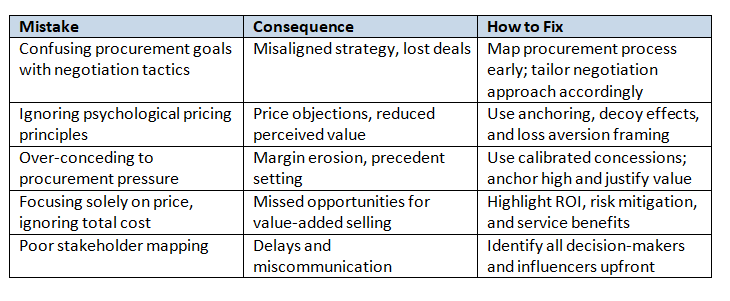
Common Mistakes and How to Avoid Them
Advanced Tactics
1. Multi-Offer Decoy Strategy: Present three pricing options where the middle option is the one you want accepted, but priced between a low-value "decoy" and a premium tier to guide procurement choice.
2. Reverse Anchoring: Start by discussing the highest-value outcome first before revealing prices, anchoring the buyer’s expectation on value, not cost.
3. Scarcity Framing with Contract Terms: Emphasize limited availability of special terms or volume discounts to instill urgency.
4. Behavioral Concessions: Instead of straight price cuts, offer non-price concessions like extended payment terms or enhanced support to satisfy procurement without eroding margins.
5. Collaborative Problem Solving: Engage procurement as partners in solving supply chain or cost challenges rather than adversaries, building trust and opening flexible negotiation space.
Scripts and Templates
Script 1: Initial Procurement Engagement Email
“Dear [Name],
I understand your team is evaluating suppliers for [product/service]. We have extensive experience delivering measurable value in this area, including [specific outcome]. I would appreciate the opportunity to discuss how we can align our solutions with your procurement goals and deliver both cost efficiency and innovation.
Would you be available for a 30-minute call next week?
Best regards,
Script 2: Responding to Price Objection
“Thank you for your feedback. I appreciate the importance of budget constraints. It’s important to consider that our pricing reflects the total cost of ownership, including [quality, reliability, support]. For example, our recent client [name] achieved [specific ROI], which offset the initial investment. Could we explore which aspects of value are most critical to your team?”
Script 3: Closing Negotiation Call
“Based on our discussions, it sounds like we have aligned on terms that meet your needs and protect your budget. I will send over a summary document to confirm. Please let me know if there are any outstanding concerns. We look forward to a successful partnership.”
Frequently Asked Questions
Q1: How does procurement differ from price negotiation in B2B sales?
Procurement is a strategic, multi-step process focused on supplier evaluation, risk management, and total cost of ownership, typically involving multiple stakeholders and formal procedures. Price negotiation is a tactical phase within procurement or sales processes centered specifically on agreeing on price and contract terms.
Q2: What psychological principles should sales teams use when negotiating price with procurement?
Key principles include anchoring by setting initial offers strategically, leveraging loss aversion to frame value, using scarcity and reciprocity to influence urgency and concessions, and applying social proof to demonstrate credibility.
Q3: Can procurement teams benefit from understanding sales negotiation tactics?
Yes, understanding negotiation psychology helps procurement professionals better manage supplier interactions, avoid manipulation, and collaborate effectively to achieve best value rather than just lowest price.
Q4: How can companies avoid margin erosion during procurement-driven negotiations?
By adopting value-based pricing, preparing calibrated concessions, focusing on total cost of ownership, and maintaining clear documentation and stakeholder communication throughout.
Q5: What role does data play in modern procurement and price negotiation?
Data provides benchmarking for reference pricing, risk assessment, supplier performance tracking, and predictive analytics that enable both buyers and sellers to make informed, strategic decisions.
Conclusion
Distinguishing procurement from price negotiation is more than academic; it’s a prerequisite for sales success and margin protection in complex B2B deals. By mastering the psychological underpinnings of price perception and applying structured frameworks like the Procurement Cycle Model and Negotiation Funnel, professionals can navigate these intertwined processes with precision. Real-world examples from Apple’s supplier strategy to McKinsey’s value pricing illustrate that aligning procurement understanding with negotiation expertise unlocks premium pricing power.
As you integrate these insights, adopt advanced tactics such as decoy pricing and behavioral concessions, and deploy the scripted dialogues provided, you will transform negotiations from margin risks into strategic revenue drivers. Begin today by mapping your next client’s procurement landscape and anchoring your pricing proposal with compelling value—your margins and client relationships depend on it.
References
1. Kahneman, D., & Tversky, A. (1979). Prospect Theory: An Analysis of Decision under Risk. Econometrica.
2. Ariely, D. (2008). Predictably Irrational: The Hidden Forces That Shape Our Decisions. HarperCollins.
3. Cialdini, R. B. (2007). Influence: The Psychology of Persuasion. Harper Business.
4. Hinterhuber, A. (2004). Towards Value-Based Pricing – An Integrative Framework for Decision Making. Industrial Marketing Management, 33(8), 765-778.
5. McKinsey & Company. (2015). Pricing: The Third Business Growth Engine. McKinsey Insights.
6. Malhotra, D., & Bazerman, M. H. (2007). Negotiation Genius: How to Overcome Obstacles and Achieve Brilliant Results at the Bargaining Table and Beyond. Bantam Books.