Procurement vs Sales Dynamics: Understanding the Power Struggle

The tension was palpable in the conference room. A major supplier had just lost a multi-million-dollar contract after a brutal RFP process led by a procurement team determined to squeeze every last cent of margin. The supplier’s account manager left frustrated, realizing the buyer’s demands had gone beyond price—stretching into delivery timelines, quality assurance, and penalty clauses. On the buyer’s side, the category manager sat triumphant but wary, knowing that pushing too hard could backfire by damaging the supplier relationship or increasing total cost of ownership. This standoff wasn’t just about dollars; it was a high-stakes chess match where information asymmetry, power dynamics, and strategic positioning shaped the outcome.
Procurement negotiations are often misunderstood by both buyers and sellers, who focus excessively on price without appreciating the underlying strategic factors and psychological drivers at play. Buyers are measured on KPIs like cost savings, risk mitigation, and supplier innovation, while suppliers seek to protect margins, build trust, and ensure contract longevity. Yet many fail to leverage proven frameworks like the Kraljic Matrix for supplier segmentation, should-cost modeling to identify realistic price floors, or BATNA (Best Alternative to a Negotiated Agreement) to understand negotiation boundaries. The result: lost opportunities, eroded partnerships, and suboptimal total cost of ownership.
This comprehensive guide will transform how you approach procurement vs sales dynamics. You will master key frameworks including the Kraljic Matrix and transaction cost economics, learn step-by-step negotiation strategies with exact scripts for buyer and seller roles, analyze real-world case studies from Toyota, Apple, and Amazon, and gain access to a tactical matrix matching procurement moves with counter-strategies. Whether you manage procurement categories or lead supplier sales engagements, this definitive resource arms you with actionable insights to navigate and win the procurement power struggle.
· Table of Contents
· The Strategic Landscape: How Procurement Really Works
· Key Frameworks and Models
· Step-by-Step Strategy: Buyer and Seller Perspectives
· Real-World Case Studies: Toyota, Apple, Amazon
· Tactics and Counter-Tactics Matrix
· Advanced Strategies in Procurement Negotiation
· Scripts and Templates for Procurement Scenarios
· Frequently Asked Questions
· Conclusion
· References
The Strategic Landscape: How Procurement Really Works
Understanding procurement requires a shift from viewing it as a transactional cost-cutting exercise to appreciating it as a strategic function that balances risk, value, and supplier relationships. The procurement process typically starts with category management, where spend is segmented into discrete categories to allow focused strategy development. Buyers employ tools like the Kraljic Matrix to classify suppliers by supply risk and profit impact, enabling prioritized management of strategic, bottleneck, leverage, and routine suppliers.
Professional buyers are incentivized not merely by price reduction but by total cost of ownership (TCO) optimization. TCO analysis extends beyond unit price to include quality, delivery reliability, inventory carrying costs, and after-sales support. Should-cost modeling, an advanced technique, helps buyers estimate what a product or service should cost based on raw materials, labor, overhead, and profit margins, providing a reality check against supplier quotes.
Psychologically, buyers exhibit loss aversion as described by Kahneman, meaning they are more motivated to avoid cost overruns and supply disruptions than to chase marginal price improvements. This leads to conservative negotiation postures but also to strategic opacity—buyers may withhold information or downplay alternatives to maintain leverage.
Supplier segmentation is critical: strategic suppliers (high profit impact, high supply risk) require partnership and joint value engineering, whereas routine suppliers are managed via streamlined processes emphasizing price and efficiency. This segmentation drives key performance indicators (KPIs) such as cost savings, supplier innovation, risk mitigation, and compliance, all vital to the procurement mandate.
Key Frameworks and Models
A handful of frameworks underpin the strategic understanding of procurement vs sales dynamics. At the core is the Kraljic Matrix, which segments suppliers and informs negotiation strategy. Complementing this is the TCO vs price analysis framework and BATNA application in procurement negotiations.
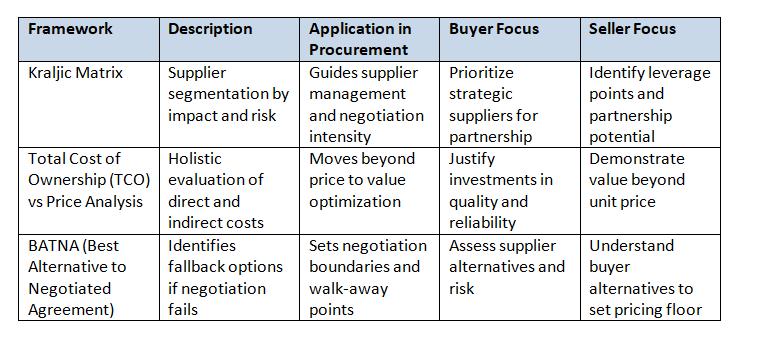
The Kraljic Matrix quadrants—Strategic, Bottleneck, Leverage, Routine—dictate negotiation tactics. Strategic suppliers demand collaboration and joint innovation to reduce risks and costs; leverage suppliers face aggressive price competition; bottleneck suppliers require risk mitigation strategies; routine suppliers are managed for efficiency.
TCO analysis introduces a comprehensive lens beyond sticker price, incorporating inventory costs, quality impacts, and service levels. Buyers armed with should-cost models use these to challenge supplier pricing, while sellers craft value propositions highlighting total value.
BATNA is fundamental for both sides. Buyers evaluate what alternatives exist if a deal fails—such as alternate suppliers or insourcing—thus informing their maximum concessions. Sellers similarly assess their best alternative customers or projects, helping define their minimum acceptable terms.
Step-by-Step Strategy
Effective procurement negotiations follow a disciplined process that balances tactical rigor with strategic insight. Below is a six-step walkthrough from both buyer and seller perspectives, illustrating specific tactics and language to deploy.
Step 1: Prepare with Data and Intelligence
Buyer: Conduct spend analysis, develop should-cost models, and segment suppliers per Kraljic Matrix. Identify KPIs and define BATNA. "Our internal cost benchmarking indicates a target price range of $X–$Y based on raw material and labor rates."
Seller: Analyze buyer’s category strategy, research competitive landscape, and identify your BATNA. Prepare to demonstrate value beyond price. "We understand your TCO concerns and have innovations that reduce maintenance costs by 15%."
Step 2: Initiate with Clear Objectives and Agenda
Buyer: Set meeting expectations emphasizing collaboration and mutual benefit. "Our goal is to align on cost, quality, and delivery targets to ensure a win-win outcome."
Seller: Reinforce commitment to partnership and seek to clarify buyer priorities. "We want to understand your key drivers—price, service, innovation—to tailor our proposal."
Step 3: Exchange Information Transparently but Strategically
Buyer: Share high-level TCO targets, but keep detailed cost assumptions confidential. Use probing questions. "Can you explain your cost drivers for packaging and logistics?"
Seller: Provide credible data supporting pricing, highlight value-adds. "Our advanced manufacturing process reduces defect rates by 20%, lowering TCO."
Step 4: Negotiate on Value, Not Just Price
Buyer: Employ should-cost insights to challenge pricing, introduce alternative scenarios. "If you can reduce lead time by 10 days, we could consider a price premium."
Seller: Quantify value of innovations and flexibility. "Offering extended payment terms reduces your working capital needs, offsetting our price."
Step 5: Manage Concessions and Use BATNA Wisely
Buyer: Make concessions conditional and reciprocal. "We can agree to a longer contract term if pricing moves closer to our target."
Seller: Know your walk-away point and signal scarcity if appropriate. "Given our capacity constraints, this is our best offer for the next quarter."
Step 6: Close with Clear Contractual Terms and Relationship Plans
Buyer: Confirm KPIs, service levels, and penalty clauses. "We will monitor delivery performance monthly and hold quarterly business reviews."
Seller: Agree on joint continuous improvement initiatives. "We propose quarterly innovation workshops to drive cost reductions."
Real-World Case Studies
Examining leading companies reveals the practical application of procurement vs sales dynamics.
Toyota: Toyota’s supplier partnership model emphasizes long-term collaboration, joint problem-solving, and value engineering. Instead of aggressive price-cutting, Toyota invests in supplier development, reducing total cost and boosting innovation. The Kraljic Matrix guides Toyota to treat key suppliers as strategic partners, aligning incentives to drive mutual growth.
Apple: Apple leverages its massive purchasing power and rigorous should-cost modeling to pressure suppliers on price and quality. However, Apple also employs strict supplier codes of conduct and invests in supplier capabilities to ensure compliance and innovation. The BATNA for Apple is strong given its scale, but it balances this power with strategic risk management to prevent supply disruptions.
Amazon: Known for squeezing suppliers on price and service levels, Amazon uses data-driven procurement and lean procurement principles to optimize costs. Suppliers face high pressure but access massive volumes. Amazon’s negotiation tactics include aggressive RFPs and leverage of alternative suppliers, forcing sellers to innovate or risk losing contracts.
These cases highlight how procurement power can be wielded differently—through partnership, leverage, or operational excellence—depending on strategic intent.
Tactics and Counter-Tactics
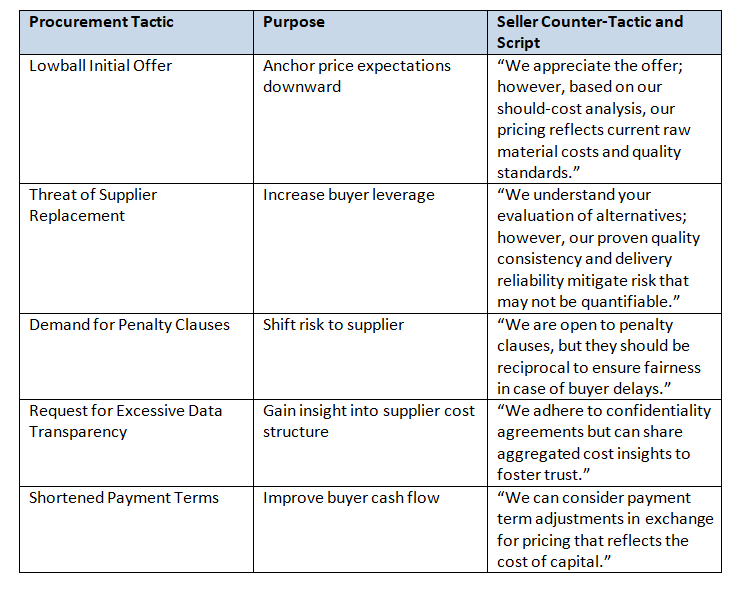
The following table maps common procurement tactics to their purpose and exact counter-responses sellers can deploy to protect margins and maintain negotiation leverage.
Advanced Strategies
Beyond basic negotiation, expert procurement professionals employ advanced techniques to tilt dynamics in their favor.
Relationship Leverage: Building multi-tier supplier relationships can create influence beyond direct contacts. For example, engaging supplier executive teams can secure innovation commitments and preferential treatment.
Multi-Year Deal Structuring: Locking in prices and volumes over multiple years balances risk and incentivizes supplier investment. For sellers, multi-year contracts provide revenue predictability and cost amortization opportunities.
Value-Based Positioning: Sellers craft proposals that emphasize total value delivered, including reduced downtime, improved quality, and sustainability benefits. Buyers assess beyond price, focusing on strategic outcomes.
Lean Procurement: Streamlining procurement processes reduces transaction costs (Williamson’s transaction cost economics) and accelerates decision-making. This requires trust and data transparency between parties.
Scenario Planning and Simulation: Using decision trees to model negotiation outcomes allows both sides to anticipate concessions and counter-moves, optimizing strategies preemptively.
Scripts and Templates
Below are exact negotiation scripts for common procurement scenarios.
Script 1: Initial Proposal Email (Buyer to Seller)
“Dear [Supplier],
Following our category review, we invite you to submit a proposal aligned with our target total cost of ownership parameters. We value your partnership and look forward to a collaborative discussion.
Best regards,
Script 2: Pricing Challenge Call (Buyer)
“Thank you for your quote. Based on our should-cost model, we see opportunities to lower costs especially in logistics and packaging. Can you help us understand your cost drivers and potential areas for improvement?”
Script 3: Value Justification Email (Seller)
“Dear [Buyer],
In addition to competitive pricing, our solution offers a 15% reduction in downtime and extended warranty coverage, translating into significant TCO savings. We welcome the opportunity to discuss how these benefits align with your objectives.
Best,
Script 4: Concession Conditionality (Buyer)
“We can consider extending contract duration to three years if pricing can be adjusted by 5%. This will allow us to plan volumes more effectively.”
Script 5: Walk-Away Signal (Seller)
“Given current capacity constraints and market conditions, this is our final offer. We hope to continue our partnership on these terms.”
Frequently Asked Questions
Q1: How can suppliers counteract the power imbalance in procurement negotiations?
A1: Suppliers can leverage relationship-building, demonstrate unique value propositions, use should-cost data to justify pricing, and identify their BATNA to avoid conceding unnecessarily. Engaging senior stakeholders and proposing multi-year contracts can also rebalance power.
Q2: What role does the Kraljic Matrix play in procurement negotiation strategy?
A2: The Kraljic Matrix segments suppliers by profit impact and supply risk, guiding buyers on where to focus collaboration or competitive pressure. Strategic suppliers require partnership and innovation focus, while leverage suppliers face tougher price negotiations.
Q3: How does total cost of ownership differ from price in procurement decisions?
A3: TCO includes all costs associated with a purchase over its lifecycle—purchase price, maintenance, quality defects, inventory, and disposal—providing a comprehensive view that supports better decision-making beyond headline price.
Q4: What negotiation scripts are effective when buyers use lowball offers?
A4: Sellers should respond by referencing should-cost models and market benchmarks, emphasizing value delivered and risks of quality or supply disruption if pricing is pushed too low.
Q5: How can procurement teams use BATNA effectively?
A5: BATNA helps buyers understand their alternatives if negotiations fail, setting limits on concessions and strengthening bargaining positions. It also informs risk assessments regarding supplier replacement or insourcing.
Conclusion
The procurement vs sales dynamic is a complex interplay of strategy, psychology, and data-driven decision-making. Winning negotiations requires more than price haggling; it demands mastery of frameworks like the Kraljic Matrix, TCO analysis, and BATNA, combined with tactical finesse and relationship management. Buyers must balance cost savings with risk mitigation and supplier innovation, while sellers need to defend margins through value articulation and advanced negotiation techniques.
This definitive guide equips procurement managers and sales professionals alike with actionable strategies, real-world examples, and exact scripts to navigate the power struggle confidently and effectively. Embrace these insights to transform adversarial standoffs into collaborative, profitable partnerships that sustain competitive advantage.
For a tailored negotiation strategy session or supplier engagement workshop, contact our team of procurement experts today.
References
1. Kraljic, P. (1983). Purchasing Must Become Supply Management. Harvard Business Review.
2. Kahneman, D. (2011). Thinking, Fast and Slow. Farrar, Straus and Giroux.
3. Porter, M.E. (1980). Competitive Strategy: Techniques for Analyzing Industries and Competitors. Free Press.
4. Williamson, O.E. (1985). The Economic Institutions of Capitalism. Free Press.
5. Monczka, R., Handfield, R., Giunipero, L., Patterson, J. (2020). Purchasing and Supply Chain Management. Cengage Learning.
6. Fisher, R., Ury, W. (1981). Getting to Yes: Negotiating Agreement Without Giving In. Penguin Books.