Psychological Tactics in Negotiation: The Mind Games That Win Deals

Negotiations often unfold in boardrooms, conference calls, or informal settings, but beneath the surface lies a subtle battlefield of psychological tactics and mind games. Consider the 2011 Apple vs Samsung patent negotiations, where both tech giants maneuvered not only through legal claims but also through psychological posturing that influenced public opinion and settlement terms. Samsung’s calibrated delays and Apple’s strategic anchoring in demands reflected deep psychological plays — moves that shaped the multi-billion dollar outcome far beyond the written contracts.
What many negotiators overlook is that negotiation is less about numbers and more about understanding human cognition, biases, and social dynamics. The science of behavioral economics, cognitive psychology, and game theory reveals why anchoring, framing, and reciprocity often decide who wins and who concedes. Yet, few professionals systematically apply these insights, leading to missed opportunities or worse — costly losses. Research by Daniel Kahneman on loss aversion and Robert Cialdini’s principles of influence underscores the critical psychological levers at play, while experts like Chris Voss expose tactical empathy as a game-changing skill.
This article is designed to elevate your negotiation mastery by unpacking the psychology behind these tactics, introducing indispensable frameworks, and providing actionable scripts to deploy in real-world scenarios. You will learn to recognize and counter psychological ploys, leverage anchoring and scarcity effectively, and apply advanced mind games ethically to secure optimal outcomes. Whether structuring multi-million dollar mergers, closing SaaS enterprise deals, or navigating labor disputes, this definitive guide arms you with the science-backed tools to dominate negotiations.
· Table of Contents
· The Psychology and Science Behind Psychological Tactics in Negotiation
· Key Frameworks and Models for Negotiation Mind Games
· Step-by-Step Process to Implement Psychological Tactics
· Real-World Case Studies: Tech, Sports, and Diplomacy
· Recognition and Counter-Response Guide
· Advanced Insights for Elite Negotiators
· Scripts and Templates for Winning Negotiations
· Frequently Asked Questions
· Conclusion: Synthesizing Psychological Mastery
· References
The Psychology and Science Behind This Topic
Psychological tactics in negotiation are rooted in well-established principles of behavioral economics and cognitive psychology. At the core lies the human brain’s limited rationality — negotiators are prone to biases, emotional triggers, and social influences that shape decisions often unconsciously.
Daniel Kahneman’s dual-system theory (2011) explains how System 1 (fast, intuitive) thinking dominates in high-pressure negotiations, making negotiators susceptible to anchoring bias — the tendency to rely too heavily on the first piece of information offered. For example, an initial price anchor can heavily influence the final agreed figure, even if arbitrary. Prospect theory, also by Kahneman and Tversky (1979), illustrates loss aversion: losses loom larger than equivalent gains, making framing offers in terms of avoiding losses more persuasive.
Robert Cialdini’s six principles of influence (2006) — reciprocity, commitment and consistency, social proof, authority, liking, and scarcity — are psychological levers frequently exploited in negotiation. Scarcity, for example, increases perceived value, while reciprocity creates obligation to concede or reciprocate favors. This aligns with Adam Grant’s “Give and Take” (2013), where strategic giving builds social capital that can be leveraged later.
Chris Voss’s “Never Split the Difference” (2016) introduces tactical empathy — the deliberate acknowledgment and verbalization of the other party’s emotions — as a critical tool to build rapport and extract information. Techniques like mirroring and labeling reduce tension and open channels for collaboration.
Game theory adds another layer, modeling negotiation as strategic interactions where understanding the other’s incentives and likely responses guides optimal moves. Concepts like Nash equilibrium help negotiators predict stable outcomes in competitive settings, while the prisoner’s dilemma warns of suboptimal results from mistrust.
Together, these psychological and scientific insights form the foundation for mastering mind games in negotiation — enabling professionals to influence, persuade, and secure superior deals systematically.
Key Frameworks and Models
Several frameworks synthesize these psychological tactics into actionable negotiation models. Below are three foundational frameworks widely used by elite negotiators.
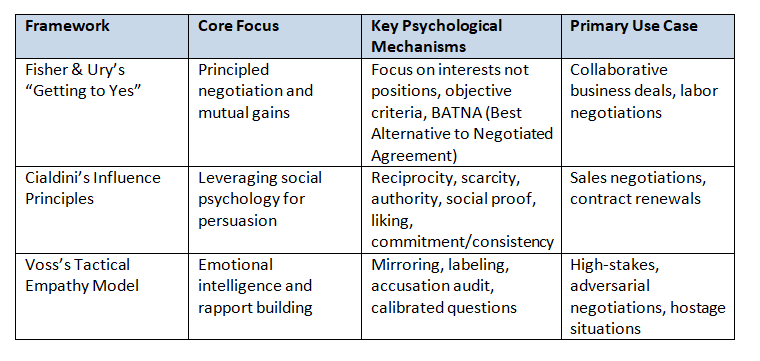
These frameworks differ in approach but complement each other. Fisher & Ury emphasize win-win outcomes by separating people from problems. Cialdini’s model harnesses psychological triggers to ethically nudge decisions. Voss’s model focuses on emotional dynamics to turn adversaries into collaborators.
Understanding when and how to deploy these frameworks — often dynamically within the same negotiation — is a hallmark of expert negotiators.
Step-by-Step Process or Analysis
Mastering psychological tactics requires a structured approach. Below is a six-step process incorporating timing, language, and psychological guidance.
Step 1: Preparation and Anchoring Setup
Before the negotiation, research the counterpart’s interests and BATNA. Prepare your initial offer to serve as an anchor — a high or low figure that psychologically influences their expectations. Use precise numbers (e.g., $1,975,000 rather than $2 million) to increase credibility (Epley & Gilovich, 2006).
Script example: “Based on our detailed market analysis, we believe $1.975 million reflects the fair value for this deal.”
Step 2: Establishing Tactical Empathy
Early in discussions, use mirroring and labeling to build rapport and extract emotional undercurrents. Mirror their words subtly: if they say “We’re concerned about deadlines,” respond with “Deadlines are a concern?”
Label emotions to validate feelings: “It sounds like you’re worried about the risks involved.”
This creates psychological safety, unlocking information otherwise withheld.
Step 3: Deploying Reciprocity and Concessions
Introduce small, strategic concessions to trigger reciprocity. For instance, “We can expedite delivery by two weeks if you agree to flexible payment terms.”
This plays on the norm of reciprocation, compelling counterparts to reciprocate concessions.
Step 4: Framing and Loss Aversion
Frame offers to emphasize what the other party loses by not agreeing. “Delaying this agreement could cost your team valuable market share.”
Loss framing is more motivating than gain framing (Kahneman & Tversky, 1979).
Step 5: Using Calibrated Questions
Ask open-ended, calibrated questions that prompt the counterpart to solve problems collaboratively: “How can we structure this deal to meet your revenue targets while staying within our budget?”
This shifts focus from positions to interests and invites joint problem-solving.
Step 6: Closing with Scarcity and Commitment
Highlight scarcity: “This pricing is only available until the end of the quarter due to supplier constraints.”
Then secure commitment: “Can we agree to move forward on these terms today?”
Combining scarcity with commitment leverages urgency and consistency principles.
Real-World Case Studies
Context: Apple sued Samsung for patent infringement, leading to high-stakes negotiations and public legal battles. Apple anchored demands with astronomical damages claims, leveraging loss aversion and legal authority. Samsung responded with calibrated delays and social proof tactics by highlighting industry standards.
Lesson: Effective anchoring combined with public framing can pressure adversaries, but recognizing and countering delays through calibrated questions can prevent stalemate.
Players and owners negotiated collective bargaining agreements. Owners used scarcity by threatening season cancellation; players used tactical empathy to highlight fan impact. Ultimately, both sides employed BATNA analysis to gauge walk-away options.
Lesson: Understanding mutual interests and leveraging scarcity can force compromise, but empathy defuses hostility.
The P5+1 nations employed framing effects emphasizing gains of nuclear compliance vs. losses of sanctions. Tactical empathy was essential in understanding Iran’s security concerns. Complex multi-party interests required iterative calibrated questions to identify overlapping goals.
Lesson: Multi-party negotiations demand advanced psychological insight and patience to navigate competing narratives.
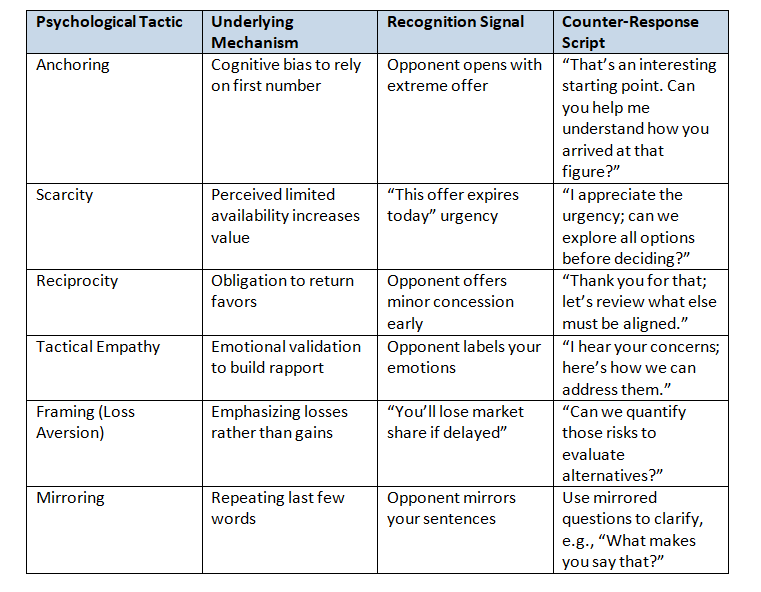
Recognition and Counter-Response Guide
Advanced Insights
Top negotiators integrate psychological tactics fluidly with power dynamics. Drawing from Machiavelli and Sun Tzu, understanding not just the opponent’s psychology but also broader context and timing is critical. For instance, the strategic use of the “accusation audit” (Voss) — preemptively voicing your opponent’s potential objections — defuses resistance before it arises.
Game theory’s concept of mixed strategies advises unpredictability in tactic deployment to avoid becoming exploitable. Elite negotiators also use “foot-in-the-door” and “door-in-the-face” techniques sequentially to escalate concessions while maintaining control.
Neurological studies suggest that stress impairs System 2 rational thinking, so controlling physiological states through breathing or pacing can enhance decision-making under pressure.
Ethically, blending transparency with psychological insight fosters long-term relationships rather than short-term wins, in line with Adam Grant’s “Give and Take” reciprocity model.
Scripts and Templates
“Given the comprehensive value we deliver and market benchmarks, our initial proposal is $2.15 million. I’m open to discussing how this aligns with your expectations.”
“It seems like the timing is causing some concern on your side, is that right?”
“To accommodate your budget constraints, we can adjust the delivery timeline by two weeks if that works.”
“How can we structure this agreement to meet both your cost targets and our quality standards?”
“Our supplier has limited capacity, so this pricing is only available if we finalize by Friday. Can we commit today?”
Frequently Asked Questions
Q1: How do psychological tactics differ from manipulation in negotiation?
Psychological tactics leverage human cognitive biases and social principles ethically to influence decisions. Manipulation involves deception or coercion that harms trust. Ethical negotiators focus on transparency and mutual benefit.
Q2: Can psychological tactics backfire?
Yes, if overused or detected, tactics like anchoring or scarcity can cause distrust or resistance. Skilled negotiators balance assertiveness with empathy and adapt tactics to context.
Q3: How can I practice tactical empathy effectively?
Listen actively, mirror language subtly, and label emotions without judgment. Practice with role-plays and reflect on emotional cues beyond words, such as tone and body language.
Q4: When should I use calibrated questions?
Use calibrated questions after establishing rapport to invite collaborative problem-solving. They are especially effective in deadlocks or when exploring underlying interests.
Q5: Are there cultural considerations in psychological negotiation tactics?
Absolutely. Cultural norms affect perceptions of authority, reciprocity, and conflict. Adapt tactics accordingly, respecting communication styles and hierarchical sensitivities.
Conclusion
Psychological tactics in negotiation transcend mere tactics; they represent a sophisticated interplay of human cognition, emotion, and strategy. By understanding the underlying behavioral science and mastering frameworks like Fisher & Ury’s principled negotiation, Cialdini’s influence principles, and Voss’s tactical empathy, professionals can transform negotiations from zero-sum battles into opportunities for creative value creation.
The step-by-step processes, real-world case studies, and counter-response strategies provided here equip negotiators with a comprehensive toolkit to recognize, deploy, and neutralize psychological mind games. Elevate your negotiation outcomes by integrating these insights with ethical rigor and adaptive finesse. Begin applying these techniques today, and watch your deals reach new heights of success.
References
- Kahneman, D. (2011). Thinking, Fast and Slow. Farrar, Straus and Giroux.
- Cialdini, R. B. (2006). Influence: The Psychology of Persuasion. Harper Business.
- Voss, C. (2016). Never Split the Difference: Negotiating As If Your Life Depended On It. Harper Business.
- Fisher, R., Ury, W., & Patton, B. (2011). Getting to Yes: Negotiating Agreement Without Giving In. Penguin Books.
- Grant, A. (2013). Give and Take: A Revolutionary Approach to Success. Penguin Books.
- Tversky, A., & Kahneman, D. (1979). Prospect Theory: An Analysis of Decision under Risk. Econometrica, 47(2), 263-291.