Real-Life Negotiation Skills Examples

In today’s fast-paced, interconnected world, negotiation skills have become indispensable across professional and personal contexts. Whether securing a business deal, navigating a salary discussion, or resolving conflicts, mastering negotiation strategies can unlock better outcomes, stronger relationships, and enhanced influence. Yet, negotiation is often misunderstood as a zero-sum game rather than a collaborative problem-solving process grounded in psychology and communication science.
This comprehensive guide on real-life negotiation skills examples will deepen your understanding of proven techniques and psychological frameworks that top negotiators use worldwide. You will learn how to apply concepts like BATNA (Best Alternative To a Negotiated Agreement), anchoring, active listening, and mirroring through detailed scenarios and practical exercises. By developing these skills, you will be equipped to negotiate with confidence, maximize value, and build lasting agreements.
· Table of Contents
· Understanding Core Negotiation Principles and Frameworks
· Real-Life Example #1: Salary Negotiation Using BATNA and Anchoring
· Real-Life Example #2: Business Contract Negotiation with Collaborative Techniques
· Real-Life Example #3: Conflict Resolution Through Active Listening and Empathy
· Psychological Tactics: Mirroring, Framing, and Reciprocity in Practice
· Practical Exercises to Enhance Your Negotiation Skills
· Frequently Asked Questions
· Conclusion
· References
Understanding Core Negotiation Principles and Frameworks
Effective negotiation is rooted in a few key psychological and strategic principles that guide decision-making and communication. One foundational concept is BATNA, introduced by negotiation scholars Roger Fisher and William Ury in their seminal work, "Getting to Yes." BATNA represents your best fallback option if negotiations fail, empowering you to set realistic goals and avoid unfavorable agreements. Knowing your BATNA enhances confidence and leverage.
Another essential principle is anchoring, a cognitive bias where the first number or offer presented sets a psychological benchmark that shapes the negotiation's trajectory. Experienced negotiators strategically establish anchors to frame value perceptions positively. For example, a seller might start with a high initial price, encouraging buyers to negotiate down but remain above their minimum acceptable figure.
Active listening is a psychological skill critical to discerning underlying interests beyond stated positions. It involves fully concentrating, understanding, responding, and remembering what the other party says. This practice builds trust and uncovers mutual gains, as described in Daniel Goleman’s emotional intelligence research.
Mirroring, or subtly mimicking the counterpart’s body language and tone, fosters rapport and increases persuasion by triggering subconscious liking mechanisms identified in social psychology studies.
In practice, combining these principles with structured frameworks such as the Interest-Based Relational (IBR) approach or the Harvard Negotiation Project’s principled negotiation model creates a powerful foundation for successful outcomes.
Real-Life Example #1: Salary Negotiation Using BATNA and Anchoring
Imagine you are offered a new position with a salary proposal below your expectations. Before responding, you identify your BATNA: staying in your current job with a known salary and benefits package. Understanding this fallback helps you set a minimum acceptable salary during negotiation.
You begin by expressing enthusiasm for the role and then anchor the conversation by proposing a salary higher than your minimum but aligned with market research. For example:
"I’m excited about this opportunity. Based on my experience and industry standards, I was expecting a salary in the range of $85,000 to $95,000."
This initial anchor sets a favorable frame and signals your value. The hiring manager counters with $80,000, but because your BATNA is solid, you confidently negotiate other benefits such as flexible working hours or a signing bonus to bridge the gap.
A practical exercise for salary negotiation:
· Research industry salary ranges and define your BATNA before negotiation.
· Practice stating your salary anchor confidently with a peer.
· Role-play negotiation scenarios with varying counteroffers using scripts.
This approach aligns with the anchoring effect and BATNA framework, improving your chances of a satisfactory outcome.
Real-Life Example #2: Business Contract Negotiation with Collaborative Techniques
In complex business contracts, negotiation often shifts from competitive bargaining to collaborative problem-solving. Consider a supplier and a manufacturer negotiating delivery timelines and payment terms.
Instead of focusing solely on price, they apply the Interest-Based Relational (IBR) approach, which emphasizes maintaining relationships while addressing interests. The supplier explains their constraints on delivery capacity, while the manufacturer shares cash flow cycles affecting payment timing.
Using active listening, each party paraphrases the other’s concerns, fostering empathy and reducing defensiveness. They explore options such as phased deliveries with milestone payments that accommodate both parties’ needs.
This example illustrates the power of principled negotiation, avoiding positional deadlocks and creating joint value.
Practical exercise:
· Identify underlying interests in a mock contract negotiation.
· Practice paraphrasing and summarizing the other party’s perspective.
· Brainstorm multiple options before committing to terms.
Real-Life Example #3: Conflict Resolution Through Active Listening and Empathy
Negotiation frequently arises in conflict resolution, whether workplace disputes or personal disagreements. For instance, two team members disagree on project responsibilities.
A skilled negotiator employs active listening techniques, such as reflecting emotions and asking open-ended questions:
"It sounds like you’re feeling overwhelmed with the current workload. Can you tell me more about which tasks are most challenging?"
This approach validates feelings and uncovers root causes. By mirroring tone and body language, the negotiator builds rapport and lowers tension.
Once both parties feel heard, the negotiator facilitates generating shared solutions, such as redistributing tasks or setting clearer deadlines.
Psychological frameworks like Emotional Intelligence (Daniel Goleman) and Nonviolent Communication (Marshall Rosenberg) underpin this process.
Practical exercise:
· Practice active listening with a partner, focusing on paraphrasing emotions.
· Use "I" statements to express your perspective without blame.
· Role-play conflict scenarios emphasizing empathy and collaborative problem-solving.
Psychological Tactics: Mirroring, Framing, and Reciprocity in Practice
Beyond core principles, specific psychological tactics can significantly influence negotiation outcomes.
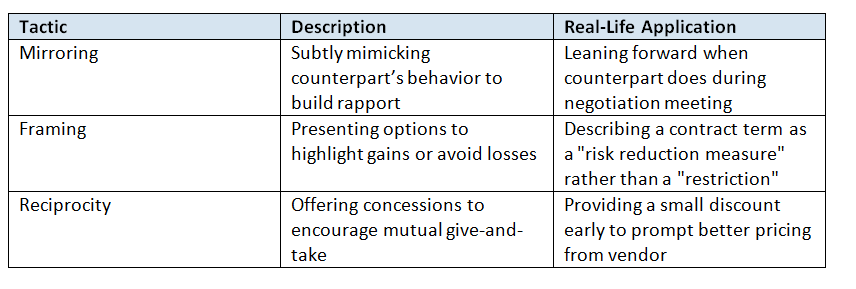
Mirroring involves subtly copying the other person’s gestures, speech patterns, or posture. Research by Chartrand and Bargh (1999) found that mirroring increases liking and trust, which can lead to more favorable agreements. For example, if your counterpart leans forward, you lean forward slightly to build rapport.
Framing shapes how options are presented. Kahneman and Tversky’s prospect theory demonstrates that people react differently depending on whether choices are framed as gains or losses. For instance, framing a discount as a "limited-time savings opportunity" rather than just a price reduction taps into urgency and value perception.
Reciprocity leverages the social norm of returning favors. When you offer a concession early, the other party is more likely to reciprocate. In sales, this could be providing free samples or extra services upfront.
Practical exercise:
· Observe and practice mirroring body language in low-stakes conversations.
· Experiment with framing offers differently and note responses.
· Initiate small concessions to test reciprocity effects.
Practical Exercises to Enhance Your Negotiation Skills
Developing negotiation skills requires deliberate practice and reflection. Here are targeted exercises:
· BATNA Mapping: Before any negotiation, list your alternatives and estimate their value. Compare offers against your BATNA for informed decisions.
· Role-Playing: Partner with colleagues to simulate diverse negotiation scenarios, incorporating techniques like anchoring and active listening. Record and review to identify improvement areas.
· Emotional Intelligence Journaling: After negotiations, reflect on emotional triggers, your responses, and outcomes. This builds self-awareness and regulation.
· Script Development: Prepare and rehearse scripts for common negotiation openings and responses to reduce anxiety and increase fluency.
· Feedback Sessions: Seek constructive feedback from mentors or peers on negotiation style, language, and effectiveness.
Consistent application of these practices leads to mastery and adaptability in various negotiation contexts.
Frequently Asked Questions
What is the most important negotiation skill to develop?
How do I determine my BATNA?
First, brainstorm all possible alternatives if the current negotiation fails. Then realistically assess the value and feasibility of each. Your BATNA is the option with the highest value you can confidently pursue. This process requires research, market knowledge, and sometimes consultation.
Can anchoring backfire?
Yes, if your anchor is perceived as unreasonable or aggressive, it may alienate the other party or stall negotiations. Anchoring should be firm but credible, backed by data or market standards to maintain legitimacy.
How can I handle emotional counterparts?
Use emotional intelligence principles: remain calm, acknowledge their feelings without judgment, and use empathy to de-escalate. Active listening and asking open-ended questions help uncover concerns and redirect focus toward problem-solving.
Are negotiation skills innate or learned?
While some individuals may have a natural aptitude, negotiation is primarily a learnable skill. Training, practice, and feedback significantly improve outcomes. Cognitive behavioral techniques can also help overcome anxiety or limiting beliefs.
Conclusion
Mastering negotiation skills is essential for achieving favorable and sustainable agreements in today’s complex environments. By understanding and applying core principles like BATNA, anchoring, active listening, and psychological tactics such as mirroring and framing, you can elevate your negotiation effectiveness. Real-life examples demonstrate that negotiation success depends not only on strategy but also on emotional intelligence and adaptability.
Start integrating these techniques into your daily interactions and professional negotiations. With deliberate practice and reflection, you will enhance your confidence, influence, and results. Take the next step by practicing the exercises outlined here and seeking opportunities to negotiate deliberately and mindfully.
References
Roger Fisher, William Ury, and Bruce Patton. Getting to Yes: Negotiating Agreement Without Giving In. Penguin Books, 2011.
Daniel Goleman. Emotional Intelligence: Why It Can Matter More Than IQ. Bantam Books, 2006.
Marshall B. Rosenberg. Nonviolent Communication: A Language of Life. PuddleDancer Press, 2003.
Robert B. Cialdini. Influence: The Psychology of Persuasion. Harper Business, 2006.
Richard Shell. Bargaining for Advantage: Negotiation Strategies for Reasonable People. Penguin Books, 2006.