Rebuilding Trust in Negotiation After a Breakdown: The Definitive Guide for High-Stakes Professionals

Negotiations can unravel in an instant. Imagine a multinational merger negotiation where two corporate giants, after months of painstaking discussions, suddenly hit a wall: a misunderstood email sparks accusations of bad faith, causing one side to abruptly withdraw. The resulting breakdown threatens billions in shareholder value, thousands of jobs, and years of strategic planning. In such moments, rebuilding trust is not just advisable—it’s imperative.
This scenario is far from rare. Negotiators often fall into psychological traps under pressure, where emotional flooding, impulsive System 1 thinking (as Daniel Kahneman describes in "Thinking, Fast and Slow"), and misinterpretation of counterparts’ intentions exacerbate conflict. Most people attempt to push harder after a breakdown or resort to ultimatums, only deepening mistrust. Yet, research from behavioral economics, clinical psychology, and negotiation theory reveals that trust can be repaired with deliberate, evidence-based strategies.
In this comprehensive guide, you will master the psychology behind trust breakdowns, explore key frameworks like Chris Voss’s Tactical Empathy and William Ury’s "Going to the Balcony," and learn a step-by-step repair process grounded in science and real-world examples. You will gain actionable, word-for-word scripts to regain trust even in the most hostile negotiations, advanced tactics for subtle influence, and strategies for recognizing and countering difficult dynamics. Whether you are a senior manager, a sales leader, a lawyer, or a diplomat, this is the ultimate resource to turn negotiation breakdowns into breakthroughs.
· Table of Contents
· The Psychology Behind This Challenge
· Key Frameworks and Models for Trust Repair
· Step-by-Step Process to Rebuild Trust
· Real-World Case Studies of Negotiation Recovery
· Recognizing and Countering Difficult Dynamics
· Advanced Techniques for Expert Negotiators
· Scripts and Templates for Difficult Scenarios
· Frequently Asked Questions
· Conclusion
· References
The Psychology Behind This Challenge
Trust breaks down in negotiation primarily because human beings operate with layered cognitive and emotional systems that often conflict under stress. At the neurological level, the amygdala—a key brain structure responsible for threat detection—activates during perceived betrayal or hostility, triggering what Daniel Goleman termed the "amygdala hijack." This reflexive response floods the brain with stress hormones, severely impairing rational thought and leading to emotional flooding, a state John Gottman extensively researched in relationship conflict. Emotional flooding causes negotiators to default to fight, flight, or freeze behaviors—dramatically reducing their ability to engage constructively.
Daniel Kahneman’s dual-process theory illuminates this further. System 1 thinking is fast, automatic, and emotional; System 2 is slow, deliberative, and logical. Under pressure, negotiators often rely excessively on System 1, leading to snap judgments, misattributions, and escalation. The challenge is to shift back to System 2 deliberation, enabling thoughtful trust repair.
Chris Voss, former FBI lead hostage negotiator, emphasizes "tactical empathy"—the deliberate acknowledgment of another’s emotions without necessarily agreeing—as a tool to de-escalate tension and rebuild connection. This taps into the human need for validation and reduces perceived threats, calming the amygdala response.
Trust repair theory from organizational psychology shows that rebuilding trust requires acknowledging the breach, demonstrating vulnerability, and restoring predictability. Behavioral economics research, including ultimatum game experiments, confirms that people often reject offers perceived as unfair even at personal cost, underscoring the importance of fairness and reciprocity in trust restoration.
In sum, rebuilding trust after a negotiation breakdown demands managing intense emotions, shifting cognitive processing modes, employing empathy strategically, and adhering to principles of fairness and transparency.
Key Frameworks and Models
Several established frameworks provide structured approaches to trust repair in negotiation. Below is a comparison of three widely respected models:
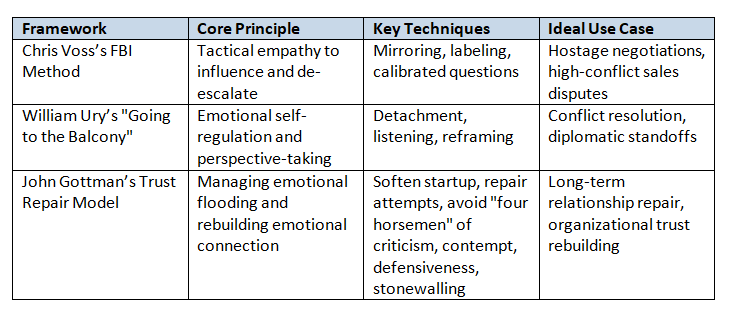
Chris Voss’s FBI method centers on tactical empathy, where negotiators validate emotions to reduce hostility. Mirroring (repeating last words), labeling ("It seems like..."), and calibrated questions ("How can we solve this together?") are tactical tools.
William Ury’s "Going to the Balcony," from "Getting Past No," teaches negotiators to step back emotionally—like going to a balcony to observe the conflict dispassionately—thus gaining control and perspective to re-engage constructively.
Gottman’s trust repair focuses on managing emotional flooding by recognizing and interrupting toxic interaction patterns (the four horsemen). It involves consciously softening initial statements and making genuine repair attempts to rebuild trust.
By integrating these frameworks, negotiators can approach trust breakdowns with a robust toolkit adaptable to diverse contexts.
Step-by-Step Process
Step 1: Pause and Regulate Emotions
Before addressing the breach, control your emotional state using techniques like deep diaphragmatic breathing or Amy Cuddy’s power poses to regain presence under pressure. This shifts from amygdala hijack to prefrontal cortex control, enabling System 2 thinking.
Step 2: Acknowledge the Breakdown Explicitly
Use transparent language to name the trust breach without defensiveness. For example, "I realize that my previous message caused confusion and may have seemed dismissive."
Step 3: Apply Tactical Empathy
Employ Chris Voss’s labeling technique: "It sounds like you felt sidelined in the last discussion." This validates emotions and reduces perceived threat.
Step 4: "Go to the Balcony"
Mentally step back to analyze the conflict objectively. Ask yourself: What are the underlying interests? What external pressures might be influencing the counterpart?
Step 5: Propose Small, Reversible Steps
Start rebuilding trust with low-risk commitments or offers to demonstrate reliability. This aligns with behavioral economics’ reciprocity principle.
Step 6: Invite Collaborative Problem-Solving
Use calibrated questions to foster joint ownership: "How can we move forward together to address these concerns?"
Step 7: Monitor and Repair Micro-Breakdowns
Be alert to emotional cues signaling renewed mistrust and employ Gottman’s repair attempts immediately, such as apologizing or clarifying intent.
Step 8: Establish Predictability and Transparency
Agree on communication protocols and checkpoints to build consistent patterns, reinforcing trust over time.
Each step leverages psychological insights to reduce defenses and promote cooperation.
Real-World Case Studies
Case Study 1: FBI Hostage Negotiation in the 1996 Montana Standoff
During a tense 21-day siege, negotiators faced a suspect who felt betrayed by law enforcement’s tactics. Lead negotiator Gary Noesner used tactical empathy and labeling to validate the suspect’s fears without conceding demands, gradually rebuilding trust. The result was a peaceful resolution without casualties. This case exemplifies emotional regulation and empathy’s power.
Case Study 2: Daimler-Chrysler Merger Breakdown (1998)
Post-merger cultural clashes and communication breakdowns nearly collapsed the deal. Executives applied Ury’s "Going to the Balcony" by creating neutral forums to reframe conflicts and rebuild trust through transparency and joint problem-solving. Eventually, trust was restored enough to complete the integration, though challenges remained.
Case Study 3: 2019 UK Rail Workers’ Labor Strike
A sudden breakdown in negotiations led to a strike threatening critical infrastructure. Union leaders and management used Gottman’s trust repair principles by openly acknowledging grievances and avoiding blame, facilitating incremental agreements on working conditions that restored trust and ended the strike.
These examples illustrate the tactical and strategic application of trust repair methods in markedly different contexts.
Recognizing and Countering Difficult Dynamics
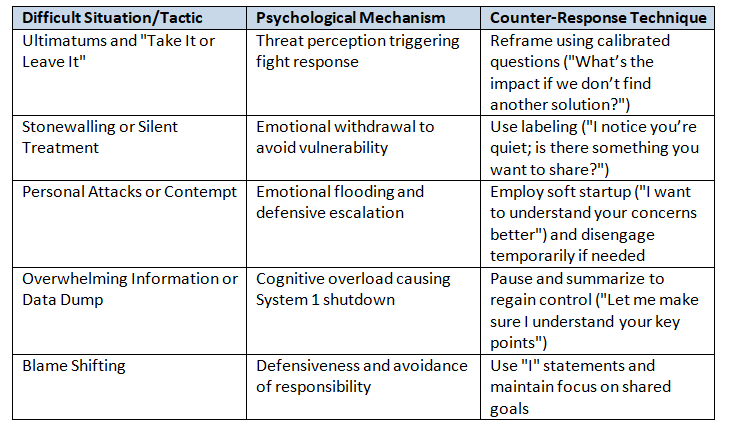
Understanding these dynamics enables negotiators to anticipate and strategically respond to tactics designed to sabotage trust.
Advanced Techniques
For expert negotiators, subtle psychological and strategic maneuvers can accelerate trust rebuilding:
- Strategic Vulnerability Disclosure: Sharing controlled personal or organizational weakness to humanize and invite reciprocity, based on Robert Cialdini’s principles of influence.
- Emotional Label Stacking: Repeatedly labeling multiple emotions to deepen tactical empathy and dismantle defensive walls.
- Micro-Expression Reading: Applying Paul Ekman’s research to detect concealed emotions and tailor responses moment-to-moment.
- Presence Anchoring: Using Amy Cuddy’s power poses and vocal tone modulation to project calm authority, influencing counterpart’s emotional state subconsciously.
- Third-Side Facilitation: Employing William Ury’s concept of the "Third Side" by involving neutral mediators or stakeholders who can help reframe conflict and restore trust.
These techniques require high emotional intelligence, practice, and situational awareness but yield disproportionate gains in high-stakes negotiations.
Scripts and Templates
Scenario 1: Acknowledging a Miscommunication
"I realize that my previous message may have come across differently than I intended. That wasn’t my aim, and I want to clear up any confusion."
Scenario 2: Labeling Emotions to De-escalate
"It sounds like you feel frustrated by how this process has unfolded. That’s understandable given the stakes."
Scenario 3: Calibrated Question to Invite Collaboration
"How can we work together to ensure we both achieve our key objectives here?"
Scenario 4: Repair Attempt After a Heated Exchange
"I’m sorry if my words upset you earlier; that wasn’t my intention. Let’s focus on finding a solution."
Scenario 5: Reframing an Ultimatum
"I hear your position clearly. What would it take for us to explore alternative options that meet both our needs?"
These scripts serve as ready-to-use language to manage trust breakdowns effectively.
Frequently Asked Questions
Q1: How long does it typically take to rebuild trust after a negotiation breakdown?
A: The timeline varies based on the severity of the breach, prior relationship history, and the commitment of parties. Research indicates initial trust signals can be restored in as little as a few meetings if repair steps are diligently applied, but deep trust may require sustained effort over weeks or months.
Q2: Can trust be rebuilt if one party refuses to engage?
A: Trust repair requires at least minimal reciprocal engagement. If one party refuses, efforts should focus on creating safe, low-risk opportunities for re-engagement, possibly with third-party facilitation.
Q3: What role does nonverbal communication play in rebuilding trust?
A: Nonverbal cues such as eye contact, open body language, and tone of voice profoundly impact trust perceptions. Skilled negotiators monitor and modulate these signals to reinforce sincerity and presence.
Q4: Are apologies necessary for trust repair?
A: Genuine apologies are powerful repair attempts but must be sincere and accompanied by behavioral change. Insincere apologies can backfire and deepen mistrust.
Q5: How can digital negotiation environments affect trust rebuilding?
A: Virtual negotiations limit nonverbal cues and increase misinterpretation risks. To mitigate this, negotiators should over-communicate intentions, use clear language, and incorporate video when possible to preserve emotional connection.
Conclusion
Rebuilding trust after a negotiation breakdown is among the most challenging yet critical skills for professionals navigating high-stakes conflicts. By understanding the underlying psychological mechanisms—from amygdala hijack to System 1 impulsivity—negotiators can consciously shift dynamics through tactical empathy, emotional regulation, and structured frameworks like those of Voss, Ury, and Gottman. Real-world cases demonstrate that even entrenched conflicts yield when approached with deliberate humility, transparency, and collaboration.
Mastering the step-by-step process and advanced tactics shared here empowers you not only to recover from rupture but to forge stronger, more resilient partnerships. Begin applying these insights today to transform your negotiation outcomes and lead with trust at the core.
References
- Kahneman, D. (2011). Thinking, Fast and Slow. Farrar, Straus and Giroux.
- Voss, C., & Raz, T. (2016). Never Split the Difference: Negotiating As If Your Life Depended On It. Harper Business.
- Ury, W. (1991). Getting Past No: Negotiating in Difficult Situations. Bantam Books.
- Gottman, J. (1999). The Seven Principles for Making Marriage Work. Crown Publishers.
- Cialdini, R. B. (2006). Influence: The Psychology of Persuasion. Harper Business.
- Ekman, P. (2003). Emotions Revealed: Recognizing Faces and Feelings to Improve Communication and Emotional Life. Times Books.
- Goleman, D. (1996). Emotional Intelligence: Why It Can Matter More Than IQ. Bantam Books.