Relationship vs Task Cultures in Negotiation: How to Read and Adapt to Your Counterpart

In 2018, a major joint venture negotiation between a Scandinavian technology firm and a Middle Eastern conglomerate collapsed after weeks of discussions. The Scandinavian team, known for their task-focused, direct approach, attempted to close the deal quickly by focusing on contracts and deliverables. Meanwhile, their Middle Eastern counterparts prioritized relationship-building, trust, and social rituals before discussing any business specifics. The Scandinavian team’s rushed, transactional style was perceived as cold and disrespectful, causing the Gulf delegation to withdraw abruptly. This failure cost both sides millions and years of lost opportunity, illustrating the high stakes of misreading relationship versus task cultures in negotiation.
Understanding whether your counterpart operates from a relationship-focused or task-focused culture is critical to international negotiation success. While many executives emphasize contract terms and deadlines, they dangerously underestimate the role of cultural expectations around relationship primacy, communication style, and pacing. Misalignment on this dimension can sour negotiations before substantive issues are addressed. Professionals often misinterpret relationship-driven patience as procrastination or task-driven directness as rudeness, triggering frustration and impasse.
This comprehensive guide will equip you with a robust cultural intelligence toolkit to identify and adapt to relationship versus task negotiation styles. You will master foundational frameworks—drawing from Hofstede’s dimensions, Erin Meyer’s Culture Map, Richard Lewis’s typologies, Edward Hall’s context theories, and more—to analyze counterpart behaviors. We will explore country-specific insights from China’s guanxi to Germany’s Sachlichkeit, provide step-by-step adaptation strategies, deliver exact word-for-word scripts for key cultural contexts, and examine real-world case studies. By the end, you will be empowered to read your counterpart’s cultural cues accurately and adjust your negotiation approach for success across global markets.
· Table of Contents
· The Theoretical Foundation — Cultural Dimensions and Country Data
· Key Frameworks and Models — Comparative Analysis Table
· Step-by-Step Strategy for Adapting to Relationship vs Task Cultures
· Real-World Case Studies — Cross-Cultural Negotiation Successes and Failures
· Country/Region-Specific Insights — Do’s and Don’ts Table
· Advanced Strategies — Expert-Level Cultural Adaptation Techniques
· Scripts and Templates — Exact Language for Different Cultures
· Frequently Asked Questions — Deep Dive into Common Challenges
· Conclusion — Synthesis and Call to Action
· References — Authoritative Sources
The Theoretical Foundation — Deep Dive into Relevant Cultural Frameworks
To grasp the nuances of relationship versus task orientations in negotiation, we must anchor our understanding in established cultural frameworks from leading scholars. These models reveal how different societies prioritize interpersonal connections versus goal achievement, shaping negotiation behaviors and expectations.
Hofstede’s Cultural Dimensions
Geert Hofstede’s six dimensions provide foundational insights. The most relevant dimensions here are Individualism versus Collectivism and Long-Term Orientation versus Short-Term Normative Orientation. Collectivist, long-term oriented societies tend to emphasize relationships and social harmony over immediate task completion, while individualist, short-term oriented ones prioritize objectives and efficiency.
For example:
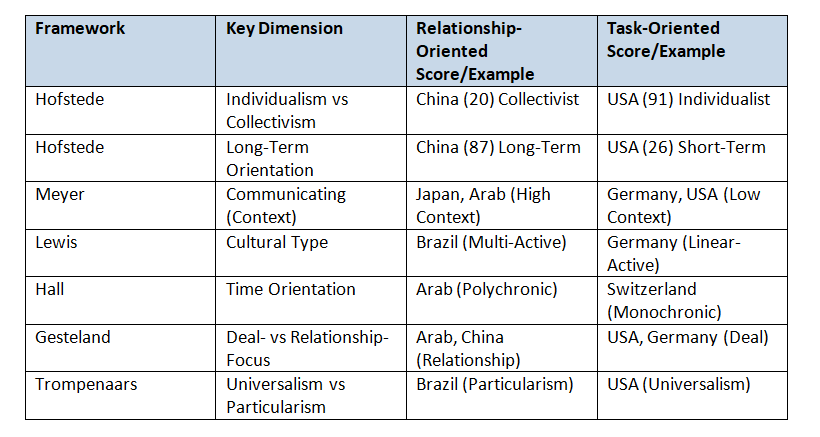
- China scores low on Individualism (20) and high on Long-Term Orientation (87), reflecting a relationship-centric, future-focused approach.
- The United States scores high on Individualism (91) and low on Long-Term Orientation (26), indicating a task-driven, short-term pragmatic culture.
- Germany falls between with high Individualism (67) but moderate Long-Term Orientation (83), combining task focus with respect for process.
Erin Meyer’s Culture Map
Erin Meyer’s eight scales provide actionable negotiation insights:
- Communicating (Low-Context vs High-Context): High-context cultures (Japan, Arab countries) rely on implicit messages emphasizing relationships; low-context (US, Germany) are direct and task-focused.
- Evaluating (Direct Negative Feedback vs Indirect): Direct feedback cultures align with task orientation; indirect feedback, with relationship preservation.
- Leading (Egalitarian vs Hierarchical): Hierarchical cultures emphasize respect and relationship roles in negotiation.
- Deciding (Consensual vs Top-Down): Relationship cultures favor consensus and prolonged relationship-building.
- Scheduling (Linear vs Flexible): Task cultures keep rigid schedules; relationship cultures are flexible with time to nurture trust.
Richard Lewis’s Model
Lewis categorizes cultures as:
- Linear-Active: Highly task-oriented, plan-driven (Germany, US).
- Multi-Active: Relationship-oriented, emotional, flexible (Brazil, India).
- Reactive: Relationship-focused, listening, harmony-seeking (Japan, China).
For example, a Linear-Active negotiator seeks to check agenda items efficiently; Multi-Active prioritizes social rapport; Reactive listens carefully to maintain harmony.
Edward Hall’s Context and Time Theories
High-context cultures (China, Japan, Arab world) embed meaning in relationships and nonverbal cues, making relationship-building foundational. Low-context cultures (US, Switzerland) emphasize explicit communication and task clarity. Furthermore, monochronic time cultures (Germany, US) focus on schedules and punctuality, while polychronic (Arab, Latin America) treat time fluidly, prioritizing relational meetings over deadlines.
Richard Gesteland’s Dimensions
Gesteland contrasts deal-focused (task) versus relationship-focused negotiation:
- Deal-focused cultures (US, Germany, Switzerland) separate business from personal.
- Relationship-focused cultures (Arab countries, China, Latin America) require trust, social interaction, and face-saving.
David Livermore’s Cultural Intelligence (CQ)
Livermore’s four CQ capabilities help negotiators:
- CQ Drive: Motivation to engage cross-culturally.
- CQ Knowledge: Understanding relationship vs task cultural norms.
- CQ Strategy: Planning culturally adaptive negotiation tactics.
- CQ Action: Executing appropriate verbal and nonverbal behaviors.
Trompenaars & Hampden-Turner Dimensions
Key dimensions:
- Universalism vs Particularism: Particularist cultures (China, Brazil) prioritize relationships and context over universal rules.
- Achievement vs Ascription: Ascription cultures (India, Middle East) emphasize hierarchical relationships over merit, impacting negotiation roles and respect.
Key Frameworks and Models — Comparative Analysis Table
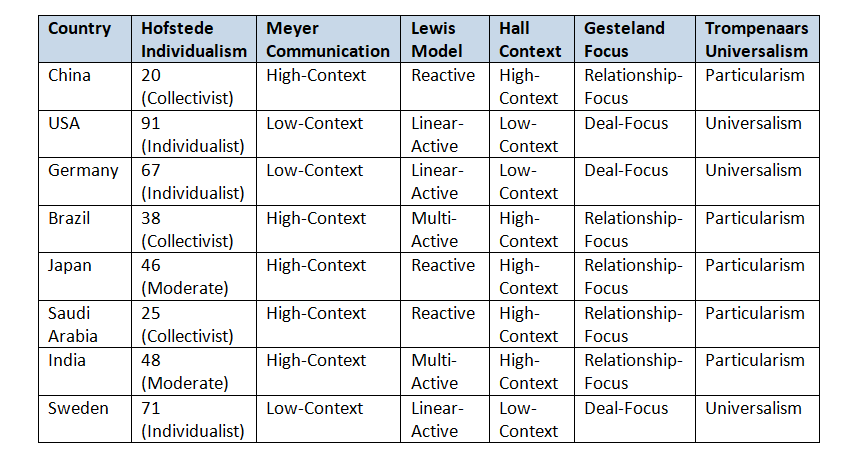
This section compares selected countries across multiple frameworks to reveal consistent patterns in relationship versus task orientation. The table below synthesizes scores from Hofstede, Meyer, Lewis, Hall, Gesteland, and Trompenaars to create a multi-dimensional cultural profile relevant for negotiation.
Step-by-Step Strategy for Adapting to Relationship vs Task Cultures
Effective cross-cultural negotiators actively adapt their approach based on counterpart culture. Below are six critical steps with detailed tactics and culturally tailored language.
Step 1: Diagnose Your Counterpart’s Cultural Orientation Early
Do preliminary research using frameworks and country data to assess whether your counterpart is relationship or task oriented. Listen carefully for verbal and nonverbal cues: Are they asking personal questions? Are they focused on contract details immediately? Use open-ended questions like, “How do you usually approach partnerships?” to clarify orientation.
Step 2: Adjust Your Meeting Structure and Agenda Accordingly
For relationship cultures, start with informal conversation to build rapport over multiple meetings. Avoid rushing to the point. For task cultures, provide a clear agenda and stick to timelines. Example language:
- Relationship culture: “Before we discuss details, I’d love to learn more about your team and company history.”
- Task culture: “We have a packed agenda today; let’s proceed to the contract terms.”
Step 3: Tailor Communication Style — Direct vs Indirect
In relationship cultures (e.g., Japan, Saudi Arabia), use indirect language, honorifics, and avoid blunt criticism. Employ storytelling or analogies. In task cultures (e.g., Germany, USA), be concise, clear, and transparent. Scripts in section 11 expand on this.
Step 4: Manage Time Expectations — Flexible vs Rigid
Be patient with polychronic cultures (e.g., Brazil, Arab countries) who may prioritize socializing or face-saving over deadlines. For monochronic cultures (e.g., Switzerland, Germany), respect punctuality and agenda order. Communicate timeline expectations explicitly but flexibly.
Step 5: Build Trust Strategically
In relationship cultures, invest time in social rituals, shared meals, gift-giving, and demonstrating respect for hierarchy and face. Task cultures value competence and reliability—showcase credentials and provide clear deliverables.
Step 6: Negotiate Conflict and Feedback Appropriately
Use indirect, harmonious conflict resolution in relationship cultures, employing the Thomas-Kilmann Conflict Mode Instrument: avoid or accommodate styles are preferred. Task cultures tolerate direct confrontation and debate; compete or collaborate modes fit better. Frame disagreements carefully to preserve relationships.
Real-World Case Studies — Cross-Cultural Negotiation Successes and Failures
Case Study 1: U.S. Tech Firm and Japanese Partner
A U.S. software company sought to license technology from a Japanese firm. Early U.S. impatience to finalize terms was perceived as disrespectful. After adopting a relationship-focused approach — extending meetings, engaging in social rituals, and honoring hierarchical decision processes (nemawashi) — progress accelerated. The deal closed with a decade-long partnership.
Case Study 2: German Automotive Supplier and Brazilian Distributor
The German supplier’s task-driven style clashed with the Brazilian distributor’s flexible, warm, and personable approach. Initial meetings were tense as the German team pushed for deadlines while Brazilians prioritized relationship-building (jeitinho). Training on cultural adaptation and mixed leadership teams enabled both to co-create a schedule balancing task commitment and relational warmth.
Case Study 3: Chinese State-Owned Enterprise and Middle Eastern Energy Company
Both sides emphasized relationships but differed in guanxi (China) versus wasta (Middle East) customs. Misunderstandings arose around gift exchanges and social obligations. Cultural coaching and a local cultural liaison helped clarify expectations and build mutual trust, leading to a landmark energy infrastructure deal.
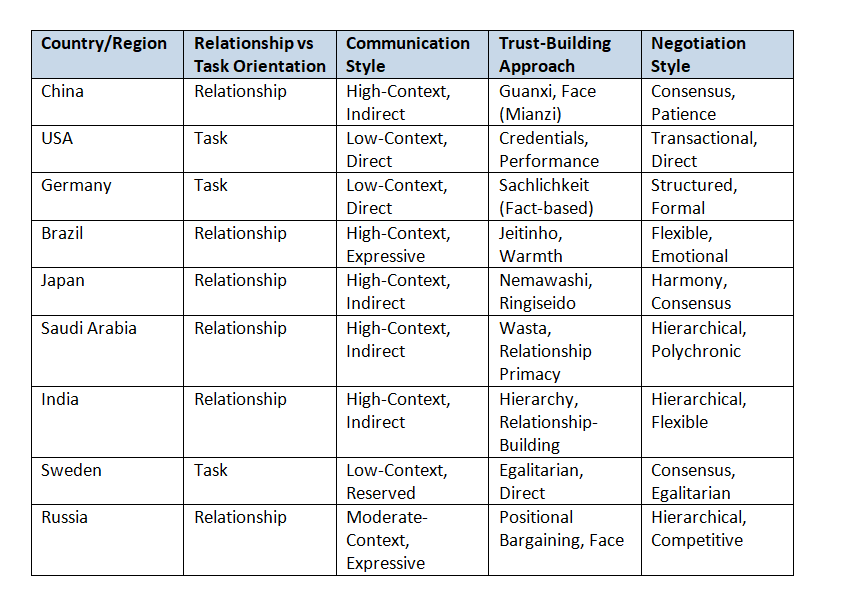
Country/Region-Specific Insights — Cultural Do’s and Don’ts Table
Advanced Strategies — Expert-Level Cross-Cultural Techniques
· Leverage Cultural Intelligence (CQ) Cycle: Continuously observe, interpret, and adapt negotiation behaviors rather than relying on static assumptions.
· Use Local Cultural Liaisons or Negotiation Coaches to bridge subtle nuances in relationship rituals or conflict avoidance.
· Apply Trompenaars’s Specific vs Diffuse dimension: understand how much personal life blends into business, guiding boundary setting.
· Employ Thomas-Kilmann Conflict Mode Instrument to tailor conflict resolution: favor avoid/accommodate in relationship cultures, collaborate/compete in task cultures with caution.
· Calibrate Nonverbal Communication: eye contact, physical distance (proxemics per Hall), gestures, and silence convey relationship respect or task focus.
· Design Hybrid Negotiation Processes: blend relationship-building phases with task-focused agenda items, signaling cultural respect and efficiency.
Scripts and Templates — Exact Language for Different Cultural Contexts
Script 1: Opening Conversation with a Relationship-Oriented Chinese Partner
“Before we begin our discussion today, I’d appreciate learning more about your company’s journey and your key values. Building a strong partnership is very important to us, and we respect the importance of trust and mutual understanding.”
Script 2: Direct Task-Focused Opening with a German Counterpart
“Thank you for joining. We have a detailed agenda to cover and aim to conclude the contract terms by the end of this meeting to meet project timelines. Shall we start with the technical specifications?”
Script 3: Navigating Conflict with a Brazilian Partner
“I understand your concerns, and it’s important we find a solution that works for both sides. Let’s consider some alternatives that respect your approach while meeting key deliverables. I’m confident we can reach an agreement that benefits us both.”
Script 4: Showing Respect and Deference in a Saudi Arabian Meeting
“It is an honor to meet with you. We value your wisdom and experience greatly and look forward to building a strong relationship that will benefit our organizations for years to come.”
Script 5: Closing a Meeting with a U.S. Task-Oriented Team
“Thank you for your time today. We’ve made excellent progress on the key points and will circulate a draft contract by the end of the week. Please let us know if you have any questions or additional input.”
Frequently Asked Questions
Q1: How can I quickly identify if my negotiation counterpart is relationship or task oriented?
Look for verbal cues (focus on social topics vs contract details), body language (warmth, formality), meeting pacing (patience vs urgency), and consult country cultural profiles. Early open questions about decision-making style help clarify orientation.
Q2: What are the biggest mistakes when negotiating with a relationship-focused culture?
Rushing to contract terms, ignoring social rituals, delivering direct criticism, and neglecting hierarchical respect can damage trust and stall negotiations.
Q3: How should I adapt conflict resolution strategies for relationship vs task cultures?
Use indirect, harmony-preserving approaches such as avoid or accommodate modes in relationship cultures. In task cultures, direct discussion and collaborative problem-solving are preferred.
Q4: Can relationships be converted into task focus over time?
Yes, strong relationships can create trust that speeds task-oriented decision-making. Initial relationship investment often pays off in streamlined later phases.
Q5: How does technology-mediated negotiation affect relationship vs task dynamics?
Virtual communication reduces nonverbal cues critical in relationship cultures, requiring extra effort to build trust digitally. Task cultures may adapt more easily to direct, text-based negotiation.
Conclusion
Mastering the dynamic between relationship and task cultures is a cornerstone of successful cross-cultural negotiation. This guide has unpacked complex cultural frameworks, illustrated country-specific negotiation norms, and provided actionable strategies and scripts to help you read your counterpart’s orientation accurately and respond with cultural intelligence. Whether engaging with China’s guanxi networks or Germany’s structured Sachlichkeit, adapting your approach prevents costly misunderstandings and builds durable international partnerships.
As global business becomes increasingly interconnected, executives who cultivate nuanced understanding and flexible negotiation styles will gain significant competitive advantage. Begin applying these insights today to transform your negotiation outcomes and unlock new opportunities across diverse cultural landscapes.
References
· Hofstede, G. (2001). Culture’s Consequences: Comparing Values, Behaviors, Institutions, and Organizations Across Nations. Sage Publications.
· Meyer, E. (2014). The Culture Map: Breaking Through the Invisible Boundaries of Global Business. PublicAffairs.
· Lewis, R. D. (2006). When Cultures Collide: Leading Across Cultures. Nicholas Brealey Publishing.
· Hall, E. T. (1976). Beyond Culture. Anchor Books.
· Gesteland, R. R. (2012). Cross-Cultural Business Behavior: Marketing, Negotiating and Managing Across Cultures. Copenhagen Business School Press.
· Livermore, D. A. (2015). Leading with Cultural Intelligence: The Real Secret to Success. AMACOM.
· Trompenaars, F., & Hampden-Turner, C. (2012). Riding the Waves of Culture: Understanding Diversity in Global Business. McGraw-Hill.