RFP and RFQ Negotiation Strategies: How to Win Without Discounting

In 2022, a mid-sized electronics supplier watched in disbelief as it lost a multi-million-dollar contract to a competitor willing to slash prices by 15%. The buyer’s relentless focus on price overshadowed the supplier’s superior quality and innovation. This procurement standoff left the supplier scrambling to understand where negotiations faltered and how to avoid future margin erosion. On the buyer’s side, the procurement team celebrated initial savings but soon faced supply disruptions and increased total costs. Behind the scenes, a complex dance of power, information asymmetry, and flawed negotiation tactics had played out — with both sides losing in the long term.
Such scenarios are common in the world of Requests for Proposal (RFP) and Requests for Quotation (RFQ). The stakes go far beyond the sticker price: the negotiation outcome impacts strategic supplier relationships, operational continuity, innovation potential, and total cost of ownership (TCO). Yet many buyers and sellers fall into the trap of aggressive discounting, driven by incomplete data, misaligned incentives, and a narrow view of value. The result is a lose-lose negotiation dynamic that erodes profits, damages trust, and wastes resources.
This comprehensive guide will transform how procurement professionals and suppliers approach RFP and RFQ negotiations. You will master critical frameworks such as the Kraljic Matrix and BATNA analysis, learn to deploy should-cost modeling and category management insights, and execute step-by-step negotiation strategies tailored for both buyers and sellers. We will reveal proven word-for-word scripts, tactical counters, and advanced deal-structuring methods that enable you to win contracts while preserving margins and building long-term strategic partnerships. Whether you want to outmaneuver a tough buyer or secure a premium contract with a demanding supplier, this definitive guide equips you with the tools and confidence to succeed without resorting to discounting.
· Table of Contents
· The Strategic Landscape: How Procurement Really Works
· Key Frameworks and Models
· Step-by-Step Strategy for Buyers and Sellers
· Real-World Case Studies
· Tactics and Counter-Tactics Matrix
· Advanced Procurement Negotiation Strategies
· Scripts and Templates for Negotiation Scenarios
· Frequently Asked Questions
· Conclusion and Call to Action
· References
The Strategic Landscape: How Procurement Really Works
Procurement is far more than issuing purchase orders and chasing the lowest price. At its core, it is a strategic function designed to optimize organizational spend, mitigate risks, and foster supplier innovation. Understanding the incentives, key performance indicators (KPIs), and psychological drivers behind procurement decisions is essential to mastering RFP and RFQ negotiations.
Professional buyers operate within a framework driven by organizational goals such as cost savings, quality assurance, supplier risk management, and compliance. Their KPIs often focus on cost reductions, supplier diversity, on-time delivery rates, and contract compliance. However, these KPIs can sometimes create tunnel vision on short-term price cuts, obscuring the bigger picture of total cost of ownership (TCO).
The Kraljic Matrix remains the seminal model for supplier segmentation and strategic sourcing. It classifies purchases into four quadrants based on supply risk and profit impact: strategic, bottleneck, leverage, and non-critical items. This segmentation guides procurement on where to apply negotiation rigor, supplier relationship management, and risk mitigation efforts. For example, strategic items demand collaborative partnerships, while leverage items invite competitive bidding.
Category management complements this by aggregating spend into logical groups, enabling deeper market analysis, should-cost modeling, and tailored negotiation strategies. Should-cost analysis, which estimates a supplier’s true production cost, empowers buyers to challenge prices constructively and identify value-engineering opportunities.
From the seller’s perspective, understanding buyer psychology is paramount. Buyers are often loss-averse (Kahneman’s Prospect Theory) — they fear losing value or service more than they appreciate gains. This asymmetry means sellers can leverage value-based positioning and risk-sharing models rather than price concessions alone. Recognizing when a buyer is negotiating from a position of power (Porter’s Five Forces: buyer power) versus when transaction costs or switching risks favor suppliers can inform strategic responses.
Ultimately, mastering procurement negotiation requires a holistic view of the supplier portfolio, economics, behavioral dynamics, and organizational imperatives.
Key Frameworks and Models
Three foundational frameworks illuminate different facets of RFP and RFQ negotiations: the Kraljic Matrix for supplier segmentation, Total Cost of Ownership (TCO) analysis versus price-only evaluation, and BATNA (Best Alternative To a Negotiated Agreement) for negotiation leverage assessment. Understanding and combining these models enables precision in strategy and communication.
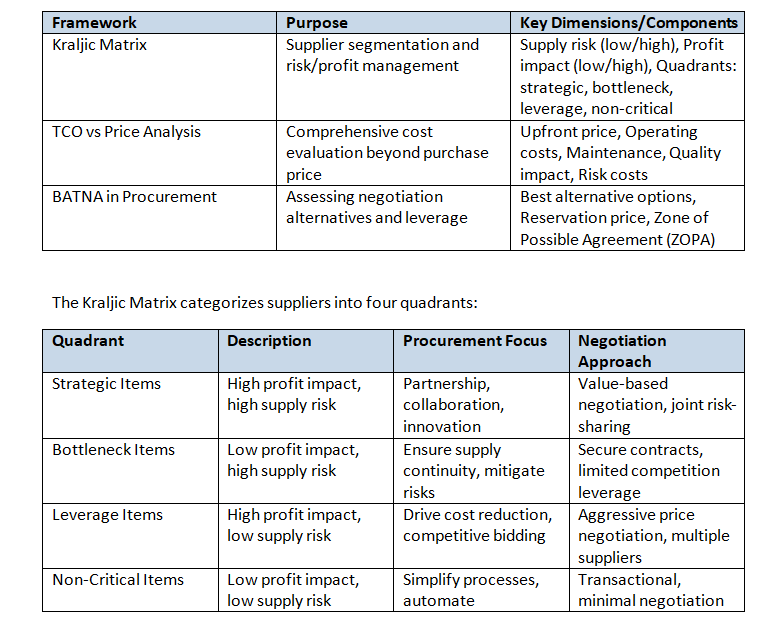
TCO analysis enables buyers to look beyond the sticker price and consider operating expenses, risks of failure, supplier reliability, and quality impacts. For example, a supplier quoting a higher price may yield savings through fewer defects and lower warranty costs.
BATNA is crucial in assessing negotiation power. A buyer with multiple qualified suppliers has a strong BATNA and can push harder; a supplier with few alternatives may need to focus on differentiation and relationship building.
Step-by-Step Strategy
Mastering RFP and RFQ negotiations requires a disciplined, structured approach. Below are six essential steps, each with buyer and seller perspectives, concrete tactics, and sample language.
Step 1: Preparation and Market Intelligence
Buyer: Conduct thorough market research and should-cost modeling. Segment suppliers using the Kraljic Matrix. Define clear objectives beyond price, including quality, risk, and innovation. Prepare your BATNA and ZOPA.
Seller: Analyze the buyer’s category and procurement KPIs. Identify how your offering aligns with their strategic priorities. Develop your own BATNA by exploring alternative customers and partnerships.
Sample buyer phrase: “We’ve benchmarked market prices and identified key cost drivers to ensure our expectations align with industry standards.”
Sample seller phrase: “Our solution not only meets specifications but offers process efficiencies that reduce your operational costs by 12%.”
Step 2: RFP/RFQ Design and Issue
Buyer: Craft RFPs/RFQs that elicit comprehensive responses, including value-added services and lifecycle costs. Include scoring criteria weighted on total cost and quality. Avoid language that overemphasizes lowest price.
Seller: Respond with detailed proposals addressing all criteria, highlighting value beyond price. Use should-cost data to justify pricing. Include options for customization or risk-sharing.
Step 3: Bid Evaluation and Shortlisting
Buyer: Use multi-criteria decision analysis (MCDA) tools to balance price, quality, supplier capacity, and risk. Engage cross-functional teams to reduce bias.
Seller: Monitor competitor bids and buyer feedback. Prepare to clarify or negotiate based on evaluation metrics.
Step 4: Initial Negotiation Meeting
Buyer: Open with clear agenda and objectives, emphasizing partnership potential. Use calibrated questions to uncover seller constraints.
Seller: Listen actively, express commitment to partnership, and probe buyer priorities beyond price.
Example buyer opening: “Our goal is to establish a relationship that delivers sustainable value. Can you share what flexibility you have on innovation or service levels?”
Seller response: “We prioritize quality and reliability, and we’re open to exploring models that share risks and rewards over time.”
Step 5: Value Engineering and Concession Management
Buyer: Propose alternative specifications or packaging to reduce costs. Use should-cost insights to challenge pricing line items. Manage concessions carefully; avoid immediate price cuts.
Seller: Present options for cost optimization without compromising quality. Propose trade-offs such as volume commitments for better pricing.
Example script buyer: “If we consider extending delivery lead times, can you offer more competitive pricing?”
Seller: “Yes, with a 20% volume increase and longer lead times, we can reduce unit costs by 8%.”
Step 6: Final Agreement and Contract Structuring
Buyer: Structure contracts that incentivize performance, include clear KPIs, and provide flexibility for innovation. Consider multi-year deals with escalation clauses.
Seller: Negotiate terms that protect margins, outline deliverables, and build collaboration mechanisms. Use contract language to embed value-based pricing.
Sample closing buyer language: “We look forward to a partnership that aligns interests and drives continuous improvement over the contract term.”
Seller closing: “This agreement provides a foundation for mutual growth and shared success.”
Real-World Case Studies
Toyota’s Supplier Partnership Model
Toyota revolutionized procurement by treating suppliers as strategic partners rather than adversaries. Their Toyota Production System emphasizes just-in-time delivery, quality circles, and continuous improvement. In negotiations, Toyota focuses on total cost, supplier capability, and long-term collaboration rather than short-term price cuts. The result is a resilient supply chain with innovation embedded at each level.
Lesson: Value-based negotiation and relationship leverage yield superior outcomes over aggressive discounting.
Apple’s Procurement Leverage
Apple leverages its massive purchasing volume and brand prestige to negotiate favorable terms. However, Apple also invests heavily in supplier development and risk management, using should-cost analysis extensively. They balance supplier power by diversifying sources but do not rely solely on price demands, understanding the value of supplier innovation in product differentiation.
Lesson: Combine buying power with strategic supplier development and TCO considerations.
Walmart’s Supplier Squeeze Tactics
Walmart is notorious for aggressively pushing suppliers to lower prices. Their procurement model uses data analytics to squeeze margins and demands strict compliance. While effective short term, this approach can strain supplier relationships and reduce innovation incentives.
Lesson: Excessive price pressure can damage supplier ecosystems and increase long-term risk.
Tactics and Counter-Tactics
Advanced Strategies
Relationship Leverage
Beyond transactional negotiation, cultivating deep supplier relationships creates intangible leverage. Techniques include joint innovation workshops, co-investment in process improvements, and shared risk-reward contracts. These build trust and reduce adversarial bargaining.
Multi-Year Deal Structuring
Negotiating contracts over multiple years with performance-based escalators and volume incentives reduces short-term margin pressure. It aligns interests toward continuous improvement and cost reductions over time.
Value-Based Positioning
Shifting negotiation focus from price to business outcomes—such as uptime, environmental impact, or customer satisfaction—enables pricing based on delivered value rather than commodity cost. Sellers can justify premium pricing; buyers achieve strategic goals.
Scripts and Templates
Script 1: Opening Negotiation Meeting (Buyer)
“Thank you for joining today. Our objective is to explore how we can jointly create a partnership that delivers quality, innovation, and cost-effectiveness. Could you share which aspects of your solution you believe add the most value beyond price?”
Script 2: Price Justification Request (Buyer)
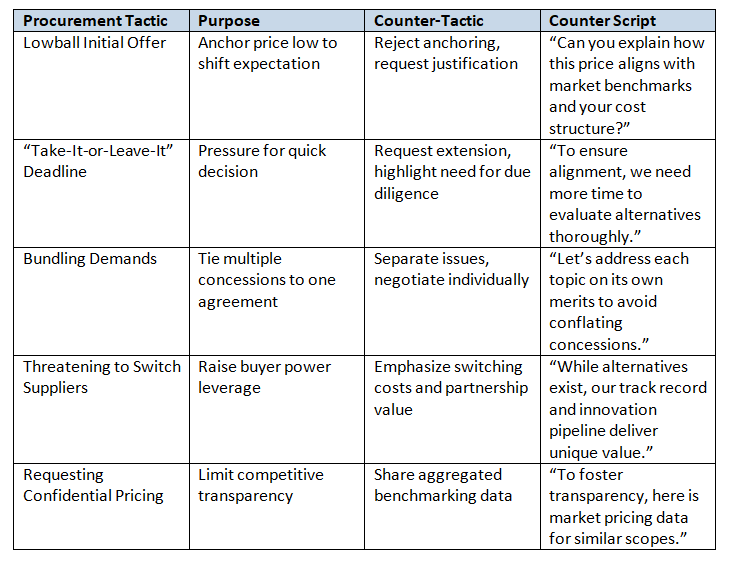
“Your pricing appears above market averages. Can you walk us through your cost drivers and demonstrate how these investments translate into measurable benefits for us?”
Script 3: Concession Offer with Trade-Off (Seller)
“We can offer a 5% price reduction if there is flexibility on delivery schedules or minimum order quantities. Would those options be feasible for you?”
Script 4: Counteracting Deadline Pressure (Seller)
“To ensure a thorough response that meets your requirements, we request a one-week extension on the deadline. This will enable us to provide a solution aligned with your strategic goals.”
Script 5: Closing Agreement (Buyer)
“We appreciate your collaboration through this process. The agreed terms reflect a fair balance of cost, quality, and innovation. We look forward to a successful partnership.”
Frequently Asked Questions
Q1: How can suppliers protect margins during an RFQ when buyers focus solely on price?
A1: Suppliers should shift conversations to total cost of ownership and value-added services, provide should-cost breakdowns, and propose risk-sharing or performance-based contracts that justify premium pricing.
Q2: What role does the Kraljic Matrix play in negotiation strategy?
A2: The Kraljic Matrix segments suppliers by risk and profit impact, guiding whether negotiation should focus on collaboration, risk mitigation, or competitive bidding, thus tailoring tactics appropriately.
Q3: How can buyers prevent being trapped by supplier lowball offers during RFP evaluations?
A3: Buyers should validate bids through should-cost models, request detailed cost breakdowns, and apply multi-criteria evaluation beyond price, including supplier capacity and quality metrics.
Q4: What are effective ways to counter buyer deadline pressure in RFP negotiations?
A4: Sellers can request deadline extensions citing the need for comprehensive responses, highlight the risks of rushed decisions, and offer phased proposals that address immediate and long-term needs.
Q5: How do multi-year contracts benefit both buyers and suppliers?
A5: Multi-year deals provide pricing stability, enable joint investments in efficiency, reduce transaction costs, and align incentives for continuous improvement and innovation over time.
Conclusion
RFP and RFQ negotiations are pivotal moments that shape supply chain resilience, cost structures, and competitive advantage. By transcending the simplistic focus on price discounting and embracing a strategic, data-driven, and psychologically astute approach, both buyers and suppliers can achieve win-win outcomes. Leveraging frameworks like the Kraljic Matrix and BATNA analysis, deploying should-cost modeling, and executing disciplined negotiation steps empowers professionals to preserve margins while meeting organizational goals.
The tactics, scripts, and case studies presented here provide a comprehensive toolkit to navigate complex procurement landscapes. Whether you are a procurement manager seeking to optimize spend or a supplier aiming to protect margins and build lasting partnerships, the strategies outlined will transform your negotiation outcomes. Start applying these insights today to move beyond discount battles and toward sustainable, value-driven agreements.
References
1. Kraljic, P. (1983). Purchasing must become supply management. Harvard Business Review, 61(5), 109-117.
2. Kahneman, D. (2011). Thinking, Fast and Slow. Farrar, Straus and Giroux.
3. Porter, M. E. (1979). How competitive forces shape strategy. Harvard Business Review, 57(2), 137-145.
4. Williamson, O. E. (1985). The Economic Institutions of Capitalism. Free Press.
5. Monczka, R., Handfield, R., Giunipero, L., & Patterson, J. (2020). Purchasing and Supply Chain Management. Cengage Learning.
6. Harvard Business Review. (2015). Negotiation Strategies for Procurement Professionals. Articles by various authors.