Risk in Global Negotiations: How to Identify, Assess, and Mitigate It

International business negotiations often unfold on a razor’s edge of complexity and risk. Consider the high-profile 2018 US-China trade negotiations, which teetered perilously due to misunderstandings about negotiation rhythms, trust-building, and underlying cultural expectations. While the US team pressed aggressively for quick concessions reflecting a Western low-context, monochronic negotiation style, Chinese negotiators emphasized long-term relationship building and consensus, emblematic of their high-context, polychronic culture. This cultural mismatch led to broken deadlines, mistrust, and near collapse of a multi-billion-dollar trade deal, illustrating how deeply cultural misinterpretations can escalate risk in global deals.
The stakes in international negotiations transcend those found in domestic settings. Beyond language differences, negotiators must navigate fundamental disparities in values, communication styles, legal regimes, and political environments. Factors such as Hofstede’s power distance and uncertainty avoidance, Lewis’s cultural types, Edward Hall’s context and time perceptions, and Erin Meyer’s culture map dimensions all intertwine to make each negotiation a dynamic interplay of psychology and corporate strategy. Without cultural intelligence and rigorous risk assessment, negotiators risk not only deal failure but also reputational damage and long-term strategic setbacks.
In this definitive guide, you will master how to identify, assess, and mitigate risk in global negotiations with precision. We will unpack leading cultural frameworks, provide exact negotiation scripts tailored to diverse cultures, offer step-by-step strategy guides, and analyze landmark international case studies. You will gain actionable tools for managing political, legal, and cultural risks, learn to adapt communication styles effectively, and implement advanced techniques to safeguard your global deals. This comprehensive resource equips you to navigate the unpredictable waters of international negotiation with confidence and cultural dexterity.
· Table of Contents
· The Foundations of International Negotiation
· Key Frameworks and Cultural Models
· Step-by-Step Strategy for Global Negotiations
· Real-World Case Studies of Cross-Border Deals
· Country-Specific Negotiation Insights and Tactics
· Advanced Strategies to Manage Complex Risks
· Scripts and Templates for Cross-Cultural Negotiations
· Frequently Asked Questions on Negotiation Risk
· Conclusion
· References
The Foundations of International Negotiation
International negotiations are fundamentally distinct from domestic ones due to the interplay of culture, psychology, and structural variables. Understanding these foundational elements is critical for effective risk identification and mitigation.
Geert Hofstede’s seminal research identifies six dimensions that profoundly influence negotiation behavior:
- Power Distance: The extent to which less powerful members expect and accept unequal power distribution. High power distance cultures (e.g., Malaysia, Mexico) prefer hierarchical decision-making, while low power distance cultures (e.g., Denmark, New Zealand) favor egalitarianism.
- Individualism vs. Collectivism: Individualistic societies (e.g., USA, Australia) emphasize personal goals and contracts; collectivist societies (e.g., China, South Korea) prioritize group harmony and relationships.
- Uncertainty Avoidance: Cultures with high uncertainty avoidance (e.g., Greece, Japan) prefer formal rules and predictable negotiations; low uncertainty avoidance cultures (e.g., Sweden, India) tolerate ambiguity.
- Masculinity vs. Femininity: Masculine cultures (e.g., Japan, Germany) prize competition and assertiveness; feminine cultures (e.g., Sweden, Netherlands) value cooperation and consensus.
- Long-Term Orientation: Long-term orientation cultures (e.g., China, South Korea) focus on perseverance and future rewards; short-term oriented cultures (e.g., USA, Russia) emphasize quick results.
- Indulgence vs. Restraint: Indulgent cultures (e.g., Mexico, Nigeria) allow relatively free gratification of desires; restrained cultures (e.g., Egypt, Pakistan) regulate gratification through strict social norms.
Edward Hall’s concepts of high-context versus low-context communication highlight how much information is implicit versus explicit during negotiations. High-context cultures (Japan, Arab countries) rely on subtle cues and shared understanding, whereas low-context cultures (Germany, USA) prefer direct, explicit communication. Similarly, Hall’s monochronic versus polychronic time orientation explains how cultures manage schedules and deadlines — monochronic cultures (Switzerland, USA) adhere strictly to time, while polychronic cultures (India, Latin America) view time as flexible.
Erin Meyer’s research further refines these dimensions into eight scales critical for negotiation:
- Communicating (low-context to high-context)
- Evaluating (direct negative feedback to indirect)
- Persuading (principles-first to applications-first)
- Leading (egalitarian to hierarchical)
- Deciding (consensual to top-down)
- Trusting (task-based to relationship-based)
- Disagreeing (confrontational to avoids confrontation)
- Scheduling (linear time to flexible time)
Negotiators must also consider cognitive biases heightened by cross-cultural differences, such as ethnocentrism and confirmation bias. Structurally, international deals often involve multiple jurisdictions, varying legal systems (common law, civil law, Islamic law), and political risk environments that domestic negotiations do not face. These factors compound risk and require layered analysis.
Key Frameworks and Cultural Models
To systematically assess and manage negotiation risk, several frameworks offer complementary insights. Below is a comparison table summarizing key cultural models relevant for risk identification:
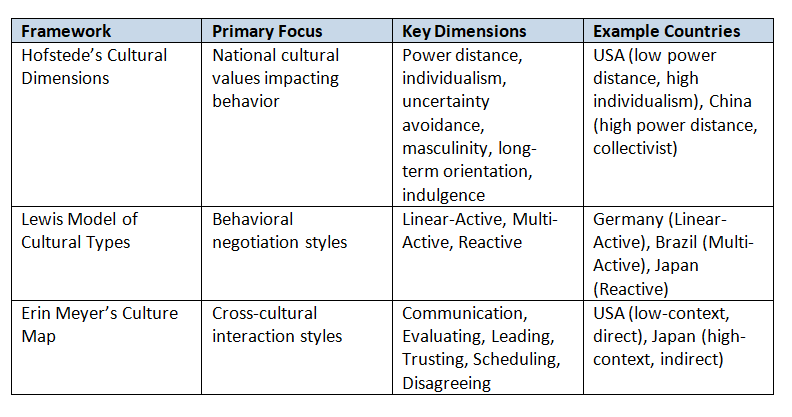
Each framework offers actionable diagnostics. For example, identifying a negotiation partner’s Lewis type informs how to pace discussions and structure agreements. Combining Hofstede’s values with Meyer’s trust and disagreement scales enables a granular risk assessment of potential misunderstandings.
Step-by-Step Strategy for Global Negotiations
Managing risk requires a meticulous, culturally attuned process from preparation to follow-up. The six essential steps are:
1. Preparation and Cultural Due Diligence
Conduct in-depth research on your counterpart’s culture, legal environment, and political landscape. Use Hofstede and Meyer’s frameworks to anticipate communication and decision-making styles. Assess political risk using tools like the Political Risk Services (PRS) matrix to identify country-specific uncertainties.
2. Opening: Establishing Rapport and Trust
In collectivist and high-context cultures (e.g., Middle East, East Asia), invest time in relationship-building before discussing substantive issues. Utilize trusted intermediaries or wasta/guanxi networks to facilitate introductions. In low-context, individualistic cultures, directness is valued but initial rapport remains critical.
3. Exploration: Information Exchange and Needs Assessment
Adapt communication style to counterpart culture. For example, in high-context Japan, listen carefully to implied meanings and non-verbal cues. Use open-ended questions in India’s high-context environment to uncover underlying interests. Confirm understanding explicitly in low-context contexts like Germany.
4. Bargaining: Managing Concessions and Deadlocks
Apply Fisher & Ury’s principled negotiation adapted for cultural contexts. For example, in hierarchical cultures (e.g., Korea), defer to senior decision-makers appropriately. In Multi-Active cultures (e.g., Brazil), expect emotional appeals and flexible deadlines. Prepare BATNAs and ZOPA carefully considering legal and political risk.
5. Closing: Sealing the Deal with Clarity
Ensure contract language is clear and culturally appropriate. Engage legal counsel familiar with CISG, ICC arbitration clauses, or UNCITRAL rules pertinent to the jurisdictions involved. In high uncertainty avoidance cultures (e.g., Japan), provide detailed guarantees and contingency plans.
6. Follow-Up: Sustaining Relationships and Managing Post-Deal Risk
Maintain communication channels post-agreement to manage emerging risks. In collectivist cultures, ongoing relationship management is critical. Use periodic reviews and renegotiations to adapt to political or market changes, especially in unstable regions.
Real-World Case Studies of Cross-Border Deals
Context: The US imposed tariffs to pressure China on intellectual property and trade imbalances. Negotiations stalled repeatedly.
Cultural Dynamics: The US team’s linear-active, low-context style clashed with China’s reactive, high-context approach. The US sought rapid, explicit commitments, while China emphasized face-saving and consensus.
Outcome: Delays and mistrust escalated risk; partial agreements were reached only after adapting communication styles and involving senior political leaders.
Lesson: Cultural intelligence combined with flexible negotiation pacing mitigated risk and enabled partial deal closure.
Context: Complex negotiations over trade, border controls, and legal rights following the UK’s EU exit.
Cultural Dynamics: EU negotiators favored formal rules and consensus (high uncertainty avoidance), while UK negotiators pushed for sovereignty and pragmatic solutions.
Outcome: Deadlines extended repeatedly; eventual agreement required creative legal mechanisms (Northern Ireland Protocol).
Lesson: Understanding different risk tolerance and legal traditions enabled negotiators to craft flexible solutions.
Context: US pressured Japan to open markets; Japan insisted on consensus and nemawashi (informal pre-negotiation).
Cultural Dynamics: US’s direct, confrontational style conflicted with Japan’s indirect, relationship-based approach.
Outcome: US adapted to Japanese consensus process, resulting in gradual market liberalization.
Lesson: Respecting cultural decision-making processes reduces negotiation risk.
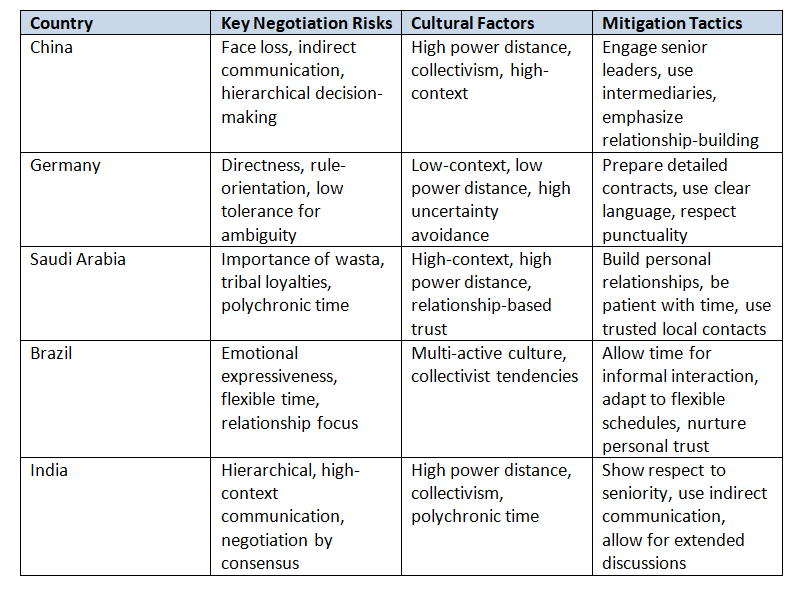
Country-Specific Negotiation Insights and Challenge-Specific Tactics
The following table summarizes key negotiation risks and mitigation tactics across select countries:
Advanced Strategies to Manage Complex Risks
Use professional interpreters with negotiation experience. Brief interpreters thoroughly on terminology and cultural nuances. Avoid double negatives or idioms that confuse translation. Speak slowly and pause frequently.
Invest time and resources to establish trusted networks before negotiations. Understand local customs for gift-giving, hospitality, and social interaction. Use these networks for informal intelligence and dispute resolution.
In cultures with high power distance, always identify and respect the ultimate decision-makers. Use indirect language and third-party endorsements to allow counterparts to save face. Avoid public criticism or confrontational tactics.
Recognize whether your counterpart’s culture is monochronic or polychronic and adapt meeting agendas accordingly. Use flexible scheduling in polychronic cultures but maintain deadlines through periodic reminders and interim milestones.
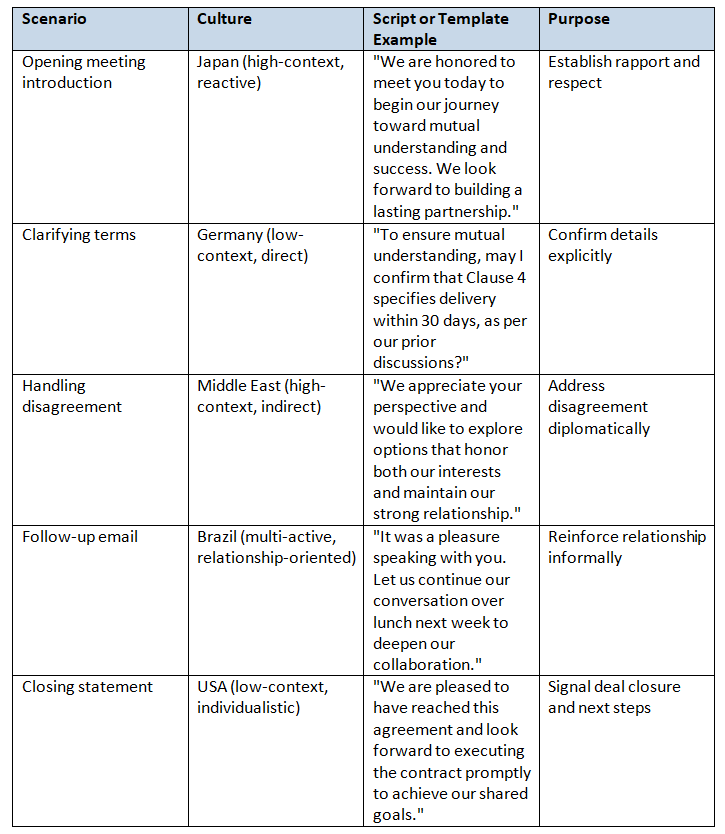
Scripts and Templates for Cross-Cultural Negotiations
Frequently Asked Questions on Negotiation Risk
Use established political risk frameworks such as the PRS Group’s International Country Risk Guide, which evaluates political stability, government effectiveness, and conflict likelihood. Combine this with local intelligence and scenario planning to anticipate risks.
High uncertainty avoidance cultures require detailed contracts with clear dispute resolution mechanisms, while low uncertainty avoidance cultures may accept more flexible agreements. Tailor contract drafting accordingly.
Use tools like shared calendars adjusted for time zones. Confirm meeting times explicitly, and be sensitive to cultural attitudes toward punctuality and time flexibility, adapting your scheduling approach as needed.
Relying on untrained interpreters can cause miscommunication. Avoid using family or friends as interpreters. Prepare simple language and avoid idiomatic expressions to minimize errors.
Recognize that counterparts may have different perceptions of acceptable alternatives due to cultural values. Explicitly clarify your Best Alternative to a Negotiated Agreement and explore the Zone of Possible Agreement with cultural sensitivity to avoid deadlock.
Conclusion
Risk in global negotiations emerges from a complex web of cultural, legal, political, and psychological factors that demand sophisticated understanding and preparation. By leveraging leading cultural frameworks—such as Hofstede’s dimensions, Lewis’s behavioral types, and Erin Meyer’s Culture Map—negotiators can anticipate potential misunderstandings, adapt communication styles, and build resilient relationships. Combining these insights with rigorous risk assessment tools and meticulously crafted negotiation strategies substantially reduces the likelihood of deal failure and reputational damage.
Armed with the step-by-step methodologies, real-world case studies, country-specific tactics, and precise negotiation scripts outlined in this guide, international business professionals can confidently navigate the intricacies of cross-border deals. The ability to identify, assess, and mitigate risk is no longer optional but essential for global success. We invite you to apply these principles actively in your negotiations and continue refining your cultural intelligence to secure sustainable, value-creating international agreements.