Risk Management in Negotiation Strategy: Frameworks, Tactics, and Real-World Applications

Imagine negotiating a multi-billion-dollar merger where a single overlooked risk could cost hundreds of millions, or a supplier contract where hidden contingencies lead to catastrophic delivery failures. In today’s volatile business environment, the ability to manage risk within negotiation strategy is not just an advantage—it is a necessity. According to Harvard Business Review, over 70% of corporate negotiations fail to account for risk exposure adequately, resulting in lost value or protracted conflict.
Risk management in negotiation stands at the intersection of strategic foresight, psychological insight, and tactical execution. As global markets grow increasingly complex, the stakes of negotiation outcomes rise exponentially. Executives and dealmakers must master a structured approach to identify, evaluate, and mitigate risks throughout every phase of negotiation—from preparation to closure.
By the end of this comprehensive guide, you will master foundational theories underpinning negotiation risk, compare key frameworks such as Harvard Principled Negotiation and BATNA risk management, execute a detailed step-by-step risk mitigation process, analyze landmark real-world cases, avoid common pitfalls, and implement advanced tactics and scripts proven to safeguard and optimize your negotiation outcomes.
· Table of Contents
· The Strategic Foundation of Risk Management in Negotiation
· Key Frameworks and Models: Comparing BATNA, ZOPA, and Harvard Principled Negotiation
· Step-by-Step Process to Manage Risk in Negotiations
· Real-World Case Studies: Apple-Samsung, Amazon Procurement, IBM Enterprise Sales
· Common Pitfalls and How to Avoid Them
· Advanced Tactics for Experienced Negotiators
· Scripts and Templates: Dialogue and Email Examples
· Frequently Asked Questions on Negotiation Risk Management
· Conclusion and Call to Action
· References
The Strategic Foundation — Core Theory, Psychology, and Research Behind Risk Management in Negotiation
Risk management in negotiation strategy is rooted in interdisciplinary research spanning behavioral economics, negotiation theory, and cognitive psychology. Daniel Kahneman’s Nobel-winning work on prospect theory and cognitive biases reveals that negotiators systematically misjudge risks due to overconfidence and loss aversion. These biases can skew risk perception and lead to suboptimal concessions or overlooked threats.
Fisher and Ury’s seminal work in “Getting to Yes” introduced the Harvard Principled Negotiation framework, emphasizing separating people from problems and focusing on interests rather than positions. This approach inherently promotes risk management by encouraging transparent communication and joint problem-solving, reducing uncertainty and adversarial conflict.
Robert Cialdini’s principles of influence—particularly consistency and social proof—inform how negotiators anticipate counterpart behavior and mitigate the risk of deception or non-compliance post-agreement. Shell’s “Bargaining for Advantage” incorporates both psychological insight and strategic planning to identify risk zones in negotiation, such as weak BATNAs (Best Alternative to a Negotiated Agreement) and hidden agendas.
Effective risk management integrates these insights into a proactive approach: assess risk exposure early, design flexible agreements that allow contingencies, and employ integrative bargaining tactics that expand value while minimizing downside. Research by Lewicki et al. (2016) shows that negotiators who apply structured risk analysis outperform counterparts by up to 30% in value creation and risk reduction.
Key Frameworks and Models — Comparing BATNA, ZOPA, and Harvard Principled Negotiation for Risk Management
Three dominant frameworks provide the backbone for risk management in negotiation strategy: BATNA analysis, Zone of Possible Agreement (ZOPA), and Harvard Principled Negotiation. Each addresses risk from a unique angle—alternatives, boundaries, and process integrity.
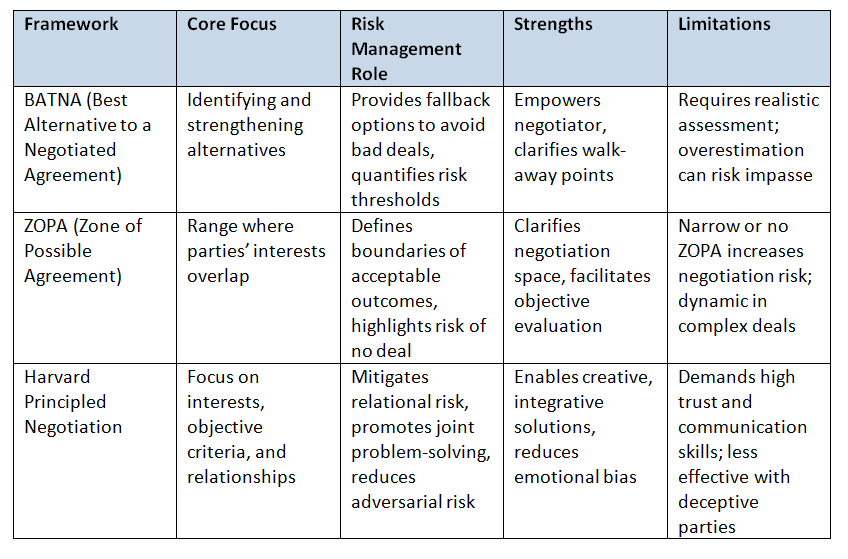
Applying these frameworks in combination is best practice. For instance, establishing a strong BATNA ensures you never accept high-risk concessions. Understanding the ZOPA prevents entering negotiations with unrealistic expectations that increase failure risk. Employing principled negotiation reduces risk of post-agreement disputes by building mutual trust and clear criteria.
Step-by-Step Process — Detailed Numbered Walkthrough for Managing Risk in Negotiations
Step 1: Comprehensive Risk Identification
Begin by systematically identifying all potential risks: financial, legal, operational, reputational, and relational. Use brainstorming sessions, stakeholder interviews, and historical deal analysis. Tools like SWOT (Strengths, Weaknesses, Opportunities, Threats) analysis are effective here.
Example: In an M&A deal, identify risks such as cultural integration failure, regulatory hurdles, or intellectual property disputes.
Step 2: Quantify and Prioritize Risks
Assign probability and impact scores to each identified risk, using scales (e.g., 1–5 or 1–10). Calculate risk exposure by multiplying likelihood by impact. Prioritize risks that threaten deal viability or value.
Step 3: Develop BATNA and Assess Counterpart BATNA
Evaluate your alternatives thoroughly to understand your negotiation power and risk tolerance. Estimate the counterpart’s BATNA to anticipate their fallback position and risk appetite.
Step 4: Define Your ZOPA and Negotiation Boundaries
Using BATNA analysis, determine the range within which an agreement is beneficial and low-risk. Establish walk-away points and reservation prices.
Step 5: Design Risk Mitigation Clauses and Contingencies
Draft contract terms that allocate risks appropriately. Include warranties, indemnities, penalty clauses, and performance guarantees. Use earn-outs or phased payments to mitigate execution risk.
Step 6: Employ Integrative Bargaining and Objective Criteria
Shift from positional bargaining to interest-based negotiation. Leverage objective standards (market data, precedents) to reduce subjective risk and build consensus.
Step 7: Communicate Transparently and Build Trust
Use open dialogue to reduce information asymmetry and prevent hidden risks. Employ Cialdini’s principles to foster compliance and commitment.
Step 8: Monitor and Adapt Post-Agreement
Risk management extends beyond signing. Establish governance structures for monitoring performance and resolving disputes. Adapt terms if new risks emerge.
Real-World Case Studies — Specific Named Examples of Risk Management in Negotiation
Case Study 1: Apple vs. Samsung Patent Licensing Negotiations
Apple and Samsung’s negotiations over patent licensing exemplify high-stakes risk management. Both companies faced risks of costly litigation and market share loss. Apple’s strategy involved aggressively strengthening its BATNA by winning initial injunctions, while Samsung sought to expand the ZOPA through cross-license deals with contingencies. The eventual settlement included detailed risk-sharing clauses on future product releases, limiting litigation exposure and enabling cooperative innovation.
Case Study 2: Amazon’s Global Supplier Procurement Contracts
Amazon’s procurement team uses a risk-driven negotiation approach to manage supplier performance risk. They incorporate detailed service-level agreements (SLAs) with penalty clauses and real-time monitoring. Amazon’s negotiators apply Harvard Principled Negotiation to build long-term partnerships, mitigating relational risk and ensuring supply chain resilience during market disruptions like the COVID-19 pandemic.
Case Study 3: IBM Enterprise Sales Negotiations
IBM’s enterprise sales teams employ advanced risk assessment to tailor contract terms with large clients. They analyze client financial health, project complexity, and regulatory compliance risks, incorporating flexible payment terms and phased delivery to mitigate execution risk. IBM’s use of MESO (Multiple Equivalent Simultaneous Offers) helps them present risk-adjusted options, improving closure rates and reducing renegotiation risk.
Common Pitfalls and How to Avoid Them — Mistakes, Consequences, and Fixes
Pitfall 1: Overestimating Your BATNA
Consequence: Accepting a suboptimal deal due to false confidence, leading to value loss.
Fix: Conduct rigorous alternative analysis with third-party validation; stress-test assumptions.
Pitfall 2: Ignoring Relational and Psychological Risks
Consequence: Breakdown in communication, hidden agendas, and post-agreement conflicts.
Fix: Use principled negotiation techniques; invest in trust-building and transparency.
Pitfall 3: Neglecting Contingency Planning
Consequence: Exposure to unforeseen external shocks (regulatory changes, market volatility).
Fix: Incorporate flexible contract clauses and scenario-based planning.
Pitfall 4: Anchoring Too Early or Over-Disclosing Information
Consequence: Giving away negotiating power or locking into unfavorable terms.
Fix: Time disclosures strategically; use calibrated questions to gather intelligence.
Pitfall 5: Failing to Monitor Post-Deal Risks
Consequence: Contract breaches and value erosion.
Fix: Establish governance frameworks and regular performance reviews.
Advanced Tactics — Expert-Level Techniques for Experienced Negotiators
Tactic 1: MESO (Multiple Equivalent Simultaneous Offers)
Present multiple offers of equal value but differing terms to reveal counterpart preferences and reduce risk of impasse. For example, vary price, delivery timelines, and warranty terms simultaneously to gauge tolerance.
Tactic 2: Risk-Adjusted Concessions
Make concessions contingent on risk mitigation measures, e.g., agreeing to price reductions only if milestones are met, minimizing downside exposure.
Tactic 3: Silent Risk Probing
Use calibrated, open-ended questions to uncover hidden risks without alerting counterparts. Example script: “What challenges do you foresee in meeting these terms?”
Tactic 4: Scenario Negotiation
Negotiate agreements that explicitly address future uncertainties by including “if-then” clauses covering market or regulatory changes.
Tactic 5: Leveraging Third-Party Experts
Involve independent experts for risk assessment or arbitration clauses to enhance credibility and reduce dispute risk.
Scripts and Templates — Exact Dialogue and Email Examples
Script Example: Risk Clarification Dialogue
Negotiator A: “To ensure we both avoid surprises, can we discuss potential obstacles you foresee in delivering on the timeline?”
Negotiator B: “Certainly, the main risk is supply chain variability, which we are mitigating through multiple sourcing.”
Negotiator A: “That’s helpful. Would you be open to including a clause that addresses delays beyond your control?”
Email Template: Proposing Risk Mitigation Clause
Subject: Proposal to Include Risk Mitigation Terms in Contract
Dear [Counterpart Name],
Following our recent discussions, we believe incorporating specific performance guarantees will safeguard both parties against unforeseen risks. We propose adding a clause outlining penalties for delivery delays beyond agreed timelines, coupled with a dispute resolution mechanism.
Please let us know your thoughts, and we can schedule a call to align on the details.
Best regards,
Frequently Asked Questions — Detailed Q&A Targeting Long-Tail Keywords
Q1: How do you identify risks in negotiation strategy?
A1: Begin with a comprehensive stakeholder analysis and historical deal review to surface financial, operational, legal, and relational risks. Employ structured tools like SWOT and risk matrices to categorize and prioritize them systematically.
Q2: What is the role of BATNA in negotiation risk management?
A2: BATNA provides a fallback option ensuring you do not accept unfavorable terms. Assessing and strengthening your BATNA reduces the risk of accepting a bad deal and clarifies your walk-away point.
Q3: How can negotiation frameworks reduce risk exposure?
A3: Frameworks like Harvard Principled Negotiation reduce relational and process risks by fostering trust and joint problem-solving. ZOPA analysis identifies feasible deal zones, minimizing the risk of impasse.
Q4: What are common mistakes that increase risk in negotiations?
A4: Overconfidence in BATNA, ignoring psychological factors, neglecting contingencies, premature anchoring, and lack of post-deal monitoring are common mistakes that elevate risk.
Q5: How do advanced tactics like MESO enhance risk management?
A5: MESO reveals counterpart preferences, allowing tailored offers that reduce stalemates and risk of no agreement. It also signals flexibility and understanding, which builds trust and de-risks the negotiation.
Conclusion
Effective risk management in negotiation strategy is a critical competency for senior leaders navigating today’s complex business landscape. By grounding your approach in proven theory, leveraging complementary frameworks like BATNA, ZOPA, and Harvard Principled Negotiation, and following a disciplined step-by-step process, you significantly reduce downside risks and enhance value creation. Real-world cases from Apple to Amazon underscore the tangible benefits of structured risk mitigation.
Avoid common pitfalls by maintaining realism, transparency, and contingency planning. Elevate your practice through advanced tactics such as MESO and calibrated questioning. Employ the provided scripts to ensure clarity and build trust.
The time to integrate rigorous risk management into your negotiation playbook is now. Begin by auditing your current negotiation processes for risk blind spots, and invest in training and tools that embed these strategies deeply into your organizational culture. Your next negotiation’s success—and your company’s strategic resilience—depend on it.
References
1. Fisher, R., Ury, W., & Patton, B. (2011). Getting to Yes: Negotiating Agreement Without Giving In. Penguin Books.
2. Kahneman, D. (2011). Thinking, Fast and Slow. Farrar, Straus and Giroux.
3. Cialdini, R. B. (2006). Influence: The Psychology of Persuasion. Harper Business.
4. Shell, G. R. (2006). Bargaining for Advantage: Negotiation Strategies for Reasonable People. Penguin.
5. Lewicki, R. J., Saunders, D. M., & Barry, B. (2016). Negotiation. McGraw-Hill Education.
6. Harvard Business Review. (2018). The Hidden Risks of Negotiation. HBR Press.