Short-Term vs Long-Term Negotiation Strategy: The Definitive Guide for Business Leaders

In 2018, Amazon reportedly negotiated a multi-billion dollar cloud services contract with the U.S. Department of Defense — a deal whose complexity required balancing immediate concession with long-term partnership value. This juxtaposition of short-term tactical gains and long-term strategic positioning epitomizes the critical tension every negotiator faces today. Choosing whether to pursue a short-term or long-term negotiation strategy can mean the difference between a profitable transaction and a relationship-damaging impasse.
In today’s volatile, hyper-connected business environment, mastering the interplay between short-term wins and long-term relationships is more crucial than ever. The rise of platform economies, rapid technological disruption, and increasingly sophisticated counterparties demand that senior negotiators not only understand but expertly deploy nuanced strategies that optimize outcomes across time horizons. Failure to do so risks losing competitive advantage, eroding trust, and missing opportunities for sustainable growth.
By the end of this comprehensive guide, you will master the psychological foundations of negotiation timeframes, learn to apply proven frameworks like Harvard Principled Negotiation and MESO to tailor strategies, understand the step-by-step orchestration of deals balancing immediacy and durability, analyze real-world corporate examples, and gain access to expert-level scripts and templates. This is not theory for theory’s sake — it is a practical playbook for negotiation excellence in complex business settings.
· Table of Contents
· The Strategic Foundation: Psychology and Theory Behind Negotiation Timeframes
· Key Frameworks and Models: Comparing Harvard Principled Negotiation, BATNA, and MESO
· Step-by-Step Process: How to Design and Execute Short-Term vs Long-Term Strategies
· Real-World Case Studies: Amazon DoD Contract, Apple vs Samsung, IBM Enterprise Sales
· Common Pitfalls and How to Avoid Them
· Advanced Tactics for Seasoned Negotiators
· Scripts and Templates: Exact Dialogue and Email Templates
· Frequently Asked Questions on Negotiation Timeframes
· Conclusion: Synthesizing Insights and Next Steps
· References
The Strategic Foundation — Understanding the Psychology and Theory Behind Negotiation Timeframes
Negotiation is fundamentally a decision-making process under uncertainty. Daniel Kahneman’s seminal work in behavioral economics, especially in "Thinking, Fast and Slow," illuminates how cognitive biases influence negotiators’ preferences for immediate versus delayed gains. Kahneman’s Prospect Theory reveals that negotiators disproportionately weigh losses over gains and often prefer certain short-term wins to uncertain longer-term benefits, a phenomenon called loss aversion. This psychological predisposition explains why short-term negotiation strategies frequently dominate in high-pressure, transactional contexts.
Conversely, the Harvard Negotiation Project, led by Fisher and Ury, introduced the concept of Principled Negotiation in their landmark book "Getting to Yes." Their framework emphasizes interests over positions, fostering integrative bargaining that often focuses on long-term value creation. They argue that anchoring negotiations on mutual gains and objective criteria builds durable agreements and preserves relationships — a core principle in long-term strategy.
Robert Cialdini’s research on influence and persuasion further supports long-term negotiation approaches. His principles of commitment and consistency, liking, and reciprocity underscore the importance of trust and rapport, which accrue over repeated interactions rather than one-off transactions. Negotiators who strategically invest in these social currencies can unlock exponentially greater value over time.
Shell’s "Bargaining for Advantage" distills negotiation into six foundational elements: goals, standards, alternatives, relationships, communication, and commitments. His work stresses that effective negotiators calibrate these elements differently depending on whether the focus is short-term or long-term. For example, short-term strategies may emphasize strong alternatives (BATNA) and positional bargaining, whereas long-term strategies prioritize relationship management and collaborative problem-solving.
In short, the strategic choice between short-term and long-term negotiation strategies is deeply rooted in cognitive psychology, behavioral economics, and social influence theory. Understanding these foundations enables negotiators to design approaches that align with their business objectives, counterparties’ expectations, and contextual constraints.
Key Frameworks and Models — Comparing Harvard Principled Negotiation, BATNA, and MESO
Three foundational frameworks dominate the negotiation literature and practice for differentiating short-term and long-term strategies: Harvard Principled Negotiation, Best Alternative to a Negotiated Agreement (BATNA), and Multiple Equivalent Simultaneous Offers (MESO). Each offers distinct lenses and tactical prescriptions.
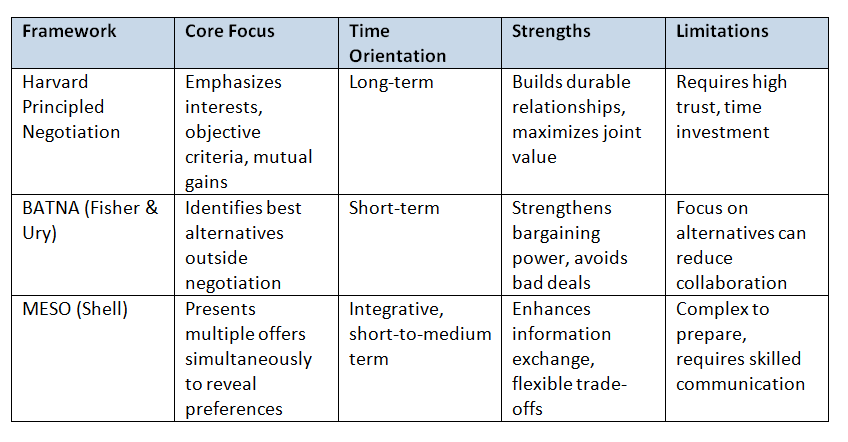
Harvard Principled Negotiation is quintessentially a long-term strategy, designed to foster trust and integrative outcomes. It invites negotiators to jointly explore interests behind positions, set objective standards like market rates or legal precedents, and develop options for mutual gain. This framework aligns with relationship-focused sectors such as labor unions, strategic partnerships, and mergers & acquisitions where sustaining cooperation is paramount.
BATNA is a tactical concept that underpins short-term negotiation leverage. Knowing your BATNA — for example, an alternative supplier or a competing offer — empowers negotiators to walk away from disadvantageous deals. BATNA is central in procurement negotiations, where immediate cost savings and contract terms dominate.
MESO, developed by Leigh Thompson and adapted by Shell, blends short- and medium-term approaches by proposing multiple simultaneous offers of equivalent value but differing attribute mixes. This technique reveals the counterpart’s priorities without explicit disclosure, enabling creative trade-offs and expanding the Zone of Possible Agreement (ZOPA). MESO is especially effective in complex sales or licensing negotiations where balancing price, timing, and service levels matters.
Understanding how these frameworks map onto negotiation timeframes equips negotiators with a versatile toolkit. The optimal approach often involves integrating elements from each depending on context, counterpart, and strategic objectives.
Step-by-Step Process — Designing and Executing Short-Term vs Long-Term Negotiation Strategies
Step 1: Clarify Strategic Objectives and Time Horizon
Begin by explicitly articulating whether the negotiation aims for immediate transactional gains or sustainable long-term value. Ask:
· Is the goal a one-time contract or a recurring partnership?
· What is the acceptable time frame for returns or benefits?
· How critical is relationship preservation?
Document these criteria to guide subsequent steps.
Step 2: Assess BATNA and Counterpart’s Alternatives
Conduct a rigorous BATNA analysis for both parties. This involves:
· Listing all realistic alternatives if negotiation fails.
· Estimating the value and feasibility of these alternatives.
· Anticipating the counterpart’s BATNA through market intelligence.
A strong BATNA strengthens short-term positional bargaining; a weak BATNA encourages collaborative long-term strategies.
Step 3: Identify Interests and Prioritize Them
Move beyond stated positions to uncover underlying interests:
· Use open-ended questions and active listening.
· Map interests on a priority matrix (urgent vs important).
· Separate interests that require immediate resolution from those that can be deferred or bundled.
This step supports integrative bargaining critical for long-term strategy.
Step 4: Choose an Appropriate Framework or Blend
Based on objectives and information gathered, select an approach:
· For short-term focus: emphasize BATNA and distributive bargaining.
· For long-term focus: apply Harvard Principled Negotiation or integrative approaches.
· For mixed-term or complex deals: deploy MESO offers.
Step 5: Develop Multiple Offers and Concession Plans
Prepare offers reflecting different trade-offs, especially for MESO:
· Quantify value of each issue.
· Create at least 3 equivalent offers varying in price, timing, or scope.
· Define clear concession thresholds and fallback positions.
Step 6: Execute Negotiation with Psychological Awareness
During negotiation:
· Manage cognitive biases (anchoring, loss aversion).
· Use tactical empathy to build rapport.
· Signal commitment to long-term collaboration if applicable.
· Leverage silence and calibrated questions to extract information.
Step 7: Document Agreements and Plan Follow-Up
Finalize agreements with clear terms and contingencies. For long-term deals:
· Include mechanisms for renegotiation, performance reviews, and dispute resolution.
· Plan relationship management activities.
For short-term deals:
· Ensure clarity on deliverables and timelines.
· Establish payment or penalty clauses.
Real-World Case Studies — Applying Short-Term and Long-Term Negotiation Strategies
Case Study 1: Amazon’s DoD JEDI Cloud Contract — Balancing Urgency with Partnership
Amazon’s negotiation with the U.S. Department of Defense for the Joint Enterprise Defense Infrastructure (JEDI) contract illustrates the blend of short-term and long-term strategies. Amazon needed to secure a multi-year contract quickly to preempt competitors like Microsoft, emphasizing short-term BATNA leverage by highlighting its superior technology and readiness. However, the negotiation also involved long-term relationship building with government agencies to position Amazon as a trusted partner for future defense projects.
Amazon’s approach combined distributive tactics (strong alternatives and firm pricing) with integrative elements (customized solutions, compliance guarantees) — reflecting a hybrid strategy that managed immediate competition and fostered sustainable collaboration.
Case Study 2: Apple vs Samsung Patent Negotiations — Prolonged Strategic Positioning
The protracted patent litigation and settlement negotiations between Apple and Samsung underscore a primarily long-term negotiation strategy. Both firms understood that short-term wins in court would be costly and damage brand reputations. Instead, they used integrative negotiation principles, mediated discussions, and incremental agreements to balance intellectual property rights with ongoing supply chain and market competition relationships.
This case highlights how long-term negotiation strategies can mitigate risks and preserve complex interdependencies.
Case Study 3: IBM Enterprise Sales — Using MESO to Tailor Client Deals
IBM’s enterprise sales teams frequently employ the MESO technique to negotiate customized software and service contracts. By offering clients multiple proposals simultaneously with varied price and service features, IBM uncovers client preferences without direct questioning, speeding consensus and enhancing satisfaction.
This approach leverages short-to-medium term strategies that both close deals faster and build groundwork for long-term partnerships.
Common Pitfalls and How to Avoid Them
· Pitfall: Overemphasis on Short-Term Gains at Relationship Expense
Consequence: Damaged reputations, lost future business
Fix: Integrate relationship-building tactics such as expressing empathy, maintaining transparency, and including collaborative clauses in contracts.
· Pitfall: Ignoring BATNA Strength and Overcommitting
Consequence: Accepting unfavorable terms, missed alternative opportunities
Fix: Conduct rigorous BATNA analysis before and during negotiation, and be willing to walk away.
· Pitfall: Failing to Prepare Multiple Equivalent Offers
Consequence: Reduced flexibility, limited ZOPA discovery
Fix: Develop MESO offers in advance to adapt dynamically to counterpart’s preferences.
· Pitfall: Cognitive Biases Undermining Judgement (Anchoring, Overconfidence)
Consequence: Poor concessions, misreading counterpart’s position
Fix: Use objective criteria, involve diverse internal reviewers, and practice calibrated questioning.
· Pitfall: Neglecting Post-Negotiation Relationship Management
Consequence: Agreement erosion, conflicts arising later
Fix: Establish clear follow-up mechanisms, regular check-ins, and dispute resolution processes.
Advanced Tactics — Expert Negotiation Techniques for Experienced Professionals
· Tactical Empathy: Echoing Chris Voss’s FBI negotiation methods, use mirroring and labeling to validate counterpart’s emotions and encourage openness, especially effective in long-term strategy.
· Anchoring with Adjusted Ranges: Instead of a single anchor, present a credible range to avoid psychological rigidity, enhancing flexibility in short-term deals.
· Time Pressure Manipulation: Create or alleviate artificial deadlines strategically to influence counterpart concessions without damaging trust.
· Contingent Contracts: Use conditional agreements that link outcomes to future events, managing uncertainty in long-term deals.
· Strategic Silence and Pauses: Employ deliberate silence at critical junctures to prompt counterpart disclosure and concessions.
· Integrating Organizational Stakeholders: Engage cross-functional teams early to anticipate internal objections and build consensus, crucial for complex long-term negotiations.
Scripts and Templates — Exact Dialogue and Email Templates for Immediate Use
Script for Opening a Long-Term Negotiation Discussion
"Thank you for meeting today. Before we dive into specifics, I want to emphasize that our goal is to establish a partnership that benefits both parties well beyond this initial agreement. To do that effectively, I’d like us to focus on understanding each other’s core interests and explore options that create mutual value over time."
Script for Presenting Multiple Equivalent Offers (MESO)
"We’ve prepared a few proposals that each deliver the value you’re looking for but vary in terms of pricing, delivery timelines, and service levels. I’d like to walk you through each so we can identify what aligns best with your priorities."
Email Template for BATNA Disclosure (Selective and Strategic)
Subject: Clarifying Our Options to Facilitate Productive Dialogue
"Dear [Name],
To ensure transparency and help us find the best path forward, I want to share that we are currently evaluating alternative suppliers that can meet our requirements within a similar timeframe. That said, we value your expertise and prefer to find a mutually beneficial agreement. Looking forward to your thoughts.
Best regards,
Closing Script for Short-Term Negotiation
"I appreciate your flexibility during this discussion. Given the urgency on both sides, let’s finalize the key terms we’ve agreed upon today and ensure that we have clear next steps for implementation."
Frequently Asked Questions — Detailed Q&As on Negotiation Timeframes
Q1: How do I decide whether to prioritize a short-term or long-term negotiation strategy?
A1: Evaluate your strategic objectives, relationship importance, and market dynamics. If immediate gains and tight deadlines dominate, a short-term approach emphasizing BATNA and distributive bargaining is appropriate. For ongoing partnerships or complex deals, prioritize long-term integrative strategies to maximize joint value.
Q2: Can short-term negotiation strategies damage long-term relationships?
A2: Yes, aggressive short-term tactics like hard anchoring or withholding information can erode trust. To mitigate this, even short-term negotiations should maintain professionalism, transparency, and respect, preserving the possibility of future collaboration.
Q3: How can I effectively use MESO to balance short-term and long-term goals?
A3: MESO enables presenting multiple offers that optimize different value dimensions (price, delivery, service). By revealing counterpart preferences indirectly, MESO facilitates agreements that deliver immediate results while laying groundwork for sustained engagement.
Q4: What psychological biases should I be aware of when negotiating across time horizons?
A4: Common biases include loss aversion (preferring immediate smaller gains), anchoring on initial offers, and overconfidence in BATNA strength. Awareness and deliberate countermeasures like objective criteria and calibrated questions improve decision-making.
Q5: How do I manage negotiations when the counterpart prefers a different time horizon?
A5: Use active listening to understand their priorities and concerns. If they favor short-term gains but you seek long-term value, find integrative options that provide immediate benefits alongside future opportunities, creating a bridge between perspectives.
Conclusion — Synthesizing Key Insights and Next Steps
The strategic choice between short-term and long-term negotiation strategies is neither binary nor static. It requires nuanced understanding of psychological drivers, careful assessment of alternatives, and the application of robust frameworks such as Harvard Principled Negotiation, BATNA, and MESO. Real-world cases from Amazon, Apple, and IBM elucidate how top organizations blend these approaches to navigate complexity and uncertainty.
Avoiding common pitfalls such as relationship neglect or cognitive biases can elevate negotiation outcomes from transactional wins to transformative partnerships. Advanced tactics like tactical empathy and contingent contracts empower experienced negotiators to finesse deals across time horizons.
As a senior professional, you now possess a comprehensive playbook — from foundational theory, step-by-step processes, to scripts and FAQs — to confidently design and execute negotiation strategies tailored to your context. Your next step is to actively apply these insights in your upcoming negotiations, experiment with MESO offers, rigorously analyze BATNAs, and prioritize relationship-building even when under pressure for quick decisions.
By mastering the delicate balance between short-term gains and long-term value, you will not only drive superior deal outcomes but also build enduring competitive advantage for your organization.
References
· Kahneman, Daniel. "Thinking, Fast and Slow." Farrar, Straus and Giroux, 2011.
· Fisher, Roger, William Ury, and Bruce Patton. "Getting to Yes: Negotiating Agreement Without Giving In." Penguin Books, 2011.
· Cialdini, Robert B. "Influence: The Psychology of Persuasion." Harper Business, 2006.
· Shell, George R. "Bargaining for Advantage: Negotiation Strategies for Reasonable People." Penguin Books, 2006.
· Bazerman, Max H., and Margaret A. Neale. "Negotiating Rationally." Free Press, 1992.
· Thompson, Leigh. "The Mind and Heart of the Negotiator." Pearson, 2014.