Strategic Mistakes in Negotiation and How to Avoid Them

Negotiation is the lifeblood of business success, yet even the most seasoned professionals routinely fall prey to strategic mistakes that undermine their outcomes. Consider the landmark 2011 Apple vs. Samsung patent battle, where Samsung’s failure to fully anticipate Apple's BATNA (Best Alternative to a Negotiated Agreement) and overreliance on distributive bargaining cost it billions and market leadership in key segments. Or recall the 2008 financial crisis fallout, where numerous M&A negotiations collapsed due to parties misjudging their negotiation zones of possible agreement (ZOPA) and anchoring too aggressively. Such high-stakes scenarios underscore how strategic errors in negotiation can cause irreversible financial and reputational damage.
In today’s hypercompetitive, interconnected business environment, negotiation skills are not optional—they are critical strategic assets. Organizations face complex deals involving multiple stakeholders, cultural nuances, and rapidly shifting dynamics, making a nuanced understanding of negotiation psychology and frameworks indispensable. The ability to identify and avoid common strategic pitfalls can be the difference between securing a multi-million-dollar contract or walking away empty-handed with reputational harm. Equally, mastering advanced techniques allows negotiators to expand value and build sustainable partnerships rather than merely haggling over price.
This comprehensive article delivers an unparalleled deep dive into strategic mistakes in negotiation and how to avoid them. You will master the foundational psychological theories, explore essential negotiation frameworks, learn a rigorous step-by-step process to prepare and execute negotiations flawlessly, and analyze real-world case studies with actionable lessons. We will dissect frequent pitfalls with concrete fixes, introduce advanced tactics reserved for elite negotiators, and provide ready-to-use scripts and templates. By the end, you will be equipped to anticipate, identify, and neutralize strategic errors—transforming your negotiations into consistent wins.
· Table of Contents
· The Strategic Foundation: Core Theory and Psychology of Negotiation
· Key Frameworks and Models: Comparative Analysis
· Step-by-Step Negotiation Process: Six Essential Steps
· Real-World Case Studies: Lessons from Apple, IBM, and WTO
· Common Pitfalls and How to Avoid Them: Mistakes with Remedies
· Advanced Tactics: Elite Techniques Beyond the Basics
· Scripts and Templates: Ready-to-Use Negotiation Dialogue
· Frequently Asked Questions: Expert Answers to Critical Queries
· Conclusion: Key Insights and Strategic Call to Action
· References: Authoritative Books and Research Articles
The Strategic Foundation — Core Theory and Psychology Behind Negotiation Mistakes
Understanding strategic mistakes in negotiation begins with grasping the underlying cognitive biases, psychological drivers, and principled negotiation theory. Pioneering research by Kahneman and Tversky (1979) on loss aversion explains why negotiators often irrationally overvalue potential losses relative to equivalent gains, leading to stubbornness and deadlock. For example, in salary negotiations, candidates anchored on avoiding a pay cut may reject reasonable offers—failing to recognize the bigger picture of career growth.
Fisher and Ury’s seminal work, Getting to Yes (1981), advocates principled negotiation focused on interests rather than positions. Strategic mistakes arise when negotiators fixate on positions (distributive bargaining) rather than exploring mutual gains (integrative bargaining). This positional bargaining fuels zero-sum thinking, escalating conflict and narrowing the zone of possible agreement (ZOPA).
Cialdini’s principles of influence (2006) — including reciprocity, commitment, and social proof — reveal how psychological levers can be wielded both ethically and manipulatively. Ignoring these dynamics leads to missed opportunities for value creation or, conversely, falling victim to counterpart manipulation. Shell’s Bargaining for Advantage (2006) synthesizes these insights into a practical framework emphasizing preparation, leverage, and communication style.
Malhotra and Bazerman’s Negotiation Genius (2007) integrates behavioral economics with negotiation strategy, explaining common biases such as overconfidence and anchoring, and offering empirically validated tactics to overcome them. For example, anchoring early with a strong but realistic offer sets the negotiation tone, while remaining flexible guards against impasses.
Together, these foundational theories and research reveal that strategic mistakes often stem from cognitive biases, misaligned mental models, and failure to apply integrative principles. Recognizing these roots enables negotiators to implement more effective, evidence-based approaches.
Key Frameworks and Models — Comparative Analysis of Essential Negotiation Frameworks
Negotiation theory provides several frameworks that help diagnose and avoid strategic mistakes. Here we analyze three foundational models: BATNA/ZOPA Framework, Harvard Principled Negotiation, and the MESO (Multiple Equivalent Simultaneous Offers) Approach. Understanding their unique features and applications helps negotiators select the right tool for each context.
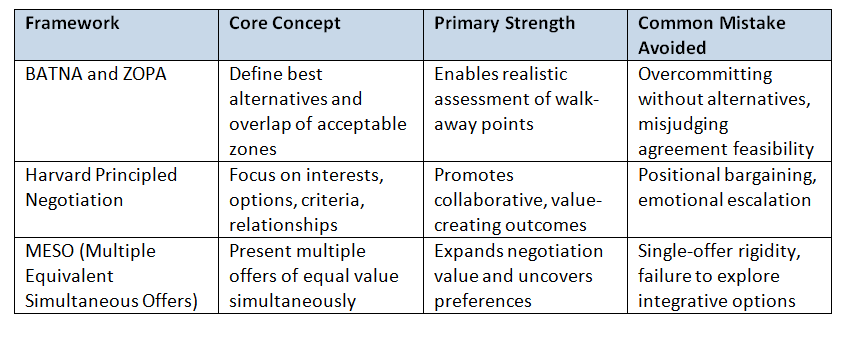
BATNA and ZOPA are critical in establishing negotiation boundaries and understanding whether an agreement is possible. For example, Amazon’s procurement teams rigorously assess supplier BATNAs and internal ZOPA before engaging, preventing costly overbidding. Harvard Principled Negotiation, championed in labor union negotiations such as the 1997 UPS Teamsters deal, helped parties focus on mutual interests (e.g., healthcare costs) rather than entrenched wage positions, enabling breakthrough agreements. MESO, increasingly popular in complex enterprise sales like IBM’s multi-stakeholder deals, allows presenting several pricing and service configurations simultaneously, accelerating consensus and uncovering hidden priorities.
Each framework addresses specific strategic mistakes—overconfidence in BATNA strength, positional inflexibility, or failure to expand options. Expert negotiators blend these frameworks fluidly depending on negotiation type, scale, and relationship context.
Step-by-Step Process — Six Essential Steps to Avoid Strategic Mistakes
A disciplined process rooted in research mitigates strategic mistakes throughout negotiation. Below is a detailed walkthrough of the six critical steps, each with concrete actions and psychological rationale.
Step 1: Preparation and Research
Effective negotiation begins long before the table. Gather detailed intelligence on counterpart’s interests, constraints, authority levels, and cultural context. Identify your BATNA and estimate theirs. Preparation reduces uncertainty, anchoring bias, and emotional reactions during negotiation (Malhotra & Bazerman, 2007).
Actionables:
- Construct a BATNA matrix outlining alternatives with pros and cons.
- Research past deals and public statements for signals on priorities.
- Prepare objective criteria to justify positions.
Step 2: Setting Clear Objectives and Priorities
Define your goals with clear distinctions between must-haves, tradeables, and concessions. Use the Harvard framework to focus on interests rather than positions, avoiding rigid stances. Prioritize issues based on value and feasibility to optimize resource allocation.
Actionables:
- Develop a priority ladder listing issues from essential to nice-to-have.
- Prepare MESO packages with multiple equivalent offers.
- Anticipate counterpart’s priorities through empathy mapping.
Step 3: Opening and Anchoring
Make the first offer when strategically advantageous; research shows early anchoring influences negotiation trajectory (Tversky & Kahneman). Anchor offers slightly ambitious but credible to leave room for concessions without alienating the other party.
Actionables:
- Use data-backed justifications for your anchor.
- Express openness and rationale to mitigate perception of rigidity.
- Avoid anchoring too aggressively, which can stall talks.
Step 4: Information Exchange and Listening
Active listening and open-ended questions reveal underlying interests and constraints. Leverage Cialdini’s reciprocity principle by sharing calibrated information to encourage disclosure. Avoid premature concessions or revealing your BATNA too soon.
Actionables:
- Prepare targeted questions to explore priorities.
- Paraphrase counterpart’s responses to confirm understanding.
- Observe nonverbal cues for unspoken concerns.
Step 5: Bargaining and Problem-Solving
Shift from distributive to integrative bargaining by exploring tradeoffs and creating value. Use MESO to present multiple offers and invite counterpart to rank preferences. Be mindful of cognitive biases like loss aversion that may cause stubbornness.
Actionables:
- Propose package deals combining multiple issues.
- Address emotional triggers by reframing losses as gains.
- Use objective standards to justify concessions.
Step 6: Closing and Commitment
Ensure agreement is clearly articulated, documented, and mutually understood to avoid post-deal disputes. Use commitment devices such as written contracts or public announcements to solidify terms. Plan for contingencies and follow-up.
Actionables:
- Summarize key points and confirm consensus.
- Draft clear, precise contract language.
- Schedule follow-up meetings and define enforcement mechanisms.
This structured process minimizes common strategic mistakes by promoting preparation, flexibility, and psychological savvy at every stage.
Real-World Case Studies — Lessons from Apple, IBM, and WTO Negotiations
Examining high-profile negotiations reveals how strategic mistakes manifest and how experts avoid them.
Case Study 1: Apple vs. Samsung Patent Litigation (2011-2014)
Context: Apple sued Samsung over smartphone patents, seeking injunctions and damages. Samsung underestimated Apple’s BATNA and overcommitted to distributive positional bargaining.
What Happened: Samsung’s aggressive anchoring on patent defenses backfired as courts sided with Apple, resulting in multi-billion dollar losses and damaged market credibility.
Lesson: Misjudging counterpart’s alternatives and failing to explore integrative solutions (e.g., cross-licensing) led to adversarial escalation and loss. Emphasizes importance of BATNA analysis and principled negotiation.
Case Study 2: IBM Enterprise Sales Negotiations
Context: IBM routinely negotiates complex multi-year contracts with global enterprises involving software, services, and hardware bundles.
What Happened: By employing the MESO approach—presenting multiple equivalent offers simultaneously—IBM uncovered client priorities and accelerated consensus, avoiding stalemates common in large deals.
Lesson: Using MESO expands value and prevents rigid positional bargaining. Highlights need for flexibility and creative tradeoffs in complex negotiations.
Case Study 3: WTO Doha Round Trade Negotiations
Context: The Doha Development Round aimed to reduce global trade barriers but stalled repeatedly due to divergent interests and poor zone of possible agreement estimation.
What Happened: Parties failed to define realistic ZOPA and allowed emotional and positional escalation, resulting in a decade-long impasse.
Lesson: Shows criticality of early BATNA and ZOPA assessment, mutual interests focus, and trust-building to avoid deadlock in multilateral negotiations.
These cases demonstrate that strategic negotiation mistakes often stem from neglecting psychological insights, framework applications, or process discipline.
Common Pitfalls and How to Avoid Them — Mistakes with Real Consequences and Concrete Fixes
Negotiators frequently fall into predictable traps that erode value and relationships. Below is a detailed table summarizing common pitfalls, their consequences, and actionable remedies.
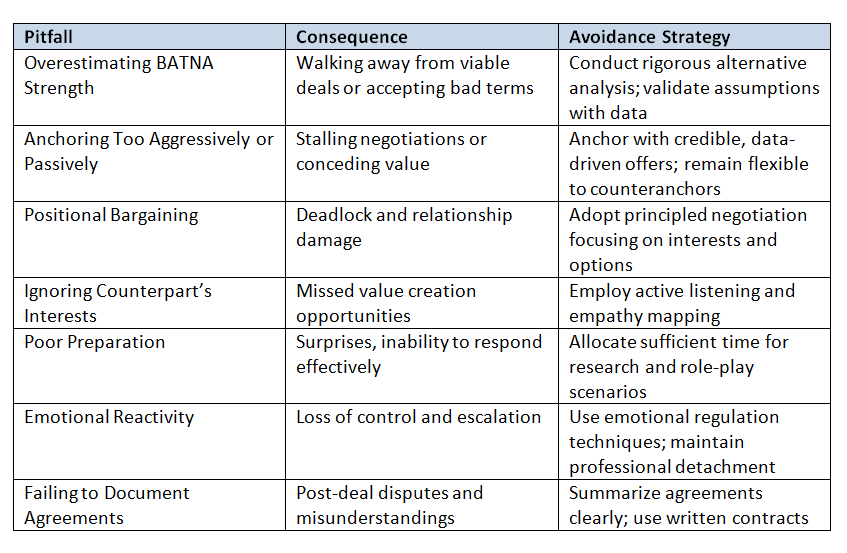
Addressing these pitfalls requires a combination of self-awareness, preparation, and adherence to structured frameworks.
Advanced Tactics — Elite Techniques Beyond the Basics
Experienced negotiators can leverage sophisticated tactics that go beyond standard guides:
· Strategic Silence and Timing: Deliberately pausing after offers to compel counterpart to fill the void with concessions or information.
· Reverse Anchoring: Inviting counterpart to suggest an anchor first, then reframing it to your advantage.
· Decoy Offers: Presenting less attractive options to steer counterparts toward preferred terms.
· Multi-Party Coalition Building: In multi-stakeholder negotiations, forming alliances to strengthen ZOPA and leverage.
· Scenario Planning and War-Gaming: Running multiple what-if simulations to anticipate counterpart moves and prepare responses.
· Emotional Intelligence Deployment: Reading microexpressions and subtle cues to detect deception or hidden priorities.
These tactics require high situational awareness, emotional control, and experience but can dramatically shift negotiation power dynamics.
Scripts and Templates — Ready-to-Use Negotiation Dialogue and Documents
Below are sample scripts and templates designed for immediate adaptation:
Script: Opening Offer with Anchoring and Interest Framing
“After thorough analysis of market benchmarks and our mutual interests, we propose a starting package at $1.2 million annually. This reflects both the value we bring and the need for a sustainable partnership. We’re, of course, open to discussing how we can adjust terms to better align with your priorities.”
Template: BATNA Analysis Worksheet
- Alternative 1: Description | Pros | Cons | Estimated Value
- Alternative 2: Description | Pros | Cons | Estimated Value
- Best Alternative: Selected based on highest net value
Template: Agreement Summary Checklist
- Parties involved
- Key negotiated terms
- Commitments and deliverables
- Timelines and milestones
- Dispute resolution methods
- Signature lines
Using such scripts and templates reduces cognitive load and ensures consistency.
Frequently Asked Questions
Q1: How do I accurately assess my BATNA without full information on the counterpart?
A1: Use triangulation by gathering market data, industry benchmarks, and indirect signals from third parties. Scenario analysis helps estimate a range of BATNA strengths. Remain flexible if new information emerges during negotiation.
Q2: How can I handle emotional counterparts who escalate conflict?
A2: Practice active listening and acknowledge emotions without matching intensity. Use calming language and redirect focus to problem-solving. If needed, propose breaks or neutral mediators.
Q3: When is it better to make the first offer?
A3: Making the first offer is advantageous if you have strong market intelligence and can anchor decisively. In uncertain contexts or when counterpart has superior information, it may be wiser to let them open.
Q4: How can I ensure negotiations remain integrative rather than distributive?
A4: Focus discussions on underlying interests rather than positions. Propose multiple equivalent offers (MESO) and seek tradeoffs across issues. Build rapport to encourage collaboration.
Q5: What are signs that my negotiation is heading toward deadlock?
A5: Indicators include repeated positional restatements, refusal to share information, emotional escalation, and no movement on key issues. Counter by reframing, introducing objective criteria, or pausing to reassess.
Conclusion
Strategic mistakes in negotiation are often costly but avoidable with deliberate preparation, psychological insight, and disciplined frameworks. By grounding your approach in evidence-based theory—from Kahneman’s loss aversion to Fisher and Ury’s principled negotiation—and adopting flexible, interest-focused tactics, you can transform from a reactive bargainer into a proactive value creator. Real-world cases like Apple vs. Samsung and IBM’s enterprise sales vividly illustrate the difference that mastery makes in outcomes and relationships.
We invite you to integrate the comprehensive step-by-step process, avoid the common pitfalls detailed, and experiment with advanced tactics and scripts provided here. Whether negotiating multi-billion-dollar deals or everyday contracts, the principles remain the same: prepare thoroughly, listen deeply, anchor smartly, and seek mutual gain. Your next negotiation can be your best yet—start applying these strategies today.
References
Fisher, R., & Ury, W. (1981). Getting to Yes: Negotiating Agreement Without Giving In. Penguin Books.
Kahneman, D., & Tversky, A. (1979). Prospect Theory: An Analysis of Decision under Risk. Econometrica, 47(2), 263–291.
Cialdini, R. B. (2006). Influence: The Psychology of Persuasion. Harper Business.
Shell, G. R. (2006). Bargaining for Advantage: Negotiation Strategies for Reasonable People. Penguin.
Malhotra, D., & Bazerman, M. H. (2007). Negotiation Genius: How to Overcome Obstacles and Achieve Brilliant Results at the Bargaining Table and Beyond. Bantam.
Sebenius, J. K. (1992). Negotiation Analysis: A Characterization and Review. Management Science, 38(1), 18–38.