Strategic Planning Before Negotiation: Mastering the Art of Preparation for Unbeatable Outcomes

Imagine a high-stakes negotiation where two tech giants, Apple and Samsung, face off over patent rights. Months of preparation, data gathering, and strategic planning precede the actual negotiation session. Without this meticulous groundwork, Apple’s legal team might have missed critical leverage points, costing billions in licensing fees. This scenario exemplifies how strategic planning before negotiation can determine success or failure at the highest level.
In today’s hypercompetitive business environment, organizations must navigate complex negotiations involving multiple stakeholders, high risks, and unpredictable variables. Strategic planning is not just a preliminary step; it is the foundation upon which every effective negotiation rests. Research by Nobel laureate Daniel Kahneman highlights how cognitive biases can derail poorly planned negotiations, while Fisher and Ury’s seminal work on principled negotiation underscores the importance of preparation in achieving mutual gains.
By the end of this comprehensive guide, you will master the psychology behind negotiation planning, understand and apply key negotiation frameworks, execute a detailed step-by-step planning process, learn from real-world corporate negotiation case studies, avoid common pitfalls, implement advanced tactics, and use ready-to-deploy scripts and templates that will elevate your negotiation outcomes.
· Table of Contents
· The Strategic Foundation: Theory, Psychology, and Research Behind Negotiation Planning
· Key Frameworks and Models for Strategic Negotiation Planning
· Step-by-Step Process: How to Prepare for a Negotiation Like a Pro
· Real-World Case Studies: Lessons from Top Corporate Negotiations
· Common Pitfalls in Negotiation Planning and How to Avoid Them
· Advanced Tactics for Experienced Negotiators
· Scripts and Templates: Exact Dialogue and Email Formats for Preparation
· Frequently Asked Questions About Strategic Planning Before Negotiation
· Conclusion: Synthesizing Key Insights and Next Steps
· References: Authoritative Sources for Deeper Learning
The Strategic Foundation — Theory, Psychology, and Research Behind Negotiation Planning
Strategic planning prior to negotiation is grounded in a rich body of psychological research and negotiation theory. Understanding these foundational elements helps negotiators anticipate behavioral dynamics and structure their approach to maximize outcomes.
Daniel Kahneman’s research on cognitive biases, especially “loss aversion” and “anchoring,” reveals why negotiators who enter discussions without preparation are vulnerable to suboptimal outcomes. Loss aversion explains why parties often reject beneficial deals due to fear of losses, while anchoring describes how initial offers disproportionately influence final agreements. Strategic planning allows negotiators to set deliberate anchors and anticipate counterpart biases.
Fisher and Ury’s Harvard Principled Negotiation framework, introduced in “Getting to Yes,” advocates for preparation emphasizing interests rather than positions, inventing options for mutual gain, and using objective criteria. Their approach is supported by research showing that negotiators who identify shared interests and prepare objective standards outperform those who engage in positional bargaining.
Robert Cialdini’s principles of persuasion — reciprocity, commitment, social proof, authority, liking, and scarcity — further inform strategic planning. Anticipating how and when to leverage these influence tactics can create psychological advantages during the negotiation.
Shell’s “Bargaining for Advantage” synthesizes these insights and introduces the concept of BATNA (Best Alternative to a Negotiated Agreement), emphasizing that knowing your alternatives and those of your counterpart is critical for strategic leverage. Planning also includes identifying ZOPA (Zone of Possible Agreement), the range where deals are possible.
Collectively, this research underscores that strategic planning is not merely administrative but a cognitive and behavioral science-driven process that enables negotiators to control complex interactions and drive optimal results.
Key Frameworks and Models — Presenting 3 Frameworks with Comparison
Strategic negotiation planning can be approached using several established frameworks. Here we compare three of the most influential: Harvard Principled Negotiation, Shell’s BATNA/ZOPA model, and MESO (Multiple Equivalent Simultaneous Offers).
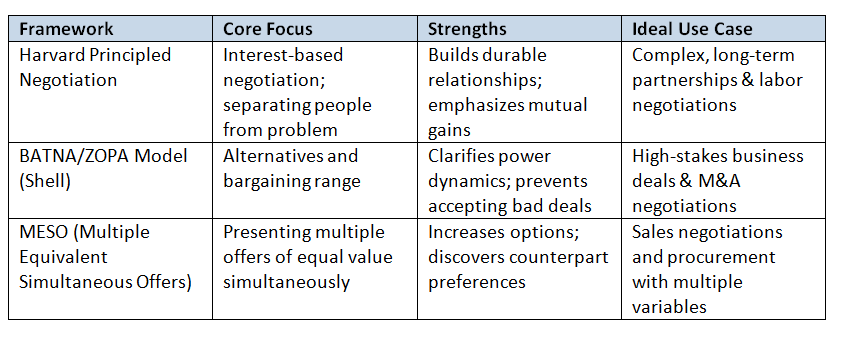
Harvard Principled Negotiation focuses on collaborative problem solving by identifying interests behind positions, which reduces adversarial postures. This framework is especially valuable in labor union talks or joint ventures where relationships matter.
Shell’s BATNA and ZOPA analysis centers on preparation to understand your fallback options and the feasible zone for agreement. This framework is essential in M&A deals or vendor contract negotiations where alternatives determine power.
MESO, developed by negotiation scholar Margaret Neale, involves preparing multiple offers of equivalent value to present at once. This tactic uncovers counterpart preferences and creates value by expanding the negotiation space. It shines in complex sales or procurement processes with multiple contract variables.
Skilled negotiators often blend these models to tailor their planning to context, balancing relationship focus, power assessment, and creative offer-making.
Step-by-Step Process — Detailed Numbered Walkthrough
Step 1: Define Clear Objectives and Desired Outcomes
Start by articulating what success looks like. Define your primary goals (e.g., price, contract terms, partnership scope) and secondary objectives (e.g., goodwill, future collaboration). Setting SMART (Specific, Measurable, Achievable, Relevant, Time-bound) goals provides clarity and focus.
Step 2: Conduct Comprehensive Stakeholder Analysis
Map all participants and influencers on both sides. Assess their interests, power levels, decision-making authority, and relationships. Tools like power-interest grids help prioritize engagement strategies.
Step 3: Gather and Analyze Relevant Information
Collect data on market conditions, past deals, counterpart organization, cultural factors, and legal constraints. Use public filings, industry reports, and social media intelligence. This intelligence supports realistic expectations and credible proposals.
Step 4: Identify Your BATNA and Estimate Counterpart BATNA
Determine your Best Alternative to a Negotiated Agreement—your fallback if talks fail. Also estimate your counterpart’s BATNA to gauge their leverage. This step requires honest assessment and scenario planning.
Step 5: Establish Your ZOPA (Zone of Possible Agreement)
Based on objectives and BATNAs, define the overlap zone where agreement is feasible. This zone guides offer ranges and settlement targets.
Step 6: Develop Multiple Offer Packages Using MESO
Create several packages or offers that vary in terms but hold equivalent value to you. This approach reveals counterpart preferences and facilitates trade-offs.
Step 7: Plan Communication and Persuasion Strategies
Decide on messaging frameworks, timing, and use of Cialdini’s influence principles. Prepare arguments supported by objective criteria to justify your position.
Step 8: Anticipate Counterpart Tactics and Prepare Responses
Analyze probable negotiation tactics your counterpart might employ (e.g., highball offers, silence, deadlines). Plan countermeasures and concessions.
Step 9: Role-Play and Rehearse Negotiation Scenarios
Conduct mock negotiations with colleagues to simulate dynamics and refine scripts. Role-playing uncovers vulnerabilities and builds confidence.
Step 10: Assemble the Negotiation Team and Assign Roles
If negotiating in teams, clarify roles (lead negotiator, subject matter expert, note taker). Define decision-making authority and escalation paths.
Step 11: Finalize Logistics and Contingency Plans
Confirm meeting formats, locations, technology, and backup plans. Prepare to adjust if unexpected developments occur.
Real-World Case Studies — 3 Specific Examples
Apple vs. Samsung Patent Negotiations (2014-2018)
Apple and Samsung engaged in protracted patent licensing negotiations amid high-profile litigation. Apple’s legal team meticulously prepared by analyzing Samsung’s financials, patent portfolios, and market strategies. By clearly defining BATNA as continuing litigation versus settlement, Apple negotiated a licensing deal that yielded multi-billion-dollar fees. Their use of principled negotiation focused on objective criteria—patent validity and market impact—rather than positional haggling, enabling a durable agreement.
IBM Enterprise Sales Negotiations
IBM’s complex enterprise sales involve multi-year contracts with large corporations. IBM’s sales teams apply MESO strategies to simultaneously present multiple contract options balancing price, service levels, and customization. Before meetings, IBM negotiators conduct in-depth stakeholder mapping and role-play internal scenarios. This preparation empowers them to adapt offers on-the-fly and close deals efficiently, exemplifying integrative bargaining.
Delta Airlines and Labor Union Negotiations
During collective bargaining with pilots’ unions, Delta’s negotiation team applied Harvard Principled Negotiation principles, emphasizing mutual interests such as safety and operational efficiency. Extensive pre-negotiation planning included analyzing union demands, economic conditions, and alternative dispute resolution options. By focusing on interests rather than rigid positions, Delta avoided strikes and secured a multi-year contract beneficial to both parties.
Common Pitfalls and How to Avoid Them
Pitfall 1: Insufficient BATNA Analysis
Failing to accurately assess your BATNA or your counterpart’s leads to unrealistic expectations and poor decision-making.
Fix: Dedicate time to research alternatives, consult stakeholders, and build scenario models to confirm your fallback options.
Pitfall 2: Overlooking Stakeholder Dynamics
Ignoring informal influencers or political factors can cause unexpected resistance or stalemates.
Fix: Conduct thorough stakeholder mapping and engage early with all relevant parties to build buy-in.
Pitfall 3: Anchoring on Initial Offers Without Flexibility
Rigidly sticking to one offer or position ignores counterpart needs and reduces value creation.
Fix: Develop multiple equivalent offers (MESOs) and practice adaptive bargaining.
Pitfall 4: Neglecting Emotional and Psychological Preparation
Underestimating cognitive biases and emotions leads to impulsive or defensive reactions.
Fix: Train in emotional intelligence, anticipate biases, and prepare calming techniques.
Pitfall 5: Poor Role Definition in Team Negotiations
Ambiguous roles cause confusion, mixed messages, and inefficiency.
Fix: Clearly assign responsibilities and decision authority within the team before negotiations.
Advanced Tactics — Expert-Level Techniques
Integrative Bundling: Combine multiple issues into packages that create trade-offs, expanding the pie rather than fighting over slices.
Timing Manipulation: Use deadlines, strategic pauses, or phased proposals to increase pressure or buy time.
Reciprocity Sequencing: Plan concessions in a sequence that maximizes psychological reciprocity and concessions from the other side.
Information Asymmetry Management: Deliberately control what information you reveal and when to shape counterpart perceptions.
Meta-Negotiation Setup: Negotiate the negotiation process itself—agenda, rules, and authority—to gain procedural advantages.
Scripts and Templates — Exact Dialogue and Email Formats
Email Template for Pre-Negotiation Information Gathering
Subject: Preparation for Upcoming Negotiation Meeting
Dear [Counterpart Name],
Ahead of our scheduled negotiation on [date], we would appreciate if you could share any relevant documentation or data regarding [specific topics]. This will help ensure our discussion is productive and focused.
Please let us know if there are particular points you wish to address or clarify beforehand.
Looking forward to a collaborative session.
Best regards,
---
Opening Negotiation Dialogue Script
“Thank you for meeting today. Before we begin, I’d like to confirm that we share a common goal: to reach an agreement that benefits both parties. To achieve this, I propose we focus on interests rather than positions, explore creative options, and use objective criteria to guide our discussion. Does this approach sound agreeable to you?”
---
MESO Offer Presentation Script
“We have prepared several options that meet our objectives but differ in terms of pricing, delivery timelines, and service levels. For example, Option A emphasizes cost savings with longer lead times, while Option B offers faster delivery with a premium. I’d be interested to hear which of these aligns best with your priorities.”
Frequently Asked Questions
Q1: What is the most critical element to focus on during strategic planning before negotiation?
A1: Identifying and understanding your BATNA is paramount. It anchors your decision-making and ensures you do not accept unfavorable terms. Equally important is understanding the counterpart’s BATNA to estimate bargaining power.
Q2: How can I effectively anticipate my counterpart’s negotiation style and tactics?
A2: Conducting thorough stakeholder and behavioral analysis using historical data, past negotiation records, and direct intelligence gathering helps anticipate styles. Role-playing scenarios can simulate likely tactics.
Q3: What role does emotional intelligence play in strategic negotiation planning?
A3: High emotional intelligence allows you to predict and manage emotional dynamics, reducing conflict escalation and enabling rapport building. Planning should include strategies to manage emotions for both sides.
Q4: How can I leverage multiple equivalent simultaneous offers (MESO) effectively?
A4: By preparing offers that differ in terms but are of equal value to you, you provide your counterpart with choices. This reveals their preferences and increases the likelihood of mutually beneficial agreements.
Q5: How do I ensure my negotiation team is well-prepared and coordinated?
A5: Clearly define roles, establish communication protocols, rehearse scenarios together, and agree on authority limits before negotiation. This reduces confusion and presents a united front.
Conclusion
Strategic planning before negotiation transforms uncertainty into opportunity. Incorporating rigorous psychological insights, proven frameworks, and a disciplined preparatory process enables negotiators to navigate complexity and unlock value. The real-world examples underscore that preparation is the difference between costly impasses and winning agreements.
Whether you are negotiating multimillion-dollar contracts, labor agreements, or vendor deals, adopting the step-by-step planning process, leveraging frameworks like BATNA and MESO, and avoiding common pitfalls will elevate your results dramatically.
Take action now: apply the frameworks and checklists in this guide to your next negotiation. Assemble your team, analyze your alternatives, and rehearse your negotiation strategy. Mastering strategic planning before negotiation is your competitive edge in today’s dynamic business world.
References
Fisher, R., Ury, W., & Patton, B. (2011). Getting to Yes: Negotiating Agreement Without Giving In. Penguin Books.
Kahneman, D. (2011). Thinking, Fast and Slow. Farrar, Straus and Giroux.
Cialdini, R. B. (2007). Influence: The Psychology of Persuasion. Harper Business.
Shell, G. R. (2006). Bargaining for Advantage: Negotiation Strategies for Reasonable People. Penguin.
Neale, M. A., & Bazerman, M. H. (1991). Cognition and Rationality in Negotiation. Free Press.
Malhotra, D., & Bazerman, M. H. (2007). Negotiation Genius: How to Overcome Obstacles and Achieve Brilliant Results at the Bargaining Table and Beyond. Bantam.