Strategic Sourcing and Negotiation: How to Align Procurement with Business Goals

In 2019, Toyota faced a crucial juncture in its global supply chain when semiconductor shortages threatened to halt production lines worldwide. The company’s procurement leaders turned to strategic sourcing and negotiation frameworks that not only mitigated risk but aligned supplier partnerships tightly with Toyota’s business goals of just-in-time production and lean manufacturing. By applying targeted supplier segmentation and leveraging total cost of ownership (TCO) analysis, Toyota was able to secure critical components while maintaining cost control and operational resilience.
This scenario underscores the strategic stakes at play in modern procurement. Organizations are no longer just chasing price reductions; they must embed procurement decisions into overarching corporate strategies to drive innovation, sustainability, and competitive advantage. Negotiation, too, has evolved from transactional haggling to a structured dialogue shaped by data-driven insights and value engineering principles. The ability to align sourcing choices with business objectives can spell the difference between supply chain disruption and agile growth.
This comprehensive guide will equip you with the frameworks, models, and methodologies that underpin strategic sourcing and negotiation excellence. You will master proven step-by-step processes, learn from industry leaders including Apple, Boeing, and Walmart, and gain access to practical scripts and counter-tactics to sharpen your negotiation acumen. Whether you are a procurement manager, category leader, or CPO, this article will elevate your capacity to transform procurement into a strategic enabler of business value.
· Table of Contents
· The Strategic Foundation: Frameworks, Models, and Psychology
· Key Frameworks and Models for Strategic Sourcing and Negotiation
· Step-by-Step Strategic Sourcing and Negotiation Process
· Real-World Case Studies: Lessons from Industry Leaders
· Tactics and Counter-Tactics in Negotiation
· Advanced Strategies for Procurement Excellence
· Scripts and Templates for Effective Negotiation in Procurement
· Frequently Asked Questions
· Conclusion and Call to Action
· References
The Strategic Foundation - frameworks, models, psychology with named research
Strategic sourcing and negotiation are deeply rooted in a foundation of proven frameworks and an understanding of behavioral psychology. The procurement function has evolved from tactical purchasing to a strategic discipline that drives competitive advantage. Central to this evolution is the recognition that sourcing decisions impact multiple facets of business performance — from cost and risk to innovation and sustainability.
One foundational model is Michael Porter’s Five Forces, which helps procurement professionals analyze supplier power, threat of new entrants, and competitive rivalry to inform sourcing strategies that fit the industry context. Additionally, the Kraljic Portfolio Matrix, developed by Peter Kraljic, is seminal in segmenting suppliers based on risk and profitability, enabling tailored sourcing approaches that optimize both leverage and security.
Behavioral research also informs negotiation practices. Studies from Harvard's Program on Negotiation, notably by Fisher, Ury, and Patton, emphasize principled negotiation, focusing on interests rather than positions to create win-win outcomes. Cognitive biases such as anchoring and loss aversion also impact decision-making; skilled negotiators recognize and manage these psychological factors to maintain strategic alignment.
Total Cost of Ownership (TCO) and should-cost modeling further embed financial rigor into sourcing decisions by expanding the focus beyond purchase price to include lifecycle costs, quality implications, and supplier innovation potential. This holistic perspective ensures procurement decisions are aligned with long-term business goals rather than short-term cost savings.
Key Frameworks and Models
Effective strategic sourcing and negotiation rely on a toolkit of frameworks designed to analyze, segment, and manage supplier relationships aligned with corporate objectives. Below are three foundational models widely applied in procurement excellence:
1. Kraljic Portfolio Matrix
2. Porter's Five Forces
3. Total Cost of Ownership (TCO) Analysis
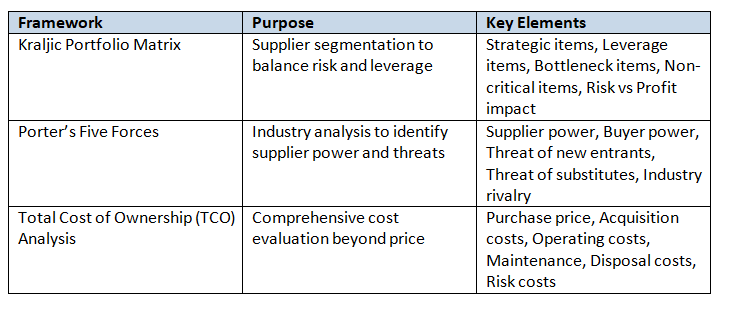
Each framework serves a unique purpose in driving procurement strategy:
- The Kraljic Matrix guides category managers on sourcing tactics by classifying suppliers into quadrants, enabling prioritization of strategic partnerships versus transactional dealings. For example, Boeing uses this matrix to manage critical aerospace component suppliers ensuring supply continuity while negotiating aggressively on leverage items like office supplies.
- Porter’s Five Forces informs negotiation positioning by identifying supplier bargaining power and market dynamics. Apple leverages this analysis in its supplier negotiations for key smartphone components to balance cost pressure with innovation collaboration.
- TCO analysis ensures sourcing decisions are financially sound over the entire lifecycle. Walmart applies rigorous should-cost models to understand the hidden costs in packaging materials, driving sustainable supplier collaboration.
Step-by-Step Process - [H3] for each step (minimum 6), specific tactics and language
Strategic sourcing and negotiation require a disciplined, repeatable process. Below is a six-step framework with specific tactics and language to align procurement with business goals effectively.
Step 1: Define Business-Aligned Sourcing Objectives
Begin by mapping procurement goals to company strategy. Clarify whether the priority is cost reduction, risk mitigation, innovation enablement, or sustainability. Use stakeholder interviews and SWOT analysis.
Suggested language:
"We want to ensure our sourcing strategy supports the company’s 5-year growth plan by prioritizing suppliers who can innovate alongside us."
Step 2: Conduct Spend and Market Analysis
Analyze historical spend data and market conditions using Porter’s Five Forces and should-cost models. Identify supplier concentration and risks.
Tactic: Utilize data visualization tools to highlight high-value categories and potential bottlenecks.
Step 3: Segment Suppliers Using Kraljic Matrix
Classify suppliers based on risk and impact. Develop differentiated engagement plans.
Language example:
"For strategic items, we will pursue collaborative partnerships with joint risk-sharing agreements."
Step 4: Develop Sourcing Strategy and RFP/RFQ Process
Design sourcing approaches tailored to each segment. For leverage items, initiate competitive bidding; for strategic items, co-innovation workshops.
Tactic: Create balanced scorecards incorporating TCO and supplier capability metrics.
Step 5: Plan and Execute Negotiations
Prepare by setting BATNA (Best Alternative to a Negotiated Agreement) and ZOPA (Zone of Possible Agreement). Use interest-based negotiation to create mutual value.
Negotiation script snippet:
"Our goal is a partnership where both parties share risks and rewards fairly. Can we explore how to align on delivery timelines and cost structure?"
Step 6: Monitor Performance and Continuous Improvement
Implement KPIs linked to business outcomes (cost savings, quality, innovation). Conduct quarterly supplier business reviews and adjust strategies accordingly.
Tactic: Use supplier segmentation to prioritize improvement initiatives and leverage value engineering.
Real-World Case Studies - 2-3 named examples with lessons
Case Study 1: Apple’s Strategic Component Sourcing
Apple’s procurement team exemplifies strategic sourcing by integrating supplier capabilities with innovation goals. By applying TCO and Kraljic segmentation, Apple negotiates long-term contracts with key suppliers like TSMC for chips, balancing cost, supply security, and R&D collaboration. The lesson: embedding innovation into sourcing strategy drives competitive advantage.
Case Study 2: NHS Procurement Transformation
The UK’s National Health Service (NHS) adopted strategic sourcing frameworks to streamline medical supply procurement. By segmenting suppliers and applying category management, NHS reduced costs by 15% while improving supplier accountability. Strategic alignment with patient care goals was critical. The lesson: public sector procurement benefits from structured frameworks and cross-functional alignment.
Case Study 3: Boeing’s Supplier Risk Management
Facing supply chain disruptions post-2010, Boeing enhanced strategic sourcing by implementing Kraljic Matrix risk assessments and TCO modeling. This enabled prioritizing secure contracts for critical aerospace parts and negotiating buffer stock terms. The lesson: risk-informed sourcing protects business continuity.
Tactics and Counter-Tactics
Negotiation is a dynamic interplay of tactics and countermeasures. Below is a table outlining common buyer tactics, supplier counter-tactics, and suggested responses to maintain alignment and strategic advantage.
Advanced Strategies - expert-level techniques
Beyond foundational methods, expert procurement leaders employ advanced strategies to deepen alignment and procurement value.
· Value Engineering Collaboration: Engage suppliers early in product design to reduce costs and improve functionality, as practiced by Toyota’s lean procurement teams.
· Dynamic Supplier Segmentation: Use real-time data analytics and AI to continuously update supplier risk profiles and adjust sourcing tactics dynamically.
· Multi-Attribute Negotiation: Incorporate non-price factors such as sustainability certifications, innovation potential, and supplier diversity into negotiation scoring.
· Risk-Reward Sharing Agreements: Structure contracts where savings and risks are shared, promoting long-term collaboration, exemplified by Amazon’s logistics partnerships.
· Behavioral Economics Techniques: Leverage nudges and framing to influence supplier decision-making, using insights from negotiation psychology.
Scripts and Templates - 4-5 word-for-word scripts
Script 1: Opening a Strategic Negotiation Meeting
"Thank you for joining today. Our goal is to develop a mutually beneficial agreement that supports our strategic priorities. We want to understand your capabilities and explore areas for innovation and cost optimization together."
Script 2: Responding to a Price Increase Request
"We value our partnership and want to understand the drivers of the price increase. Could you provide a detailed breakdown so we can collaboratively identify cost-saving opportunities?"
Script 3: Proposing a Risk-Reward Sharing Contract
"To align our interests, we propose a contract structure where both parties share savings achieved through efficiency improvements and bear risks equitably. This approach promotes transparency and joint value creation."
Script 4: Handling Supplier Delay During Negotiation
"We recognize the complexities involved. To keep our project on track, can we agree on interim milestones and regular updates while you complete your due diligence?"
Script 5: Closing a Negotiation with Agreement
"We appreciate the constructive discussions and believe this agreement reflects a strong partnership. Let's finalize the terms and outline next steps to ensure seamless implementation."
Frequently Asked Questions - 5 detailed Q&As
Q1: How does strategic sourcing differ from traditional purchasing?
A1: Strategic sourcing involves a data-driven, long-term approach that aligns procurement with business goals, focusing on supplier relationships, risk management, and total cost rather than just transactional price negotiation typical of traditional purchasing.
Q2: What role does negotiation psychology play in procurement?
A2: Understanding cognitive biases (anchoring, loss aversion), interests versus positions, and communication cues helps procurement professionals build rapport, manage conflicts, and create value-driven agreements.
Q3: How can I effectively measure supplier performance aligned with business objectives?
A3: Develop KPIs that reflect cost, quality, innovation, delivery reliability, and sustainability. Use supplier scorecards and regular business reviews to ensure alignment and continuous improvement.
Q4: What is BATNA and how does it influence negotiation strategy?
A4: BATNA is the Best Alternative to a Negotiated Agreement. Knowing your BATNA empowers you to negotiate confidently, avoid unfavorable deals, and identify the zone of possible agreement (ZOPA).
Q5: How do I integrate sustainability into strategic sourcing?
A5: Include environmental and social criteria in supplier evaluation, adopt multi-attribute negotiation approaches, and collaborate with suppliers on sustainable innovation aligned with corporate responsibility goals.
Conclusion
Strategic sourcing and negotiation are pivotal levers through which procurement can transform from a cost center to a strategic business partner. By embedding robust frameworks like the Kraljic Matrix and TCO analysis, applying behavioral insights, and following structured processes, procurement leaders can ensure sourcing decisions are tightly aligned with organizational goals.
Learning from global exemplars such as Toyota, Apple, and the NHS illustrates that strategic procurement is a dynamic blend of data, psychology, and collaboration. Armed with advanced tactics, negotiation scripts, and continuous performance management, your procurement function can drive innovation, mitigate risk, and deliver sustainable value. Start integrating these principles today to elevate your procurement strategy and secure competitive advantage.
References
· Kraljic, P. (1983). Purchasing Must Become Supply Management. Harvard Business Review.
· Porter, M. E. (1979). How Competitive Forces Shape Strategy. Harvard Business Review.
· Fisher, R., Ury, W., & Patton, B. (2011). Getting to Yes: Negotiating Agreement Without Giving In. Penguin Books.
· NHS Supply Chain (2020). Strategic Sourcing Case Study.
· Toyota Motor Corporation. (2021). Supplier Partnership and Lean Procurement Practices.
· Walmart Corporate. (2022). Supplier Collaboration and Cost Management Initiatives.