Strategic Thinking in Negotiation

In today’s hyper-competitive and interconnected business landscape, negotiation no longer revolves solely around price haggling or simple agreement-making. Instead, strategic thinking in negotiation has become a critical skill that distinguishes top negotiators from the rest. It involves anticipating the other party’s moves, aligning your goals with broader organizational objectives, and systematically shaping the negotiation environment to produce mutually beneficial outcomes. Whether you lead sales teams, manage partnerships, or resolve conflicts, mastering strategic thinking can dramatically elevate your negotiation results.
Strategic thinking in negotiation matters because it transforms reactive bargaining into proactive value creation. It leverages psychological principles and decision-making frameworks to navigate complex interactions, avoiding common pitfalls like cognitive biases or zero-sum mindsets. This pillar page will guide you through the essential theories behind strategic thinking, provide actionable techniques, and offer practical exercises you can implement immediately. You will gain insights on frameworks like BATNA, anchoring, and integrative bargaining, enriched with real-world examples and psychological research to sharpen your negotiation acumen.
By the end of this article, you will understand how to approach negotiations as strategic challenges, develop nuanced plans, and build sustainable relationships that extend beyond the negotiation table. This comprehensive guide is designed for executives, sales professionals, and anyone seeking to enhance their influence through strategic negotiation.
· Table of Contents
· Understanding Strategic Thinking: Definitions & Frameworks
· Psychological Principles Underpinning Strategic Negotiation
· Key Negotiation Frameworks: BATNA, ZOPA, and Anchoring
· Applying Strategic Thinking in Real-World Negotiations
· Practical Exercises to Build Strategic Negotiation Skills
· Overcoming Cognitive Biases and Emotional Traps
· Frequently Asked Questions
· Conclusion and Next Steps
· References
Understanding Strategic Thinking: Definitions & Frameworks
Strategic thinking in negotiation is the deliberate process of analyzing and planning your negotiation approach with a long-term perspective and holistic understanding of the context. Unlike tactical negotiation, which focuses on immediate moves and responses, strategic thinking emphasizes goal clarity, anticipating counterpart motivations, and systemic problem-solving.
One foundational framework is Michael Porter’s concept of competitive strategy, which encourages negotiators to assess their position relative to competitors and identify unique value propositions. In negotiation, this translates into understanding your leverage points and how to maximize value creation, not just claiming value. Another key model is the “Win-Win” approach pioneered by Fisher and Ury in "Getting to Yes," which promotes integrative negotiation by focusing on interests rather than positions.
Strategic thinking also involves scenario planning—envisioning multiple negotiation outcomes and preparing contingencies. This cognitive exercise enhances flexibility and reduces the risk of being blindsided. For instance, before entering a supplier contract negotiation, a strategic thinker will map out best-case, worst-case, and most likely scenarios, adjusting tactics accordingly.
· Core components of strategic thinking in negotiation include:
· Goal alignment with broader organizational objectives
· Environmental scanning for contextual intelligence
· Anticipation of counterpart’s interests and BATNA (Best Alternative to a Negotiated Agreement)
· Iterative reflection and adaptation during negotiations
Real-world Example: A senior sales executive at a tech firm used strategic thinking by analyzing a client’s recent product launches and challenges. Anticipating the client’s need for cost-effective innovation, she tailored proposals that aligned with the client’s strategic goals rather than focusing on price discounts. This foresight led to a multi-year partnership with increased revenue.
Psychological Principles Underpinning Strategic Negotiation
Understanding human psychology is essential to strategic negotiation because decisions are influenced by cognitive biases, emotions, and social dynamics. Recognizing these influences allows negotiators to design approaches that guide counterpart behavior and foster trust.
One fundamental principle is the concept of reciprocity—a social norm where people feel compelled to return favors. Using small concessions early can trigger reciprocal gestures from the other party, facilitating progress. Another is the anchoring effect, where the first number or offer presented sets a mental benchmark influencing subsequent negotiation positions.
Active listening is a psychological skill that promotes rapport and uncovers underlying interests. It involves not only hearing words but also observing nonverbal cues and reflecting emotions, creating a safe environment for open communication. Mirroring, a technique where negotiators subtly mimic the counterpart’s body language or speech patterns, can enhance empathy and trust.
The Dual Process Theory from cognitive psychology explains how negotiators switch between fast, intuitive thinking (System 1) and slow, analytical thinking (System 2). Strategic negotiators cultivate awareness of when to rely on each mode, avoiding impulsive decisions.
· Psychological techniques for strategic negotiators:
· Use anchoring deliberately to set favorable starting points
· Employ active listening to identify interests and build rapport
· Leverage reciprocity to encourage concessions
· Manage emotional intelligence to maintain composure and influence
Practical Exercise: Before your next negotiation, practice active listening by summarizing the counterpart’s statements aloud and asking clarifying questions. Observe their reactions and adjust your tone to mirror theirs subtly. Reflect afterward on how this affected the flow of conversation.
Key Negotiation Frameworks: BATNA, ZOPA, and Anchoring
Strategic thinking requires mastery of core negotiation frameworks that guide planning and execution.
BATNA (Best Alternative to a Negotiated Agreement) represents your fallback option if negotiations fail. Knowing your BATNA strengthens your negotiating position by defining your walk-away point and preventing acceptance of unfavorable deals. For example, a procurement manager negotiating with a supplier must understand alternative vendors’ offers to push for better terms confidently.
ZOPA (Zone of Possible Agreement) defines the range within which two parties’ interests overlap and a deal can be reached. Identifying ZOPA early enables negotiators to focus on realistic outcomes and avoid wasting time on incompatible demands.
Anchoring, as discussed, involves setting the initial offer to influence the negotiation range. Research by Tversky and Kahneman highlights that first offers exert disproportionate influence on final agreements.
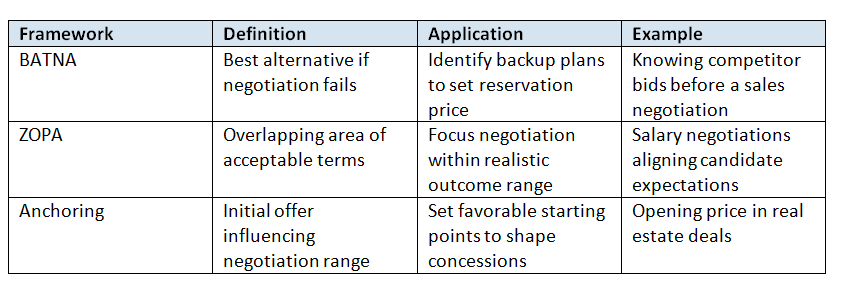
Real-world Example: In a cross-border merger negotiation, executives developed a clear BATNA by lining up potential alternative partners. This knowledge gave them leverage to reject lowball offers. They also mapped the ZOPA by analyzing cultural and regulatory constraints, ensuring proposals remained viable.
Applying Strategic Thinking in Real-World Negotiations
Strategic thinking translates into concrete actions before, during, and after negotiations. Preparation is paramount: gather intelligence on the counterpart’s needs, constraints, and decision-making style. This may involve stakeholder mapping or analyzing publicly available information.
During negotiation, employ tactical patience—resisting premature concessions and letting the counterpart reveal their priorities first. Use calibrated questions to probe interests, such as “What challenges are you trying to solve with this agreement?” This aligns with the Harvard Negotiation Project’s emphasis on focusing on interests over positions.
Strategic negotiators also manage the negotiation environment by controlling timing, setting agendas, and shaping meeting dynamics. For example, scheduling negotiations when the counterpart is less pressured can enhance cooperation.
Post-negotiation, strategic thinking includes reflection and relationship management. Document lessons learned and maintain connections to facilitate future deals.
Real-world Example: A government procurement officer used strategic thinking by scheduling contract negotiations after budget approval cycles, ensuring counterparts had the authority and flexibility to agree. He also prepared multiple proposal versions, adapting based on counterpart feedback to maximize value.
· Key strategic negotiation tactics:
· Conduct comprehensive counterpart research
· Use calibrated questions to uncover interests
· Control negotiation timing and agenda
· Practice tactical patience to avoid rushed decisions
· Follow up with relationship-building activities
Practical Script Sample for Calibrated Questioning
Negotiator: “Can you help me understand what priorities you have for this project’s timeline?”
Counterpart: “We need delivery within six weeks due to market demands.”
Negotiator: “Given that, what flexibility exists around other contract terms, such as payment schedules?”
This script illustrates how open-ended, calibrated questions guide counterpart disclosure and identify negotiation levers.
Practical Exercises to Build Strategic Negotiation Skills
Skill-building through deliberate practice is critical to embedding strategic thinking in negotiation habits.
Exercise 1: BATNA Development Drill
Identify an upcoming negotiation. Write down your BATNA and assess the counterpart’s BATNA through research. Practice articulating your BATNA confidently during role-plays.
Exercise 2: Anchoring Role-Play
Partner with a colleague to practice opening offers. Experiment with different anchor points and observe counterpart reactions. Reflect on how initial offers influenced outcomes.
Exercise 3: Emotional Intelligence Reflection
After each negotiation, journal your emotional triggers and responses. Use mindfulness techniques to increase awareness and control of emotions in future negotiations.
Exercise 4: Scenario Planning Workshop
Select a complex negotiation scenario. Map out best-case, worst-case, and likely outcomes. Develop contingency plans for each and rehearse adapting your approach.
Exercise 5: Active Listening Practice
In daily conversations, focus on summarizing and mirroring techniques. Record yourself to evaluate tone and body language alignment.
These exercises combine cognitive preparation and interpersonal skills development, reinforcing strategic approaches.
Overcoming Cognitive Biases and Emotional Traps
Even the most skilled negotiators fall prey to cognitive biases and emotional pitfalls that undermine strategic thinking.
Common biases include:
· Confirmation Bias: Seeking information that supports preconceptions while ignoring contrary data.
· Overconfidence Bias: Overestimating one’s position strength, leading to unrealistic demands.
· Anchoring Bias: Focusing too heavily on initial offers without sufficient adjustment.
· Loss Aversion: Fear of loss causing overly conservative decisions.
To counter these, negotiators should:
· Engage in perspective-taking to challenge assumptions.
· Use decision checklists to ensure all options are considered.
· Seek feedback from trusted colleagues or mentors.
Emotionally, negotiators can fall into traps such as anger escalation or frustration withdrawal, which impair judgment. Techniques from emotional intelligence training—such as mindfulness, breathing exercises, and cognitive reframing—help maintain composure.
Real-world Example: A corporate lawyer recognized her overconfidence during a high-stakes contract negotiation which caused her to ignore valid counteroffers. After receiving feedback, she adopted structured reflection and peer consultation practices that improved her strategic flexibility.
Frequently Asked Questions
Q1: How does strategic thinking differ from tactical negotiation?
Strategic thinking focuses on long-term goals, context analysis, and planning multiple scenarios before and during negotiation. Tactical negotiation involves immediate actions and responses to counterpart moves. Strategic thinking provides the framework within which tactical decisions are made, ensuring consistency and adaptability.
Q2: What role does BATNA play in strategic negotiation?
BATNA defines your fallback option if talks fail, anchoring your reservation price and empowering you to walk away rather than accept unfavorable terms. Knowing your BATNA enhances confidence and negotiating leverage, allowing you to negotiate from strength.
Q3: Can strategic thinking be developed, or is it an innate skill?
While some individuals may have a natural aptitude, strategic thinking is a skill that can be developed through deliberate practice, education, and reflection. Exercises such as scenario planning, role-plays, and psychological awareness training help build this capability over time.
Q4: How do I handle negotiations when the counterpart is uncooperative or aggressive?
Maintain composure and focus on interests rather than positions. Use active listening and calibrated questions to de-escalate tension and uncover underlying motivations. If necessary, set clear boundaries and be prepared to walk away based on your BATNA.
Q5: What are common mistakes to avoid when applying strategic thinking in negotiation?
Avoid tunnel vision by considering multiple perspectives and outcomes. Don’t rely solely on intuition; use data and research. Be cautious of cognitive biases like anchoring on your own initial offers, and manage emotions to prevent rash decisions.
Conclusion
Strategic thinking in negotiation is a transformative negotiation skill that elevates interactions from transactional exchanges to dynamic problem-solving opportunities. By integrating frameworks such as BATNA and ZOPA, applying psychological insights like anchoring and active listening, and practicing deliberate skill-building exercises, negotiators can achieve superior outcomes that create lasting value for all parties involved.
As negotiations become increasingly complex and high-stakes, cultivating strategic thinking will set you apart as a trusted advisor and influential leader. Begin incorporating these principles today—assess your BATNA, prepare multiple scenarios, and practice emotional intelligence—to unlock your full negotiation potential.
Take the next step: identify an upcoming negotiation to apply these strategic techniques and observe how your approach transforms results.
References
· Fisher, R., Ury, W., & Patton, B. (2011). Getting to Yes: Negotiating Agreement Without Giving In. Penguin Books.
· Shell, G. R. (2006). Bargaining for Advantage: Negotiation Strategies for Reasonable People. Penguin.
· Kahneman, D. (2011). Thinking, Fast and Slow. Farrar, Straus and Giroux.
· Lewicki, R. J., Barry, B., & Saunders, D. M. (2015). Negotiation. McGraw-Hill Education.
· Malhotra, D., & Bazerman, M. H. (2007). Negotiation Genius: How to Overcome Obstacles and Achieve Brilliant Results at the Bargaining Table and Beyond. Bantam.