Strategy for High-Stakes Negotiations: Mastering the Art of Critical Deal-Making

In 2018, IBM faced a pivotal negotiation with AT&T over a multi-billion-dollar cloud services contract that would define their competitive positioning for years to come. With billions at stake and reputations on the line, every word, every offer, and every concession could shift the outcome dramatically. High-stakes negotiations like this are not just about haggling prices—they determine market leadership, corporate survival, and sometimes entire industries’ futures.
In today’s hyper-competitive global business landscape, mastering high-stakes negotiation strategy is a strategic imperative. Whether navigating mergers and acquisitions, securing vital supplier agreements, or managing labor union contracts, the ability to strategically influence outcomes under pressure is a critical differentiator for senior leaders. The stakes are higher than ever due to rapid technological shifts, geopolitical uncertainty, and increasingly sophisticated counterparts.
This comprehensive guide will equip you with the deep theoretical foundations, proven frameworks, step-by-step processes, and expert tactics that define successful high-stakes negotiators. By the end, you will be able to confidently navigate complex negotiations—anticipating challenges, leveraging psychological insights, avoiding costly mistakes, and driving agreements that maximize value for all parties involved.
· Table of Contents
· The Strategic Foundation: Theory, Psychology & Research
· Key Frameworks and Models for High-Stakes Negotiations
· Step-by-Step Process to Navigate High-Stakes Deals
· Real-World Case Studies: Lessons from Industry Giants
· Common Pitfalls and How to Avoid Them
· Advanced Tactics for Experienced Negotiators
· Scripts and Templates: Ready-to-Use Negotiation Dialogue
· Frequently Asked Questions
· Conclusion: Synthesizing Insights & Taking Action
· References: Authoritative Sources for Further Mastery
The Strategic Foundation — Theory, Psychology, and Research
At its core, high-stakes negotiation is a complex interplay of psychology, strategy, and communication under conditions of uncertainty and power asymmetry. Understanding the foundational research behind human decision-making and influence is critical to crafting winning strategies.
One of the seminal insights comes from Daniel Kahneman and Amos Tversky’s Prospect Theory, especially the concept of loss aversion — the idea that losses loom larger than gains psychologically. Kahneman’s research (1979) shows negotiators are more motivated to avoid losses than to achieve equivalent gains. This explains why anchoring with aggressive initial offers or framing proposals as avoiding losses rather than gaining benefits can shape counterparts’ perceptions dramatically.
Fisher and Ury’s landmark book “Getting to Yes” (1981) introduced the Harvard Principled Negotiation method, emphasizing separating people from the problem, focusing on interests rather than positions, inventing options for mutual gain, and insisting on objective criteria. This approach shifts negotiation from purely distributive (win-lose) to integrative (win-win), a critical mindset for sustaining long-term relationships and creating value in high-stakes deals.
Robert Cialdini’s research on influence (2006), especially principles like reciprocity, commitment/consistency, and authority, provides powerful psychological levers negotiators can use to build trust, create obligations, and guide decision-making without coercion. Employing reciprocity by offering small early concessions can trigger a compelling urge in the counterpart to reciprocate, moving the deal forward.
Deepening this, G. Richard Shell’s “Bargaining for Advantage” (2006) integrates psychological insights with practical strategy, emphasizing preparation, understanding bargaining styles, and leveraging power effectively. Shell stresses that effective negotiators develop a strong BATNA (Best Alternative to a Negotiated Agreement), which anchors their confidence and informs their limits.
Finally, Max Bazerman and Deepak Malhotra’s “Negotiation Genius” (2007) explores cognitive biases, emotional intelligence, and strategic moves in negotiation, providing research-backed tactics such as MESO (Multiple Equivalent Simultaneous Offers) to create value and manage impasses. Their work underscores that mastering negotiation is not just art but also science—combining empirical research with human psychology.
· Key Psychological & Strategic Principles in High-Stakes Negotiation
· Loss Aversion (Kahneman & Tversky): Fear of loss outweighs desire for gain
· Principled Negotiation (Fisher & Ury): Separate people from problem, focus on interests
· Influence Principles (Cialdini): Reciprocity, commitment, authority
· Preparation & BATNA (Shell): Knowing alternatives builds power and clarity
· Cognitive Bias Awareness (Malhotra & Bazerman): Avoid pitfalls, use MESO
Key Frameworks and Models
To structure a high-stakes negotiation effectively, experienced negotiators rely on proven frameworks that guide strategy and decision-making. Among the most respected are:
1. Harvard Principled Negotiation
2. BATNA & ZOPA Framework
3. MESO (Multiple Equivalent Simultaneous Offers)
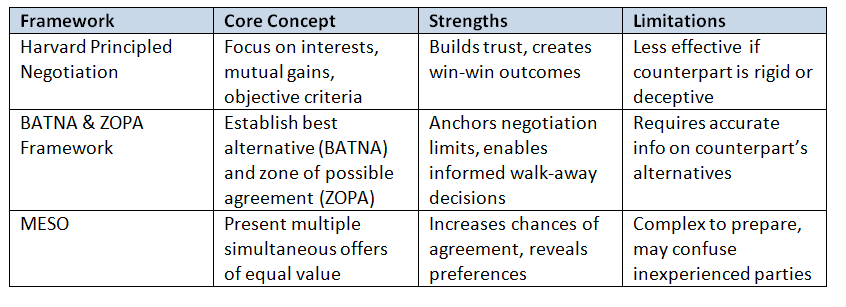
Harvard Principled Negotiation fosters collaborative problem-solving by focusing on interests underlying positions. For example, in labor union negotiations at General Motors, negotiators focused on job security and wage fairness rather than fixed salary demands, leading to integrative solutions.
The BATNA and ZOPA framework serves as the backbone for assessing negotiation viability. In the 2017 Amazon procurement deal with key suppliers, understanding their BATNA helped Amazon calibrate offers just above the suppliers’ alternatives, ensuring agreement while maintaining cost controls.
MESO, advocated by Malhotra & Bazerman, is a sophisticated technique often deployed in enterprise software sales such as IBM’s multi-million-dollar contracts. By offering multiple packages simultaneously, IBM elicited client preferences while maintaining leverage.
Step-by-Step Process
High-stakes negotiations require a rigorous, methodical approach. Below is a detailed six-step process:
Step 1: Preparation and Research
Begin with exhaustive intel gathering. Map stakeholders, understand interests, BATNA, and ZOPA. Research counterpart’s history, culture, and negotiation style. Use tools like stakeholder matrices and decision trees to clarify outcomes.
Step 2: Setting Clear Objectives and Strategy
Define your minimum acceptable terms and aspirational goals. Develop a flexible strategy incorporating both distributive and integrative tactics. Plan your opening offers using anchoring principles.
Step 3: Opening and Building Rapport
Initiate with a tone of respect and collaboration to reduce tension. Establish common ground and trust leveraging Cialdini’s reciprocity and authority principles. Use small concessions to build momentum.
Step 4: Information Exchange and Interest Exploration
Ask open-ended questions to uncover underlying interests and constraints. Listen actively and validate counterpart concerns. Share select information strategically to foster transparency and find mutual gains.
Step 5: Bargaining and Making Concessions
Employ MESO or calibrated anchoring. Make concessions incrementally and reciprocate to signal fairness. Use objective criteria to justify positions. Monitor emotional dynamics to avoid escalation.
Step 6: Closure and Agreement Implementation
Summarize agreed terms clearly. Draft detailed contracts with explicit contingencies. Confirm understanding and commitment to implementation. Plan follow-up to manage relationship and future negotiations.
Real-World Case Studies
IBM and AT&T Cloud Services Negotiation (2018)
IBM negotiated a multi-year cloud infrastructure contract with AT&T worth over $2 billion. By applying BATNA analysis, IBM realized AT&T’s limited alternatives due to legacy systems, enabling IBM to anchor aggressively yet offering MESO packages tailored to different service tiers. The deal combined integrative solutions and strict SLAs. Lesson: Deep preparation and MESO create flexible, value-maximizing agreements.
Apple vs. Samsung Patent Dispute Settlement (2014)
After years of litigation, Apple and Samsung negotiated settlements involving licensing deals. Fisher & Ury’s principled negotiation was evident as both sides shifted from positional bargaining to focusing on mutual interests—market innovation and IP protection. The settlement avoided prolonged costly litigation. Lesson: Shifting from distributive to principled negotiation preserves long-term business relationships.
Amazon’s Strategic Supplier Contracts (2017)
Amazon’s procurement team used BATNA and ZOPA analysis to negotiate cost-effective supply agreements with global manufacturers. By researching supplier alternatives and using calibrated concessions, Amazon secured favorable terms without damaging supplier partnerships. Lesson: Power derived from BATNA knowledge enables balanced agreements.
Common Pitfalls and How to Avoid Them
Negotiators often fall prey to cognitive biases and strategic errors, which can derail high-stakes deals.
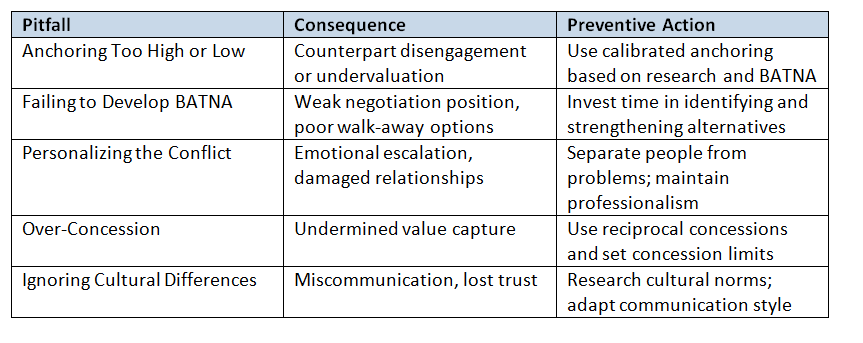
For example, in the 2013 M&A talks between HP and Autonomy, HP’s failure to rigorously assess BATNA and overreliance on optimistic assumptions led to a disastrous acquisition and write-down. Conversely, Amazon’s careful BATNA preparation avoided such pitfalls.
Advanced Tactics
Experienced negotiators leverage nuanced tactics beyond basic frameworks:
· Anchoring with Loss Aversion Framing: Present offers highlighting counterpart’s potential losses vs. gains to motivate concessions.
· MESO with Conditional Concessions: Use simultaneous offers with built-in trade-offs to reveal priorities and drive towards integrative agreements.
· Strategic Silence and Pausing: Use calibrated silence after offers to increase counterpart discomfort and elicit additional concessions.
· Using Third-Party Benchmarks: Introduce objective market data or expert opinions to legitimize offers and reduce disputes.
· Emotional Intelligence Calibration: Monitor counterpart’s emotional state and adapt tactics to defuse tension or build rapport.
· Pre-Commitment and Deadlines: Introduce credible time constraints to create urgency without appearing coercive.
These tactics were instrumental in IBM’s complex negotiations with global clients and in WTO trade talks where multilateral interests require deft balancing of power and collaboration.
Scripts and Templates
Below is a ready-to-use negotiation script template for the opening phase, adaptable across industries:
“Thank you for meeting today. We appreciate the opportunity to explore how our organizations can create value together. Before we dive into specifics, I want to emphasize that our goal is to find a solution that meets both our interests effectively. To start, could you share your key priorities for this negotiation?”
“That’s helpful to understand. From our side, our primary objectives are [list key interests]. We believe there are multiple ways to structure an agreement that can satisfy these goals. We’d like to propose several options and hear your feedback to identify what aligns best with your needs.”
This script uses rapport building, interest exploration, and sets a collaborative tone.
Frequently Asked Questions
Q1: How do I identify my BATNA in a complex negotiation?
A1: Begin by listing all alternatives if the current negotiation fails, such as other suppliers, contracts, or internal solutions. Evaluate their feasibility, costs, and benefits objectively. Strengthen your best alternative by negotiating parallel options or improving internal capabilities.
Q2: What’s the best way to handle a counterpart who uses aggressive tactics?
A2: Maintain composure and do not reciprocate aggression. Use principled negotiation to refocus on interests, call out unfair tactics politely, and if necessary, take breaks. Anchoring with objective criteria can neutralize pressure tactics.
Q3: How can I negotiate effectively when cultural differences exist?
A3: Research counterpart’s communication style, decision-making norms, and negotiation etiquette. Adapt your approach to show respect for these differences. For example, some cultures value indirect communication or consensus-building.
Q4: When should I walk away from a high-stakes negotiation?
A4: If the terms fall outside your BATNA or threaten your core interests, walking away preserves value. Also consider reputational risks and long-term relationships. Be prepared to communicate your decision professionally and leave the door open for future talks.
Q5: How do MESO offers work in practice?
A5: You prepare multiple offers of equivalent value but with different trade-offs (e.g., price vs. delivery time). Present them simultaneously to the counterpart, who then reveals preferences based on which they find most attractive, enabling value creation and customized agreements.
Conclusion
Mastering high-stakes negotiation strategy is essential for senior leaders who face complex, high-impact decisions. This guide has provided you with a rich theoretical foundation rooted in psychological research and influential frameworks, a systematic process to prepare and execute negotiations, lessons from leading companies, and advanced tactics to elevate your approach. The ability to navigate these challenging conversations with confidence and strategic insight directly influences organizational success and competitive advantage.
Now is the time to apply these insights to your next critical negotiation. Begin by rigorously preparing, crafting multiple offers that create mutual value, and leveraging psychological principles to influence outcomes. Remember, negotiation is not a zero-sum game but an opportunity to forge durable agreements that propel your organization forward. Commit today to mastering the art and science of high-stakes negotiation and transform your deal-making capabilities.
References
· Kahneman, D., & Tversky, A. (1979). Prospect Theory: An Analysis of Decision under Risk. Econometrica.
· Fisher, R., & Ury, W. (1981). Getting to Yes: Negotiating Agreement Without Giving In. Penguin Books.
· Cialdini, R. B. (2006). Influence: The Psychology of Persuasion. Harper Business.
· Shell, G. R. (2006). Bargaining for Advantage: Negotiation Strategies for Reasonable People. Penguin.
· Malhotra, D., & Bazerman, M. H. (2007). Negotiation Genius: How to Overcome Obstacles and Achieve Brilliant Results at the Bargaining Table and Beyond. Bantam.
· Mnookin, R. H. (2000). Bargaining with the Devil: When to Negotiate, When to Fight. Simon & Schuster.