Strategy for Price Negotiation: Win on Value, Not Just Numbers

In 2019, IBM faced a critical negotiation with a major enterprise client over a multi-year cloud services contract worth hundreds of millions. The buyer aggressively pushed for steep discounts, betting on volume to drive value. Instead of slugging it out on price alone, IBM’s negotiators shifted the conversation toward the unique integration capabilities and long-term scalability of their platform. This pivot elevated the perceived value, enabling IBM to secure a premium contract without conceding on price. This story exemplifies a fundamental truth in price negotiation: winning isn’t about conceding numbers but about mastering value.
In today’s hyper-competitive global marketplace, price pressure comes from every angle—be it savvy procurement teams armed with data analytics, disruptive startups undercutting traditional pricing, or customers demanding more for less. Simply matching or lowering prices is a race to the bottom that erodes margins and brand equity. Savvy negotiators understand that strategically anchoring on value—tied to quality, innovation, and outcomes—creates sustainable advantage. This approach requires deep psychological insight, refined frameworks, and disciplined process mastery to translate into superior results.
By the end of this comprehensive guide, you will master the strategic foundations of value-based price negotiation, understand and apply key negotiation frameworks, execute a rigorous six-step process, learn from landmark real-world cases, avoid common costly pitfalls, and deploy advanced tactics and ready-to-use scripts. Whether you lead sales, procurement, or corporate strategy, this pillar article equips you to transform price negotiations from zero-sum haggling into value-creating partnerships.
· Table of Contents
· The Strategic Foundation: Psychology and Research behind Value Negotiation
· Key Frameworks and Models: Comparing BATNA, ZOPA, and MESO
· Step-by-Step Process: Six Steps to Win on Value
· Real-World Case Studies: IBM, Amazon, and Apple
· Common Pitfalls and How to Avoid Them
· Advanced Tactics: Expert-Level Techniques for Value Negotiation
· Scripts and Templates: Exact Dialogue and Written Tools
· Frequently Asked Questions
· Conclusion: Synthesizing Insights and Next Steps
· References
The Strategic Foundation — Psychology and Research Behind Value Negotiation
Negotiation is as much a psychological endeavor as it is a transactional one. Understanding the cognitive biases, behavioral drivers, and principled approaches that undergird negotiation enables negotiators to strategize beyond mere price numbers.
One foundational concept is Kahneman and Tversky’s Prospect Theory (1979), which reveals the power of loss aversion. Humans experience losses more intensely than equivalent gains. In price negotiation, this means framing concessions as avoiding losses rather than giving up value yields better outcomes. For example, highlighting the cost of not adopting a solution focuses counterparties on what they risk losing rather than just the price tag.
Fisher and Ury’s seminal work, Getting to Yes (1981), introduced Principled Negotiation, which emphasizes separating people from the problem, focusing on interests rather than positions, generating options for mutual gain, and insisting on objective criteria. This approach shifts negotiation from distributive “win-lose” bargaining to integrative “win-win” value creation.
Cialdini’s Influence (2006) adds the science of persuasion, introducing principles like reciprocity, commitment, and social proof that can be tactically applied to build trust and move counterparts toward value recognition.
Shell’s Bargaining for Advantage (2006) blends psychological insight with practical negotiation strategy, introducing concepts such as understanding one’s Best Alternative to a Negotiated Agreement (BATNA) and Zone of Possible Agreement (ZOPA), which define the negotiation boundaries and leverage points.
Malhotra and Bazerman’s Negotiation Genius (2007) deepens this with behavioral economics and game theory, offering strategies to overcome biases, use framing effectively, and create value in seemingly zero-sum environments.
Together, these foundational theories and research highlight why focusing solely on price is short-sighted. By anchoring negotiation on value, addressing underlying interests, and managing psychological dynamics, negotiators unlock superior outcomes.
Key Frameworks and Models — Comparing BATNA, ZOPA, and MESO
To operationalize value-based price negotiation, practitioners rely on structured frameworks that clarify leverage, boundaries, and offer creation.
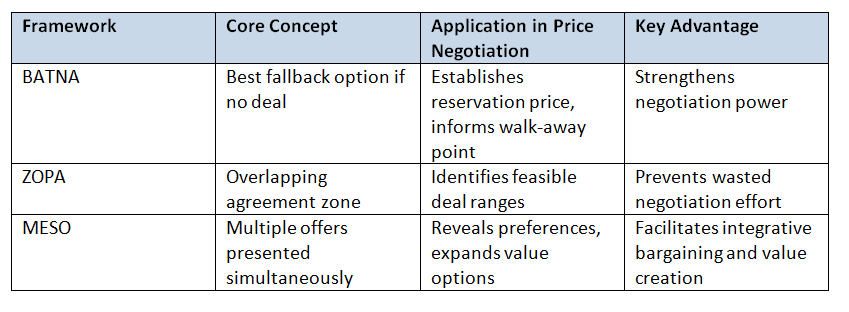
Understanding and combining these frameworks enable negotiators to craft strategies that balance firmness with flexibility, leverage alternatives, and discover non-price value trade-offs.
Step-by-Step Process — Six Steps to Win on Value
Negotiating price on value requires a disciplined, systematic approach. Below is a detailed six-step process to execute value-driven price negotiations.
Step 1: Preparation and Intelligence Gathering
Start by mapping out your BATNA and estimating the counterpart’s BATNA. Collect data on market benchmarks, competitive offerings, and the counterpart’s business drivers. Identify the key value elements beyond price—such as quality, service, risk reduction, or innovation. Prepare objective criteria and metrics to support your value claims.
Step 2: Establish Rapport and Build Trust
Opening with relationship-building sets a collaborative tone. Use Cialdini’s reciprocity and liking principles by finding common ground, demonstrating empathy, and sharing small concessions that build goodwill. Trust reduces defensive postures and opens channels for value discussion.
Step 3: Explore Interests, Not Positions
Ask open-ended questions to uncover the underlying interests behind stated price demands. For example, a buyer pressing for a discount may really need budget certainty or faster delivery. Understanding interests allows tailoring solutions that address root concerns without just cutting price.
Step 4: Present Multiple Equivalent Offers (MESO)
Offer several packages that balance price with other variables like payment terms, service levels, or delivery schedules. For example, Amazon’s procurement teams often present MESO offers to suppliers—mixing unit price with volume commitments or exclusivity—to reveal supplier priorities and negotiate on dimensions beyond price alone.
Step 5: Anchor on Objective Criteria and Value Metrics
Use independent benchmarks, total cost of ownership analyses, or ROI calculators to justify price relative to benefits. Anchoring on data reduces subjective bias and reframes the discussion from “cheapness” to “value for money.” For instance, Apple’s negotiations with suppliers often incorporate strict quality and innovation standards as objective criteria underpinning premium pricing.
Step 6: Close with Clear Agreements and Contingencies
Confirm agreed terms in writing, highlighting the value exchanges. Where uncertainty exists, include contingencies or phased reviews to mitigate risks without discounting price prematurely. Reinforce mutual gains to sustain long-term relationships.
Real-World Case Studies — IBM, Amazon, and Apple
Context: IBM negotiated a multi-year cloud infrastructure contract with a Fortune 500 client. The buyer sought heavy discounts based on volume.
What Happened: IBM’s team leveraged value-based negotiation by highlighting the platform’s integration capabilities and scalability, shifting focus from price to business outcomes. They used MESO by proposing options combining price, service levels, and customization support.
Lesson: Value differentiation and flexible offer design enable premium pricing even under aggressive discount demands.
Context: Amazon’s procurement teams negotiate with thousands of suppliers globally, aiming for cost efficiency without compromising quality.
What Happened: Amazon extensively uses BATNA analysis to benchmark alternatives and MESO offers presenting different trade-offs on price, delivery speed, and exclusivity. They anchor negotiations on objective data such as supplier performance metrics.
Lesson: Combining BATNA, MESO, and objective anchoring fosters negotiations that optimize total value, not just lowest cost.
Context: Apple and Samsung engaged in complex negotiations over patent licensing fees and component pricing amid fierce competition.
What Happened: Apple insisted on high licensing fees justified by its innovation leadership and brand premium, using objective criteria like patent valuations and market share. Samsung countered with volume discounts and bundled component pricing.
Lesson: Anchoring price on intellectual property value and objective metrics enables capturing premium pricing in technology negotiations.
Common Pitfalls and How to Avoid Them
Negotiators frequently stumble into traps that undermine value creation. Below is a table summarizing key pitfalls, consequences, and actionable fixes.
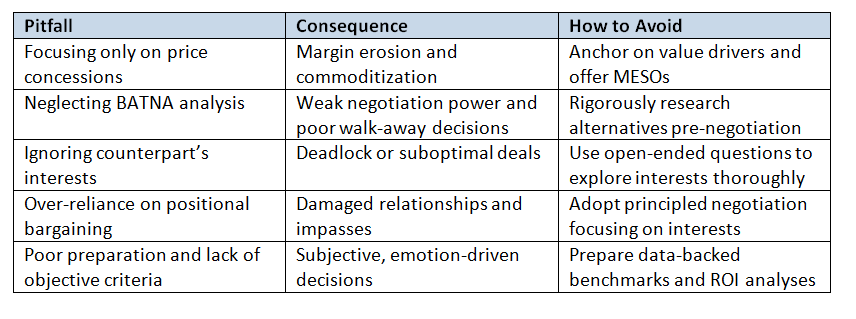
Avoiding these pitfalls requires discipline, preparation, and a mindset shift from distributive to integrative negotiation.
Advanced Tactics — Expert-Level Techniques for Value Negotiation
Experienced negotiators can deploy sophisticated methods to further leverage value in price talks.
Reframe concessions as preventing losses rather than granting gains to exploit psychological bias. For example, “By choosing this premium package, you avoid downtime costs estimated at $X.”
Set initial offers high but credible to anchor negotiations favorably. Calibrate anchors using objective data and market intelligence to maintain legitimacy.
Structure agreements with performance-based clauses that link payment to outcomes, aligning incentives and justifying premium pricing.
Offer small but meaningful concessions early to trigger reciprocal concessions on price or terms, building momentum.
Use deadlines strategically to create urgency but avoid rushed concessions. Manage pacing to maximize counterpart’s willingness to concede on value.
Quantitatively analyze trade-offs across multiple negotiation dimensions to optimize total value rather than focusing narrowly on price.
Scripts and Templates — Exact Dialogue and Written Tools
Below are ready-to-use scripts and templates to implement value-based negotiation in real conversations.
“Thank you for considering our proposal. Beyond the headline price, we focus on delivering measurable business outcomes such as [list benefits], which together generate a total value that far exceeds initial costs. Let’s explore how we can align this value with your strategic goals.”
“We have prepared three tailored packages for your consideration:
Package A: Lower price with standard delivery and support
Package B: Mid-level price with enhanced support and faster delivery
Package C: Premium price with full customization and dedicated account management
We’d appreciate your feedback on which aspects matter most so we can collaborate on the best fit.”
“What alternatives are you considering if we cannot reach an agreement? How do those compare in terms of value and risk? Understanding these helps us find a mutually beneficial solution.”
Subject: Confirmation of Agreement and Next Steps
Dear [Name],
Following our productive discussions, I’m pleased to confirm our agreement on the following terms: [Summarize key points].
We believe this partnership delivers significant value to both parties and look forward to a successful collaboration. Please review and let me know if you have any questions.
Best regards,
Frequently Asked Questions
Q1: How do I determine the real value drivers in a price negotiation?
A: Conduct thorough research on the counterpart’s business priorities, industry benchmarks, and the specific benefits your offering delivers. Use open-ended questions during negotiation to validate and refine these drivers.
Q2: What if the counterpart insists only on price reductions?
A: Shift the conversation by illustrating total cost of ownership, risk mitigation, and quality differentiators. Propose MESO offers that trade off other terms for price flexibility.
Q3: How can I strengthen my BATNA before negotiation?
A: Identify alternative suppliers, potential internal solutions, or different timing options. Invest time in market intelligence and prepare credible alternatives to walk away if terms are unfavorable.
Q4: When is it appropriate to use contingent contracts?
A: Use contingent contracts where future uncertainties exist, such as new product launches or performance-based services, to align incentives and protect both parties.
Q5: How do I recover if I’ve already conceded too much on price?
A: Re-anchor by emphasizing additional value or introducing new dimensions such as service enhancements. Seek reciprocal concessions and clarify the long-term partnership benefits.
Conclusion
Mastering price negotiation by winning on value rather than mere numbers is a strategic imperative in today’s complex business environment. By integrating psychological insights, rigorous frameworks like BATNA, ZOPA, and MESO, and a disciplined six-step process, negotiators can shift conversations from zero-sum price battles to collaborative value creation. Real-world examples from IBM, Amazon, and Apple illustrate how this approach secures premium pricing without sacrificing relationships.
To elevate your negotiation outcomes, avoid common pitfalls such as focusing solely on price or neglecting interests, and deploy advanced tactics like strategic anchoring and contingent contracts. Use the provided scripts and templates as practical tools to embed value-based negotiation in your daily practice. Start today by preparing your BATNA and reframing your next negotiation around the unique value you bring—turning price talks into powerful strategic wins.
References
Fisher, R., & Ury, W. (1981). Getting to Yes: Negotiating Agreement Without Giving In. Penguin Books.
Kahneman, D., & Tversky, A. (1979). Prospect Theory: An Analysis of Decision under Risk. Econometrica.
Cialdini, R. B. (2006). Influence: The Psychology of Persuasion. Harper Business.
Shell, G. R. (2006). Bargaining for Advantage: Negotiation Strategies for Reasonable People. Penguin.
Malhotra, D., & Bazerman, M. H. (2007). Negotiation Genius: How to Overcome Obstacles and Achieve Brilliant Results at the Bargaining Table and Beyond. Bantam.
Bazerman, M. H., & Neale, M. A. (1992). Negotiating Rationally. Free Press.