Supplier Evaluation and Negotiation: How to Select and Negotiate with the Right Partners

In today’s hyper-competitive business environment, the ability to select and negotiate with the right suppliers can make or break an organization’s operational success and profitability. Imagine the procurement team at Toyota facing a global semiconductor shortage. The stakes are enormous: a failure to secure reliable suppliers risks factory shutdowns, delayed vehicle deliveries, and lost market share. On the other side, suppliers know their leverage and push for premium pricing amid scarce availability — forcing buyers to deploy advanced evaluation and negotiation strategies to strike the best deals.
Supplier evaluation and negotiation are not just transactional processes; they are strategic imperatives that require blending rigorous frameworks like the Kraljic Matrix, Total Cost of Ownership (TCO) analysis, and should-cost modeling with nuanced psychological and behavioral insights. This article unveils how procurement professionals can build a systematic, repeatable approach to supplier selection, segmentation, and negotiation that delivers measurable value and sustainable partnerships.
By the end of this comprehensive guide, you will master the strategic foundations underpinning supplier management, understand critical frameworks used by world-class companies such as Apple, Boeing, and Amazon, learn a detailed step-by-step supplier evaluation and negotiation process, gain insights from real-world case studies, and acquire actionable scripts and expert tactics to elevate your procurement function to a strategic powerhouse.
· Table of Contents
· The Strategic Foundation: Procurement frameworks and psychology
· Key Frameworks and Models: Kraljic Matrix, TCO, and Supplier Segmentation
· Step-by-Step Process: From preparation to contract finalization
· Real-World Case Studies: Toyota, Apple, NHS procurement
· Tactics and Counter-Tactics: Negotiation scripts and responses
· Advanced Strategies: Value engineering and BATNA optimization
· Scripts and Templates: Word-for-word negotiation dialogues
· Frequently Asked Questions: Procurement challenges answered
· Conclusion: Summary and call to action
· References: Authoritative sources for further reading
The Strategic Foundation
Supplier evaluation and negotiation rest on a robust strategic foundation combining supply chain management theories, procurement psychology, and competitive market analysis. At its core lies the recognition that suppliers are not mere vendors but strategic partners whose performance influences cost, quality, innovation, and risk exposure.
The Kraljic Portfolio Purchasing Model, introduced by Peter Kraljic in 1983, revolutionized procurement thinking by categorizing purchases based on supply risk and profit impact. This model compels procurement professionals to tailor their supplier strategies accordingly — from forming close partnerships for strategic items to rigorous cost control for leverage items.
Total Cost of Ownership (TCO) frameworks extend beyond price to encompass all direct and indirect costs over the supplier relationship lifecycle — including logistics, quality, compliance, and risk mitigation. Should-cost modeling builds on this by estimating what a product or service should cost based on inputs and market conditions, arming buyers with data-driven negotiation leverage.
Psychology also plays a vital role. Research by Dr. Leigh Thompson at Northwestern University highlights how cognitive biases and emotional intelligence influence negotiation outcomes. Understanding counterpart motivations, anchoring effects, and BATNA (Best Alternative to a Negotiated Agreement) dynamics empowers procurement leaders to craft win-win agreements.
Porter’s Five Forces analysis, applied in supplier evaluation, facilitates understanding of supplier power, buyer power, threat of substitutes, and competitive rivalry — essential for anticipating negotiation leverage and risks.
Together, these strategic frameworks enable procurement managers to transform supplier evaluation and negotiation from ad hoc activities into a disciplined, high-impact business capability.
Key Frameworks and Models
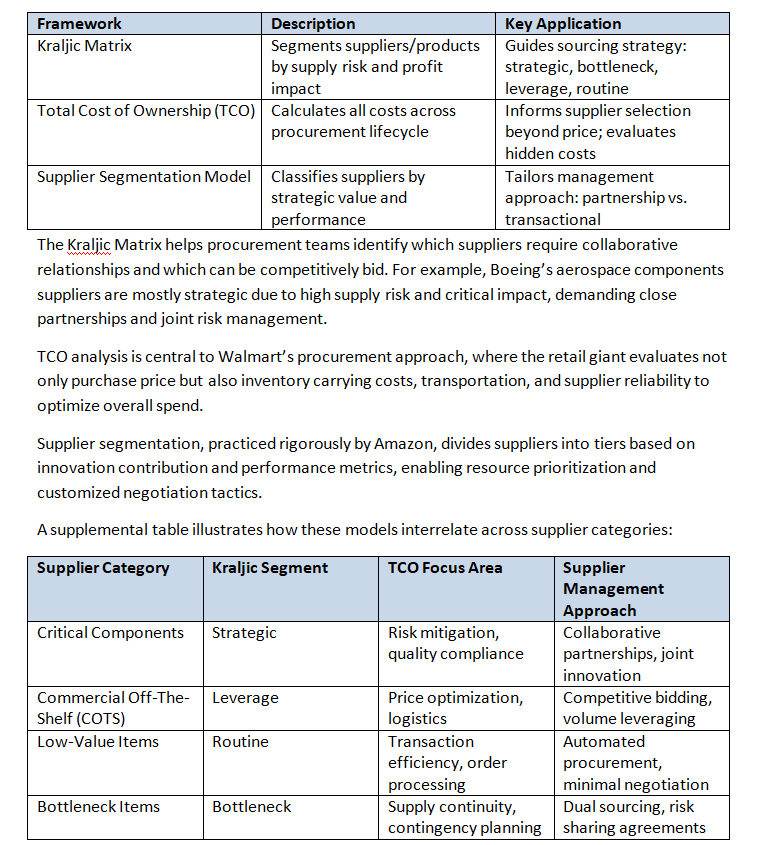
To systematically select and negotiate with the right suppliers, mastering key frameworks is essential. Below are three foundational models widely adopted by leading organizations.
Step-by-Step Process
Effective supplier evaluation and negotiation require a disciplined process with clear, actionable steps. Below is a detailed walkthrough.
Step 1: Define Requirements and Objectives
Begin by articulating detailed specifications, quality standards, delivery schedules, and cost targets. Align these with strategic business objectives and forecasted demand. Incorporate stakeholder inputs from engineering, operations, and finance to ensure comprehensive criteria.
Specific tactic: Use cross-functional workshops to build consensus on priorities.
Step 2: Conduct Market and Supplier Research
Leverage Porter’s Five Forces to analyze market conditions and supplier bargaining power. Identify potential suppliers through databases, trade shows, and industry networks. Gather intelligence on supplier capacities, financial health, innovation capabilities, and reputations.
Tactic: Use should-cost models to benchmark supplier pricing against input costs and market conditions.
Step 3: Segment Suppliers Using Kraljic and Performance Metrics
Classify suppliers into Kraljic categories and segment by past performance, risk exposure, and strategic value. This informs negotiation approach and resource allocation.
Tactic: Use data analytics tools for supplier scorecards capturing on-time delivery, quality defect rates, and responsiveness.
Step 4: Develop Negotiation Strategy and BATNA
Define negotiation objectives including target price, payment terms, and service levels. Establish your BATNA and ZOPA (Zone of Possible Agreement). Anticipate supplier tactics and prepare counter-tactics.
Tactic: Prepare value engineering proposals highlighting redesign opportunities to reduce cost.
Step 5: Engage in Structured Negotiation Sessions
Initiate discussions with clear agendas and collaborative tone. Use objective data and TCO insights to support your position. Leverage anchoring by proposing your ideal terms first while remaining open to concessions.
Tactic: Use calibrated questions to uncover supplier constraints and motivations. For example, “What challenges do you foresee in meeting this delivery schedule?”
Step 6: Finalize Contract and Implement Supplier Management
Once terms are agreed, document detailed contracts including KPIs, penalties, and review mechanisms. Establish regular performance reviews and continuous improvement initiatives.
Tactic: Embed clauses for innovation incentives and flexibility to adapt to market changes.
Real-World Case Studies
Examining real organizations illustrates how these frameworks and processes deliver impact.
Case 1: Toyota’s Supplier Risk Management Amid Semiconductor Shortage
Toyota diversified its semiconductor suppliers early, categorizing critical suppliers as strategic in the Kraljic Matrix. Applying TCO, Toyota invested in joint inventory buffers and supplier capability development. Negotiation focused on long-term agreements with flexibility clauses, balancing cost and supply continuity. The result was minimized production disruption compared to competitors.
Lesson: Strategic segmentation and collaborative negotiation mitigate high supply risk.
Case 2: Apple’s Supplier Innovation Partnerships
Apple segments suppliers based on innovation contribution and performance. Using supplier segmentation and value engineering, Apple co-develops components, sharing proprietary designs and cost models. Negotiations hinge on joint value creation rather than price alone, fostering loyalty and technological advantage.
Lesson: Supplier evaluation extends beyond cost to innovation potential, requiring partnership mindsets.
Case 3: NHS Procurement Cost Reduction Initiative
The NHS applied rigorous TCO analysis and supplier segmentation to its medical supplies procurement. By renegotiating contracts with bundled services and performance-based KPIs, NHS reduced overall spend by 15% while improving service levels.
Lesson: Data-driven evaluation combined with strategic negotiation delivers cost savings without quality compromise.
Tactics and Counter-Tactics
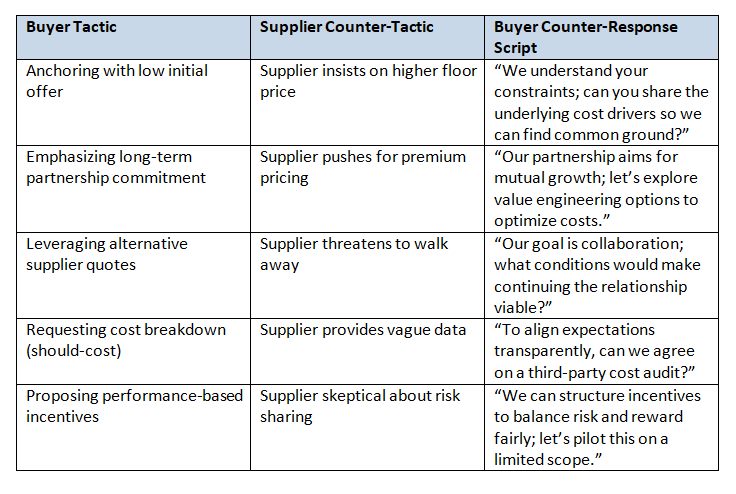
Negotiation is a dynamic interplay. Below is a table summarizing common buyer tactics, supplier counter-tactics, and effective buyer responses.
Advanced Strategies
Top procurement professionals employ advanced techniques to deepen supplier collaboration and negotiation outcomes.
Value Engineering: Collaborate with suppliers to redesign products/processes reducing cost without sacrificing quality. Toyota’s Kaizen approach exemplifies continuous cost reduction through supplier partnership.
Supplier Risk Pooling: Aggregate demand across business units or regions to improve supplier capacity utilization and negotiate volume discounts, used extensively by multinational firms like Unilever.
BATNA Optimization: Develop alternative sourcing and internal capabilities to strengthen negotiation leverage. For example, Boeing’s dual-sourcing strategy for critical components enhances BATNA.
Behavioral Economics in Negotiation: Utilize framing and anchoring effects, reciprocity, and trust building. Amazon’s negotiation teams receive training in emotional intelligence and cognitive bias awareness.
Digital Procurement Platforms: Employ AI-driven analytics for supplier risk assessment, spend analysis, and dynamic negotiation support, as implemented by NHS procurement modernization.
Scripts and Templates
Below are practical, word-for-word scripts to deploy at key negotiation stages.
Script 1: Opening Negotiation
“Thank you for meeting today. Our objective is to establish a partnership that delivers mutual value. Based on our analysis, we believe there is room to optimize pricing and service levels. Could you walk us through your cost structure to identify opportunities?”
Script 2: Handling Price Pushback
“We appreciate the quality you bring. To move forward, we need to ensure our costs align with market benchmarks. Would you be open to exploring design changes or volume commitments to reduce costs?”
Script 3: Responding to Supplier Ultimatum
“We value our relationship and want to find a solution that works for both parties. Could you share what your key concerns are? Perhaps we can adjust terms or timelines to accommodate.”
Script 4: Closing Agreement
“Based on our discussions, we’ve agreed on [summarize terms]. We will document these in a formal contract with clear KPIs and review schedules. Let’s establish a joint team to oversee implementation and continuous improvement.”
Script 5: Post-Negotiation Follow-up
“Thank you for the productive negotiation. As we move forward, regular communication will be critical. We propose monthly performance reviews to ensure targets are met and to address any emerging issues promptly.”
Frequently Asked Questions
Q1: How do I evaluate suppliers in markets with limited transparency?
A1: Use proxy indicators such as financial reports, customer references, and certifications. Engage third-party audits and leverage should-cost models to estimate fair pricing. Industry networks and trade associations can provide additional insights.
Q2: How can I negotiate with monopolistic or bottleneck suppliers?
A2: Focus on building strategic partnerships with risk-sharing agreements, joint contingency planning, and volume commitments. Explore alternative suppliers or design changes to reduce dependency. BATNA development is critical in these scenarios.
Q3: What are the best KPIs for managing supplier performance post-selection?
A3: Common KPIs include on-time delivery, quality defect rate, responsiveness, cost adherence, and innovation contribution. Tailor KPIs based on supplier category and criticality, and include both leading and lagging indicators.
Q4: How do I handle cultural differences in global supplier negotiations?
A4: Invest in cultural competency training, understand negotiation styles, and adapt communication accordingly. Building trust and relationships often precede formal negotiations in some cultures. Patience and flexibility are key.
Q5: How can technology improve supplier evaluation and negotiation?
A5: Digital procurement platforms enable analytics-driven supplier risk assessment, automated scorecards, scenario modeling, and virtual negotiation rooms. AI tools can identify cost-saving opportunities and simulate negotiation outcomes.
Conclusion
Mastering supplier evaluation and negotiation is a cornerstone of modern procurement excellence. By leveraging strategic frameworks like the Kraljic Matrix, TCO analysis, and supplier segmentation, procurement professionals can systematically select suppliers that align with business objectives and market realities. Coupling these with disciplined negotiation processes and psychological insights unlocks value beyond price — enhancing innovation, mitigating risk, and building resilient supply chains.
We encourage procurement leaders to embed these practices in their category management and strategic sourcing initiatives, continuously refine their negotiation capabilities using the scripts and tactics shared, and foster collaborative partnerships that drive sustainable competitive advantage. Begin today by assessing your current supplier evaluation process against these frameworks and identifying one immediate improvement to implement.
Need more knowedge? Visit:
https://www.michalchmielecki.com/procurement-negotiation
References
1. Kraljic, P. (1983). Purchasing Must Become Supply Management. Harvard Business Review.
2. Ellram, L. M. (1995). Total Cost of Ownership: Elements and Implementation. International Journal of Purchasing and Materials Management.
3. Thompson, L. (2013). The Mind and Heart of the Negotiator. Pearson.
4. Porter, M. E. (1979). How Competitive Forces Shape Strategy. Harvard Business Review.
5. NHS Supply Chain (2020). Strategic Supplier Management Case Studies. NHS Procurement Journal.
6. Liker, J. K. (2004). The Toyota Way: 14 Management Principles. McGraw-Hill.