Supplier Negotiation Strategies: How to Get Better Terms and Prices

Imagine a global electronics manufacturer losing a multi-million-dollar contract to a competitor after a tense procurement negotiation broke down. The supplier had underestimated the buyer’s insistence on total cost of ownership rather than just sticker price. Meanwhile, the buyer’s procurement team had squeezed margins aggressively without understanding supplier constraints, causing a last-minute supply chain disruption. This scenario is all too common in procurement—where power dynamics, asymmetrical information, and misaligned incentives create complex negotiation landscapes that can make or break business relationships.
The stakes in supplier negotiations extend far beyond price alone. Buyers seek to optimize cost, quality, delivery, and risk, while suppliers must protect margins and foster long-term partnerships. Yet many procurement professionals and suppliers fall into traps of zero-sum thinking or transactional tactics that erode value. Understanding buyer psychology, leveraging strategic frameworks like the Kraljic Matrix, and applying should-cost models can dramatically shift negotiation outcomes. The interplay of trust, information sharing, and negotiation power must be managed with precision to unlock superior contract terms.
In this definitive guide, procurement managers, category leaders, and sales directors will master cutting-edge negotiation frameworks, step-by-step strategies, and actionable scripts. We will dissect real-world case studies from Toyota, Apple, and Walmart, reveal advanced tactics like multi-year deal structuring and value engineering, and provide counter-tactic playbooks for buyers and suppliers alike. Whether you are aiming to reduce supplier costs or protect your price integrity, this article equips you with the tools to succeed in high-stakes negotiations.
· Table of Contents
· The Strategic Landscape: How Procurement Really Works
· Key Frameworks and Models
· Step-by-Step Strategy for Buyers and Suppliers
· Real-World Case Studies
· Tactics and Counter-Tactics Matrix
· Advanced Strategies in Procurement Negotiations
· Scripts and Templates for Common Scenarios
· Frequently Asked Questions
· Conclusion and Call to Action
· References
The Strategic Landscape: How Procurement Really Works
Procurement in large organizations is a complex, multi-stage process designed to balance cost, risk, and value over the supplier lifecycle. At its core, procurement managers and category leaders must align sourcing decisions with organizational KPIs such as total cost of ownership (TCO), supplier on-time delivery, quality metrics, and innovation contribution. Unlike casual buyers, professional procurement teams operate under significant pressure to optimize spend while managing supply risks and fostering strategic supplier relationships.
One foundational tool in procurement strategy is the Kraljic Matrix (Kraljic, 1983), which segments suppliers and spend categories into four quadrants based on supply risk and profit impact: strategic, bottleneck, leverage, and non-critical items. This segmentation guides negotiation intensity and collaboration approach. For example, “strategic” suppliers warrant partnership and joint innovation efforts, whereas “leverage” suppliers are prime candidates for competitive bidding and aggressive price negotiation.
Category management further refines procurement by focusing on end-to-end category spend analysis, market intelligence, and supplier segmentation. Should-cost analysis, a critical technique, models the true cost components—materials, labor, overhead, profit—that should drive supplier pricing. This enables buyers to identify cost drivers and challenge supplier quotes effectively. Understanding the psychological biases of buyers, such as loss aversion (Kahneman, 2011), explains why some procurement teams hesitate to push hard on price despite potential savings, fearing supplier fallout.
Together, these strategic concepts underpin buyer incentives: reduce TCO, secure supply continuity, and enable innovation. Suppliers must mirror this understanding to position their offers effectively, balancing margin protection with value delivery. The negotiation table is therefore a dynamic interplay of data-driven analysis, relationship management, and tactical maneuvering.
Key Frameworks and Models
Several established frameworks help procurement and sales professionals navigate supplier negotiations by clarifying strategic priorities and defining negotiation boundaries.
1. Kraljic Matrix
2. Total Cost of Ownership (TCO) vs. Price Analysis
3. BATNA and ZOPA in Procurement Context
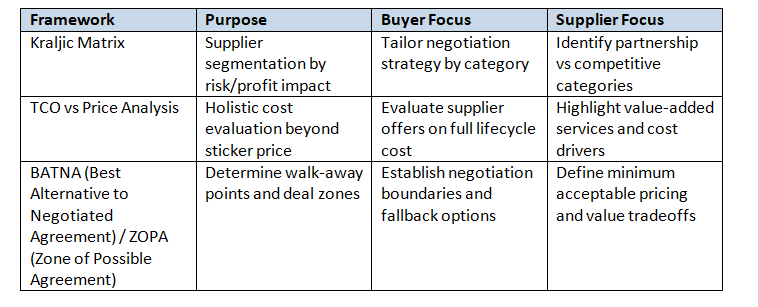
The Kraljic Matrix enables buyers to allocate negotiating resources efficiently. For example, “bottleneck” items with high supply risk but low profit impact require careful supplier relationship management to avoid disruptions. Contrastingly, “leverage” items invite aggressive price negotiation due to many alternative sources.
TCO analysis shifts the focus from upfront price to total costs including delivery, inventory holding, quality issues, and disposal. This framework prevents buyers from pursuing short-term savings that inflate costs elsewhere.
BATNA and ZOPA concepts borrowed from negotiation theory (Fisher & Ury, 1981) are essential for both sides to understand acceptable deal ranges and avoid costly walkaways or concessions. For instance, a buyer’s BATNA may be to source from an alternative supplier, setting a lower bound on acceptable pricing.
Step-by-Step Strategy
This section provides a detailed six-step negotiation strategy, unfolding buyer and supplier tactics and exact phrasing examples to apply at each stage.
Step 1: Preparation and Intelligence Gathering
Buyer: Conduct comprehensive spend analysis, segment suppliers using Kraljic, and build should-cost models. Use market intelligence to benchmark pricing and supplier financial health.
Supplier: Analyze buyer’s procurement KPIs, understand category criticality, and prepare value propositions aligned with buyer priorities.
Buyer script: “We have benchmarked current market costs and expect proposals reflecting total cost improvements.”
Supplier script: “Our cost structure is transparent; we’ve identified efficiency levers that can reduce your TCO without compromising quality.”
Step 2: Setting Objectives and BATNA
Buyer: Define clear negotiation goals (price reduction, lead time, quality), and identify BATNA alternatives.
Supplier: Determine minimum price thresholds, acceptable contract terms, and alternative customer options.
Buyer script: “Our budget requires that pricing aligns with our BATNA of alternative suppliers offering 5% less.”
Supplier script: “To maintain service levels, our pricing floor reflects sustainable margins given current raw material costs.”
Step 3: Initial Offer and Anchoring
Buyer: Open with a firm, data-backed offer below current pricing benchmarks to anchor discussion.
Supplier: Respond with a value-based counteroffer emphasizing quality and total cost savings.
Buyer script: “Based on our analysis, we propose a 10% reduction in unit price to reflect market conditions.”
Supplier script: “While price is important, our solution reduces your inventory costs and warranty claims, justifying current pricing.”
Step 4: Concession Planning and Trade-offs
Buyer: Prepare concession packages linking price trade-offs to delivery flexibility or volume commitments.
Supplier: Identify value engineering opportunities to reduce costs in exchange for contract length or payment terms.
Buyer script: “If you can improve delivery lead times by 20%, we can consider a 5% price adjustment.”
Supplier script: “Extending contract duration to three years enables us to invest in process improvements and offer you a 4% price decrease.”
Step 5: Managing Deadlocks and Psychological Dynamics
Buyer: Use calibrated questions and loss aversion framing to break impasses.
Supplier: Leverage reciprocity and anchoring to regain negotiation momentum.
Buyer script: “If we do not reach an agreement, we risk losing critical market share from production delays. How can we collaboratively avoid this?”
Supplier script: “We’re committed to partnership and can explore phased price reductions tied to volume growth.”
Step 6: Closing and Contract Finalization
Buyer: Recap agreed-upon terms clearly and confirm mutual benefits before contract drafting.
Supplier: Reinforce value delivered and propose addenda for continuous improvement clauses.
Buyer script: “To confirm, we agree on a 7% price reduction, 15% faster delivery, and quality KPIs measured quarterly.”
Supplier script: “We will provide quarterly reviews to ensure ongoing cost optimization and value creation.”
Real-World Case Studies
Toyota’s Supplier Partnership Model
Toyota revolutionized automotive procurement by embedding long-term collaboration, just-in-time delivery, and shared continuous improvement programs. Instead of squeezing prices aggressively, Toyota focuses on supplier development and joint problem solving, reducing total costs and enhancing quality over time. This approach aligns with the “strategic” quadrant of the Kraljic Matrix, where partnership and risk sharing prevail.
Apple’s Procurement Leverage and Innovation
Apple uses its immense purchasing volume and brand power to negotiate aggressive pricing and exclusivity clauses with suppliers. However, Apple balances this leverage by involving suppliers early in product development, fostering joint innovation that supports premium pricing and supply security. Apple’s category managers leverage BATNA by dual-sourcing critical components to enhance negotiation positions.
Walmart’s Supplier Squeeze Tactics
Walmart’s procurement strategy famously pressures suppliers for cost reductions through large-scale volume commitments and stringent compliance requirements. Walmart’s buyer teams employ tactical negotiation approaches such as reverse auctions and penalty clauses. However, this approach risks supplier relationship strain, highlighting the importance of balancing power with partnership.
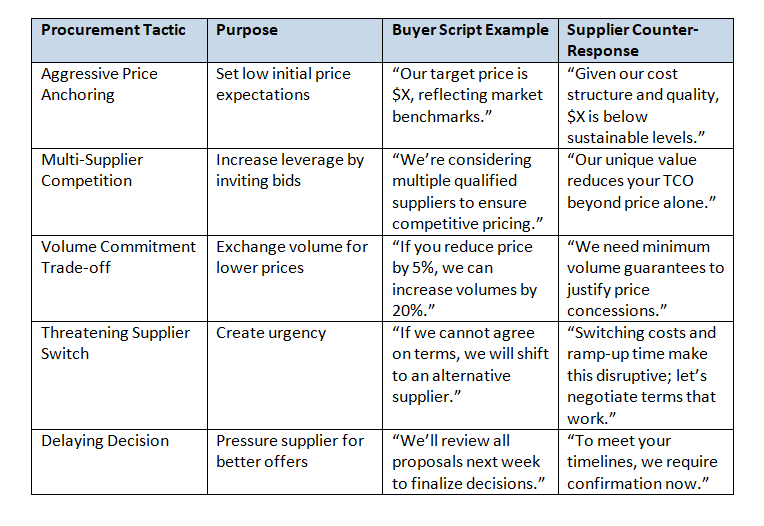
Tactics and Counter-Tactics
Advanced Strategies
Beyond foundational tactics, expert negotiators deploy advanced strategies:
Relationship Leverage: Utilize cross-functional collaboration and executive sponsorship to deepen supplier partnerships, transforming adversarial negotiation into joint value creation.
Multi-Year Deal Structuring: Negotiate long-term contracts with built-in price adjustment formulas linked to raw material indices, volume tiers, and performance KPIs to reduce risk and incentivize continuous improvement.
Value-Based Positioning: Shift conversations from price to outcomes—demonstrate total cost savings through innovation, quality improvements, and supply chain resilience to justify premium pricing or concessions.
Integrated Risk Sharing: Embed clauses for shared investments, contingency planning, and collaborative problem-solving during disruptions, balancing negotiation power with mutual dependency.
Scripts and Templates
Scenario 1: Initial RFP Response Email (Supplier to Buyer)
“Dear [Buyer Name],
Thank you for the opportunity to participate in your RFP. Based on our detailed should-cost analysis and market insights, we propose a solution that balances competitive pricing with superior quality and delivery reliability. We look forward to discussing how we can align our capabilities with your strategic goals.
Best regards,
Scenario 2: Buyer Request for Price Reduction Email
“Dear [Supplier Name],
Following our recent discussions, we request a revised pricing proposal reflecting a 7% reduction to align with market benchmarks and our total cost optimization strategy. We value our partnership and invite you to explore volume-based incentives as part of this adjustment.
Regards,
Scenario 3: Supplier Counteroffer Phone Script
“Thank you for your request, [Buyer Name]. We appreciate your focus on cost, and to accommodate this, we propose a 5% price reduction tied to a two-year contract commitment and quarterly performance reviews to ensure mutual benefits.”
Scenario 4: Buyer Negotiation Closing Script
“To confirm our agreement: a 6% price reduction, improved delivery lead times by 10%, and quality KPIs tracked monthly. We will proceed with contract drafting accordingly.”
Scenario 5: Supplier Follow-up Email Post-Contract
“Dear [Buyer Name],
Thank you for finalizing our agreement. We are committed to delivering on the agreed terms and suggest quarterly business reviews to identify further value creation opportunities.
Best,
Frequently Asked Questions
Q1: How do I calculate should-cost to prepare for supplier negotiations?
A1: Should-cost involves breaking down supplier pricing into raw materials, labor, overhead, logistics, and profit margin components. Start with industry benchmarks for raw materials, estimate manufacturing cycle times, apply standard labor rates, and factor in overhead percentages. This model enables you to identify cost drivers and challenge inflated pricing intelligently.
Q2: What is the best way to handle a supplier who refuses to lower prices?
A2: Instead of insisting solely on price cuts, explore alternative value levers such as extended payment terms, volume guarantees, joint value engineering projects, or improved service levels. Use calibrated questions to understand supplier constraints and seek win-win solutions.
Q3: How can BATNA improve my procurement negotiation outcomes?
A3: Knowing your BATNA—the best alternative if negotiations fail—gives you a clear walk-away point, strengthening your negotiation position. Similarly, estimating the supplier’s BATNA helps anticipate their flexibility. This knowledge prevents making unreasonable concessions and drives disciplined negotiation.
Q4: When should I use multi-year contracts in procurement?
A4: Multi-year contracts are beneficial when supply stability and cost predictability are strategic priorities, such as for critical components or in volatile markets. They enable better supplier investment planning and price stability, but require built-in adjustment mechanisms to mitigate risk.
Q5: How do psychological factors like loss aversion influence supplier negotiations?
A5: Buyers and suppliers may irrationally avoid losses more than pursuing gains, leading to stubborn positions or missed opportunities. Recognizing this bias allows negotiators to frame proposals emphasizing avoiding losses (e.g., supply disruption) rather than just potential gains, facilitating agreement.
Conclusion
Mastering supplier negotiation strategies requires a sophisticated blend of analytical rigor, psychological insight, and tactical agility. By leveraging frameworks like the Kraljic Matrix and should-cost analysis, understanding buyer and supplier motivations, and applying structured step-by-step approaches, procurement professionals can secure better terms and prices without sacrificing long-term relationships. Real-world exemplars from Toyota to Apple demonstrate that negotiation success hinges on balancing power with partnership, price with value, and data with diplomacy.
We encourage procurement leaders and sales professionals to integrate the frameworks, scripts, and counter-tactics shared here into their negotiation playbooks. Begin with thorough preparation, articulate clear BATNAs, and navigate dialogues with transparent communication and creativity. For those ready to elevate their procurement negotiations to the next level, download our free negotiation toolkit linked below and join our upcoming masterclass on strategic supplier relationship management.
References
- Kraljic, P. (1983). Purchasing must become supply management. Harvard Business Review.
- Kahneman, D. (2011). Thinking, Fast and Slow. Farrar, Straus and Giroux.
- Fisher, R., & Ury, W. (1981). Getting to Yes: Negotiating Agreement Without Giving In. Penguin Books.
- Porter, M. E. (1979). How Competitive Forces Shape Strategy. Harvard Business Review.
- Williamson, O. E. (1981). The Economics of Organization: The Transaction Cost Approach. American Journal of Sociology.
- Monczka, R., Handfield, R., Giunipero, L., & Patterson, J. (2015). Purchasing and Supply Chain Management. Cengage Learning.